Son of missionaries at the Camden Art Centre in Hampstead

MATTHEW KRISHANU WAS born in Bradford (UK) in 1980. His parents were Christian missionaries. His father was British, and his mother Indian. Their work took them to Bangladesh, where Matthew and his brother spent some of their childhood years. Matthew’s formal education in art took place at Exeter University, and then at London’s Central St Martin. Today, the 1st of June 2024, we viewed a superb exhibition of his paintings at the Camden Art Centre in Hampstead’s Arkwright Road. The exhibition continues until the 23rd of June 2024.

Many of the paintings on display include depictions of two young boys – the artist and his brother – often in a tropical setting that brings to mind places on the Indian Subcontinent. The paintings vary in size, but all of them are both pleasing to the eye and full of interest. His paintings of trees and other plants are impressionistic. Like many of the other pictures, they were inspired by the artist’s childhood in Bangladesh and later visits to India.

One room with several paintings contains works that must have been inspired by the artist’s memories of being brought up in a missionary family. The paintings in this gallery are depictions of the colonial legacy of Christianity in the Indian Subcontinent. Another indication of the artist’s upbringing in a Christian religious family setting is the appearance of small images of the Last Supper in several of the paintings, including those which are not specifically portrayals of religious environments.

Although, there is no doubt much that can be read into his paintings, Krishanu’s works are both approachable and engaging. I liked them immediately – as soon as I saw them. It is worth a visit to Arkwright Road to see this well laid-out exhibition.

A Marian mix-up and Mother Teresa

IN THE MID 1970s, I attended a series of evening lectures given by the art historian Ernst Gombrich. They were held in the Mary Ward Centre in London’s Bloomsbury.

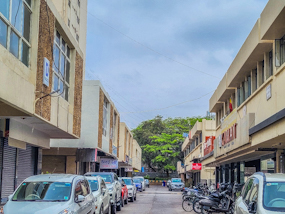
Sign post at Loreto House School

In January 2023, we visited Sister Marilla, who works for Loreto House School and College in Middleton Row in the heart of Kolkata. My wife attended the school for several years in the 1960s. The two educational establishments are part of a larger organisation, the Loreto branch of the Institute of the Blessed Virgin Mary (‘IBVM’). When Sister Marilla told us that the IBVM was founded by Mary Ward (1585-1645), I immediately thought of the Mary Ward Centre in London, and was a bit surprised because I had always assumed that the Centre was named after a 19th century woman.

My assumption was correct. The Centre is named after the novelist Mary Augusta Ward (1851 – 1920), not the Mary Ward, founder of the IBVM.

The earlier Mary Ward (b 1585) was born in Yorkshire – Roman Catholic during the time that Roman Catholicism was outlawed in England. She felt the need to take up holy orders and instead of becoming yet another Catholic martyr, she wanted to do something worthwhile and practical. She went to Flanders where she joined the Poor Clares in St Omer.

To cut a long story short, she became, to oversimplify a lot, a female version of a Jesuit, but not a member of the Jesuit Order. After leaving St Omer, she founded the Poor Clare House for English women at Gravelines. There, and later elsewhere, she taught women about the Roman Catholic faith. In about 1609, she returned to England, where she gathered women to teach girls about the banned faith. Mary Ward suffered many hardships, including imprisonment in Germany, before succumbing to ill health in England

Leaping ahead in time, this group founded by Mary Ward, which had to surmount much criticism from the Jesuits and members of the Roman Catholic hierarchy, was the seed that germinated to become the officially recognised IBVM in 1877.

Followers of the group she had founded in 1609, established the Bar Convent in York in 1686. It was from here in 1821 that the IBVM Loreto branch was founded in Dublin by Teresa Frances Ball.

On the 12th of October 1928, 18 year old Albanian Agnes Gonxha from Skopje (now in North Macedonia) joined the IBVM at their Loreto Abbey at Rathfarnham in Ireland. She left Ireland on the 1st of December 1928, and landed at Kolkata on the 6th of January 1929. From there she travelled to Darjeeling, where on the 24th of May 1931, as a novice, she made her First Profession in Darjeeling’s Cathedral of the Immaculate Conception. In this church she made her Final Profession on the 24th of May 1937.

Next, Agnes was sent to the Loreto Convent at Entally in Kolkata. At first, she taught catechism and geography at Loreto St Mary’s Bengali School, which was on the campus of the convent. Eventually, she became the school’s headmistress.

On the 10th of September 1946, whilst travelling to a retreat in Darjeeling, she decided that her true calling was to work with the poor in the slums of Kolkata. By that time, she was known not as Agnes Gonxha but as the now much more familiar Mother Teresa. The order she founded, The Missionaries of Charity, maintained a warm relationship between it and the IBVM. Internationally famous, she died in 1997.

Had it not been for our visit to Sister Marilla and the informative booklets she gave us, it might have been a long time before I discovered the two Mary Wards and the connection that one of them had with both my wife’s school and Mother Teresa.

She sailed on a leaf

IVES


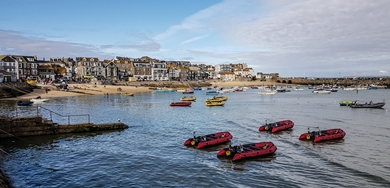
St Ives in Cornwall is one of my favourite places to visit in the UK. This charming, picturesque town straddles a shoulder of land separating two beautiful bays. One of its most endearing features is the quality of the light. The light has the same special quality as that which bathes Venice in Italy. Maybe, it is the extraordinarily light that attracted many artists to St Ives in the past and still in the present. As extraordinary as the light is, so is the story of St Ia after whom St Ives was named.

During the 5th or 6th century AD, St Ia was due to travel from Ireland to England along with several other Christian missionaries, many of whom were later to become saints. When Ia discovered that she had been left behind, she began praying and shedding tears. One of her tears fell upon a leaf floating in the sea near where she was praying. She noticed that the leaf began growing in size. It became so big that there was room for her to stand on it. Putting her trust in God, she set sail on the leaf, which carried her across the sea to Cornwall. 

After landing in Cornwall, she set up a small oratory. Sadly, she was killed at Hayle by a local chieftain. She was buried at what is now the town of St Ives, where the main church in the town is dedicated to her memory. St Ive’s Parish Church is well worth visiting not only to contemplate St Ia but also because it is a fine example of a 15th century gothic church. The church contains many superb features including a lovely café where you can enjoy tea or coffee and home-made cakes in a peaceful environment.