
Most tough regimes come
And reach their end at long last
Only stones remain

Most tough regimes come
And reach their end at long last
Only stones remain
IT WAS UNUSUAL for my parents to take us on holidays at the seaside during my childhood. Mostly we went to cities, such as Bruges, Florence, and Delft, where there were plenty of artistic treasures to be viewed. Yet, one year when I was less than 10 years old, we spent a holiday at a hotel in a small place, Maidencombe, which is a few miles east of Torquay in Devon. All I can recall of this trip was staying in a country house hotel that had a beautiful flower-filled garden.
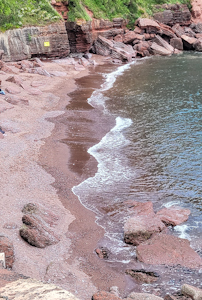
Yesterday (4 June 2025), my wife and I stopped at Maidencombe. I could not recognise anything, and I believe that the hotel where we stayed over 60 years ago has disappeared.
We followed signs to the Café Rio, which is reached down a winding staircase that clings to the slopes of a hillside overlooking a secluded cove surrounded by striated red rocks. The hillside is covered with luxuriant vegetation. The café is on a terrace above a small beach, where intrepid swimmers were enjoying the sea. We ate a light lunch on this terrace, and enjoyed the view.
I am pleased we visited Maidencombe but I can not stop wondering why my parents chose to go there instead of one of our usual culturally rich destinations. What or who influenced them to select Maidencombe? I will most probably never know.
WHILE SORTING THROUGH some old photographs, I came across some I had taken during my first visit to Paris. It was 1968 and I was 16. I travelled there with my parents on the overnight Silver Arrow, a train that was put on board a ferry to cross the English Channel. We stayed in a hotel on the Ile St Louis. Everything about the city both enchanted and amazed me.

The photograph included in this post was taken through the window of my compartment in the Silver Arrow as soon as the train pulled into Paris Gare du Nord.
I have visited Paris many times since 1968, but it was during my first visit that the city impressed me most. Although the photographs I found brought back happy memories, I have no great yearning to visit Paris again in the near future.
DURING MY CHILDHOOD and teenage years, there used to be two entrances to Golders Green’s tube (Underground) station, which is on the Edgware Branch of the Northern Line. One of these entrances, which is the only one in use today, is from the bus station (bus yard) next to the old Hippodrome Theatre and opposite the clock tower.

The other entrance, which has been closed for several decades, was beneath the bridge that carries the railway tracks over Finchley Road. The canopy at this entrance is still standing. Passengers used to walk beneath this canopy and then along a long walkway covered by a wooden canopy supported by timber pillars with simply ornamented capitals. . This passageway , which still exists, led to a ticket hall. Neither the ticket hall nor the passageway are accessible to the public.
You can discover much more about Golders Green, its past and present, in my book, which is available from Amazon, e.g.:
ON OUR LAST visit to Istanbul at least 15 years ago, we visited a small but attractive mosque in Üsküdar (the Asian part of Istanbul). During our present holiday in the city (in April 2024), we hoped to see this mosque again, but we had forgotten its name.
After having waited for the midday Friday prayers to be over at the Atik Valide Mosque, we looked around this edifice that was designed by the famous architect Mimar Sinan in 1583-1584. Incidentally, to reach this building, we climbed a steep staircase with 114 steps – a so-called short cut. Apart from its fine architectural form, the mosque is adorned with several lovely tiled plaques covered with Arabic calligraphy intertwined with the occasional flower.
As we were leaving the mosque’s enclosed compound, a man stopped us, and told us in broken English that we should visit another mosque in the neighbourhood. He said it had beautiful tiling, and it’s name is Çinili. When we heard the name, we remembered that was the mosque, whose name we had forgotten.

After climbing another hill, we reached the Çinili mosque. Completed in 1640, it is not as fine architecturally as buildings by Sinan. However, it’s interior is lined with intricately decorated tiling. Unfortunately, the mosque was locked up, but by peering through the windows we got a good impression of the magnificent tiling. The wall of the covered porch in which the main entrance can be found is also covered with beautiful tiling. What we saw was what we remembered from our first visit there at least 15 years ago. We were very grateful that a complete stranger reminded us of the name of the place that we remembered, but whose name we could not recall.
PS both mosques mentioned above were connected with a Valide Sultan – that is with the mother of a reigning Sultan.
DURING THE 1970s and 1980s, we used to make visits to a restaurant in north London’s Willesden Lane. Founded in 1964 and specialising in South Indian cuisine, it was called Vijay. It still exists at the same address. Out of curiosity and ‘for old times’ sake’, we paid it a visit last night (the 29th of February 2024).
Entering Vijay was like stepping back in time. It was uncanny; nothing seemed to have changed. The walls are still lined with raffia work panelling, the wooden Kerala-style ceiling, and the pictures on the wall (mostly colourful depictions of Hindu deities) looked exactly as we remembered. Naturally, none of the staff were recognizable.
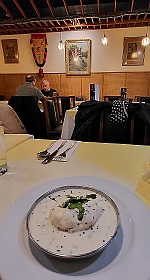
Back in the ‘70s and ‘80s, we used to eat at Vijay to enjoy South Indian dishes that were not easy to find elsewhere in London. If I remember correctly, in those days Vijay only had this kind of food on its menu. Today, the menu still has South Indian dishes, but also many offerings of food that is definitely not typical of South India. It offers a wide selection of North Indian dishes – such as most British people would hope to find in an ‘Indian restaurant’. One of the hors d’oeuvres, which you would never find on India, but is common in British Indian restaurants is fried pappads (poppadums) served with a tray of chutneys and pickles to accompany them, Vijay now offers this. Probably, Vijay has added North Indian dishes to their menu because, for many potential customers, South Indian dishes are far less familiar.
Yesterday, we ordered a few dishes. They were enjoyable enough but not outstanding, However, it was great fun sitting in a place that had hardly changed since we last visited it at least 30 years ago.
THE LAST TIME I watched a film at the Everyman cinema in London’s Hampstead was in the 1960s. In my book “Beneath a Wide Sky: Hampstead and its Environs”, which I published in 2022, I described the cinema and my recollections of it as follows:
“It was at the Everyman that I went to the cinema for the first time in my life. My parents, who were not regular cinemagoers, decided that the rather sad French film, “The Red Balloon” (first released in the UK in late 1956), was a suitable production to introduce me, a four-and-a-half-year-old, to the joys of cinema. My parents, who tended to avoid popular culture, probably selected the “Red Balloon”, an arty French film, because it was a little more recherché than the much more popular Disney films that appeared in the late 1950s. The cinema, which still exists, was, according to Christopher Wade, built in 1888 as a drill hall for The Hampstead Rifle Volunteers. Then, in 1919 its windows were bricked-in, and it became MacDermott’s Everyman Theatre. In 1933, it became a cinema. I saw many more films there in my childhood and adolescence. Every year, there used to be a festival of Marx Brothers films in the summer months. I loved these films and used to visit the Everyman on hot sunny afternoons when I was often the only person in the auditorium. In those days, the cinema’s auditorium had a strange smell that strongly resembled household gas. Indeed, there were gas lamps attached to the walls of the auditorium, but I am certain that I never saw them working. They might have there for use as emergency lighting in case there was an electricity supply failure. These were quite frequent during my childhood but never happened when I was at the Everyman.
The cinema is, I have been told, now a very luxurious place. The seats are comfortable and have tables beside them, at which waiting staff serve food and drinks. This is a far cry from what I can remember of the rather basic cinema in the 1960s. Back in those days, the Everyman, like the now long-gone Academy cinemas in Oxford Street, favoured screenings of ‘arty’ films rather than the more popular films that most cinemas showed. Now, the Everyman, formerly an art-house cinema, thrives by screening films that are most likely to attract full houses. That this is the case is yet more evidence to support the idea that Hampstead is not what it was. Many of the sort of people who might enjoy arty films that attract often small niche audiences, who used to live in Hampstead, can no longer afford to reside in the area.”
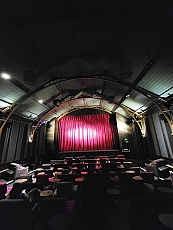
Today, the 16th of May 2023, my daughter took me to see a film at the Everyman (see picture). As already mentioned, the cinema is now quite ‘swish’. It had been re-designed late last year. Whereas once it had only one screen, now it has two. We saw our film, “The Unlikely Pilgrimage of Harold Fry”, screened in what was the original auditorium – Screen 1. The ceiling supported by tapering metal struts is how I remember it from at least 50 years ago. Otherwise, all has been changed. The smell of gas has gone. The seating is curious to say the least. It consists of well-upholstered armchairs and couches, all well separated from each other. In between them, there are tables, and metal wine cooler buckets are attached beside each of them. The upholstery materials are colourful and differ from seat to seat. For my taste, the aesthetics are not too successful. The screen is placed high enough so that it does not matter how tall a person sits in the seat in front of you. The acoustics were good. All in all, it was a pleasure revisiting the cinema in which I saw my first ‘movie’ sixty-six years ago.
My book about Hampstead is available from Amazon:
https://www.amazon.co.uk/BENEATH-WIDE-SKY-HAMPSTEAD-ENVIRONS/dp/B09R2WRK92/
IN COMMON WITH most people, I have little or no memory of the first two or three years of my life. My earliest recollections are the birth of my sibling when I was four years old, and walking with my parents to St Albans Church Hall in Golders Green to collect the free orange juice that the government provided in the 1950s. That was issued to children under the age of two, so it must have been for my sibling within the first two years of her life. At that time, I would have been less than six years old.
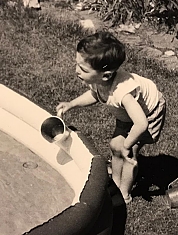
Recently, a cousin sent me scans of some family photographs. They include several of me before I was four years old. One of them taken of me in our garden in Hampstead Garden Suburb shows me standing beside a circular inflatable swimming pool filled with water. In the photograph, I am bending over the pool with a small jug in my right hand. None of this can I recall, except the crazy paving garden path behind me, which remained in existence until the 1990s, and might well still be there.
Seeing the photograph, which must have been taken before 1956, did jog my memory. I recall that after my sibling was born, my parents bought a bigger paddling pool for use in our garden. This was a rectangular affair. It consisted of a metal framework that had to be assembled and a plastic pool that was hung from its four sides before being filled with the garden hose. At each corner there was a small triangular metal seat. Well, I doubt I would have remembered this had I not seen the image of something I cannot remember at all.
GIOVANNI BATTISTA TIEPOLO (1696-1770) is one of my favourite artists. I have been familiar with his works ever since my childhood, when we visited Venice annually from the late 1950s or early 1960s onwards. My parents took me from church to church to see the great master’s paintings, which I prefer to the somewhat more photograph-like paintings of Canaletto.

We used to stay in a pensione on the Fondamente Zattere, a waterfront facing across a wide canal to the Giudecca island. The Gesuati church was a few yards from where we resided in Venice. It contains ceiling panels and a wall painting, all created by Tiepolo. Often, we passed the church and almost always entered it to gaze up at Tiepolo’s ceiling. I cannot remember it, but my sibling recalls that almost every morning, early, my father used to stand quietly and alone in the church for a few minutes.
I became so keen on Tiepolo that I broke my train journey between Ostend and Vienna to spend a night in Würzburg in order to see Tiepolo’s paintings in the city’s Residenz (a palace).
This September (2022), I was walking along a narrow passageway (Calle S Domenico) when I spotted a commemorative plaque above an archway leading into a long narrow courtyard surrounded by tall residential buildings. The plaque recorded that in the courtyard there was the house in which Tiepolo was born on March 1696. Exactly in part the courtyard, the Corte S Domenico, the artist was born, I could not determine. However, I had never seen this place before and was thrilled to have stumbled across the place where one of my favourite artists was born.
MY FRIEND MICHAEL Jacobs (1952-2014) studied history of art at A Level (university entrance examinations) and then later at university. Later, he became a prolific author. When we were in our late teens, we used to visit Hampstead’s second-hand bookshops together. A few days ago (early September 2022), I was walking along Marylebone’s New Cavendish Street when I spotted something that reminded me of one of our bookshop visits in the late 1960s.

There is a building on the northeast corner of New Cavendish Street and Wimpole Street, which caught my eye. As I passed it, I spotted a small plaque giving the architect’s details. It reads: “BANISTER FLETCHER & SONS ARCHITECTS AD 1912” Sir Banister Flight Fletcher (1866-1953) trained at London’s Kings College, University College, the Royal College of Art, the Architectural Association, and Paris’s École des Beaux-Arts. In 1889, he became a partner in the architectural firm founded by his father: Banister Fletcher & Sons. In addition to designing buildings, Banister Fletcher (and his father) wrote a book of great importance.
The book, “A History of Architecture on the Comparative Method”, which was first published in 1896, was republished several times during the 20th century. It was the standard reference work in English on the history of architecture.
Seeing the name Banister Fletcher on the building in Marylebone reminded me of an afternoon in Hampstead during the late 1960s. We were rummaging around the somewhat disorderly collection of books in Francis Norman’s bookshop in Perrins Lane when Michael discovered a copy of Banister Fletcher’s history of architecture, a book that was well-suited for the bookshelf of a student of the history of art. Michael bought it at an extremely reasonable price.
Until I spotted the building on New Cavendish, I had always associated the name Banister Fletcher with that afternoon with Michael in Hampstead. The building I saw is the first example of a structure that I have been able to associate with the author of the history purchased by my late friend.
 yamey
yamey 