WHEN ARSLAN KHAN was appointed Sultan of the Malwa Sultanate (now part of Madhya Pradesh) in 1406, he became known as Hoshang Shah. He ruled until his death in 1435.
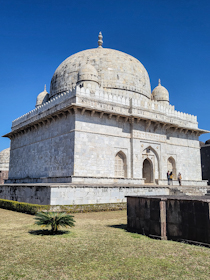
Hoshang’s body lies within a splendid, white marble mausoleum in Mandu. It has one large central dome and 4 smaller domes, one at each corner of the square edifice. As soon as I saw this marvellous building, I thought of the Taj Mahal, which I have seen in many photographs.
Hoshang Shah’s mausoleum was constructed in the fifteenth century, long before the Taj Mahal. A tablet within Hoshang’s mausoleum has an inscription that records the visit of 4 of Shah Jahan’s architects in 1659. They came to pay homage to the builders of the tomb. One of the four was Ustad Hamid, who was closely involved in the construction of the Taj Mahal in Agra (completed in 1653). This illustrates the high esteem that Hoshang’s mausoleum inspired.
I wonder whether those builders saw Hoshang’s mausoleum before designing the Taj Mahal.
ALTHOUGH THE MAIN attraction of Dulwich Picture Gallery is the collection of works of art by famous painters, there is a small but fascinating feature that should not be missed. And that is the mausoleum. This small chamber houses the sarcophagi containing the remains of the gallery’s founders, Sir Peter Francis Bourgeois, Noel Desenfans, and his wife Margaret.
Like the rest of the gallery, the mausoleum was designed by Sir John Soane (1753-1837). Working in an age before electric lighting was available, he was a master of maximising the use of natural illumination to get light into his buildings. The galleries at Dulwich are provided with clear glass ceilings that are sufficient to provide adequate lighting of the artworks. However, this is now supplemented with electric lighting. Light enters the mausoleum through glass windows at the top of it. Instead of plain glass, he used amber coloured glass. The light passing through this gives the mausoleum a warm glow, making it feel a spiritual place.
The mausoleum was badly damaged during an air raid in WW2. However, it was restored and is said to look exactly as it did before the war. Although it was designed as a final resting place, it is occasionally used to house art installations and films about temporary exhibitions being held in the galleries.
KHWAJA SAFAR SULEMANI (1500 – 1546) was born in either Otranto or Brindisi. He entered life as a Christian, named Cosa Zaffar in Italian. But later, after being converted to Islam, his first name became Khwaja Safar. I have written about him before because his most likely heritage interests me. He is most likely to have been the son of Catholic Albanian parents, who fled to Italy to escape the Ottomans who had invaded what is now Albania.
Khundhavan Khan Rojo – a detail
Khwaja was captured by an Ottoman general at sea when he was 15. The Sultan in Istanbul was impressed by him. To cut a long and complicated story short, he was put in charge of vessels to attack the ships of the Portuguese, who were trying to monopolise trade between India and Europe. The Ottomans carried goods from India to places in their Empire on the coasts of Egypt and the Arabian peninsula. From there, they were carried overland to Europe. Their competitors, the Portuguese, carried goods from India to Portugal via the Cape of Good Hope, thereby bypassing transit through lands held by the Ottomans. This proved very damaging to the economy of the Ottomans.
During the Ottoman attack on the Portuguese colony of Diu (on the south coast of Saurashtra – part of modern Gujarat state), Khwaja, whose fighting skills were highly regarded by his opponents, was killed by a cannon ball near, or in Diu. Interestingly, the Portuguese, with whom he joined forces briefly before turning against them, erected a monument in his honour. It stands in Diu, and I have seen it.
And that summarises all I knew until we visited the superb museum housed in the restored fort of Surat. There, I learned that Khwaja’s body was brought from Diu to Surat, where it was buried.
After his burial, a mausoleum was built over his grave. Probably established by his eldest son, Rajab, this lovely edifice, called the Khudhavand Khan Rojo (or Rauza), contains architectural features typical of 15th century mosques in Ahmedabad. It includes structural elements that were influenced by Hindu and Jain temples. By the way, Khwaja became known as ‘Khudhavand Khan’, the title he was given when Sultan Mahmud III made him Governor of Surat.
I entered the domed mausoleum, which contains six gravestones, all covered, as is usual, with coloured cloths. None of these is the grave of the man who was born of Albanian parents in the south of Italy. His body lies somewhere beneath the mausoleum.
As is often the case when I visit India, I come across completely unexpected things. Although I had known about Khwaja’s death in Diu, it was a delightful surprise to come across his final resting place in Surat – a city across the sea from Diu, but not too distant from it.
At first sight, it seems ironic that Khwaja’s Albanian parents fled from the Ottomans, yet their son became prominent in the Ottoman Empire. However, it is not so strange. Many Albanian boys (including Skanderbeg) were abducted, or taken as hostages, by the Ottomans, and later both served in the empire’s army, some of them becoming high officials.
THE HAZIRA MAQBARA is an impressive octagonal structure in Baroda (Gujarat). It was built in about 1586 in the Mughal style of architecture, such as can be found in Delhi. This beautiful mausoleum houses the graves of Qutb-ud-din Muhammad Khan who was the tutor of Salim, son and successor of Akbar, and also that of his son Naurang Khan who held important posts in Gujarat under Akbar. There are other graves within the building and also nearby on land near it.
The various graves are covered with colourful cloths upon which red rose heads are placed. The roses are replaced daily, and the cloths every Thursday. This we were told by an elderly man who had been praying loudly within the main central chamber of the mausoleum.
Apart from the beauty of the building and its wonderful jaalis (latticework window screens), I was impressed by some things that I have noticed in many other Muslim mausoleums in India.
Incense stick near some gravestones
Within the mausoleum and close to the graves outside it, there were incense sticks (agarbatti) burning, releasing small clouds of fragrant smelling smoke. Within the mausoleum, I spotted at least two oil lamps (diyas), each with small flickering flames.
Agarbatti and diyas are commonly found in Hindu temples, and often at the beginning of the day in shops, restaurants, etc. I first noticed them being used in Islamic settings in India in Sufi dargahs (shrines containing graves) in Bangalore when going on excellent guided walks led by my friend Mansour Ali. Later I begun noticing these things, which I had initially assumed were only associated with Hinduism, in places associated with Islam. I have discussed this commonality of Hindu and Muslim practices in one chapter of my new book about travels in India, which is available from Amazon (eg https://www.amazon.co.uk/HITLER-LOCK-OTHER-TALES-INDIA/dp/B0CFM5JNX5/ ) AND if you live in India, from https://store.pothi.com/book/adam-yamey-hitler-lock-and-other-tales-india/ .
Other chapters in my book about my experiences of visiting India cover a wide variety of subjects. The book, which is aimed both at those who ‘know’ India and those who do not, is both informative and entertaining.
ALTHOUGH THERE WERE ALREADY villages on the banks of the River Hooghly where the city of Kolkata (Calcutta) now stands, the Britisher Job Charnock (1630-1693), a man of commerce, is often regarded as the founder of Calcutta. He died there and his remains are interred in a charming mausoleum (1695) of oriental design in the churchyard of Kolkata’s former cathedral, the church of St John.
Job Charnock’s mausoleum
Job does not rest alone in that structure. His companions include the surgeon William Hamilton, who died in 1717. He had cured Ferukseer, the “ King of Indostan”, and beneath his memorial, written in English, there is another written in Persian script. Job’s wife Mary lies next to him. She died in 1700. There is no mention of his other wife, an Indian named Maria. There is also a memorial to Martha Eyles, who died in 1748, having first been married to John Gumley (who died in Dhaka in what is now Bangladesh), and then married Edward Eyles, who was on the council of Calcutta’s Fort William.
Whereas Martha Eyles had had two husbands, Mrs Frances Johnson, whose remains lie in a mausoleum a few feet away from Charnock’s, had a more exciting marital record. Born in 1725, she died in 1812 at the age of 87. Frances had four husbands. First, she married Parry Purple Templer, then after his demise , James Altham. Mr Altham died of smallpox a few days after marrying Frances. Next, she married William Watts, and they produced 4 children. In 1774, after the death of Mr Watts, she married the Reverend William Johnson. He survived until Frances died.
Apart from the above-mentioned graves in the churchyard of St John’s, there are many others that commemorate the deaths of early European inhabitants of Charnock’s Calcutta, and there is also a memorial to those who died in the Black Hole of Calcutta, but more about this at a later date.



 yamey
yamey 