
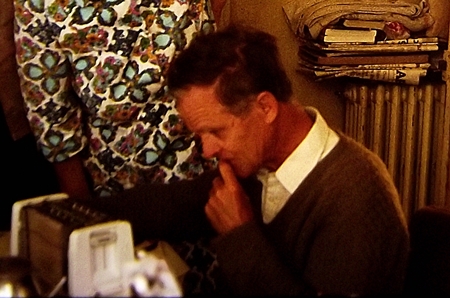
‘Doc’ mending a toaster in a friend’s home near Paris in 1978
Although my PhD supervisor was a full university professor of physiology, most people called him ‘Doc’. He was the pre-clinical tutor of the dental students, who undertook courses in academic rather than clinical departments of University College London (‘UCL’) during their first year of study. Doc’s PhD students were asked to volunteer to help teaching the basics of mammalian physiology to the dental students. I did this willingly. Once a week, I conducted tutorials for a group of six to eight dental students. Although I learnt a lot – teaching is the best was to learn, it was a case of the blind leading the blind. It was while doing this teaching that I met two of the people, who were to become owners of practices where I worked. They remembered me, but I did not remember them.
Once a week, the dental students carried out experiments in the physiology teaching lab. I assisted in the supervision of these classes. One of the experiments that the students undertook was pedalling on a bicycle rigged up to an electrical generator, which in turn was wired to a domestic lamp. The youngsters had to pedal furiously to get the lamp to glow, and while they did this their pulse rate and blood pressure was monitored.
Another experiment was connected with taste. The students had to prepare different dilutions of a chemical and used this to determine taste thresholds. The chemical used was phenylthiourea. Some of the students could not taste this at any dilution. These people were lacking a certain dominant gene that allows people to taste this substance. The point of the experiment was to teach the students both about taste and, also, about genetic variation. Doc was keen for the future practitioners to learn that we are not all ‘built’ the same way.
Another experiment was examining the effects of various chemicals on the strength and frequency of contractions of short lengths of rodent gut in oxygenated tissue media. When we did this experiment and ones like it during our BSc physiology course, we attached the contracting gut too electronic force transducers which sent electric signals to an electronic graph drawing machine.
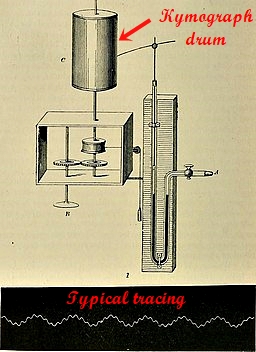
A kymograph attached to a pressure-measuring tube
Doc did not use this simple method when his dental students performed the experiment. The contractile tissue was tied to a long delicate metal lever which had a sharp point at the end of it furthest away from the fulcrum to which it was attached. Movements of the tissue caused the lever to move up and down. These movements were recorded on the smoked paper tightly attached to the cylinder (or drum) of an old-fashioned kymograph. As the lever moved in response to the contractions, the fine point at its end moved up and down and displaced the charcoal attached to the smoked paper producing a white tracing where the carbon had been removed.
Handling the kymograph drum was a tricky business. First the special plain white paper had to be tightly attached to the metal drum. Next, the drum was rotated above burning paraffin so that it became completely coated with the black particles in the smoke coming from the paraffin. When blackened, the drum and paper had to be removed from the smoking area and placed carefully on the spindle of the kymograph without touching the blackened paper so as to avoid removing the carbon coating. Attaching the gut to the kymograph lever was also tricky.
After the experiment, the paper covered with tracings had to be removed from the drum, again taking great care not to smudge the delicate layer of carbon and thereby obliterate parts of the tracings. Finally, the tracings had to be immersed briefly in a liquid lacquer that later evaporated and fixed the tracings (i.e made them immune to smudging). Only then could the students begin to make measurements of the amplitudes and frequencies of the contractions of the experimental material.
Doc had an ulterior motive in making his dental students use this highly obsolete measuring device. It was, he decided, an excellent way for future dentists to develop their manual dexterity.
As part of the pre-clinical course, Doc required that each of his students carry out a practical research project. He preferred simple projects such as measuring the blink rates of people sitting on Underground trains or assessing the rates at which peoples’ jaws moved whilst they were chewing gum. One group of students tested the theory (which has been proven) that people’s height was shorter at the end of the day than at the beginning. The main thing that concerned Doc was that his students were learning how to observe scientifically and systematically. It is most important, he felt strongly, for a clinician to be observant. He hoped that these projects would help to make these future dentists into skilled observers and therefore better clinicians.
Another reason for this project was for the students’ more immediate benefit. In the end of year physiology examination paper that he set for the dental students, he always inserted a question, which asked the student to write an essay about any aspect of physiology that interested him or her. Thus, simply by writing about the project undertaken, the student was guaranteed up to 25% of the marks.
Doc and his wife were perfect guides and became great friends during the time I was working on my PhD. I saw them socially often for many years afterwards until their deaths. It was meeting and getting to know the dental student whom I attempted to teach that was one of the reasons that I strayed into dentistry.








 yamey
yamey 