Unlocking a secret

WHEN SOMETHING GOES WRONG with a product in the UK, it is usually simpler and cheaper to discard it and buy a new one. In my experience of visiting India many times since 1994, I have discovered that there is often someone, who can mend what would normally be thrown away in the UK. Only recently, I spotted a poorly dressed man sitting by the side of MG Road (in Bangalore). He was painstakingly repairing what looked like totally decrepit umbrellas.

We use combination locks (‘number locks’ in Indian English) to secure our baggage whilst travelling. In December 2022 when we were in Panjim (Goa), we found one of ours, which would not open, even when using the correct combination. It looked as if it had become corroded.

Because we have great faith in the ingenuity of Indian craftsmen, we took it to a locksmith in Panjim. He was unwilling to work on our lock, and another lock seller advised us to throw it away. Undeterred, we carried the defective item to Bangalore.

In the Commercial Street district of Bangalore we approached a couple of locksmiths, who were unwilling to spend time on our lock. A third one accepted it, and said he would have a go. We told him the combination, and left him whilst he fiddled with the lock as if it were as enjoyable as a Rubik Cube. On the 2nd of January 2023, we set off on a long trip, returning to Bangalore on the 15th of February 2023.

A few days later, we visited the locksmith, who remembered us and fetched our lock from a glass-fronted cupboard. He had managed to open the lock, but could not remember which combination allowed him to unlock it. He said:
“You take it home and try a few numbers.”
He refused to accept any payment for his efforts.

Back at our accommodation, I tried what I remembered had been the lock’s combination, and discovered that the locksmith had rendered the once useless lock fully functional. As the tourist board slogan (Incredible!ndia) suggests, the country is truly incredible.

PS These locks are cheap to buy new in India. It was not to save money that we visited so many locksmiths, but it was for the enjoyment of the challenge to find someone to do the job that we spent the time going from one to another. Some people enjoy passing time playing games on their phones. We choose to have our timepass (Indian English) in other ways

A padlock with an unfortunate name

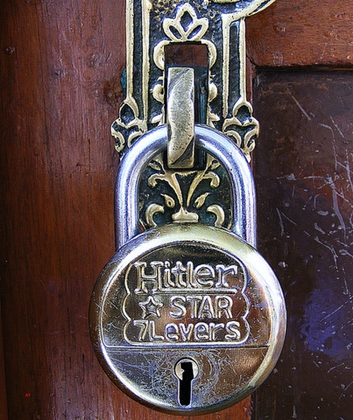
ABOUT 26 YEARS AGO, we had lunch in a state run hotel near the archaeological site at Hampi in Karnataka. On the way to a toilet, I had to pass some of the hotel’s bedrooms. Each was closed with a padlock. I do not know why I bothered to look at a lock carefully, but I am glad that I did. The lock was manufactured by the Hitler lock company. I could not believe my eyes, and I took a closeup photograph of it.

Since seeing that lock, I have visited India about 50 Times. On every visit, I have spent some time wandering around markets and bazaars in many Indian towns and cities. At every market I have kept an eye open for Hitler locks, but never found even one of them. When I have asked lock sellers if they stock them, the majority of them look blankly at me.

Today, the 9th of December 2023, we enjoyed a journey on a crowded local bus in Goa. We travelled from Panjim to the town of Mapusa to experience its large market. After wandering around for a few minutes, I noticed a small stall selling locks.

As I have always done at other markets I stopped to examine what locks were on sale. To my great surprise, the vendor had some Hitler padlocks. They were available in three sizes. I bought the middle sized version.

The locks are manufactured by Hitler Lock Enterprises,which is located in Aligarh in Uttar Pradesh State. I can only guess that the name Hitler was chosen because someone must have regarded him as being at least as strong as the locks they produce. Why they chose Hitler, rather than strong personalities such as Hanuman or Hercules, puzzles me.

After making my purchase and some others (mainly clothes), we ate superb seafood in the St Francis Xavier restaurant in the centre of the market. On our way back to the bus station (bus stand), we passed another lock seller. I noticed that he also had Hitler locks for sale.

Hitler is a brand name that would not sell well in most parts of the Western World. Judging by the fact that so far I have only found these locks in Mapusa, maybe it is not a trade name that goes down particularly well in India. However, Adolf’s book “Mein Kampf” is available in most Indian bookshops. Although its author was fixated on Aryans, he did not have a soft spot for Indians, as you will discover in the book “Hitler and India”, recently written by Vaibhav Purandare.

Arms and locks

THE GRAND UNION canal, constructed from the late 1790s onwards, is an important artery of England’s canal network. Beginning at Brentford on the River Thames, it winds its way to Braunston and Birmingham. Along its way it meets other canals, some of which are designated ‘arms’. For example, the Paddington Arm joins the main canal at Bulls Bridge in west London and from there it makes its way eastwards to Paddington. Recently, we visited friends, who live in Northamptonshire, and they took us on a walk along another arm of the Grand Union, the Northampton Arm. This branch of the main canal begins near Gayton and Blisworth and runs to nearby Northampton, where it enters the River Nene, which flows eastwards towards The Wash, an enormous inlet of the North Sea.

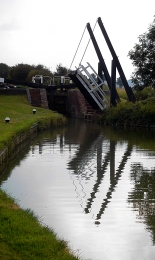
A swing bridge with a lock behind it

Much of the Northampton Arm is very narrow, just wide enough for passage of a single narrow boat. At regular intervals, the arm widens to allow vessels travelling in opposite directions to pass each other. Though short in length, only 4.6 miles, the Northampton Arm has seventeen separate, hand-operated locks for vessels to negotiate. The twelve of these, a flight of locks, is 1123 yards from the Gayton junction with the main canal. These twelve locks are along a stretch of canal only nine tenths of a mile long. The northernmost lock, that nearest towards Northampton, is a few yards north of a bridge carrying the M1 motorway. The locks carry the water from a bit over 300 feet above sea level nearest Gayton down to less than about 225 feet, each lock capable of lifting or lowering a vessel over 6 feet on average. Nearer Gayton, there is an old swing bridge, rather like a castle’s drawbridge. Looking at old maps, it appears that there were several more of these along the arm, but we only spotted one in the stretch between Gayton and the M1.

The canal and its associated towpath pass beneath the motorway through a giant concrete arch, paraboloid in shape and reinforced with horizontal concrete beams. Lined with graffiti, both conventional and anarchic artwork, walking under the motorway is an eery, rather science fictional experience. In contrast to this brutalist concrete arch, several lovely brick, hump-backed bridges carry minor roads over the Arm

The authorisation of the Northampton Arm was given in 1793, but it took another 18 years before it was ready for use. A brief hstory of the Arm (https://waterways.org.uk/waterways/discover-the-waterways/grand-union-canal-northampton-arm) relates:

“Almost immediately the Arm began to carry a large volume of merchandise and stayed busy for over 100 years through to after the First World War.  In the post war years coal, grain and timber were supplemented by goods needed for the show industry such as strawboards for packing as well as iron ingots for castings.  After World War II the carriage of goods ceased as road competition strengthened.”

Now, the Arm is used by intrepid canal boat owners, who are not averse to too much manipulation of lock gates. On the sunny Saturday afternoon that we visited the lock flight, we only saw one narrow boat attempting to negotiate the flight of twelve locks. In contrast, at Gayton Junction, the main Grand Union Canal, from which the Arm branches off, was full of pleasure-seekers’ narrow boats and other craft.

Though hardly used for freight these days, the canal system provides much pleasure to visitors both afloat and on shore. Wandering along the towpaths, one cannot fail to be amazed when considering the engineering ingenuity of the canal builders that we can still see today, as well as the work that is done to keep these waterways usable so many years after they were constructed.

A watery staircase for boats

UNLIKE IN HOLLAND, the landscape of England is often not flat. In the 18th century, a network of canals was constructed to carry freight between different places in England and its neighbouring countries. The routes of these canals almost always involved crossing hilly terrain. When a canal encounters a hill, it can sometimes be routed around it, or it can pass through a tunnel, or it can cross the incline by means of a lock or a series of locks. A series of locks can be separated by short stretches of the canal on level terrain, in which case it is called a ‘flight of locks’. A good example of this are the six locks on the Grand Union Canal at Hanwell in Middlesex. Alternatively, one lock can lead into the next in the series without an intermediate pool or stretch of water. When one lock leads into the next, and that leads into yet another one, this is called a ‘staircase’ of locks. A good example of this is on the Leicester Line (branch) of the Grand Union Canal at Foxton in Leicestershire.

Foxton lock staircase

The staircase at Foxton, which we visited recently, consists of two sets of five interconnecting locks separated by a pool where boats can queue whilst the staircase is occupied with other boats. Each of the ten locks are just broad enough to accommodate one traditional narrow boat. Locks work by raising or lowering boats by being filled or emptied of water respectively. When each of the locks at Foxton is emptied to lower a boat, the water released flows via a series of valves into a side pond. The water from a side pond is reused to fill the next lock down when a boat needs to be raised. This ingenious system means that little water is required to operate the staircases.

The staircase of locks at Foxton was constructed between 1810 and 1814. On average, if there are not queues of other boats, it takes about 45 minutes to ascend or descend the whole staircase of ten locks. In 1900, an alternative to the Foxton staircase was constructed. This was known as the Foxton Inclined Plane. The way this worked was as follows. A boat sailed into a water filled container, which was made watertight. This was then hauled up rails on an inclined ramp or lowered down it if it was descending. The motive power for this boat lift was provided by a mechanism powered by a steam engine, whose housing is now an interesting canal museum. This lift reduced to traverse time from 45 minutes to about ten minutes. There were two parallel lifts, so that when one boat was being hauled upward, another could be lowered simultaneously, rather like the counterweight in a lift in a building. This ingenious mechanism was abandoned in about 1911 and dismantled in 1926. Visitors to Foxton can see what remains of the inclined plane tracks.

A visit to Foxton Locks is highly worthwhile. It is not only fascinating from the viewpoint of the history of engineering. It is also an impressive visual treat. The volunteers who work at the locks helping both users of the canal and sightseers, like us, are both friendly and well-informed.

Hitler at Hampi

By the 16th century AD, Vijayanagara in the south of India, located in what is now the State of Karnataka, was one of the world’s largest and most prosperous cities. It was destroyed by a coalition of Muslim rulers in 1565, and since then has laid in ruin. These picturesque ruins, now much visited by tourists, lie scattered around the village of Hampi, which is close to the city of Hospet.

HAMPI 1

We first visited Hampi with our seven-month-old baby in late 1995. We stayed in a hotel in the fairly non-descript town of Hospet and made daily excursions to explore the picturesque ruins of Vijayanagara, which are scattered over a large expanse of rock-strewn, almost lunar, landscape. One day, we stopped for lunch at a state-run hotel, the Mayura, in the midst of the archaeological area. The pleasant restaurant was outdoors but sheltered from the sun by a large canopy. I will write more about this hotel in a future blog.

During the meal, I paid a visit to the toilet. On my way, I passed some of the hotel’s bedroom doors. Each was locked with a padlock. I do not know what made me look at the padlocks closely, but I did. And, what I saw surprised me. Some of the locks were made by a company called ‘Hitler’.

HAMPI 2

Adolf Hitler is far from unknown in India. Copies of his best-known work of literature, Mein Kampf, are to be found in practically every bookshop, often rubbing shoulders with works by less illustrious politicians such as Narendra Modi, Barack Obama and Nelson Mandela. There is at least one Bollywood film that I know of which has Hitler in its title. It is not a great film, and the Hitler in the film is neither German nor a Nazi. He is a police officer in a jail, if I remember rightly.

HAMPI 1a

I have scoured markets in India trying to find a lock seller with Hitler locks, but in vain. The Hitler Lock Company was set up in 1989. It is based in Aligarh (United Provinces).