HOLLAND HOUSE IN Holland Park was badly damaged by aerial bombing during WW2. What is left of the building shows that it must have been a splendid Jacobean palace. It stands on the estate of Sir Walter Cope (c1533-1614), for whom it was originally constructed. In his time, the estate extended south from what is now Holland Park Avenue almost to what is now Fulham Road.
Although much of Holland House was destroyed in the War, many of its out-houses still stand today. Amongst these are the icehouse with its conical roof; a disused dairy; a stable block which now houses a Parks police station; and an orangery, which is attached to what was once the summer ballroom.
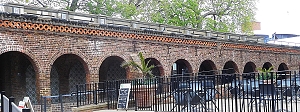
A covered arcade, open to the outside on one side, runs from where the southwest corner of the house used to stand, passing near the icehouse, to the southeast corner of the orangery. In poor weather, this long covered passageway was used by house guests moving between Holland House and its summer ballroom. From the western end of the passageway, they would have had to walk through the orangery to reach the ballroom. In fine weather, those attending balls would have walked along the walkway above the covered passage. In places, this runs past walls covered with colourful tiled panels, made in Florence (Italy), which were placed there in the 1850s. The wall of one stretch of the covered walkway, the section nearest to the orangery, are painted with scenes depicting an imaginary garden party held sometime in the 1870s. They were created between 1994 and 1995 by the artist Mao Wen Biao (born 1950).
Currently, the former summer ballroom is being restored. For many years, it was home to The Belvedere restaurant, a pricey establishment. When the restoration of the ballroom is complete and its former glory restored as much as possible, it will be used to house a new Italian restaurant, which is planned to be more affordable than its predecessor.
Over several decades, we have made innumerable visits to lovely Holland Park, but had not realised that the arcade described above was anything but decorative. Today, we met Jenny Kettlewell, who is the Chairman of the Friends of Holland Park. It was she who revealed its purpose. Currently (2nd to 10th of April 2022), there is an annual art exhibition in the orangery. The works on display are by local artists.
OF CRIMEAN WAR fame, Florence Nightingale (1820-1910) established a nursing school in what is now St Charles Hospital in North Kensington in 1884. In that time, the hospital near the northern end of Ladbroke Grove was called ‘the St Marylebone Union Infirmary’. It was so named because it was built to serve the poor of the parish of St Marylebone. It had to be put up outside the parish because there was no room available to build a hospital within it. This institution was opened in 1881 by the then Prince (future King Edward VII) and Princess of Wales. A very informative website, https://ezitis.myzen.co.uk, revealed that the hospital was:
“… three storeys high, with a central block and four pavilions. It had accommodation for 744 patients … and 86 resident staff (the Infirmary also had 82 non-resident staff).”
In 1923, the hospital was renamed the ‘St Marylebone Hospital’ and the next year, the then Minister of Health and future Prime Minister Neville Chamberlain (1869-1940) opened an extension, which had just been completed. By 1926, some wards had bedside wireless sets installed.
The hospital was given its current name when the London County Council took over its running in 1930. During WW2, wards on the top floors were closed, but the hospital suffered little damage from enemy bombing. After the war, St Charles served as a general hospital, but by 1998, there were very few beds for in-patients. Currently, the establishment is run by both the Central London Community Healthcare NHS Trust and the Central and North West London NHS Foundation Trust. Now, it is known as St Charles’ Centre for Health and Wellbeing. Most of its patient care is out-patient and since the development of vaccines against covid19, it is also a ‘vaccination hub’.
The original edifices were designed by Henry Saxon Snell (1831-1904). In grey weather, the late Victorian buildings of St Charles with their brickwork and neo-gothic decorative features present a somewhat gloomy or even ominous appearance. In bright sunlight, although they do not seem particularly welcoming, they have a certain charm. The website, http://www.british-history.ac.uk/survey-london/vol37, describes the architecture in more detail:
“The excellent plain brickwork, strong selfconfident design, and assured functional planning and detail make St. Charles Hospital a most significant building for its period. It occupies a rectangular site of three and a half acres near the north-west end of Ladbroke Grove … The buildings are planned on the pavilion principle, each block being, as far as compatible with facility of communication, isolated from the others. There are five parallel pavilions, the central administrative block being flanked on either side by two blocks of wards. The central block is surmounted by a massive tower, 182 feet in height, which forms a prominent landmark when viewed from the north and west. The chimney-shaft from the boilers below is carried up inside this tower, the upper part of which has a corbelled stage derived from northern Italian work of the Middle Ages. The tower contains a number of large tanks, providing storage for 25,000 gallons of water pumped from a well 500 feet in depth … The pavilions on either side of the tower are linked to each other by cast-iron galleries and canopied walks. A block of buildings situated at the entrance contained the residences of the medical officers, and over the spacious arched gateway in the centre there was a chapel 60 feet long by 30 feet wide, with a boarded wagon-roof of trefoil section. In a report on the infirmary written by Snell, he described the elaborate systems of heating and ventilation. Open fires heated coils of pipes containing water which then circulated, humidity also being contrived so that air would not be dried, a great advance for the time. The lighting was by gas, and fumes were carefully vented away. This ‘Thermhydric’ system, patented by the architect, included upright flues in the external walls, inlets being provided for fresh air which was warmed as it entered, and air was also admitted directly through the walls into skirtingboxes between the beds, while flues carried off the foul air and the products of gas combustion.”
Although it was clearly an advanced building for its time and it is not far from the much-visited Portobello Road, this hospital is unlikely to be on many visitors’ itineraries. However, lovers of Victorian architecture might enjoy seeing it even if they had no clinical requirement to do so.
AUBREY WALK IS a short street in Kensington. About 260 yards in length, it leads west from Campden Hill Road. Originally, it was the approach road to Aubrey House. Until 1893, when it was given its present name, the short stretch of road was named ‘Notting Hill Grove’ (https://www.british-history.ac.uk/survey-london/vol37/pp87-100#h3-0006).
St George, Aubrey Walk
Aubrey House, at first known as ‘Notting Hill House’, was completed by the end of the 17th century. It is at the western end of the street and was attached to some springs with medicinal properties: the Kensington Wells. In the mid-18th century, the house was enlarged by its then owner, Sir Edward Lloyd. The house and its extensive grounds passed through the hands of many different owners. Between 1767 and 1788, it was the home of the diarist and political observer Lady Mary Coke (1727-1811), the daughter of the second Duke of Argyll. By the mid-19th century, it acquired its present name, Aubrey House, to commemorate Aubrey de Vere, who owned the manor of Kensington at the time of the Domesday Book.
In 1863, the house became the property of a politician and Member of Parliament Peter Alfred Taylor (1819-1891). He was a radical, a supporter of the northern states in the American Civil War, and an anti-vaccinationist. A website, british-history.ac.uk, noted:
“Peter Alfred Taylor was M.P. for Leicester from 1862 until 1884 and was a noted champion of radical causes. His wife Clementia was also famous as a philanthropist and champion of women’s rights. They were closely involved in the movement for Italian liberation and Mazzini was a frequent visitor to Aubrey House. In 1873. Taylor sold the house to William Cleverley Alexander, an art collector and patron of Whistler.”
The Taylors opened the Aubrey Institute in the grounds of the house. This was to improve the education of poor youngsters. WC Alexander (1840-1916), who bought the property, employed the artist James Abbott McNeill Whistler (1834-1903) to decorate the walls of the reception rooms of the house. Sadly, today, all that the public can see of the house, which is now a private residential complex, are glimpses over the outer wall of the roof and the upper storey windows.
Aubrey House used to be neighboured by the now demolished Wycombe Lodge and its large garden. In its place, there is a set of recently built houses arranged around a rectangular open space. This is called Wycombe Square.
Walking east from the wall of Aubrey House, we pass several places of interest including Wycombe Square. On the south side of Aubrey Walk is the club house of Campden Hill Lawn Tennis Club. This was founded in 1884, only seven years after the first championship competition at Wimbledon. Its twelve courts, six outdoor and the others indoors, are not visible from Aubrey Walk. Almost opposite the club, numbers 38-40, a 20th century art deco style building, contains the former home of the singer Dusty Springfield (1939-1999), who resided there from 1968 to 1972.
At the eastern end of Aubrey Walk there is the distinctive Victorian gothic church of St George (Campden Hill). In the middle of the 19th century, the area between Kensington Church Street and Campden Hill Road, the area containing Uxbridge Street, Hillgate Street and Place, and other small lanes, was a slum. It was where labourers in the nearby gravel pits and brickfields lived, often with several families in one tall, narrow house. Many of the folk living in this locality were destitute, which is difficult to imagine when you look at the place today. It was decided to build a church nearby to cater for the poor people living in this deprived area. This became St George’s on Aubrey Walk. The first church was an iron building, a large hut, which had been used by soldiers as a chapel on the Crimean War battlefields.
In 1862, the Vicar of St Mary Abbots, the parish church of Kensington arranged to break up his huge parish into smaller units, one of which became the ecclesiastical district of St George. John Bennett, a local builder, financed the construction of a church to replace the iron structure. The first stone of the present church, which can accommodate 1500 people, was laid in 1864. Its architect was Enoch Keeling (1837-1886). The building he designed is a rare example of ‘continental gothic’, also known as ‘Eclectic Gothic’. This style makes use of brick and stonework of various colours, both externally and internally. Its exterior gives an Italianesque impression. This is especially the case when you look at the prominent bell tower at the southeast corner of the church.
St George’s was actively involved in providing education, and social work (including a soup kitchen on Edge Street) to its congregation who lived in the nearby slums. It also played a major role in the Temperance Society, which served Kensington, Notting Hill, and Shepherds Bush. Before WW1, services at St George’s were well-attended, and a wide range of music was played. Writing in a booklet about the church, its authors, Tom Stacey and Ivo Morshead, noted:
“Elaborate settings for the choir were juxtaposed with favourites from ‘Hymns Ancient and Modern’ … The repertoire consisted of works by Stanford, Goss, Barnby, and Handel … St George’s was hardly classy at this time but it sang the same music as its more fashionable contemporary churches … Perhaps the music was above the heads of some of the congregation; yet St George’s remained a full church until the outbreak of the 1914 War.”
By the 1890s, the people that attended services at St George’s were becoming more similar to those living in other parts of Kensington because slowly but surely housing conditions were being improved and what had been a ‘down and out’ part of Kensington was ‘coming up in the world’. Many of the former slum dwellings just east of St George’s are still standing, but instead of being the residences of the poor, they are the much sought-after homes of the wealthy.
In nearby Kensington Place, east of the church, stands the parish hall, St George’s Hall. In 1901, the Victorian building was, according to a plaque affixed above its main entrance:
“… acquired and altered to commemorate the glorious reign of Her Majesty Queen Victoria born at Kensington Palace May 24: 1819”
It is now used for residential purposes.
Aubrey Walk, although short in length, has several interesting sights. In the 19th century, it linked two social extremes. At the western end was the fabulous Aubrey House and at the eastern end, the poor of Kensington flocked to attend services in St George’s Church.
ONE OF MY COUSINS, who was on a trip around Europe during his high school years in the late 1960s, met me while he was in London. A keen collector of pipes, he wanted to visit the Dunhill shop in central London’s Piccadilly. We did this together, but I cannot recall whether he purchased a pipe. Since that day several decades ago, I have barely thought about Dunhill or even smokers’ pipes.
Today (8th of February 2022), I was strolling along Uxbridge Street near Notting Hill Gate when I looked at a building that looks as if it might have once been a factory or warehouse. I have often noticed it and wondered about its former purpose. However, it was only today that I noticed a commemorative plaque affixed to it. I am sure that I have never noticed it before; maybe, it was placed recently. The words on it read:
“This building was the Dunhill pipe & cigarette factory 1916-1946.”
Well, that got me interested.
Tim Rich published an article about Alfred Dunhill and his firm in an issue of “The Pipe” (number 2, 1995). Alfred Dunhill (1872-1959) opened his first tobacco shop on Duke Street in 1907. Three years earlier, he had invented a ‘windshield pipe’, which allowed motorists to smoke in draughty vehicles. In 1910, dissatisfied with the pipes he was selling in his shop, he decided to start his own pipe factory. At first, they were made in Mason’s Yard, where today a branch of the White Cube art gallery is located. As business grew, he moved his factory to Notting Hill Gate and later opened another in Plaistow in the East End. The Notting Hill factory “…turned out several thousand Dunhill pipes per week” (https://rebornpipes.com/tag/history-of-dunhill/).
According to Carolyn Hubbard-Ford, writing in a 2014 issue of “The Notting Hill & Holland Park Magazine”, Alfred Dunhill was a major employer in the area. The factory used to be linked by a bridge, now gone, to another building across the road. The bridge was made of metal and low enough for local children to throw balls over it. Alfred’s daughter Mary began working in the factory in the 1920s immediately after she left school. Dunhill’s also had a shop, no longer in existence, close to the factory at 137-143 Notting Hill Gate.
After Dunhill’s moved out of the factory in 1946, the building on which the plaque is attached was converted into offices. In about 2001, the building was again converted, this time to provide residential units.
It is interesting what one can spot when walking leisurely along a street
CALLCOTT STREET IN Notting Hill Gate is only 76 yards long. It contains two lampposts that provide evidence of Kensington’s administrative history. Once, this street was in the Borough of Kensington, which was incorporated into the larger Royal Borough of Kensington and Chelsea (‘RBKC’) in 1965.
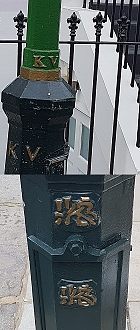
Most streetlamps in RBKC, are marked with the letters R, B, K, and C, intertwined. However, one of the lampposts in Callcott Street is marked with ‘RBK’, without the ‘C’. The other lamppost in this short thoroughfare is marked with the letters ‘KV’. This stands for Kensington Vestry. In the 19th century and probably earlier, local affairs were governed by the local vestry. This was a meeting or council of parish ratepayers, which often met in the local parish church or its vestry. In the case of Kensington, there is a fine Victorian building, now a branch of the Iranian Bank Melli, which used to serve as the Kensington Vestry Hall. Before this was built (in 1852), the local vestry used to meet in a room attached to the nearby St Mary Abbots church.
In 1901, the Metropolitan Borough of Kensington was granted the status of ‘Royal Borough’ and was known as the Royal Borough of Kensington. So, the streetlamp marked with ‘RBK’ must date from between 1901 and 1965, and the one with ‘KV’ is even older.
SOUTH OF KENSINGTON Gardens, just west of the Royal Garden Hotel, there is a small green hut with a pitched roof beside Kensington Road. It is one of the thirteen remaining cabmen’s shelters dotted around central London, which were established by the Cabmen’s Shelter Fund (‘CSF’) in 1875 and are still maintained by this organisation. Back in those days, cab drivers could not leave a cab stand whilst they were parked there. This made it difficult for cab drivers to obtain food and drink whilst on duty.
The solution to this problem was devised by the newspaper editor George Armstrong (1836–1907) and Anthony Ashley-Cooper, 7th Earl of Shaftesbury (1801-1885). They conceived the idea of the shelters to provide cabdrivers with refreshment. By law, the shelters had to be no larger a horse and cart, which explains their small size. That way, they did not encroach on the carriageway too much. In the past, these shelters confined themselves to serving cabmen. More recently, members of the public can buy snacks and drinks at these huts, whose attendants are supposed to make a living from their shelters. Cabmen can eat within a shelter, but others can only use them for take-away refreshments.
Recently, when passing the shelter on Kensington Road, I noticed that there were a couple of menus attached to it. Next to them was a small blackboard on which the following was written in chalk:
“Till Rolls 3 for 2.50 Receipt pads 4 for 2£”
This is stationery for the exclusive use of taxicab drivers. I was pleased to see this because it means that although they are open to the public, they are still of special use to cabdrivers.
I have never sampled anything at a cabmen’s shelter, so have no idea of the quality provided. Years ago, when I was practising dentistry, one of my patients was a taxicab driver. He was a ‘foodie’ and told me that he knew great quality, reasonably-priced eating places all over London. I cannot recall that amongst the many places he told me about that there were any cabmen’s shelters.
FROM THE LATE 19th century until a few years ago, High Street Kensington was a healthily flourishing retail centre. In its heyday, it boasted of three large department stores, Pontings, Barkers, and Derry & Toms. The impressive buildings that housed the latter two still stand and are fine examples of art deco architecture located close to the Underground station, which has been in service since the late 1860s. In recent years, the advent of on-line shopping, high rents, and the proximity of the Westfield Mall at Shepherds Bush (opened 2008), which has good parking, have conspired together to make High Street Kensington less appealing to shoppers. Consequently, at any one time a large proportion of shops remain empty awaiting new tenants. Sadly, what was once (especially in the 1960s and ‘70s) a bustling high street with trendy shops like Biba and the ‘funky’ Kensington Market, both gone, has become slightly dreary.
Barkers building
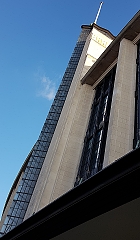
Barker’s former shop, a lovely art deco edifice, which opened in 1933, was designed by Bernard George (1894-1964). Between 1928 and 1962, he was the chief architect for Barker’s of Kensington in-house design group. It is worth examining this building closely to enjoy is many attractive details.
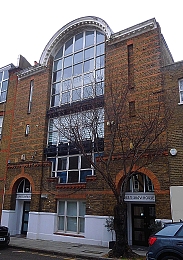
CAMPDEN STREET IN Kensington is a short thoroughfare running between Kensington Church Street and Campden Hill Road. On it, there is a distinctive building called Byam Shaw House. Until 1990, this edifice with its large centrally placed, north facing window was the Byam Shaw School of Art, which opened in 1910. Named at first as ‘Byam Shaw and Vicat Cole School of Art’, after its founders, Rex Vicat Cole (1870-1940) and John Liston Byam Shaw (1872-1919), it soon became known as the Byam Shaw school.
John Liston Byam Shaw is also known as ‘Byam Shaw’. He was born in British India, in Madras (now ‘Chennai’), where his father was registrar of the High Court at Madras. In 1878, the Shaws moved back to England, where they lived in Kensington. At an early age, he showed artistic promise and at the advice of the artist John Everett Millais (1829-1896), he entered an art school in London’s St Johns Wood. As he grew older, Byam’s works attracted less interest and he turned to teaching to earn a living. In 1910, he and Cole founded the art school in Campden Street. Sadly, Byam Shaw died during the great influenza epidemic that followed WW1.
The school in Campden Street has produced several significant artists including Winifred Nicholson (first wife of Ben Nicholson), Bernard Dunstan, Yinka Shonibare, Mona Hatoum, as well as stage designers, stained-glass makers, and actors. The inventor James Dyson also studied there. In 1990, the school moved to larger premises in Archway, and in 2003, the school was absorbed into the Central Saint Martins College of Arts and Design. Byam Shaw would have been pleased to know that his school produced such fine alumni. Guy Burch, who studied at the school between 1981 and 1984, wrote:
“The innovative independent Art School founded in the early 1900s, Byam Shaw had an open studio policy that suited my inability to fit into categories marked ‘painter’ or ‘sculptor’. Most art schools at the time made you choose one or other with cross-media working tending to be discouraged. Their studios allowed you to move between them. I was in the ‘Image Studio’, and worked on collage, painting and mixed media installations.” (http://www.guyburch.co.uk/?p=4358)
I feel it is a shame that the building in Campden Street, which has now become a block of flats, is without any notice commemorating its former use.
I USED TO PARK our car in Kensington’s elegant Edwards Square when going to work at my dental surgery in West Kensington. From the square, either I walked to work, or I caught a number 28 bus. When I felt lazy, I used the bus. The nearest stop to Edwards Square is outside a row of three Iranian food shops and their neighbour, the Apadana Iranian restaurant, which is a pleasant place to enjoy Persian cuisine. While waiting for the bus, I used to stare idly at the Persian shops with their outdoor stalls where fruits, especially piles of pomegranates, are displayed.
Today, more than four years since I retired and even longer since I last stood at the bus stop, we visited the Iranian stores to buy a bunch of fresh tarragon. While my wife was making the purchase, once again I stared idly at the colourful shops, some of whose windows are filled with stacks of tins of Iranian caviar from the Caspian Sea. It was then I noticed something I am sure I have never seen before.
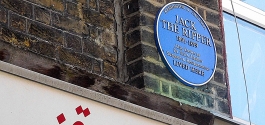
What I saw was a newish circular blue commemorative plaque on the wall between one of the shops and Apadana. The plaque reads as follows:
“Kensington & Chelsea. JACK THE RIPPER 1891-1899. Also known as Dr SSA Hasbro. Surgeon & Restauranteur LIVED HERE”
At first sight, this looks like one of many commemorative circular blue plaques, which can be found all over London. On closer examination, there are several things that are worrying. Rarely, if at all, do these blue plaques in the Royal Borough of Kensington and Chelsea bear the words “Kensington & Chelsea”. Often, they bear the words “English Heritage” or “Greater London Council” (or one of its predecessors: GLC or LCC). Another problem is the dates given. Do they refer to the period that Dr SSA Hasbro lived in this spot, or what? The next problem is that the true identity of Jack the Ripper has never been determined. As for Dr SSA Hasbro, all references to this name on Google direct one to the plaque under discussion, including an article by Lucy Elliott.
Ms Elliott wrote an article about blue plaques in “The Kensington Magazine” (September 2020 issue). With regard to the plaque for Dr SSA Hasbro above the Iranian establishments in High Street Kensington, she wrote:
“It is not known when this suddenly appeared but certainly gives visitors to the area, pause for thought (and quite enough consternation for the residents too). Definitely a fake.”
She is most probably right.
It is a little bit worrying is that the so-called Jack the Ripper, who is commemorated on this misleading sign, is said to have been a restauranteur and the plaque is almost directly above the Apadana restaurant.
KING ALFRED RULED the West Saxons from 871 to c886 and king of the Anglo-Saxons from c886 to 899. He was known as ‘Alfred the Great’. Amongst his many achievements was encouraging education and proposing that primary education was taught in (Old) English, rather than Latin. Winchester was Alfred’s capital and the place where he was buried there for a while. After the Norman Conquest in 1066, his remains were removed to Hyde Abbey near Winchester. This was destroyed in 1538 during the Reformation. Despite this, his grave remained intact until 1788, when the land where he was interred was redeveloped to build a jail. Since then, the whereabouts of his remains is unknown.
Despite, the disappearance of his bones, King Alfred dominates the centre of Winchester in the form of a huge statue near to the city’s cathedral, rich in gothic features, and its Guildhall, which is richly adorned by Victorian gothic features. The statue was erected in 1899. A plaque at its base reads:
“To the founder of the kingdom and nation D. October DCCCI. Winchester and the English name MDCCCI”
DCCCCI, being Roman for 901 and MDCCCCI, being Roman for 1901.
The tall bronze statue was designed by Sir William Hamo Thornycroft (1850-1925), a sculpto who might have been unknown to me had I not become aware of him whilst walking near London’s Holland Park back in 2017. He was an important figure in the New Sculpture movement, whose members’ oeuvres bridged the gap between the neo-classical tradition, popular during the 19th century, and early modernist trends at the end of the 19th century and beginning of the next.
I was roaming around Kensington taking photographs of buildings of interest prior to writing a piece about them when I spotted a plaque on a house in Melbury Road. Number 2a was Thornycroft’s studio, which was designed by his friend, the architect John Belcher (1841-1913).
Although I did not realise that they were created by Thornycroft before I wrote this today, I am familiar with two of his other creations: the statue of Oliver Cromwell outside The Houses of Parliament and “The Sower” at Kew Gardens. His Alfred statue is far larger than the other two.
I wonder what the great king would have thought if he knew that at his feet today, there is a short-term car park and that his capital’s cathedral now charges a fee for visitors to enter within it.






 yamey
yamey 