Problems with identifying gender in London and Bangalore (Bengaluru)

WHEN OUR DAUGHTER was about two years old and able to walk unassisted, she often wore overalls (jump suits), rather than girlish frocks. One day we were walking in London’s Kensington Gardens when we passed a couple of elderly ladies.  One of them looked at our child, and said to us: “What a cute little boy you have”

We replied:

“Actuually, she is our daughter.”

To which one of the ladies said to her friend: “it’s so difficult to tell one from the other these days.”


The former Men’s Bar at the Bangalore Club

Some months later, we were in India at the Bangalore Club (in Bangalore). In those days, the late 1990s, the club had a Men’s Bar, to which only men were admitted. Its wood panelled walls bear hunting trophies and archaic weapons.

One day, I was having a drink in that bar with my father-in-law, when our daughter arrived in the adjoining room with my wife. Excited to see us, our daughter,  dressed in her overalls, dashed into the Men’s Bar. An elderly gentleman, seeing a child in the bar, said to our daughter:

“You are too young to come in, young man. When you are 21, you will be welcome here.”

To which, my wife standing close to the entrance, said: “She’s our daughter.”

The gentleman then responded: “In that case, you will never be able to enter our bar”.

 How wrong he was.

Sometime during the early twenty-first century, the rules changed: now both men and women can use what had been the Men’s Bar.  Now, this bar has been renamed: it is simply The Bar.

Today, almost 28 years later, nobody would have any difficulty identifying our daughter as a young lady.

A capsule in time in London’s Kensington Gardens

EVERY SUMMER, THE Serpentine South Gallery in London’s Kensington Gardens hosts a temporary pavilion in its grounds. Each year, a different architect is invited to design a pavilion. And the chosen architect must be someone who has never before had any of his or her buildings constructed in England. This year, the chosen architect is Marina Tabassum, who was born in Bangladesh in 1969.

A Capsule in Time

Along with her associates, her architectural practice (Marina Tabassum Architects (MTA)) has designed a capsule-shaped pavilion, appropriately named “A Capsule in Time”. The long axis of the capsule is aligned along a north/south axis. Most of this lovely, airy structure consists of series of parallel hoops between which there are sets of angled panels made of a tinted translucent material. The walls of the pavilion have benches along their inner edges. It is not a continuous construction because there are two wide gaps between sets of parallel hoops. One of these is aligned with the clock tower on top of the Serpentine South gallery. At each end of the capsule, the hoops decrease in diameter to form quarters of spheres. Within one of these, there is a counter where refreshments are available. One of the design criteria for the annual pavilions is that they can accommodate such a counter.

In the last few years, I have found some of the pavilions to be disappointing aesthetically and architecturally. This year’s most satisfying effort by Marina Tabassum is the best Serpentine pavilion I seen during the last five years.

Boulders lodged in trees at a park in London

WHEN WALKING IN Kensington Gardens March 2025, I spotted three trees planted in an open space outside the Serpentine South art gallery on the west side of Kensington Gardens. Taller than many of the trees around them, they had not been there when I visited the area in November 2024. Without foliage and with few branches, they seemed dead when compared with the trees growing near them. We revisited these unusual trees today (13 April 2025), and they looked wonderful in the morning sunshine.

It does not take long to see that these trees have unusual features. Two of them have unwieldy granite boulders lodged in their branches. The third tree looks as if it has been split open by, for example. a lightning strike. Parts of the wood of this tree have been painted gold. Though in some respects these three tall objects look like trees, one realises quickly that they are not trees but artworks.

Created by the Italian artist Giuseppe Penone (born 1947), they are part of an exhibition of his works, most of which are housed within the Serpentine South Gallery. Penone was a leading artist in an Italian artistic movement known as ‘Arte Povera’, which focussed on exploiting the simplicity of natural materials with artistic techniques. According to the Serpentine’s website, Penone said of his exhibition:

All of my work is a trial to express my adherence and belonging to nature, and it is with this thought that I have chosen the works for the exhibition. The two paths that I have created—inside the gallery and outside of it, in the park—become two integrated gardens.”

The three tree-like sculptures both impressed and intrigued me. I have yet to see the works inside the gallery, but there is still plenty of time to view them as the exhibition continues until 7 September 2025.

A garden of funkiness in London’s Kensington

THE SERPENTINE GALLERY rarely puts on exhibitions that can be described as ‘mundane’. It is the most exciting and adventurous public art gallery in London. True to form, its current show (in the South gallery) is both weird and unexpected – actually, quite funky. Called “Emajendat” (i.e., ‘imagine that’), it is on until the 2nd of March 2025. The exhibition or art installations were created by Lauren Halsey, who was born in 1987 in Los Angeles (USA), where she lives and works.

Ms Halsey has created a series of fantasy landscapes that reflect the backyard culture of the part of Los Angeles – South Central – where was brought up and still lives. The exhibition’s leaflet explained that she:

“… has developed a distinct visual language deeply rooted in South Central Los Angeles where her family has lived for generations. Through objects and installations, Halsey archives and remixes the changing signs and symbols of her environment, gathering physical and graphic material from her neighbourhood. In her work Halsey merges past, present and future via her interest in iconography connected to the African diaspora, Black and queer icons and architecture. Halsey cites the collective sonic and visual layering associated with funk music as the blueprint for her approach to making, traversing time and drawing on a wide range of sources.”

 The extraordinary environments she has created in the various spaces within the Serpentine have a humorous dreamlike quality, and at the same time contain her comments on the social culture of Los Angeles. These comments and her message as described in the gallery’s leaflet were lost on me, but I enjoyed the visual impact and creativity of what I saw. From a purely aesthetic point of view, this extraordinary exhibition is like the proverbial ‘breath of fresh air’.

An architect from Korea making something out of nothing in a London park

ALMOST ALWAYS I ENJOY the annual temporary pavilions erected beside the Serpentine South Gallery in Kensington Gardens. This year’s offering was designed by the South Korean architect Minsuk Cho (born 1966 in Seoul). The Serpentine website (www.serpentinegalleries.org/) explained:

“Tracing the history of past Serpentine Pavilions, Minsuk Cho observed that they often emerge as a singular structure situated at the centre of the Serpentine South lawn. To explore new possibilities and previously untold spatial narratives, Cho approaches the centre as an open space. The 23rd Serpentine Pavilion envisions a unique void surrounded by a constellation of smaller, adaptable structures strategically positioned at the periphery of the lawn.”

The five structures surrounding the void (or open space) in the middle of the pavilion compound vary in shape and purpose. One serves as a library, another as a café serving area with minimum seating, another as a children’s play area, another is a kind of hallway, and the fifth is supposed to represent a tea house.  

Apart from two of the small buildings (the play area and the library), I did not find the others visually satisfying. Also, I did not feel that the five structures surrounding the central space were in harmony with each other. All in all, I was unimpressed by this year’s so-called pavilion.

I realise from reading the information on the Serpentine’s website that Minsuk Cho was trying to express a set of concepts by designing the small complex of buildings that together form the pavilion. However, without knowing that, the result looks unsubstantial compared with almost all the pavilions that have preceded it over the years. The architect’s ideas have not translated well into concrete forms. Apart from this, the current pavilion, unlike its predecessors, has few places for people to sit and enjoy the space. In all the pavilions that have been constructed before this year, there has been ample place to sit and rest. And providing such a place within uniquely designed architectural spaces has, until this year, been one of the things that makes the pavilions accessible for people of all ages to enjoy – whether or not they have an interest in the architecture or its designer.

Subversion at the Serpentine art gallery: ways with words

THE ORIGINAL SERPENTINE Gallery in London’s Kensington Gardens is housed in a former tea pavilion that was built in 1934. It began to be used as a contemporary art exhibition space in 1970. Since then, it has been showing modern and contemporary artworks in a series of temporary exhibitions. I have been visiting this gallery and its newer branch, Serpentine North, regularly since the 1990s (the North branch opened in 2013). Almost without exception, the art displayed in the Serpentine galleries has been both exciting and adventurous – sometimes quite challenging. The latest exhibition, which is on until the 17th of March 2024 in the original gallery, is of artworks by the American (USA) artist Barbara Kruger, who was born in Newark (NJ) in 1945.

Kruger’s art is not purely visual. It is designed to convey ideas that challenge the viewer to question commonly held contemporary beliefs in an eye-catching, often witty way. The exhibition, “Thinking of You. I mean Me. I mean You” consists of 12 art installations that reference or parody everyday things such as advertising, magazine illustration, video art, social media, the Internet, and other media that bombard us on a daily basis. Each of them present messages that subvert political ideas, the moral code, and the meanings of words. Kruger makes much use of video techniques. Several of the exhibits have words projected sequentially to make up sentences. Often, the words change on the screen to alter the perceived meaning of the text being projected. However, her art is not simply all about words and their meanings in different textual environments. The words are harmoniously accompanied by intriguing visual images, often continuously changing.

Although the exhibition is about words and their usage and varying meanings, words alone cannot describe this exhibition adequately. Therefore, if you can, it is worth taking a look at this interesting – nay, challenging – show. Having viewed the show, I was heartened to discover this artist from America who is perceptive enough to see where her country is heading and brave enough to criticise the political direction in which it appears to be moving. After seeing her exhibition, I would hazard a guess that she will not be voting for Mr Trump.

The force of ambition standing in Kensington Gardens

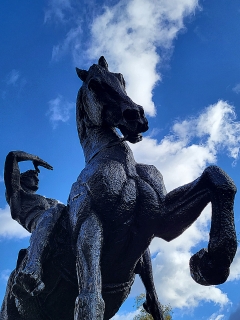
CAST IN BRONZE, he sits aside a rearing horse. He looks west towards Kensington Palace and uses his right hand to shield his eyes from the setting sun. I am describing a cast of a sculpture by George Frederic Watts (1817-1904), which bears the name “Physical Energy”. The sculptor was born on the birthday of the conductor George Frederic Handel – hence his two first names.

Watts began work on an equestrian sculpture in 1870, when it was commissioned by Hugh Lupus Grosvenor, who became 1st Duke of Westminster. It was to depict Hugh Lupus, 1st Earl of Chester. This was at Eaton Hall near Chester. In the early 1880s, Watts began working on “Physical Energy”, which was inspired by this sculpture. The first bronze casting of “Physical Energy” was made in 1902, and transported to southern Africa.   

Watts had been principally a painter until the 1870s, when his interests moved towards sculpture. “Physical Energy” was the high point of his efforts. A plaque next to the bronze horse and rider explained that this sculpture depicted:

“… a universal embodiment of the dynamic force of ambition …”

One man for whom these words might well be applied was the mining magnate and a Prime Minister of the South African Cape Colony, Cecil Rhodes (1853-1902), who ruthlessly let nothing get in the way of his ambitions. Therefore, it was particularly appropriate that one of the casts of Watts’s “Physical Energy” (that made in 1902) was placed at Groote Schuur (in Cape Town) as part of a memorial to Rhodes after Rhodes’s death. Unlike a bust of Rhodes placed nearby, which was vandalised recently, the equestrian statue has survived … so far.

An article published by Artnet News (https://news.artnet.com/art-world/watts-sculpture-royal-academy-ideological-baggage-1155971) made the following remarks:

“Watts, like Rhodes, believed in British imperial might to back its right to rule … the artist “plied” a leading politician with suggestions that military service should be introduced. (The colonial statesman Lord Grey was the man who suggested Watts turn the equestrian sculpture into a memorial to Rhodes after he died…)

… Watts’s imperialism was “liberal” and that the sculpture’s ideological meaning is open-ended. Socialists used the image, too. In fact, Watts had multicultural references in mind when he first conceived the statue: It was due to be dedicated to great empire builders including Mohammed, Attila the Hun, and Genghis Kahn. (Trowmans adds that May Watts, the artist’s second wife and a fellow artist, was much more sceptical of Rhodes.)”

The quotation mentions that Watts married twice. His first wife was the young actress Ellen Terry (1847-1928). They married when she was 16 years old. They separated after 10 months. During that brief period, she met, and was photographed by the Victorian pioneer of artistic photography, Julia Margaret Cameron (1815-1879). I have written about both Watts and his young bride in my book about Mrs Cameron (“BETWEEN TWO ISLANDS: JULIA MARGARET CAMERON AND HER CIRCLE”).

In addition to the cast in Cape Town, at least two others were made. One of them was produced in 1959. It now stands outside the National Archives in Harare (Zimbabwe). The cast which stands in Kensington Gardens was cast by AB Burton (a founder) in Thames Ditton in 1905, and was put in its present location in 1907. It stands on a line that runs between a Henry Moore sculpture on the bank of the Serpentine and Kensington Palace. Another cast was made in 2017 to commemorate the 200th anniversary of Watts’s birth. Briefly, it stood in the courtyard at the Royal Academy. Now, it stands at the Watts Gallery near Guildford.

We pass “Physical Energy” on our frequent strolls through Kensington Gardens. From it, there is a fine view of Henry Moore’s tall concrete sculpture across the Serpentine Lake. Watts was a contemporary of the French sculptor Auguste Rodin (1840-1917). However, sadly, neither Watts nor Moore produced works as fine as those of Rodin.

[My book about Julia Margaret Cameron is available from Amazon, e.g.,

https://www.amazon.co.uk/dp/B0BZFCVLX9/ ]

Sailing on the pond on Sunday mornings

REGULARLY ON SUNDAY mornings, you will see a group of people standing at the northern edge of Kensington Gardens’ so-called Round Pond. It is not truly round, but squarish with rounded corners. This group of men and women will be seen standing close to trolleys on which there might be large model sailing boats. Often, the boats, which are radio-controlled, will be sailing in the pond’s water. These model boat enthusiasts are members of the London Model Yacht Club, which was founded in London in 1876.

Prior to 1876, there were other model boating clubs in London. In the 1820s, a group of model boat enthusiasts used to sail their craft in a pond in Green Park. This pond exists no more. In 1834, when the pond was made inaccessible by railings, the boaters moved to the Serpentine in Hyde Park. The first formal London Model Yacht Club was founded in 1846. Following disagreements, this club was disbanded in 1871. In 1876, the Model Yacht Sailing Association was established. It and another club, the London Model Yacht Club (Est. 1884) have been sailing on the Round Pond since the late 1880s. Before that, they had been using a pond in Hackney. For those interested in the detailed history of model boat sailing in London, please visit  www.lmyc.org.uk/history.

Next time you are in London at around 10.30 am on a Sunday morning, visit the Round Pond to watch the model boats ashore and on the water.

Trees at sunset in Kensington Gardens

YESTERDAY EVENING, WE took a stroll in Kensington Gardens when the temperature was beginning to drop. The sun was low in the sky. This caused some parts of trees to be shadowed by neighbouring trees so that lovely patterns of light appeared on them. One any particular tree, part of its foliage was brightly coloured because the rays of the sun could reach it, and other parts appeared dark green because the sun could not reach them. All this is obvious when you see it described in words, but wonderful when you see it in life.

PS: It is light effects such as these that make it difficult for artists to paint trees