Sailing on the pond on Sunday mornings

REGULARLY ON SUNDAY mornings, you will see a group of people standing at the northern edge of Kensington Gardens’ so-called Round Pond. It is not truly round, but squarish with rounded corners. This group of men and women will be seen standing close to trolleys on which there might be large model sailing boats. Often, the boats, which are radio-controlled, will be sailing in the pond’s water. These model boat enthusiasts are members of the London Model Yacht Club, which was founded in London in 1876.

Prior to 1876, there were other model boating clubs in London. In the 1820s, a group of model boat enthusiasts used to sail their craft in a pond in Green Park. This pond exists no more. In 1834, when the pond was made inaccessible by railings, the boaters moved to the Serpentine in Hyde Park. The first formal London Model Yacht Club was founded in 1846. Following disagreements, this club was disbanded in 1871. In 1876, the Model Yacht Sailing Association was established. It and another club, the London Model Yacht Club (Est. 1884) have been sailing on the Round Pond since the late 1880s. Before that, they had been using a pond in Hackney. For those interested in the detailed history of model boat sailing in London, please visit  www.lmyc.org.uk/history.

Next time you are in London at around 10.30 am on a Sunday morning, visit the Round Pond to watch the model boats ashore and on the water.

Trees at sunset in Kensington Gardens

YESTERDAY EVENING, WE took a stroll in Kensington Gardens when the temperature was beginning to drop. The sun was low in the sky. This caused some parts of trees to be shadowed by neighbouring trees so that lovely patterns of light appeared on them. One any particular tree, part of its foliage was brightly coloured because the rays of the sun could reach it, and other parts appeared dark green because the sun could not reach them. All this is obvious when you see it described in words, but wonderful when you see it in life.

PS: It is light effects such as these that make it difficult for artists to paint trees

A homely pavilion in the park

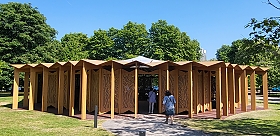
EVERY YEAR SINCE 2000, the Serpentine Gallery in London’s Kensington Gardens has commissioned the construction of a temporary pavilion in its garden. These pavilions have two things in common. One is that they contain a café and the other is that it must be designed by a noteworthy architect who has never had one of his or her creations constructed in England. Almost all the pavilions constructed to date have been examples of adventurous and exciting architecture. This year’s architect is Lina Ghotmeh, who was born in Lebanon and now works in her studio in Paris.

Given the French name “À table”, the circular timber pavilion was conceived as a place for people to sit together and chat, just as they would around a dinner table. Given this aim of the architect, it succeeds. To enhance her aim, the specially designed tables and chairs are arranged in a circle. As my wife said, it is the homeliest of all the pavilions built to date. Unlike some of the earlier pavilions, one does not feel that one is entering an unfamiliar, or even alien, environment. Despite its welcoming nature and very human scale, the pavilion’s design is far from mundane. Although it is far from being amongst the most visually spectacular of the temporary buildings, it is pleasing to the eye. I will certainly visit it again before it is dismantled on the 29th of October 2023.

Just let it grow

BETWEEN 1983 AND 1994, I owned a house in Gillingham, Kent. It was not an exceptional building, but it had a long back garden – 180 feet in length and about 22 feet wide. Much of the garden was covered with a lawn bordered by plant beds. When I first moved in, I attended the garden keenly even though I had little idea about gardening. As soon as I unearthed weeds, they re-appeared. It was most disheartening.  I discovered that planting shrubs was the best way to hide the weeds, about which I soon stopped worrying.

As for the lawn, I acquired a mowing machine, and for some months, or maybe years, I trimmed the grass regularly. Then, I found that whenever I cut the lawn, my nose would start streaming and I would have fits of sneezing. I realised that I had a grass allergy. So, I decided to cease mowing the lawn. I let the grass grow higher and higher. When it reached its greatest height, people sitting in the garden would be hidden by it. At the end of the year, the grass collapsed and more or less disappeared – only to begin growing again the following spring. I let nature take its course, and ceased worrying about it until a deputation consisting of my immediate neighbours came to my house to complain about my unruly lawn and garden. One of them, an elderly lady, was convinced that all the weeds and insects in her garden had come from mine.

One summer evening, I came home after dark and as it was a pleasant evening, I stood in my back garden looking up at the stars. As I did so, I was aware of a slight smell of burning. The following day, one of my neighbours saw me in the street as I was setting off for work. He told me that the neighbour on the other side of the garden had set fire to mine, hoping that the flames would kill the weeds. Luckily, he had spotted the conflagration, and extinguished it before it did too much damage.

Following the neighbours’ complaints, I conceived an idea about how to deal with my lawn. I decided that I would let it grow without interference, but I would mow a narrow sinuous path along its length. The idea was that I could then explain to the neighbours that the wild grass was part of my garden design. Meanwhile, my shrubs increased in size steadily and the weeds flourished. In the warmer months of the year, whenever I strolled in my garden, clouds of butterflies used to billow from the luxuriant vegetation.

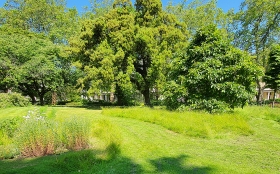
Today, in June 2023, whilst walking in Kensington Gardens, I noticed that much of the grass was growing wild – not being mowed. Here and there, the gardeners had trimmed small areas of grass with a lawnmower, much as I used to do back in Gillingham in the 1980s.

To be honest, I let my garden grow wild because I could not be bothered to spend hours of my life making it look neat and tidy. Today, what I was doing – letting the plants ‘do their own thing’ – is known as ‘wilding’. Maybe, unwittingly I was a pioneer of wilding.

A pretty perambulation

LONDON’S KENSINGTON GARDENS is bounded to the north by Bayswater Road and to the south by Kensington Gore (overlooked by the Royal Albert Hall and the Albert Memorial), which becomes Kensington Road.  Within the park and running almost parallel with its southern boundary is the South Flower Walk (also known as The Flower Walk). The Northern Flower Walk, which runs near and parallel to Bayswater Road was once used by royalty. According to a document published on the Royal Parks website, this was:

“… a delicious and appealing place to stroll for the monarch on the way to … the site of the Bayswater ‘Breakfasting House’…”

The breakfasting house no longer exists. I am not sure whether the South Flower Walk can boast of such an illustrious past. However, when it is in full bloom, it outdoes its northern counterpart in colourfulness and variety of its flora.

Although the whole of Kensington Gardens makes for a pleasant place to stroll, a walk along the South Flower Walk provides and exceedingly pretty perambulation.

The Black Chapel in the park

EVERY SUMMER SINCE 2000 except for the year 2020, the Serpentine Gallery in London’s Kensington Gardens has hosted a special event. On each of these years between June and October, a temporary pavilion has been erected near to the original Serpentine Gallery (now known as Serpentine South). No two pavilions have looked the same. However, what they have in common is that each one of them is the first ever completed structure erected in England by the pavilion’s designer/architect.  

This year (2022), the pavilion, called “Black Chapel”, was designed by the American artist Theaster Gates (born in Chicago in 1973). In the past, we have seen exhibitions of his works hosted in the White Cube Galleries at both Masons Yard and in Bermondsey. Many of his exciting artworks have impressed us greatly. So, it was with high expectations that we went to see his pavilion.

At first sight, we were disappointed by the Black Chapel. It is a huge black cylinder with three apertures. Two of them are entrances and the third is a circular orifice in the centre of the tall structure’s circular, domed ceiling. A segment of the cylinder is walled off and serves as a café servery. Benches line the lower parts of the wall of the rest of the building. Seven large, flat rectangular, metallic paintings (or plates) are attached to a part of the internal wall, and there is a large bell just outside one of the pavilion’s two entrances.

Today, many people like to have art explained to them. For me, it is my visceral reaction to an artwork that is more important than its intended meaning or the artist’s intentions. The ‘meaning’ of a work of art is, for me, secondary to the way I am affected by it. For those, who seek meaning in art, this is what the Serpentine’s website has to say about the pavilion:

“The structure, realised with the support of Adjaye Associates, references the bottle kilns of Stoke-on-Trent, the beehive kilns of the Western United States, San Pietro and the Roman tempiettos, and traditional African structures, such as the Musgum mud huts of Cameroon, and the Kasubi Tombs of Kampala, Uganda. The Pavilion’s circularity and volume echo the sacred forms of Hungarian round churches and the ring shouts, voodoo circles and roda de capoeira witnessed in the sacred practices of the African diaspora.”

Interesting as this might be, it neither increases nor diminishes my appreciation of the Black Chapel. Theaster Gates’s Black Chapel is less exciting visually than some of the past pavilions. Although our initial impressions of this seemingly simple structure were not particularly favourable, after spending a little time in it, the place grew on us and now we hope to visit it again.

Remembered with yellow flowers

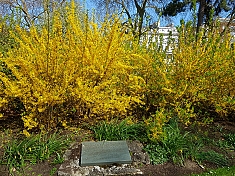
THE NORTH FLOWER Walk in Kensington Gardens runs east from the Italian Gardens. It is both close to, and parallel to, Bayswater Road. About 280 yards west of the Italian Gardens, there is a small, low rectangular memorial stone in a flower bed next to the North Flower Walk. In springtime, a large bush behind it bursts into yellow flowers. It is a forsythia plant.

The North Flower Walk used to be a part of what was once the ‘berceau’ or ‘walk of shade’. According to a document published on the Royal Parks website, this was:

“… a delicious and appealing place to stroll for the monarch on the way to … the site of the Bayswater ‘Breakfasting House’…”

Today, the Walk is filled with walkers, their children, their dogs, joggers, and the occasional cyclists.

The memorial stone celebrates the botanist and horticulturalist William Forsyth (1737-1804). A founding member of The Royal Horticultural Society (founded 1804), he was also the Curator of The Chelsea Physic Garden (from 1771) and Superintendent of various royal gardens including those of Kensington Palace (from 1784). The plant genus Forsythia, a member of the olive family (Oleaceae), was named in his honour.

Winter solstice in the park

THE TEMPERATURE HAS dropped. Fear of the Omicron variant of the covid19 virus has meant that less people are out and about in London. This was the case in Kensington Gardens today, the winter solstice. The wildfowl that gather around its not so round Round Pond wait eagerly for visitors to distribute tasty morsels. Today, I saw a lady feeding the birds. So many were attracted to her that sometimes her head seemed lost in a cloud of noisy gulls. In front of her, swans extended their necks, attempting to reach her hands. Undaunted, this animal lover continued carrying out her kind gesture.