FROM AFAR, THE VICTORIA Memorial in Kolkata looks almost magical. However, inside it is pompous and overbearing (and not particularly beautiful), just as the British must have seemed to many Indians before their country was freed from the British Empire.
Visitors to the Memorial can explore the ground floor and the one above it. Much of the upper floor is dedicated to an exhibition of photographs and facsimiles of documents relating to the exploits of those who fought to make India independent. Naturally, better known individuals such as Gandhi, the Nehrus, and Subhas Chandra Bose figure in this show. But they are outnumbered by lesser known freedom fighters. One of these is Shyamji Krishnavarma (1857-1930). Many of you reading this might well be wondering why this man deserved to be includefacsimilesexhibition.
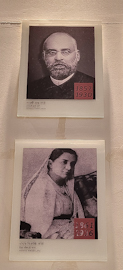
Like several other freedom fighters, Krishnavarma went to London to become a barrister. He returned to India and made a fortune working for the rulers of some of the Princely States. Then, he returned to London. In 1905, when Bengal was partitioned he conducted his own campaign against British rule in India.
Above: Krishnavarma, below: Madame Cams
Amongst the many things he did in addition to starting an anti-British newspaper, Krishnavarma purchased a house in Highgate (northwest London), which he converted into a hostel and meeting place for Indians studying in London. It was named India House. Soon, it became a meeting place for Indians who wanted to rid India of the British. I have read that amongst the revolutionary activities carried out in India House was experimentation in bomb making. Amongst those associated with India House was VD Savarkar (1883-1966). In 1910, he was arrested by the British and spent several terrible years in the Cellular Prison in Port Blair (Andaman Islands). Amongst Savarkar’s many achievements was the development of Hindutva.
In 1907, Krishnavarma migrated to Paris. Later, until his death he resided in Geneva. Unlike Gandhi and his followers, Krishnavarma and his colleagues (including Madame Cama) did not believe that India could become free by relying only on non-violent protest.
I first became interested in Krishnavarma when visiting Mandvi in Kutch (part of Gujarat). Shyamji was born in Mandvi, and his ashes are kept at a memorial centre a few miles outside the town. The centre includes a full size replica of Highate’s former India House. Seeing this building standing on its own in a flat sandy semi-desert landscape intrigued me, and got me interested in Krishnavarma. I became so fascinated that I wrote a book about Krishnavarma and what happened in and around his India House. The book is called “Indian Freedom Fighters in London (1905-1910)”, and is available from Amazon (e.g., https://www.amazon.co.uk/INDIAN-FREEDOM-FIGHTERS-LONDON-1905-1910/dp/0244270716/ ).
The exhibition at the Victoria Memorial includes several photographs and documents relating to Krishnavarma and his India House. I had seen some of these elsewhere, but a few were new to me.
Although the Victoria Memorial is not one if my favourite things in Kolkata, I am pleased we visited if only because there were exhibits related to Krishnavarma. In addition, I was pleased to see several paintings by Thomas Daniell (1749-1840) and one by an artist I like very much : John Zoffany (1733-1810). Both of these men spent several years living and working in India.
THE ALIPORE JAIL used to house political prisoners, whom the British regarded as a threat to their rule of India. The inmates included freedom fighters such as the future Sri Aurobindo, Jawaharlal Nehru, and Subhas Chandra Bose. The prison has been restored and is now a museum. In December 2024 and for the first few days of 2025, several exhibitions that are part of the Bengal Biennale have been held in some of the jail’s buildings. One of these, which I found extremely interesting and well curated, is called “Kali: Reverence and Rebellion”.
Kali is a Hindu goddess. I will not try to explain her exploits and great importance to Hindus, but will outline the subject matter of the exhibition by quoting from the website of the Biennale (www.bengalbiennale.com/):
“Divided into sections, the exhibition traces Kali’s pervasive influence across the subcontinent. It explores Kali and her cohorts of the divine feminine. Born from Durga’s angry, darkened brow as she battles the asuras Chanda and Munda, Kali decapitates the demons and assumes the form of Chamunda. Within these depictions, she is seen alongside Durga, the primordial force, as well as the ten Mahavidyas that emerge to subdue Shiva.”
Subhas Chandra Bose image
In addition to the wonderful array of images on display, which can be enjoyed without any knowledge of Kali, what fascinated me was the connection between Kali and the fight of Indians for independence. The website explained:
“During the nationalist period, Kali was invoked as a symbol of rebellion by Aurobindo Ghosh and Subhash Chandra Bose to urge their followers to fight against imperialist forces.”
In connection with this, two images fascinated me. One of them depicts Kali who has cut off her own head and she holds it in her left hand while blood shoots out of her cut neck and into the mouth of her self-decapitated head. Painted in about 1840, this image shows what Kali did after either she was unable to obtain Shiva’s blood, or she had been deprived of her conjugal rights. Known as Chinnamasta, this avatar of Kali is often shown with one foot on the chest of a god (Shiva) or standing above a copulating couple.
Elsewhere in the exhibition, there is an image of Subhas Chandra Bose created during the twentieth century. It shows the freedom fighter, Bose, standing decapitated and holding his own head in his left hand. He is standing above a group of decapitated heads. Blood pours down from his head and it falls onto a map of India on which the words “Jai Hind” (‘Victory to India’) can be seen. The image is a politicisation of the depiction of Chinnamasta.
Apart from a wonderful selection of Kali images created by Indian artists, there are a few made by early Europeans who visited India and wanted to record their experiences and to attempt to understand Hinduism. All in all, the exhibition was very well worth viewing. It was so popular with visitors to the jail that a security guard was present to regulate the number of viewers at any one time, to prevent overcrowding.
IN AUGUST 1947, India and Pakistan became independent sovereign nations. Following this, vast numbers of Sikhs and Hindus fled from Pakistan to India, and many Muslims fled in the opposite direction. This mass migration of people was accompanied by unbelievably horrific incidents of violence; many lost their lives on both sides of the frontier. Meanwhile, in much of India, daily life for many went on without incident. A yearly publication was published in Bombay from 1919 until 1979. It was called “Times of India Annual”, but between 1942 and 1948, it was called “Indian Annual”. The 1948 issue of “Indian Annual” was published by the Times of India soon after Independence was achieved in 1947. I have a copy of this beautifully illustrated issue. In common with many magazines, it is amply supplied with advertisements. Studying these was interesting because although some of them seem to have recognised that India was independent of both the British Empire and separate from Pakistan, others have not taken this into account.
I imagine that many of the readers of the 1948 Indian Annual were Indians. The magazine includes advertisements for many products used by Indians. Many of these commercials depict faces or people. Some of them show people with faces that look Indian. These include the adverts for Firestone tyres, the India Tea Marketing Expansion Board, Cyclax (beauty products), Tata Steel, Saba Radio Company, and Himanlal Manchand (jewellers). Others feature people with faces that are unmistakably (white) European, for example: Ovaltine, Terra Trading Corporation (modern Czechoslovak glassware), Argoflex (cameras), Rogers (soft drinks), Yardley (beauty products), Rendells products (feminine hygiene), and Virol (a health product). Either these companies that used European faces were recycling pre-existing company advertising material or not sensitive to the fact that India was then independent, or both. Another possibility is that these companies were appealing to the spending abilities of the many European people who were to continue living in India until well into the 1970s. For even after Independence, there were institutions (e.g., some clubs and schools) in India that for many years were only for Europeans, but excluded Indians.
Several of the advertisements in the 1948 publication listed the cities where they had branches. Some of these listings ignored the fact that India and Pakistan were no longer parts of one country. Ovaltine was distributed by a company that had branches in Bombay, Calcutta, Karachi (Pakistan), and Madras. The mechanical and construction engineers Garlic &Co had branches in Indian cities and also in Lahore. And Modern Trading Company listed offices in Bombay, New Delhi, Karachi (Pakistan), Calcutta, and Lahore (Pakistan). Another advertisement, that for the Chicago Telephone & Radio Co. Ltd, includes listings of offices both in India and Pakistan. The Rootes Group, which manufactured cars like the Humber, the Hillman, and the Sunbeam Talbot, list their (I quote) “Distributors in India” as being in towns such as Karachi, Lahore, Peshawar, and Rawalpindi. Had the advertiser not realised that these towns were now no longer in India, but in Pakistan? In all the cases I have mentioned in this paragraph, the advertising agencies seemed to have ignored the fact that what had once been (greater) India was now India and Pakistan. Given what was happening in the way of the misery caused by the partition of India at the time the Annual was published, it seems odd or even insensitive that the advertisements display no sign that the Subcontinent had been divided.
After Independence, Jawaharlal Nehru wanted to move India into what he perceived as the ‘modern era’. Some of the advertisements reflect this both in their design and the products they were promoting. The advert for Godrej shows some tubular household furniture of a design that many would have considered avant-garde in 1948. An advertisement for Indian-made Panama cigarettes is reminiscent of the Italian Futurist style. Likewise, for the Tata steel advertisement. This has futurist features but also veers towards the Soviet Socialist Realism style.
Finally, we come to a very interesting advert, that for the Bombay based Himanlal Manchand jewellers. It depicts Indian warriors on horses and is covered with crests of various rulers of Princely States and that of the Governor of Bombay, which is accompanied by the words:
“By appointment to H.E. Rt. Hon’ble Sir John Colville, Governor of Bombay”
Sir John Colville (1894-1954) was appointed Governor of Bombay in March 1943. He held this post even after India became independent, and was replaced by Raja Maharaj Singh in early January 1948. The jewellers were also by appointment to the princely rulers of Baroda, Jodhpur, Cooch-Behar, Jubbal, Jaipur, Indore, Palanpur, and Dewas. These maharajahs had been the rulers of ‘semi-autonomous’ (vassal) states within the British Empire. All of those listed became incorporated into the India which came into existence in August 1947. Their rulers were recognised officially by the Indian government until 1971. Between 1947 and 1971, these and other rulers of princely states received a privy purse from the Indian government. In 1971, Prime Minister Indira Gandhi put an end to the majority of these payments and de-recognised their titles and put an end to all of their royal privileges. So, in 1948 when Himanlal Manchand placed their full page coloured advertisement in 1948, they were entitled to show off their appointments to Indian royalty. The advertisements alone make the 1948 Indian Annual an interesting curiosity. The articles in the magazine along with many of its fine illustrations make it into a real treasure of great historical interest. While writing this piece, I discovered that the 1949 issue can be read online (https://archive.org/details/dli.venugopal.824/page/n91/mode/2up) . Skimming through this, I noticed that some companies still depicted European faces in their adverts and others included cities in Pakistan in the lists of their branches. This was despite the fact that since October 1947 Pakistan had been fighting a war over Kashmir. This only ended on the 1st of January 1949.
HAVING BEEN BEFRIENDED by the author’s son Prithvi, and having seen some of his father’s belongings stored in the Calcutta Club (in Kolkata), I finally got around to reading a book that I bought almost 30 years ago. The 960-page volume by Prithvi’s father, Nirad C Chaudhuri (1897-1999), is called “Thy Hand, Great Anarch”, and was first published in1987. The title comes from a couplet in a poem by Alexander Pope (1688-1744):
“Thy hand, great Anarch! lets the curtain fall;
And universal Darkness buries All.”
This pessimism well summarises what Chaudhuri has written in his enormous tome.
The book is the second part of Chaudhuri’s autobiography. It covers the period from 1921 to 1952 – the years leading up to the end of British rule in India and the first few years after the country gained its independence. Chaudhuri was a keen observer of what was going on in India during this period. Without pulling any punches, he gives his often-critical opinions of what was going on in the country, and never fails to point out what he felt was being done wrong both by the British and also by the Indians fighting for the end of British rule. Although he wrote this book long after 1952, he quotes from things he wrote during the period he described. He did this, I believe, to prove to the reader that his frequently idiosyncratic opinions were not as a result of looking back with hindsight, but were what he thought at the time.
One of Nirad’s chief criticisms of the various different freedom fighters was that they all expressed their dislike of British rule but, according to him, none of them proposed plans for how India was to be ruled if or when independence was achieved. I have read several books about the history of India’s fight for freedom, and most of them portray leaders such as Gandhi, Nehru, Vallabhai Patel, and Subhash Chandra Bose as heroic figures. This was not how Nirad portrayed any of them. Having been the personal secretary of Bose’s brother Sarat Bose, Nirad was in a good position to observe many political events at close hand. As for Gandhi, he wrote (giving his reasons):
“To take the question of his contribution to Indian independence first. It is a blatant falsehood to say that he or his movements brought it about, whatever their moral effect.”
This was not an opinion I had come across before in histories of the struggle for India’s independence. It is his highly individual and original views that help to make his book so engaging. He writes very scornfully of Subhash Chandra Bose’s politics and his cooperation with the British Empire’s enemies during WW2. As for Jinnah – the ‘father’ of Pakistan – he showed less disdain, writing:
“I must set down at this point that Jinnah is the only man who came out with success and honour from the ignoble end of the British Empire in India.”
Unlike members of the Indian National Congress and their opponents – the British Government, Jinnah:
“… never made a secret of what he wanted, never prevaricated, never compromised, and yet succeeded in inflicting an unmitigated defeat on both the British Government and the Indian National Congress.”
Although I got the feeling that Chaudhuri admired the British and believed that Indians would fare better by being part of the British Empire than they would in an India ruled by Indians, his book is by no means short of criticism of the British as colonists, during the last years of empire, and after India became independent. Figures such as Attlee and Mountbatten get little or no praise from Nirad. At the beginning of a chapter called “Mount Batten Piled on Mount Attlee”, he wrote:
“As if Attlee single-handed was not enough to complete the work of demolition begun by the more cunning mediocrity. Baldwin, he piled on himself Lord Mountbatten to add greater work to his policy, which brought endless misfortunes to the Indian people.”
As the book’s title suggests, the text contains Nirad’s views on the anarchy he perceived developing as India approached independence, and then after having achieved it. It is not surprising, given what he wrote and thought about the country of his birth that Nirad chose to move to England (in about 1982) and lived there until he died. Many readers might be surprised or even horrified by what the author wrote, but he takes care to make whatever he thought sound reasonable to his readers. There are parts of the book which I found hard going – difficult to comprehend, but I ploughed on regardless, and was pleased that I did.
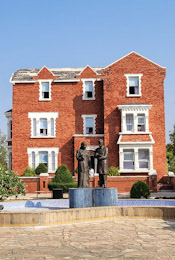
A NARROW ROAD LEADS away from the town of Mandvi (in Kachchh, a part of Gujarat) into an arid sandy area close to the seacoast. Scrubby bushes populate most of this flat terrain. After a few miles, a red building can be seen on the horizon. As you approach it, you can see that it resembles no other in the surrounding area, or, for that manner, in any other part of India. However, if you are a Londoner, it would seem familiar, although quite incongruous.
Replica of India House near Mandvi, Kachchh
The house in the desert is an accurate replica of a typical Victorian house, such as can be found in North London. In fact, it is a full-size copy of number 65 Cromwell Avenue in London’s Highgate area. The reproduction near Mandvi was built as part of a complex to commemorate Shyamji Krishnavarma (1857-1930), who was born in the centre of Mandvi.
Krishnavarma, who became a barrister and worked in various Princely States, moved to London, where he lived until about 1907. He moved to Paris, and then to Geneva, where he and his wife lived until they died.
In London, Krishnavarma lived opposite Highgate Woods. He invested wisely, and became interested in the works of English men, who had their doubts about Britain’s domination of India. He became an opponent of British rule in the Indian subcontinent. At first, his interest was mainly intellectual. However, in 1905, following the partition of Bengal, he became an activist.
One of his several activities was to purchase number 65 Cromwell Avenue. He had it adapted to become a ‘home away from home’ for Indians studying in London – they frequently had to endure the racist attitudes of English people. He named the building ‘India House’ (which should not be confused with the present Indian High Commission in London).
Apart from providing Indian food, some accommodation, and some leisure facilities, India House also hosted meetings that discussed the injustice of British rule in India. Soon, India House attracted the attention of the British police. This was because India House was becoming a nucleus or hotbed of anti-British activism. For example, some of the people who frequented the House experimented with bomb making and smuggling firearms to freedom fighters in India.
Krishnavarma left London in 1907, when he feared that he might be arrested. India House continued to be active until mid-1909 when one of its visitors assassinated an important colonial official.
Krishnavarma wrote in his will that after he was cremated, his ashes should be returned to India only after it had become independent of the British.
In the early part of this cemetery, the Chief Minister of Gujarat, then Narendra Modi, decided to bring Krishnavarma’s ashes to India – to Mandvi. Some years later, a complex to commemorate Krishnavarma was built outside Mandvi. Part if this is the replica of Highate’s former India House. The ashes of Krishnavarma and his wife are stored in urns on display in a building next to the replica.
If this story interests you and you want to know much more about India House, its replica, Krishnavarma and his fellow freedom fighters, including the currently influential VD Savarkar, you should read my, dare I say it, very informative book. I have produced two versions of it. One, the latest edition is “Indian Freedom Fighters in London 1905-1910), and is available here: https://www.amazon.co.uk/gp/aw/d/0244270716/ . The other “Ideas, Bombs, and Bullets”, which can only be delivered to addresses in India in available here: https://store.pothi.com/book/adam-yamey-ideas-bombs-and-bullets/.
NAGPADA JUNCTION IS one kilometre east of Mumbai Central Station. There are several interesting memorials located around this place where six busy roads meet. Each of them commemorates someone of the Islamic faith.
One memorial, a large rectangular bas-relief, is dedicated to the great poet Mirza Ghalib (1797-1869).
Dominating the junction is a tall flagpole from which India’s flag flutters. The base of this includes a large curved bas-relief in grey stone. The base has carvings of several important Indian freedom fighters including Mahatma Gandhi. There are also scenes of these leaders behind bars and other Indians being attacked by Britishers. The words “Quit India” can also be seen in several languages. The Quit India movement was one of many attempts to get the British to leave the huge country they ruled until 1947.
This monument and its flagpole are mainly dedicated to the memory of Maulana Abul Kalam Azad (1888-1958). In brief, he was all of the following and much more: an Indian independence activist, Islamic theologian, writer and a senior member of the Indian National Congress. Between 1947 and 1958, he was independent India’s first Minister of Education.
Lesser known than Ghalib and the Maulana, but also commemorated at Nagpada Junction is the freedom fighter Maulana Fazlul Hasan Hazrat Mohani (1875-1951). This celebrated writer of poetry in the Urdu language is best known for a slogan he created in 1921: “Inquilab zindabad”, which means “Long live the revolution”. He is also credited as being one of the first Indians to demand complete independence for India, rather than increases in the degree of the country’s autonomy whilst remaining part of the British Empire.
At first a member of The Indian National Congress, Hasan Hazrat later joined the Communist Party. He was against the Partition of India and would have preferred that India had become a confederation of states such as was the case in the USSR.
Nagpada Junction is both rich in traffic and memorials to notable Muslim men. One more memorial and a street name commemorate another Muslim, Sofia Zuber (Zubair), at this meeting place of busy. thoroughfares. She was an education superintendent for Urdu affiliated to a civic body and later a corporator from Nagpada. The short road named after her used to be a meeting place for Urdu authors and journalists.
I would not have written about this interesting traffic junction had I not noticed the Maulana Abul Kalam monument as we sped past it in a yellow and black taxi. Curious about it, we returned later and had a look around, and then ate good kebabs in the Sagar restaurant beside the junction.
RECENTLY, I WALKED in Mahatma Gandhi’s footsteps, neither in India nor in South Africa nor in London, but in southeast England.
I am sure that many years ago, at least once, I travelled by ferry across the English Channel from Folkestone in Kent to a port in France. Whether I was travelling by car or by train I cannot recall. Had I been travelling by rail I feel sure that I would have remembered the pier at Folkestone, but I cannot now recall it. If I reached the ferry by train, it would have had to have been before 2001, when the last ferry sailed from Folkestone.
The first ferry service from Folkestone to Boulogne began in 1843 (https://folkestoneharbourarm.co.uk/history/the-harbour-in-the-19th-century/). Passengers reached the boat from the mainline railway station by local transport. In 1847, a long viaduct was constructed to take a steeply inclined mile long branch line from the main line, which was 111 feet above sea level, to the shoreline. This track crossed the viaduct and a swing bridge, which still exist and separate the Inner harbour from the Outer Harbour. At the seashore, the track ran onto a newly constructed pier, The Harbour Arm, from which passengers and freight could be embarked and disembarked. The pier, which was only fully completed in 1904, had a station, a customs house, and warehousing facilities.
During WW1, the Harbour Arm played an important role in the conveyance of military personnel and materials between war-torn Europe and the UK. In December 1915, the famous spy Margaretha Geertruida Zelle (‘Mata Hari’; 1876-1917) was prevented from boarding a vessel at Folestone bound for France by Captain S Dillon of the Secret Intelligence Service. Another famous person, of far greater historical significance than Mata Hari, stepped of a vessel, the SS Biarritz, onto the Harbour Arm on the 12th of September 1931. This passenger was a Gujarati, the only member of the Indian National Congress, Mohandas K Gandhi (1869-1948), going to London to attend the Round Table Conference. A picture taken at the time (www.alamy.com/mahatma-gandhi-alighting-at-folkestone-kent-england-united-kingdom-uk-12-september-1931-old-vintage-1900s-picture-image346793736.html) shows him, dressed in white robes and a dhoti, stepping along a gangplank. The curved platform of the station on the pier, which still exists, is clearly visible in the picture. He is shown walking towards a group of policemen and reporters, some of whom are holding unfurled umbrellas. His arrival at Folkestone on a rainy day is also recorded in a short but amusingly commentated newsreel film (https://youtu.be/P6njRwz_dMw), which also illustrates the rapturous reception he received in the streets of London.
Far more recently, another arrival at Folkestone has hit the headlines. On the 19th of October 2021, a large puppet called Little Amal (‘amal’ meaning ‘hope’ in Arabic), over ten feet in height, first made its appearance in the UK in Folkestone. Little Amal has been carried on foot all the way across Europe from Turkey (www.creativefolkestone.org.uk/whats-on/the-walk-one-little-girl-one-big-hope/) as part of an exercise to raise the public awareness of the plights of refugee children fleeing their native lands. On British soil, she plans to tour the country for a while. Little Amal did not arrive, as Gandhi did, on a cross-channel ferry bound for Folkestone, but she did make her first an appearance on the Harbour Arm (www.kentonline.co.uk/folkestone/news/little-amal-coming-to-town-255932/). She was greeted by the actor Jude Law.
Folkestone harbour was heavily bombed during WW2 and then the pier was repaired after the war ended. Passenger services to France resumed in 1946, but limitations of the harbour’s depth, which prevented the docking of larger ferries, and the development of roll, on roll-off ports elsewhere, led to Folkestone’s gradual decline as a port. These factors and the completion of the nearby Channel Tunnel resulted in the ending of Folkestone’s life as a passenger port by 2000. After this date, the Harbour Arm and its buildings fell into decline and became dilapidated.
In 2014, the Department of Transport closed the railway line ad the facilities on the Harbour Arm. The following year, it was acquired by the Folkestone Harbour & Seafront Development Company (www.folkestoneseafront.com/). This organisation has tastefully restored the Harbour Arm and its buildings as well as the viaduct leading to it across the water. The rails on the viaduct have been preserved but submerged in the walkway in such a way that their top surfaces can be seen. The sinuous platforms and their canopies have been repaired, as have the signal box (now a café) and the old Customs House. Beyond the station, the pier runs out to sea towards a lighthouse. All along the pier, there are several eateries. Also, there is an artwork by Antony Gormley. What was once a busy transport hub has now become a delightful leisure facility, which along with Folkestone’s transformation as an artistic ‘creative hub’ has turned the town into a place well worth visiting, a far cry from what it was when Gandhi set foot on its pier. My wife and I wondered whether Little Amal, who is quite tall, will have as much influence on the future of the world as did the short man from India, who arrived in his dhoti at Folkestone in 1931.
I am pleased to have walked where Gandhi once stepped in Folkestone because I have also followed in his footsteps in various places in India including his birthplace Porbandar in Gujarat, Rajkot, Bhavnagar, Bombay, Madras, and Bangalore. In London, I have often walked by Friends House on Euston Road, passing the very door through which he left the building to greet his admirers back in 1931. In all these places, there are ample monuments and other reminders of the Great Soul (the Mahatma), but, as far as I know, Folkestone is yet to materially commemorate his brief presence there.
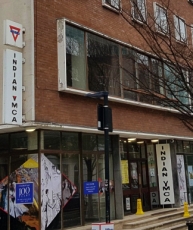
THE AREA AROUND FITZROY Square was richly supplied with restaurants serving good Indian food during the 1970s, when I was studying physiology and then dentistry at nearby University College London. My Indian friends, all students, introduced me to the delights of the Diwan-i-am, the Diwan-i-khas, and the Agra restaurants around Fitzrovia, all of which served superb food that was far better than that which could be found in most other Indian restaurants both in and out of London. The two Diwans have long gone, but I believe the Agra has been revived. Another place to which my Indian friends took me to enjoy Indian cuisine was the self-service canteen of the Indian YMCA at the north end of Fitzroy Street.
Students from India, formerly British India, have been coming to study in London since the 19th century. Whereas now people of Indian subcontinental origin are commonly seen in the streets of London, in earlier years there were not so many of them about and their presence aroused both curiosity about them and prejudice against them. For the Indian students of yesteryear, London, its inhabitants and their habits, must have presented them with puzzling experiences. Mahatma Gandhi arrived in London in October 1888. After a few weeks, he took a room at 20 Barons Court Road. His landlady was an English widow, who had lived in India. Gandhi gave his reasons for choosing to stay in a family:
“It is generally thought desirable to live in families in order to learn the English manners and customs. This may be good for a few months, but to pass three years in a family is not only unnecessary but often tiresome…” (Quoted from “Gandhi in London” by James D Hunt).
However, lodging in an English family had its pitfalls. It was difficult to lead a regular student’s life; Indian food was not served; and most landladies knew nothing of Indians and their ways of life. Gandhi, like many other students from the Indian subcontinent moved into single rooms. In 19th century London, student hostels were a rarity, and those catering to Indian students were non-existent. At Oxford and Cambridge, Indians, like the rest of the students, were housed in college accommodation.
India House, one of the first (if not the first) hostels in London dedicated to accommodating Indian students was opened at 65 Cromwell Avenue in Highgate in 1905, as part of a protest against the unpopular Partition of Bengal and because its founder recognised the lack of places where Indian students in London could find a ‘home away from home’. It was financed by a wealthy barrister and Sanskrit scholar from Kutch (now a part of Gujarat), Shyamji Krishnavarma (1857-1930). As I have described in my book “Indian Freedom Fighters in London (1905-1910)”, India House soon became a nucleus for anti-British agitation by Indians aiming to free India from British rule. Unlike Gandhi, many of the freedom fighters who met and/or lived in India House, few of them were averse to employing violent methods to oust the British. Soon, it attracted the attention of the British security organizations. Indian students, in general, were regarded with some suspicion by these organizations because there was a fear amongst the British authorities that many of them might have been sympathetic to efforts to liberate India from British rule. There were other official fears such as Indians becoming involved in miscegenation. Things came to a ghastly head in 1909 when Madan Lal Dhingra, who was closely associated with India House, murdered a high-ranking colonial official, who had worked in India. India House was closed soon after this assassination was carried out.
Conspiracies, especially those being hatched in India House, led to the setting up of the Lee-Warner Committee in 1907 “…to Enquire into the Indian Students Problem in the United Kingdom”. One of its recommendations was to set up a hostel for Indian students, who had just arrived in London. Clearly, this was to be under the supervision and ideological control of the India Office and a ‘rival’ to India House in Highgate. It and several other government-approved organizations in London (e.g., the National Indian Association and The Northbrook Club, both established before India House) were designed to provide useful assistance to Indian students, but also to ‘keep an eye’ on them. At this point, I should point out that despite the fears of British officialdom, only a small percentage of students from India were involved in, or even remotely interested in, what was then regarded as ‘sedition’; most of them wanted to better their economic status.
On the 20th of October 1919, Kanakarayan Tiruselvam (‘KT’) Paul (1876-1931), first Indian National General Secretary of the National Council of YMCAs in India and 11 others met in London to explore the idea of establishing a hostel in London for Indian students studying in the city (“YMCA Indian Students Hostel: Triumph of Faith: 1920-2010” by John Varughese). KT Paul, born in Salem (now in Tamil Nadu), was an Indian Christian leader. In 1920, he published an article critical of the horrendous behaviour of the British in the Punjab (e.g., the Jallianwala Bagh massacre in 1919). However, despite this, he like many other Indians, believed that India’s best hope for the future was by maintaining links with western Christianity and contact with the British (https://en.wikipedia.org/wiki/K._T._Paul). The meeting decided to set up a hostel for 100 students, 75% of whom should be Indian, and for up to 500 non-resident, Indian members. Thus, the Indian YMCA in London came to be born.
The first home of London’s Indian YMCA (‘IYMCA’) was not in Fitzroy Street but in Shakespeare Hut, a now non-existent half-timbered building in Keppel Street near to the University of London Senate House. It was leased to the IYMCA by the Shakespeare Society. During WW1, the so-called hut was used for entertaining troops from New Zealand. In 1924, it was demolished to make way for the London School of Hygiene and Tropical Medicine (www.ymca.co.uk/about/feature/vintage-photographs-ymca-shakespeare-hut).
In 1923, the IYMCA moved out of the Hut and acquired the freehold of numbers 106-112 Gower Street, which was then fitted out to become a hostel with 40 rooms, a restaurant, a library, and recreation facilities. As had been the case in the short-lived India House in Highgate, the hostel in Gower Street hosted many meetings during which affairs relating to India and its future were held. Unlike those held in Highgate, the meetings were far less militantly revolutionary in Gower Street. Many students came to hear and discuss with a wide variety of prominent Indian leaders. In 1931, Mahatma Gandhi addressed members of the IYMCA in Gower Street. Other still well-known leaders of the Indian independence movement who made appearances at Gower Street included BR Ambedkar, Sarojini Naidu, MA Jinnah, Subhas Chandra Bose, J Nehru, and Pandit Malaviya, to name but a few.
On the 23rd of September 1940, three of the four houses that made up the IYMCA were destroyed by bombing. One student was killed, and five others injured. The hostel moved to temporary premises leased from the University of London at 25 and 26 Woburn Square. The booklet containing the hostel’s history records that in 1946 while inter-communal tensions were frighteningly high in pre-Partition India, the marriage of a Hindu to a Muslim woman was celebrated at the hostel. After Gandhi was assassinated in 1948, Henry SL Polak (1882-1959), donated 300 books to the hostel, the nucleus of what was to become its MK Gandhi Library. Polak had been a friend and associate of Gandhi when the Mahatma was in South Africa.
When University College London offered to exchange land, which they owned near Fitzroy Square, for the site of the bombed hostel on Gower Street, the offer was accepted and planning for a new hostel on its present site began. With finances coming from many sources in India and elsewhere, construction began, with Indian High Commissioner VK Krishna Menon laying the foundation stone in 1950. The building designed by Ralph Tubbs (1912-1996) was opened on the 24th of March 1953. Tubbs tried to harmonise his building with the fine architecture in nearby Fitzroy Square. I think he did a good job. Although of a completely different architectural style, it does not clash with the fine buildings designed by Robert Adam, which line two sides of the square.
Since the inauguration of the hostel in Fitzroy Street, it has been visited by many celebrities including Jawaharlal Nehru, Queen Elizabeth II, JRD Tata, Harold Macmillan, Indira Gandhi, the Indian National Cricket Team (1971), Harold Wilson, and Lord Mountbatten. Apart from visits by celebrities, the hostel and its extension (opened 2004) has been home to many students from India and elsewhere. Despite the Christian basis of the YMCA, the hostel caters for people of all religions. In addition to providing accommodation, both long-term and for short stays, the Indian YMCA canteen is open to all, when there are no restrictions imposed by the Government during the covid19 pandemic. It provides something closer to home-cooked food rather than fancy restaurant fare.
Had the Indian YMCA, or even the short-lived, discredited India House in Highgate, been in existence when Gandhi, a vegetarian, arrived in London in 1888, he would have had no difficulties with finding food to his liking from the start of his sojourn there. I have heard from people who have stayed in the hostel in Fitzroy Street that it is reasonably priced, conveniently located, comfortable but not luxurious. What more could one want?
DID THE YOUNG BERTRAND RUSSELL ever rush up King Henry’s Mound in Richmond Park and enjoy the famous view of St Pauls Cathedral ten miles away? We might never know the answer to this, but there is a good chance that he did (on days with clear sky) because this small hillock (184 feet above sea level) that might once have been a Neolithic burial ground is only about 330 yards from Pembroke Lodge. This Georgian mansion in Richmond Park was built in the mid-18th century. In between 1788 and 1796, it was extended according to plans by the famous architect Sir John Soane (1753-1837). In 1847, Queen Victoria granted the lodge to her then prime minister, John Russell (1792-1878).
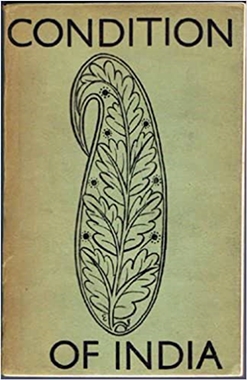
Eric Gill’s cover for the book in which Bertrand Russell wrote the preface
John Russell had a son, John Russell (Viscount Amberley), who was born in 1842. He died in 1876, four years after his son, Bertrand Arthur William Russell, was born (in Monmouthshire, Wales). Bertrand’s mother died in 1874. Bertrand and his brother were placed in the care of their grandparents, who were living at Pembroke Lodge. Had Bertrand’s parents lived longer, they would have been pleased to have learnt that their son was awarded a scholarship to study mathematics at Trinity College Cambridge in 1890.
Bertrand Russell was one of the greatest philosophers of the twentieth century, but I am not qualified to describe his contributions to that field. In his autobiographical book “Unended Quest”, the famous Karl Popper (1902-1994) wrote of Russell that he was:
“… perhaps the greatest philosopher since Kant.”
That was praise indeed.
When I visit places for the first time, they often ignite new interests. Pembroke Lodge was no exception, and visiting it sparked my interest in its former inhabitant Bertrand Russell. It appears that he was interested in a huge range of things. One of these, which also interests me, was the Indian freedom struggle that culminated in the country becoming independent in August 1947. Wikipedia reveals:
“During the 1930s, Russell became a close friend and collaborator of V. K. Krishna Menon, then President of the India League, the foremost lobby in the United Kingdom for Indian self-rule Russell was Chair of the India League from 1932-1939.”
Krishna Menon (1896-1974), born in Telicherry (now in Kerala, India) came to study at the London School of Economics (‘LSE’) in 1925, then at University College London. He became a keen promoter of the idea of independence for his native land. He was founder and president of the India League from 1928 to 1947. The League was Britain’s foremost and most influential organisation fighting against the continuation of British imperialism. During the 1930s, Bertrand Russell was one of its its leading supporters and its Chairman for a while.
In 1932, the League decided to send a delegation to India to investigate conditions there. The group, which included Menon, spent 83 days travelling the length and breadth of the country, interviewing people, Indians and Britishers, in all walks of life. After the delegation returned to the UK, they prepared a damning report, “Condition of India”, which was banned by the Government of India but published in England in 1932. Its cover was designed by the artist Eric Gill (1882-1940) and Bertrand Russell wrote its preface. Bertrand Russell began the preface with the following words
“… TO obtain a true picture of the present state of affairs in India is as important as it is difficult. Many English people content themselves with the remark that India does not interest them. If India were independent, they would perhaps be justified in this attitude, but so long as the British insist upon governing India, they have no right to ignore what is done in their name by the Government which they have elected. There has been no lack of interest in the misdeeds of the Nazis in Germany; they have been fully reported in the Press, and have been commented on with self-righteous indignation. Few people in England realise that misdeeds quite as serious are being perpetrated by the British in India. Large numbers of men and women, including many of the highest idealism, have been imprisoned under horrible conditions, often without any charge having been made against them and without any hope of being brought to trial…”
Later in the same piece Russell wrote:
“In India, the peasants are powerless against the landlords and the Government combined, so that no economic lesson is learned from their hardships, and they are expected to ‘Starve quietly without making a fuss’. Only people with political power have a right to make a fuss ; this is one of the great lessons of history, and, lest history should not sufficiently impress the Indians, we are teaching it by the lathi and the gaol. Our ruling classes have lost their former skill, and I fear the ultimate result of their folly In India must be disaster. For in India, also, if the new regime is ushered in by bloodshed the result will not be so good as if it came peacefully. Statesmanship is dead in the post-war world, and India, like other countries, suffers in consequence.”
Like the philosopher Richard Congreve (1818-1899) many years earlier (in 1857), Russell was clearly convinced that the British should leave India. By 1938, Russell, who had dedicated a substantial part of his political activity to matters regarding the future of India, began to concentrate more on philosophy and academia. In the late 1950s, he re-entered political activity, becoming one of the founder members of CND, which opposed the atomic bomb and other nuclear weaponry.
Incidentally, after India became independent, Russell’s former collaborator in Indian affairs, Krishna Menon, then India’s High Commissioner to the UK, and others including Jawaharlal Nehru and Edwina Mountbatten founded the India Club in 1951. In the mid-1950s, its premises shifted to 145 The Strand, near the LSE and India House, where it still stands today. Its shabby looking second floor restaurant preserves its original 1950s look and houses a portrait of Krishna Menon. It has a nice old-fashioned bar on the floor below. A few years ago, before the India Club got a licence to serve alcohol in its restaurant, alcohol could only be served to members of the Club. The only requirement for joining it was to pay an annual subscription of 50 pence.
Returning Pembroke Lodge, we enjoyed hot drinks with our friends in its tranquil garden. It was then that one of our friends pointed out its links with the great philosopher, who spent his childhood there (from 1876 to 1894). After returning home, I looked up Bertrand Russell on the Internet and that is when I found that he had a connection with the history of India. It is wonderful that someone brought up in such fine surroundings as Pembroke Lodge should have felt moved to fight for the people of India, very few of whom would have enjoyed such a luxurious childhood as Russell did.
MADAM CAMA ROAD IN BOMBAY is so named to commemorate the Indian pro-independence Mme Bikhaiji Cama, a Parsi who was born in Navsari in 1861 and died in 1936 in Bombay. Some of her bold exploits are described in my book “Ideas, Bombs, and Bullets”.
It is appropriate that in the street named after her, there are statues of two men who played significant roles in India’s fight for independence: Mahatma Gandhi and Jawarharlal Nehru.
A third statue in the street depicts another eminent Parsi born in Navsari: Jamsetji N Tata (1839-1904). Though not a freedom fighter, he did much to revolutionise industry in India. Starting with the cotton business, he soon became known as “the father of Indian Industry”.
In 1903, Tata opened the now famous Taj Mahal Hotel in Bombay. His successors, members of his family, established the variety of industries now known as the Tata Group. His family also fulfilled his ambition of creating educational institutions in his name with Tata money, for example The Indian Institute of Science in Bangalore.
It is appropriate that the statue of Jamsetji Tata is close to that of other important players in India’s independence movement, Gandhi and Nehru, because Tata was a keen supporter of the Swadeshi movement. That is to say, he encouraged the production of products made in India to reduce or prevent the need to import these same products. In Tata’s case, he set up cotton mills to produce cotton fabrics in India, reducing the need to import them from Manchester.
A plaque at the base of Jamsetji’s statue records that it was unveiled in 1912 by George Clarke (1848-1933), Governor of Bombay between 1907 and 1913. Incidentally, in 1907 he considered Vinayak Savarkar, future Hindu nationalist and father of Hindutva, to have been “one of the most dangerous men that India had ever produced” Clarke was a liberal, but became a supporter of fascism later in life (in the 1930s). I wonder what he thought about the Swadeshi movement as he unveiled the statue.
Madam Cama Road is not very long, yet it commemorates four people who in different ways helped India throw off the yoke of the British Empire.






 yamey
yamey 