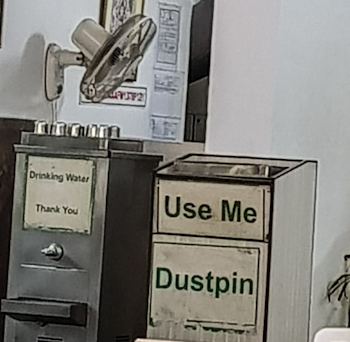
Burger buns two numbers, pizza bases three numbers

 THERE ARE MORE people who make use of the English language in India (over 130 million) than in the UK (53 million). The language is a ‘lingua franca’ in India. However, like North American English, Indian English differs in some details from British English. For example,  whereas an Indian says “I will do the needful”, a Brit says “I will carry out what is required ” or  “I’ll do it”
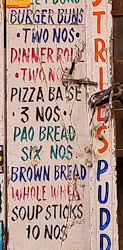
 

While strolling through the market area of Jaisalmer today, we passed a bakery that listed its wares in English on a board outside the shop. This notice employed a commonly occurring Indian use of the word ‘numbers’ (abbreviated as ‘nos’). Amongst the produce that was sold in the store were the following: “Burger buns two nos”, “pizza base 3 nos.”, and “soup sticks 10 nos” What this means is that the shop sells burger buns as a pair, pizza bases in threes, and packs of 10 soup sticks.


You can often find the same usage of the word ‘number’ in restaurant menus. For example, “pakoras (6 numbers)” means that the portion you will be served will include 6 pakoras.


This particular Indian English usage of the word ’number’ is widespread, as is the usage of  ‘avail’ as a verb. In India to avail something means to take advantage of an opportunity  or something offered, whereas in literary English it means to help or to assist, as in, for example, “no amount of struggle availed him”.


The English language is one of a few useful benefits of the centuries of British  rule in India. Yet, it has undergone some interesting adaptations by its users on the Subcontinent. I have described a few of these, but there are plenty more.

When less became very much more

IN JANUARY 1994, we had a Hindu wedding ceremony in the Indian city of Bangalore. Although the ceremony was attended mostly by family and a few close friends, the reception that followed it had about 350 guests, most of whom I had never met before. So, as an attempt to introduce me to some of them, my parents-in-law arranged a series of parties to introduce me to some of them before the ‘big day’. The gatherings were held in the spacious living room of my in-laws’ home in Koramangala – a suburb of Bangalore. As with many parties held in India, the proceedings began with a long session of drinks and snacks (‘finger food’). The parties end with food served at a buffet. Once, this late supper has been consumed, the guests leave, and the occasion ends abruptly.

My in-laws had a bar counter in their living room. At each party, an off-duty employee from the Bangalore Club was hired to serve as barman. Back in 1994, my preferred alcoholic drink was vodka. I enjoyed drinking it either with lumps of ice or with a drop of water.

At one of the series of parties, I went up to the bar and asked for vodka with water. I was handed a tall glass (approximately 330 ml, I guess) filled with a transparent, colourless liquid. I sipped it. It was rather dilute vodka – not very exciting! When I had finished the glass, I returned to the bar, and said:

“Another vodka, but less water this time, please.”

I did not watch the barman preparing my drink. He handed me a freshly filled glass, which was the same size as the one I had just emptied.

I took a small taste of my second drink. I could not believe what I tasted: it was neat vodka. The barman had poured me a third of a litre of pure vodka. I could not believe my luck. As the evening moved on, I took sips of my reservoir of vodka, and chatted to various people – I hope reasonably coherently.

Eventually, the drinking part of the evening’s proceedings were over, and people began to partake of the dishes on the buffet. Being a member of the family, I waited until the guests had taken their food, before approaching the tables where it was displayed. As I reached a counter, I felt my ankles weakening, and I thought that I might have been just about to topple over, which would not have looked good. Luckily, the vodka had not affected my brain. So, sensing the imminent risk of falling, I gripped the counter with my hands, and thereby averted embarrassing the family.

Now, my drinking habits are not the main point of this short tale. It is the meaning of the word ‘less’ in English spoken in India that is important. If, for example, you want to order coffee without sugar in India, you should say:

“Sugar less.”

That does not mean that you want less sugar in your coffee. It means you do not want any sugar in your beverage. It has taken me years of visiting India to realise this meaning of ‘less’. That is, ‘less’ means ‘none’. I did not know this in January 1994 when I asked for less water in my vodka. I suspect what happened was that English was not the barman’s mother tongue. So, hearing, the word ‘less’, when I had asked for ‘less water’, he had believed that I wanted not a drop of water in my drink.

A strange notice in a railway station

BE THEY LARGE OR SMALL, I always enjoy railway stations. Today, the 7th of January 2023, we visited the Central Station in Chennai (Madras). This huge edifice is also known as ‘Puratchi Thalaivar Dr. M.G. Ramachandran Central Railway Station’. It is the busiest station in southern India. When we visited it at about 11 am, it seemed rather sleepy even though there were many people waiting for their trains.

The station was designed by a British architect George Harding. Its distinctive exterior has neo-Romanesque decorative features. It was first opened in 1873, but was rebuilt twice: in 1959 and 1998.

We bought coffees to drink in a canteen within the station. After paying at the cash desk we were given two small plastic discs, like counters used in board games. Each disc had the word “coffee” printed on one side of it. We handed these to a lady who prepared excellent South Indian filter coffee.

The walls of this small café-cum-restaurant are decorated with murals depicting Chennai and the Central Station. Numerous informative notices were also displayed in the walls. One informed customers that all of the water used had been filtered. Another forbids the eating of “outside food”, which means food not bought in the canteen. Yet another reassured customers that “medium refined” cooking oil was used in the kitchen. And another warned clients that they are under cctv surveillance.

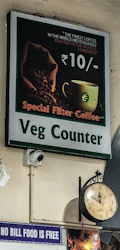
One notice puzzled us. It reads: “NO BILL FOOD IS FREE”. Grammatically, it made no sense to us. We asked another customer, who was standing close to us, if she could explain. She smiled, revealing a set of teeth that would have benefitted from orthodontic treatment, and then, as quick as a flash, she explained that these words mean that without paying, no food will be served.

English abroad: Globes, robots and bogies

Stop light_240


I must have been about eleven years old when the headmaster of my preparatory school, the Hall School in Hampstead, interviewed all of us individually in preparation for our applications to secondary school. When I had answered several questions using the word ja (pronounced ‘yah’), the headmaster said that it was wrong to say ja when I should be saying ‘yes’. 

The reason that I said, and often still say, ja instead of yes is that my parents were born and brought up in South Africa where ja is often used to express the affirmative.

In my childhood, I heard my parents using words that form part of South African English. At table, I always wiped my hands and mouth with a serviette, rather than a ‘napkin’. And, when we relaxed we usually sat in the lounge, rather than in the ‘sitting room’ or ‘drawing room’.

If I wanted to see a film, my father would enquire at which bioscope it was being shown. And, if a light bulb needed changing, he would insert a new globe

When we were in the car we used to stop at a robot, if the traffic light was showing a red light and then proceeed when it changed through amber to green.

By now, you can see that I was raised in England, but acquiring vocabulary that was only used many thousands of miles away below the Equator in South Africa. So, it was not surprising that I answered the headmaster with ja instead of ‘yes’. But, he probably had no idea about my parents’ background.

Many years after leaving home, I began visiting India and encountered another local English vocabulary. For example, when the car needs more fuel, you fill up at the petrol bunk. And, if you have baggage, you put it in the car’s (or bus’s) dickie, rather than the ‘boot’. And en-route you drive round a circle, rather than the ’roundabout’. When you board a train, you do not enter a carriage. Instead you board a bogie. If you want your coffee without sugar, do not say ‘without sugar’ but do ask for sugar less.  And, so it goes on…


English might well be one of the world’s most used languages, but it abounds with regional variations. American English is a prime example of this. As Oscar Wilde wrote:

“… we have really everything in common with America nowadays, except, of course, language

Spelling curios

All over India you can see variations in the spelling of English words. Here are some examples I saw today in Bangalore.

Here the word ‘naughty’ has been spelled semi-phonetically.

Here, b and P have been mixed up. The consonants B and P are formed similarly when spoken.

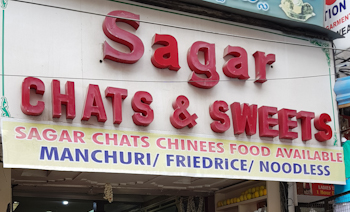
This shop sign demonstrates a variety of different kinds of spelling errors. (By the way, ‘chats’ are slightly cooked vegetables or raw fruits dressed with spicy powders.)

Remember that although English is one of India’s national languages, for many shop owners it is a foreign language. Hence, the diversity of spellings of common English words.