Between late 2024 and early 2025, we spent 88 days travelling 4000 miles through India. I have published an account of this fascinating odyssey in my book, “88 DAYS IN INDIA: A JOURNEY OF MEMORY AND DISCOVERY”, which is available from Amazon (https://www.amazon.co.uk/dp/B0FKTFBFM2). Here is a very brief excerpt from the book. It describes what happened when we were sitting in a cathedral in the formerly French colony of Pondicherry.
HERE IS THE EXCERPT:
“We sat inside the spacious cathedral’s cool interior within reach of the draught coming from a fan attached to one of the pillars supporting the long nave’s high, barrel-vaulted ceiling. As we were relaxing in the cooling breeze, a small group of Indians entered, and went to the front pews, where they knelt and prayed in front of the high altar. Amongst them was a young couple dressed in their finest. Each of them had lavish flower garlands (malas) around their necks. As they walked away from the front of the church towards where we were seated, we asked them if they had just married. They told us that that was the case. They had been married in another church and wanted to pray in the cathedral. These friendly people invited us to join them in the church’s sunlit entrance while photographs were being taken of them, of us, and of us with them. They asked us for our blessing.
Opposite the cathedral on a corner plot, we entered a large bookstore. Tables covered the floor. They were laden with books, mostly new, but not arranged in any obvious order. Along one side of this vast hall, there were ...“
END OF EXCERPT
Read my book, and enjoy discovering the wonders of India without leaving home!
AT FIRST SIGHT, there seems to be little content in the 17 paintings on show at the Tristan Hoare Gallery in London’s Fitzroy Square until the 13th of December 2024. It is not long before you realise that these images that contain larges expanses of colour are quite pleasing and visually intriguing. The artworks, all of which were created in 2024, are by Vipeksha Gupta (born 1989) who lives and works in New Delhi (India). As I looked at her work, I was reminded of the paintings by Mark Rothko in which the viewer is confronted with large areas of colour. In Rothko’s case, the borders between one colour area and its neighbour are deliberately ‘fuzzy’, whereas Vipeksha Gupta defines these transitions more sharply, yet not completely abruptly.
“The subtle abstraction of her work is seen within the repeated marks, geometries and the resistant voids made within the material. The surfaces of these works are generated through the iteration of small units into patterns that the artist then proceeded to render dynamic through gestures of rupture, incision, or slippage. She created folds, hinges or selvages of light, around which darkness could pivot and ripple. Gupta carefully plays with the structure of the paper, creating an interplay between illumination and shadow. This use of light shifts the narrative of her work as these folds generate movement, granting fluidity to the deep and mesmerising colours which she carefully crafts.” Abstraction is art often a creator’s way of distilling the essence of something that could also be represented more obviously as a recognisable physical object or scene. In Gupta’s case, she seems to be experimenting with her media (Fabriano paper [handmade with cotton fibre], paint pigments, graphite, and charcoal) to create subtly interesting visual effects for the eyes of the paintings’ viewers to enjoy. In this, she is successful. What at first viewing appeared to be organised areas of colour can be seen to be more complex and interesting the longer one looks at them. In addition, these paintings are somewhat soothing to look at.
TWO TEMPLE PLACE was built for the American businessman William Waldorf Astor (1848-1919) in 1895. Located close to Temple Underground Station and Middle Temple, this distinctive edifice is said to be designed in the ‘neo-Gothic’ style, although I would prefer to describe it, and especially its interior, as ‘Tudor Revival’. Every year, between late January and late April, the building, which is now owned and maintained by the Bulldog Trust charity, houses an exhibition, which is always worth viewing. This year’s exhibition, which continues until the 21st of April 2024, is called “The Glass Heart”.
“It will explore the narratives central to glass art and manufacturing, and celebrate the timeless skills, artistry and innovation required to work with this challenging material.”
And it does that very successfully by exhibiting a superb collection of glass creations ranging from industrial products, such as Pyrex, through stained glass, to intriguing artistic creations that defy the imagination. I will not attempt to describe all of these exhibits – each one of them both fascinating and beautiful – but I will concentrate on one small collection of items relating to the Red Lion – a pub in West Bromwich (West Midlands).
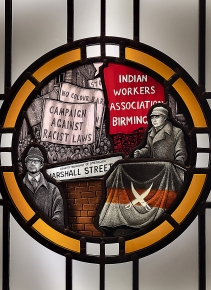
The Red Lion is a ‘desi’ pub owned by Indians, whose families originated in the Punjab, and came to work in the factories of Britain’s Black Country. Although all are welcome, the pub is mainly a socialising place for local people whose families came from the Subcontinent. It is one of several desi pubs in the former industrial heartland. In 2016, Steven Cartwright, who runs a studio that produces creative and decorative glassworks, was commissioned to create some stained-glass windows to decorate the Red Bull. His mission was to create traditional pub style stained-glass, but with an interesting slant – it was to celebrate the rich culture of the desi pub in the West Midlands. To do this, as Steven explained on his website (www.cartwrightglassdesigns.co.uk/projects/red-lion):
“I designed the window to give the appearance of a traditional pub but with a twist. The window utilises some of the colours and elements of the sub continent and tells the story of the punjabi community who migrated to the area in the 50’s. It also celebrates the establishment of the Indian workers association by Avtar Singh Jouhl and the visit of Malcolm X at their invitation.”
At the exhibition in Two Temple Place, there is a small piece of this pub’s stained-glass and some photographs of the rest of it.
What particularly intrigued me was the mention of The Indian Workers Association (‘IWA’) of Birmingham. The IWA was founded in the 1930s by Indian workers from Coventry to combat racist objections to them both by the British trade unions and the British people in general. The quote mentioned Avtar Singh Jouhl. He was born in the Punjab (British India) in 1937, and after the 1947 Partition, he came to London to study at the London School of Economics, arriving in 1958. Three years later, he moved to Smethwick in the Midlands, where he became an industrial worker. There, he saw and experienced racist anti-Indian conditions that prevailed at the time, He joined the IWA, and soon, along with others, he founded its Birmingham branch.
In February 1965, Jouhi invited the civil rights campaigner Malcolm X to visit Smethwick. A few days before his assassination, Malcolm X said of Smethwick:
“This is worse than America. This is worse than Harlem.”
In Jouhi’s obituary (The Guardian, 4th of November 2022), the following was written:
“The anti-racism campaign that attracted Malcolm X to Smethwick was spearheaded by Avtar Singh Jouhl, who has died aged 84 … Jouhl, as general secretary (1961-64; 1979-2015) and national organiser (1964-79) of the Indian Workers’ Association (IWA), challenged trade union members, factory owners and publicans to end this racism … When it came to breaking the colour bar in the town’s pubs, the IWA’s tactics were similar to those used by the Freedom Riders in the US in the previous decade. White university students were enlisted to order drinks, then hand them to British Indians, such as Jouhl. The landlord would invariably eject them, while the students challenged the eviction. The IWA then used evidence of these actions to successfully oppose the publican’s licence when it came up for renewal … This targeted campaign led to discrimination in pubs being outlawed in the Race Relations Act (1965) and paved the way for Britons of Indian heritage to become publicans themselves and set up what are commonly now known as “desi pubs”.
It was his actions described above and many others that helped to suppress racism in the Midlands and elsewhere in Britain. And it is very pleasing to see that what he achieved is being celebrated in glass in a pub owned and frequented by the people whom he helped. I visited the exhibition at Two Temple Place because I enjoy viewing glass artefacts. Little did I know that I would leave the exhibition having been introduced to an important political movement, about which I had known nothing.
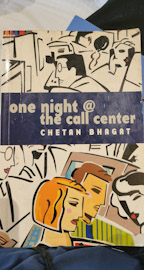
THE AUTHOR CHETAN Bhagat was born in 1974 in New Delhi. He was educated at two prestigious institutions: Indian Institute of Technology (Delhi) and the Indian Institute of Management (Ahmedabad). After graduating he had various jobs including working at the Hong Kong office of the bankers Goldman Sachs. There, he was unhappy with his boss, whom, according to Wikipedia, he: “ … characterized the villain in his second novel One Night @ the Call Center.”
The novel about the call centre was first published in 2005. The villain is Bakshi, the head of a department of a call centre that services customers in the USA. As its title suggests, the book is about one night at the call centre and its main characters are five young people working under Bakshi. I will not give the plot away, but I can tell you that the story is both entertaining and, in parts, profound. All that I will reveal is that the problems that the five workers are experiencing and described in the novel become insignificant after they receive a telephobe call … from God. But, do not worry: the book is not a religious tract. The book deals with many things, including the perception that some young Indians have: that their country is inferior to the USA.
Chetan Bhagat is a highly creative and imaginative story teller. His plots are rich in unexpected twists and turns. He has a great eye for detail and a good understanding of the minds of young Indians and they way they perceive today’s world.
Recently, a couple of people suggested that Bhagat’s humour is inadvertent rather than intentional. I completely disagree with this point of view. He concocts humorous situations in his novels with great care and expertise, and inserts them in his stories skilfully. Like Chinese sweet and sour dishes, Bhagat’s novels contain a harmonious blend of humour and seriousness, both complementing each other intelligently.
What I particularly enjoy about Bhagat’s writing – and by now I have read four of his novels – is his easy-going narrative style. As I read his books, I felt as if he was a good friend sitting and chatting with me in a bar or cafe. His books are easy to read yet full of profound observations about life, expressed effectively but with a light touch.
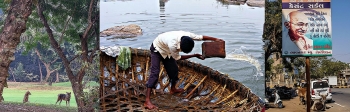
AMONGST THE 101 diverse topics in my book about travelling in India, you will find the following four: observing a padlock made by a company called Hitler; encountering jackals on a golf course; travelling in coracles on crocodile-infested waters; and having spectacles made by Gandhi’s optician. Since getting married in India in early 1994, I have made over fifty visits to the country during which I have spoken to many people and explored a multitude of places – both well-known and hardly known except to locals. My book, “The Hitler Lock & Other Tales of India”, contains a selection of my experiences in the country. The book aims to fulfil the idea of great Jean Molière (1622-1693), namely, “If you want to edify, you have to entertain.” I hope that you will find that I have achieved that.
You can purchase my book from Amazon (either as a paperback or a Kindle e-book) by clicking on the picture below:
Here is a list of the chapters in Adam Yamey’s anthology of his often entertaining travel experiences in India. The book is both for those who know India and for those who do not.
The book and/or Kindle can be bought by clicking on the picture below.
SOME SOUVENIRS FROM MY VISITS TO INDIA DURING THE PAST 30 YEARS
— A new book with a curious title —
True love drew me to India. Since my first trip there in late 1993, I have visited the country more than fifty times.
My latest book, “THE HITLER LOCK & OTHER TALES OF INDIA”, is a literary ‘collage’ or anthology of some of my many and varied experiences in India. All the episodes in it are based closely on actual occurrences.
After I married Lopa in London in October 1993, we travelled to her native land, India, a few weeks later. From the moment I first landed on Indian soil, my eyes opened wide with amazement, and ever since then, India has filled me with a delightful sense of wonder.
You might be curious about the book’s title. This relates to a chance one-off sighting (in the 1990s) of a padlock made by an Indian company with the same name as that of Germany’s former Führer. From that day onward, whenever I have been in India and seen a shop or market stall selling locks, I have always looked to see whether any of this company’s locks are on sale.
To discover some of the many things that endear me to India and whether I ever managed to find one of these curiously named locks, you need to read my new book. Illustrated with my photographs, it contains over one hundred short prose vignettes, which can be enjoyed by both those who are familiar with the country and those who are not.





 yamey
yamey 