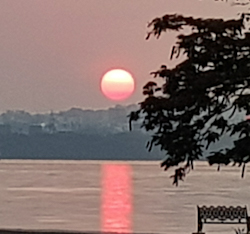
A pink orb
Casting its glow across the lake
The city at sunset

A pink orb
Casting its glow across the lake
The city at sunset

WE WERE ADVISED TO PAY a visit to the “new Niloufer café” in Hyderabad to try its Irani Chai. We hired an Uber taxi to take us there.
The New Niloufer Café turned out to be a rather scruffy place across the road from a newer looking place called “The Niloufer Café”.
Irani chai is prepared by boiling tea leaves continuously in a large kettle. This produces a strong decoction, which is poured through a muslin filter and then added to boiling milk before being served in cups.
As the New Niloufer did not serve milk without sugar, we crossed the road to the Niloufer Café, which did. This café was very crowded. In addition to tea, it sold a wide range of biscuits, cakes, and breads. One of the breads looked like an oversized bagel or an obese Turkish simit.
After taking tea at this café, we walked past several Hindu temples, mostly dedicated to Hanuman, and many medical clinics until we spotted yet another Niloufer Café. This one is newer and more luxurious than the previous café but belongs to the same company. It described itself as the “Niloufer Café Premier Lounge”.
On reflection, we realised that it was the new Premier Lounge, rather than the unrelated New Niloufer Café, that had been recommended to us.
By the way, Princess Niloufer (1916-89) was one of the princesses of the Ottoman Empire. She married the second son of the last Nizam of Hyderabad, Moazam Jah. He died in 1952 and then she married an American, Edward Julius Pope in 1963.
Photo shows kettle for boiling tea to prepare decoction
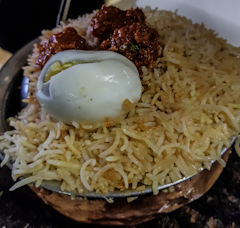
Hyderabad is justifiably renowned for tasty biryani although the very best version of this rice based dish that I have ever eaten was at Paragon in Calicut. There, they serve Moplah biryanis, which are both Arabic and Indian in taste.
The biryani we ate at the Café Bahar in Hyderabad was delicious. It was delicately flavoured and cooked with a light touch. To enter Bahar at lunchtime it is necessary to join a long queue that extends from the top of tje stairs at the doorway to the first floor dining room down on to the busy street outside. It is worth the wait.
The restaurant itself is very noisy and as busy as London’s Oxford Circus at rush hour. We shared a table with a charming couple, who let us try their ‘double masala’ chicken biryani which is richly laden with extra spices. I preferred the less spicy ‘special lamb biryani’. It is made special by adding hard boiled egg and meatballs made with minced chicken.
One should not visit Hyderabad without eating at least one biryani, but avoid the much advertised Paradise restaurant chain, which is ok but nothing like as good as Bahar or Shadab (near the Charminar)

Not long ago I spotted the old cannon shown in the picture at Golconda Fort. It bears the markings ‘A’ and ‘VOC’. The letters VOC are the abbreviation used by the Vereenigde Oostindische Compagnie, the former Dutch East India Company, which functioned between 1602 and 1799. The ‘A’ stands for one of the several distinct groups of Dutch investors, who together comprised the VOC.
Incidentally, I have seen another example of this Dutch cannon marking on an artillery piece on the island of Diu, which is close to the southern coast of the Saurashtra region of Gujarat. The example in Diu can be found in the garden commemorating the Indian soldiers who captured Diu from the Portuguese in 1961.

Washing hangs drying
In sight of antique arch-es
Still travers’d today
16th century bridge over River Musi in Hyderabad, India

The Hotel Tirupati in New Jalpaiguri (NJP) is a few minutes walk from an important railway junction in West Bengal. Its rooms are comfortable but the hotel has several curious features.
The bedrooms we occupied on two separate occasions contain more lights, each with their own switch, than I have seen anywhere in similarly sized rooms. The lighting included unshaded blue and red light bulbs and a recessed ceiling lamp which bathed the room in a subdued eery blue light.
The rooms in the hotel are arranged around galleries overlooking a covered central light well. The ground floor of the light well, a central courtyard, contains a large effigy of the Hindu deity, the elephant-headed Ganesh (see image above). It forms part of the hotel’s large Hindu shrine. At least twice a day, bells are rung and a pooja is performed. I have not come across this before in my over 25 years of visiting India and its hotels.
The most curious feature of this hotel in NJP is the presence of CCTV cameras not only in the bedrooms but also in their ensuite bathrooms. I never dared to find out their purpose and whether these were in use!
WHEN THE BRITISH RULED INDIA, they established clubs in India that were based on the sort of clubs frequented by upper class gentlemen in London (e.g. the Reform Club, the Athenaeum, and military sporting clubs). Like their counterparts back in the UK, the clubs in British India were subject to rules and strict dress codes. And, apart from servants, Indians were not admitted. There were a few exceptions. The Bangalore Club allowed some high ranking Indian military men as members, and also the Maharaja of Mysore.
Even after India became independent in August 1947, some of the British colonial clubs in India denied membership to Indians, a few of them until the late 1960s or after.
The Tollygunge Club in south Calcutta, founded in 1895, was one of the institutions that ddidnot admit Indian members until long after 1947. When my late father in law, an Indian and distinguished professional, was offered membership of this club in the 1960s because they needed to replace the dwindling number of ‘white’ members with Indians in order to remain solvent, he turned it down because he felt it wrong that he should join a club that had refused membership to him long after his country became independent.
It may seem surprising that the Indian authorities tolerated the continuation of this racial exclusivity long after independence. It was not only these clubs that denied access to Indians even after 1947, but also some hospitals and schools. This illustrates a certain tolerance amongst Indians to their foreign invaders. Remember, the Taj Mahal and the Victoria Memorial remain unscathed long after their foreign builders left the country.
The Tollygunge Club has its own golf course, a magnificent stretch of parkland where there is much wildlife including jackals, who watch the golfers seemingly unconcerned by them.
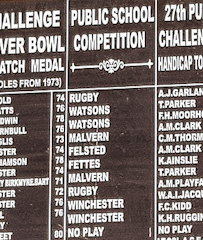
While staying at the Club, we noticed large boards on which the names of high achieving golfers are listed. For example, there is a board listing the Club members who have achieved a ‘hole in one’.
What particularly caught our attention was a board listing winners of The Public School Competition. A public school in the UK is actually a private, somewhat elitist, school. The winners of the Public School Competition on the list are not names of individual players but names of British public schools listed alongside the dates of their achievement for example: Rugby, Fettes, Felsted, Winchester, Eton, Marlborough, and many others. The competition continued until the late 1960s, by which time most of the European members of the Club had returned to the UK or elsewhere.
It would seem, although nobody has confirmed this to me, that during the Public School Competition teams of players who had all attended the same public school would compete against teams of other players each containing men who had attended this or that public school. It was a competition between school alumni teams and the winning school was listed on the board of honour.
The colonial clubs continue to thrive in India, the vast majority of their members being Indian. These pleasant establishments, often housed in colonial era buildings and set in lovely grounds are still elitist and retain some of the rules and traditions that were formulated by their British founders.
Like the gated residential communities that are springing up all over India, the formerly colonial clubs are havens where the better-off can relax, separated from the ‘madding crowds’.

A ball you flog hard
Over lawns smooth and green
A game called golf, you know

“PLEASE TAKE TIME TO READ INDIGO SEXY”, so announces a sweet female voice over the public address system in the passenger cabins of aeroplanes flown by Indigo Airlines. Actually, this voice is encouraging flyers to read Indigo’s in house magazine “Indigo 6E”. The November 2029 issue of this well produced monthly had an article about places that I have long wanted to visit: the places on the banks of the River Hooghly that were once occupied as trading posts by Europeans from various parts of that continent.
I knew that, apart from Britain, at various times the following nations had had tiny colonies on the banks of the River Hooghly (north of Calcutta): Holland, France and Denmark. Until I read an article in “Indigo 6E”, I was only barely aware that Portugal also claimed a parcel of land. That was at Bandel.
One day, we rented a car with driver to explore the former haunts of the nations listed above. We commenced at Bandel. To reach this place we drive pat endless numbers of heavy trucks north along the National Highway that links Calcutta with Delhi until we reached a road to Bandel.
To our grumpy driver’s indignation the road to the centre of Bandel was amazingly congested with cycles, tricycle rickshaws, autorickshaws, pedestrians, a variety of motorised three wheelers, dogs, trucks, buses, and so on.
Eventually, we reached the imposing church of the Miracle of Our Lady of Bandel that is separated from the Hooghly by a large garden. The church, which was built on a piece of land gifted to the Portuguese in exchange for military assistance given to a local ruler, was built at the very end of the 16th century.
The original church, one of the oldest in Bengal, still stands but has been heavily restored. It has been buried beneath shiny tiling, both outside and inside. The only original feature visible is an altar piece that looks as if it was created many centuries ago. The church was part of an Augustinian monastery, and is now part of a Salesian institution. The cloisters, like the church, are lined with tiling.
We drove south, following the Hooghly, to Chinsura, which the Dutch had occupied from 1656 to 1825. Apparently, there are several Dutch buildings in the town, but we did not find them. Instead, we managed to see the exterior of the town’s Armenian church, which is the second oldest church on Bengal. It is surrounded by a high wall surmounted by fierce looking spikes. A local informed us it wasonly opened up once a year, and we were not in Chinsura on that day! Later, we learnt that it is open for masses one Sunday in three.
Between Bandel and Chinsura, we came across an elegant house standing next to but high above the Hooghly. It was the place that Bankim Chandra Chatterjee (1838-94) lived for several years. Some say it was the place where he composed the patriotic poem “Vande Mataram” in the 1870s. It was set to music by Rabindranath Tagore. The British imperialist authorities made it a punishable offence to sing in the esrly part of the 20th century.
We drove south along congested roads that more or less followed the Hooghly until we arrived at Chandernagore, which was a French enclave until 1947.
The Institut de Chandanagor, a fine colonial building that could do with a little restoration, was once Dupleix House the former residence of the French governor. It now houses a museum that has many exhibits that recall the history of European trading settlements along the Hooghly. It stands in gardens, where once stood a fortress built by the French. The museum faces a lovely riverside promenade that includes a late 19th century pavilion built with French funding. This edifice is adorned with sculptures depicting elephant heads. At the southern end of the promenade, there stands a house, which Rabindranath Tagore has mentioned several times in his writings. When the river rises, its lower storey fills with water, by design.
The church of Sacre Coeur stands about 100 metres back from the promenade. It was built in the late 19th century, but was first established in 1691. Its interior has recently been redecorated with garish colour paint.
It was a long drive to Serampore on the Hooghly. We drove there along through narrow winding lanes and a stretch of the Grand Trunk Road. The Grand Trunk runs from Chittagong, now in Bangladesh, to Kabul in Afghanistan, passing through Calcutta and Delhi. It has existed for at least 2500 years and is one of the longest roads in Asia (almost 3000 miles).
Between 1755 and 1845, Serampore was under Danish control. The Danes knew it as Frederiknagore. We visited the church of St Olave, whose design resembles that of St Martins in the Fields in London. The internal walls of it plain but elegant interior bear memorials to several Danes who worked either for the Danes or for the British, who inherited Serampore from the Danes, or fir both. Serampore is also the home of Serampore College, which was founded in 1818 by Joshua Marsham and William Carey (1761-1834). Carey was born in Paulerspury in Northamptonshire. This village is the home of friends of ours. It was following a visit to them that we were first alerted to the existence of the former Danish colony on the Hooghly.
Before returning to Calcutta, we had coffee at the recently restored Denmark Tavern that overlooks a lovely stretch of the Hooghly. The tavern was first opened in 1786 and appears in a painting by Peter Anker dated 1790. The original building has been beautifully restored and is still serving its original purpose.
Although we only saw a few of the haunts of the former non-British European settlements on the bank of the Hooghly, our visit has made us want to revisit them in the future.
THINK OF ANY MAJOR CITY and its most famous land mark will spring to mind: Big Ben in London, the Eiffel Tower in Paris, the Coliseum in Rome, the Golden Gate in San Francisco, and so on. Calcutta evokes thoughts of the Victoria Memorial and, maybe, the Howrah Bridge.
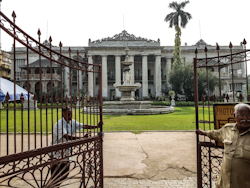
Yet, Calcutta contains something far more remarkable: The Marble Palace. It was built in 1835 in a European neoclassical style to the plans of an architect from Italy for a prosperous Bengali merchant Raja Ragendra Mullick Bahadur. Set in extensive gardens filled with marble statues mostly imported from Europe, the palace alone is remarkable to look at.
However, step inside and a treasure house awaits you. Mullick and his descendants are avid collectors of artworks. Mullick, who had the house constructed, never visited Europe but employed agents to buy precious works of art for him. The collection of paintings in the Marble Palace make it the first ever art gallery in India. Treasures amongst the large numbers of canvases include paintings by Rubens, Murillo, Reynolds, and Ravi Varma.
Rooms on the palace are filled with antique furniture, marble and other statuary, valuable ancient Chinese porcelain, and much else.
The elaborate wooden ceilings differ in design from room to room. Looking downwards, the floors are made of marble of varying colour arranged in patterns typically found in Italian renaissance buildings. They were created by Indian workers using Italian marble and designed by Italian artists.
There is a large open coutyard in the middle of the palace. One end is occupied by a covered stage-like podium, where Hindu ceremonies are performed for the Mullick family, many of whom still live in the palace. The courtyard is filled with interesting bird calls because at one end of it, facing the podium, there are several large cages each containg a large parrot.
There is a small zoo or menagerie on one side of the gardens. Apparently, it is one of the oldest zoos in India. When we visited it, we saw various types of deer and some waterfowl.
If you do no other sight seeing in Calcutta, the Marble Palace, but not the Victoria Memorial, is a ‘must’.
Note: photography is forbidden in the palace but a small book in Bengali is available for 100 Rupees and it contains a few photos.
 yamey
yamey 