Hummus in Hampi (south India)

MANY PEOPLE WILL HAVE EATEN HUMMUS, the chickpea-based dip, but far fewer will be familiar with Hampi, which is the location of an extensive archaeological site in the south Indian state of Karnataka. The village of Hampi contains the fantastic ruins of what was once one of the world’s greatest cities, rivalling Ancient Rome and second in size to Beijing, the world’s largest city in the 16th century. The metropolis, known as ‘Vijayanagara’, now in ruins, was the fabulously prosperous capital of the Vijayanagara Empire, which thrived between about 1336 AD and 1565 AD, when it was defeated by a group of Moslem sultanates. After this, the city began to decay, leaving the spectacular ruins that can be explored by visitors today.

BLOG HAMP 1

The ruins of Vijayanagara lie mainly on one side of the River Tungabadra. They are distributed over a large rocky area rich in huge boulders – almost a lunar landscape. We first visited Hampi in about 1997, when there were relatively few tourists clambering amongst the ruins of temples, palaces, stepwells, and miscellaneous other buildings. Since then, we have visited the place another four times. On each successive visit, we have noticed an increase in fellow visitors, both Indians and foreigners. With the increased visitor footfall, there has been ever growing deterioration and damage to the ruins. This is especially noticeable at the Vitthala Temple. It was intact in 1997, but when we last visited a few years ago, it was in a miserable state, with plenty of damaged carvings and being propped up by ugly pillars of grey concrete blocks. Sad as this is, this is not what I want to dwell on in this piece.

India has become a popular destination for Israelis, particularly the younger ones. India is probably a complete contrast to Israel, which I have never visited. In brief, to Israelis India must seem far more ‘laid back’ than their highly organised country. Many Israeli visitors to India visit Hampi to ‘chill out’ and relax.

During one of our stays in Hampi, we took a walk along one bank of the River Tungabadra. We came across a couple of riverside eateries advertising that they served Israeli food. As it was near lunchtime and our daughter and I love hummus, we entered one of these establishments, whose menu included the chickpea paste that we enjoy so much. Also, I was curious to try hummus in India. It was then not a food item I was expecting to see on sale a few years ago. Now, it is becoming available in select food stores such as branches of the upmarket chain Nature’s Basket.

We sat down on a rickety looking terrace overlooking the river and, with mouths watering, and ordered a portion of hummus with pitta bread. It took quite a while to arrive as the hummus was made fresh whilst we waited. When it arrived, the pitta looked remarkably similar to an Indian chapati, rather than an Arabic or Turkish pitta. As for the hummus, this was disappointing to say the least. Its colour was acceptable, but its texture resembled lumpy rice pudding rather than even the coarsest hummus. As for the taste, there was little to report: it was unseasoned and tasteless. I dread to think  what a direct Israeli guest would have made of, or said about, the hummus we were served at Hampi. I had not the heart to send it back to the charming locals who had produced it, but neither was I hungry enough to finish it.

EVERYONE NEEDS GOOD NEIGHBOURS

I HAVE BEEN ASSOCIATED WITH INDIA since my earliest days. This association was unconscious for the first 18 years of my life, that is before I met Indians, including my future wife, at university. During my childhood and until I was 30, I lived in Hampstead Garden Suburb (‘HGS’) in the shadow of the tall conical spire of St Judes Church. This brick edifice that can be seen from all around the HGS and many other places in northwest London was designed by Edwin Lutyens (1869-1944) the husband of Lady Emily Bulwer-Lytton (1874–1964), who was a daughter of the 1st Earl of Lytton, a former Viceroy of India. It was Lutyens who was given the task of designing New Delhi, the new capital of British India, between 1912 and 1930.


H0

St Judes Church by Edwin Lutyens

The construction of St Judes began in 1909, a year after our family home at 36 Hampstead Way was built. The church was consecrated in 1911, but not completed until 1935, after Lutyens had finished working on New Delhi. The north side of the church lines one side of the grassy Central Square, which was also laid out by Lutyens. The north side of the square is lined by the south side of the Free Church, a domed edifice designed by Lutyens. Its construction began in 1911 but was not fully completed until 1960.  As a child and for many years later, I had no idea that Lutyens had an important connection with India. In general,  I do not like the buildings designed by Lutyens in either HGS or in New Delhi. The only one of his buildings that appeals to me is Castle Drogo in Devon.

A recent visit to the HGS brought back several memories that I will share with you. Our house at 36 Hampstead Way looks much as it did when I was a child. In those days, and still today if you look carefully, the name ‘Inverugie’ can be discerned above the front porch beneath layers of whitewash. When my parents bought the house back in the early 1950s, they did not like the name and had it covered with paint. Despite many repaintings, it can still be seen if you know where to look.

When I was a child, our neighbour on Hampstead Way was the elderly spinster Miss Reinecke. Our other immediate neighbours on Hill Close were the very elderly Mr and Mrs Palmer. They sold the house to a young family, Mr and Mrs ‘S’. I used to babysit their children when I was a teenager. It was an easy way to make some pocket money because their children were always asleep when I arrived, and they never woke up while I was on duty. On one occasion, I was baby-sitting long enough to listen to the five long-playing records (LPs) that contained an entire performance of Wagner’s “Mastersingers of Nuremberg”. We rang on the doorbell the other day. Although Mr S could not recognise me at first, once he knew who I am, he remembered all sorts of things. He told me that all of the other houses in Hill Close have changed hands, sometimes several times, since we sold the house in the early 1990s.

A house at the top end of Hill Close used to be occupied by one of my father’s colleagues at the London School of Economics (‘LSE’), Professor Percy Cohen (1928-1999).  He was born in Durban, South Africa, and after obtaining a degree in social anthropology, he moved into the field of sociology. Occasionally, he used to stop his car and pick me up to give me a lift a part of the way to University College London, where I studied for many years.

A few steps lead up from the Cohen’s end of Hill close to a footpath that runs between hedges. When I lived in HGS, there was a tennis court on the south side of the path. All of the houses on Hill Close, including ours, had access to this court. In the second half of the 1960s, I used to play tennis there after school with three of my friends. We used to play in the fading light of the late afternoon. What with poor light and the well-worn markings on the hard court, there were often arguments about whether a ball had landed inside or outside the lines. Today, the court has disappeared and has been replaced by a well-manicured lawn, which is used by residents of a block of flats on South Square.

The footpath that begins at the end of Hill Close disgorges at South Square. A house on the corner of the footpath and South Square was once occupied by the Zacharias family. Mr Zacharias was a US diplomat. My sister and his daughter, Missie, became good friends. I enjoyed spending time with Missie’s brother, and my parents got on well with his. Occasionally, we would be invited to parties at their house. At one of these, we were introduced to Patrick Gordon Walker (1907-1980), who was an important British Labour politician. I remember being impressed at the time. I realised he was a famous person but had no idea why he was. Eventually, the Zacharias family returned to the USA. Just before they left, they came to our house to give us many half empty bottles of liqueurs and spirits.  My parents stored them in a cupboard in my father’s study. They were not keen drinkers. The bottles remained untouched, gathering dust for many years. They were still there when my father sold the house. I hope someone managed to enjoy their contents rather than chucking them away.

Henrietta Barnett School and the HGS Institute line the eastern side of Central Square. Until our recent visit, I had never noticed a stone plaque inserted in the wall of the school building. It reads: “This stone was unveiled by Her Royal Highness The Princess Margaret on 2nd July 1957 to commemorate the jubilee of The Hampstead Garden Suburb, 1907-1957”.

I was 5 years and two months old on the 2nd of July 1957. I remember that day well. I was spending the day at my mother’s sisters house near Wildwood Road in HGS. Sometime that morning, she took me and my young cousin to Wildwood Road and seated me on a piece of street furniture, a metal cupboard fixed to the pavement, which contained equipment needed for telephones. She handed me a Union Jack flag attached to a blue wooden stick. When the fancy car carrying Princess Margaret drove past, I waved the flag. You might wonder how I remember so much about that flag. The reason is that it was stored in my aunt’s downstairs bathroom for many years afterwards and I saw it each time I used the room.

Southway leads east from the south-east corner of Central Square. Harold Wilson (1916-1995), Prime Minister between 1964 and 1970 then again from 1974 to 1976, lived in a semi-detached house on Southway until 1964, when he moved to 10 Downing Street, closer to his workplace. Unlike his minister Gordon Walker, I never met him. The brickwork on the former Prime Minister’s home in Southway includes three bricks inscribed with letters. One reads “HCP”, another “AEP”, and the third “1909”, which might be the year the house was built.

Bigwood Road intersects South Way and leads south to Meadway, crosses it,  and then becomes  Meadway Close. One of my father’s close colleagues at the LSE, Lionel Robbins (1898-1984), lived in a substantial semi-detached house on this cul-de-sac that ends close to the Hampstead Heath Extension. Lord Robbins was an important twentieth century British economist. I cannot tell you about his contributions to economics because I only knew him as a friend of our family.

Lionel was over six feet tall and his wife, Iris, was truly short. He drove a tiny Mini and Iris drove a far larger vehicle. My mother knew that Robbins was fond of spaghetti. My parents were fond of Italians, and often invited my father’s Italian postgraduate students, amongst which was the former Prime Minister of Italy, Romano Prodi, to our home for dinner. Almost always, they invited Lionel Robbins as well. This was because my parents knew that most of my father’s Italian students were in awe of the great Lionel Robbins. At these dinner parties, my mother served spaghetti which Robbins enjoyed, and the young Italian guests sat around the great man enjoying his presence and the opportunity to chat with such a famous economist.

Almost opposite the home of the Robbins was the home of my school friend at Highgate School, Timothy Clarke. Tim is the younger brother of Charles Clarke, who became head boy at Highgate School before studying at Cambridge University. A member of the Labour Party, Charles served as Home Secretary between 2004 and 2006 in Tony Blair’s government. Once a Head Boy, always a Head Boy! I lost contact with Tim after we left Highgate. Whenever I pass his childhood home, I remember that there was a stylised metal sailing ship attached to its front door. When I passed it recently, I noticed that the door was no longer decorated with a ship.

We had parked our car near the intersection of Hampstead Way and Meadway, opposite a house on the north-east corner of the intersection. The building is a kind of terrace containing three or four houses. I never knew anyone who lived there, but I do remember that whenever there was to be a general election, somebody in that group of houses always put up an orange poster promoting the Liberal Party. Despite this and Harold Wilson living in the Suburb, the majority  of voters in the Hendon South Constituency, in which HGS is located, always voted for the Conservatives. When I was young, our MP had a memorable name: Sir Hugh Lucas-Tooth (1903-1985). I wonder whether his name subconsciously inspired me to take up dentistry. He held Hendon South from 1945 until 1970, when he retired from politics.

We drove away from the Suburb, a place that I found dull in my youth, with many memories revived in my head. I hope that you have enjoyed the selection I have shared with you.


Richmond, Russell, and India

DID THE YOUNG BERTRAND RUSSELL ever rush up King Henry’s Mound in Richmond Park and enjoy the famous view of St Pauls Cathedral ten miles away? We might never know the answer to this, but there is a good chance that he did (on days with clear sky) because this small hillock (184 feet above sea level) that might once have been a Neolithic burial ground is only about 330 yards from Pembroke Lodge. This Georgian mansion in Richmond Park was built in the mid-18th century. In between 1788 and 1796, it was extended according to plans by the famous architect Sir John Soane (1753-1837). In 1847, Queen Victoria granted the lodge to her then prime minister, John Russell (1792-1878).


RUS 6

Eric Gill’s cover for the book in which Bertrand Russell wrote the preface

John Russell had a son, John Russell (Viscount Amberley), who was born in 1842. He died in 1876, four years after his son, Bertrand Arthur William Russell, was born (in Monmouthshire, Wales). Bertrand’s mother died in 1874. Bertrand and his brother were placed in the care of their grandparents, who were living at Pembroke Lodge. Had Bertrand’s parents lived longer, they would have been pleased to have learnt that their son was awarded a scholarship to study mathematics at Trinity College Cambridge in 1890.

Bertrand Russell was one of the greatest philosophers of the twentieth century, but I am not qualified to describe his contributions to that field. In his autobiographical book “Unended Quest”, the famous Karl Popper (1902-1994) wrote of Russell that he was:

“… perhaps the greatest philosopher since Kant.”

That was praise indeed.

When I visit places for the first time, they often ignite new interests. Pembroke Lodge was  no exception, and visiting it sparked my interest in its former inhabitant Bertrand Russell. It appears that he was interested in a huge range of things. One of these, which also interests me, was the Indian freedom struggle that culminated in the country becoming independent in August 1947. Wikipedia reveals:

“During the 1930s, Russell became a close friend and collaborator of V. K. Krishna Menon, then President of the India League, the foremost lobby in the United Kingdom for Indian self-rule Russell was Chair of the India League from 1932-1939.”

Krishna Menon (1896-1974), born in Telicherry (now in Kerala, India) came to study at the London School of Economics (‘LSE’) in 1925, then at University College London. He became a keen promoter of the idea of independence for his native land. He was founder and president of the India League from 1928 to 1947.  The League was Britain’s foremost and most influential organisation fighting against the continuation of British imperialism. During the 1930s, Bertrand Russell was one of its its leading supporters and its Chairman for a while.

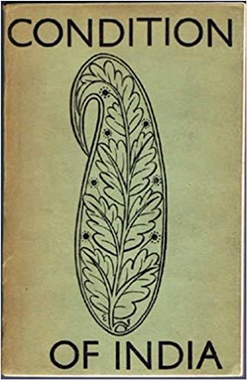
In 1932, the League decided to send a delegation to India to investigate conditions there. The group, which included Menon, spent 83 days travelling the length and breadth of the country, interviewing people, Indians and Britishers, in all walks of life. After the delegation returned to the UK, they prepared a damning report, “Condition of India”, which was banned by the Government of India but published in England in 1932. Its cover was designed by the artist Eric Gill (1882-1940) and Bertrand Russell wrote its preface. Bertrand Russell began the preface with the following words

“… TO obtain a true picture of the present state of affairs in India is as important as it is difficult. Many English people content themselves with the remark that India does not interest them. If India were independent, they would perhaps be justified in this attitude, but so long as the British insist upon governing India, they have no right to ignore what is done in their name by the Government which they have elected. There has been no lack of interest in the misdeeds of the Nazis in Germany; they have been fully reported in the Press, and have been commented on with self-righteous indignation. Few people in England realise that misdeeds quite as serious are being perpetrated by the British in India. Large numbers of men and women, including many of the highest idealism, have been imprisoned under horrible conditions, often without any charge having been made against them and without any hope of being brought to trial…”

Later in the same piece Russell wrote:

“In India, the peasants are powerless against the landlords and the Government combined, so that no economic lesson is learned from their hardships, and they are expected to ‘Starve quietly without making a fuss’. Only people with political power have a right to make a fuss ; this is one of the great lessons of history, and, lest history should not sufficiently impress the Indians, we are teaching it by the lathi and the gaol. Our ruling classes have lost their former skill, and I fear the ultimate result of their folly In India must be disaster. For in India, also, if the new regime is ushered in by bloodshed the result will not be so good as if it came peacefully. Statesmanship is dead in the post-war world, and India, like other countries, suffers in consequence.”

Like the philosopher Richard Congreve (1818-1899) many years earlier (in 1857), Russell was clearly convinced that the British should leave India. By 1938, Russell, who had dedicated a substantial part of his political activity to matters regarding the future of India, began to concentrate more on philosophy and academia. In the late 1950s, he re-entered political activity, becoming one of the founder members of CND, which opposed the atomic bomb and other nuclear weaponry.

Incidentally, after India became independent, Russell’s former collaborator in Indian affairs, Krishna Menon, then India’s High Commissioner to the UK, and others including Jawaharlal Nehru and Edwina Mountbatten founded the India Club in 1951. In the mid-1950s, its premises shifted to 145 The Strand, near the LSE and India House, where it still stands today. Its shabby looking second floor restaurant preserves its original 1950s look and houses a portrait of Krishna Menon. It has a nice old-fashioned bar on the floor below. A few years ago, before the India Club got a licence to serve alcohol in its restaurant, alcohol could only be served to members of the Club. The only requirement for joining it was to pay an annual subscription of 50 pence.

Returning Pembroke Lodge, we enjoyed hot drinks with our friends in its tranquil garden. It was then that one of our friends pointed out its links with the great philosopher, who spent his childhood there (from 1876 to 1894). After returning home, I looked up Bertrand Russell on the Internet and that is when I found that he had a connection with the history of India. It is wonderful that someone brought up in such fine surroundings as Pembroke Lodge should have felt moved to fight for the people of India, very few of whom would have enjoyed such a luxurious childhood as Russell did.

She died for the Empire

I HAVE MISLAID my copy of “Noor-un-nisa Inayat Khan” by Jean Overton Fuller (1915 -2009), first published in 1952. Jean was born in England, the only child of an officer in the British Indian Army. She was a friend of the Inayat Khan family, one of whom was Noor-un-nisa Inayat Khan (1914-1944). At the end of WW2, Jean travelled around Europe interviewing people who had been connected with Noor’s activities during WW2.


Noor 4

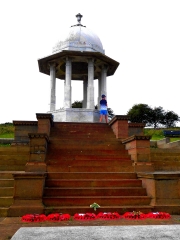
A few days ago, during a pleasant walk in London’s West End, we stopped near Hyde Park Corner to look at the memorial to those citizens of the Indian subcontinent who had fought for the British Empire during the two World Wars. Part of the memorial is a small pavilion that looks Indian in design. The ceiling of this structure is inscribed with the names of those who were awarded the prestigious George Cross and Victoria Cross awards during the two Wars. We looked up at the names, not expecting to see any that we would recognise, but were both surprised and pleased to see that one of the names is ‘Noor-un-nisa Inayat Khan’, who was awarded the George Cross, posthumously. Noor and her family were not people we knew, but her story was familiar to us.

Noor was born on the first day of 1914 in Moscow, where her father had arrived (from Baroda, now in Gujarat) in 1913 to promote Sufism in the ‘West’. Her father’s family were Muslim nobility, her father’s mother was a descendant of the great Tipu Sultan, who died in 1799, fighting the British. Her mother was an American of European origin.  Shortly after Noor’s birth, her family shifted to London, where Noor attended a nursery in Notting Hill. By 1920, the family had moved to Paris. At the outbreak of WW2, the family fled to England, landing at Falmouth in Cornwall.

During WW2, after joining the Women’s Auxiliary Air Force (‘WAAF’), she soon became a member of Special Operations Executive (‘SOE’), where she underwent tough training. Already a trained wireless operator, she had an advantage over other women who were to be ‘courier’s, who worked behind the enemy lines helping to support those resisting the Nazis. Her fluency in French was another advantage that Noor had over many of the other couriers. Also, her appearance was such that it could easily have been considered European.

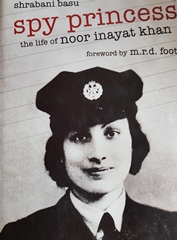
Noor was flown from Britain to Europe on the night of 16th /17th June 1943 and landed in northern France. Her courageous exploits have been well-described in a detailed book by Shrabani Basu, “Spy Princess”, published in 2006. Sadly, her presence in France was betrayed (by one of two Frenchmen), and she was first arrested by the Gestapo on about the 13th of October 1943. After intense interrogation, during which she revealed nothing of use to the Germans and nothing that compromised her comrades,  she was shot at dawn in the Dachau concentration camp near Munich in September 1944. In addition to being awarded the George Cross, Noor was also a posthumous recipient of the French Croix-de-Guerre. A commemorative blue plaque on her last home in London, 4 Taviton Street in Bloomsbury, was the first to be put up in honour of a woman of Indian origin.

Michael Richard Daniell (‘MRD’) Foot (1919-2012, the historian and former member of SOE, wrote in his introduction to Basu’s book:

“Holders of the George Cross are out of the common run; Noor Inayat Khan was even farther out of it than most.”

The memorial near Wellington’s triumphal arch at Hyde Park Corner was inaugurated in 2002. In addition to recording Noor’s name, there are over seventy other names of those awarded either the VC or the GC. Many of them have Indian sounding names, such as Noor’s, but a few have names that sound English, such as FC Booth and ECT Wilson. The Indian names suggest a fair mix of Hindu, Muslim, and Sikh recipients of these medals. Of the Indian recipients, or those who have Indian sounding names, of the two honours, the VC and the GC, awarded during WW2, the only one who was involved in behind-the-lines espionage and resistance activities was the young Noor Inayat Khan.

Noor was in favour of Britain giving India her freedom, ending its status as a colony within the British Empire. However, unlike some of the fighters for Indian independence like Subhas Chandra Bose, who favoured an alliance with the enemies of Britain during WW2, she was, to quote Basu:

“… convinced that Indian leaders should not press for independence when Britain had its hands full of fighting the war. She felt that if the Indians backed Britain and won gallantry medals it would create a sense of confidence in them, and the British would readily grant independence to India after the war…”

After WW1, there were 22 Indian recipients of VC and GC, but Britain did not relieve its domination of India. Instead, it began to tighten its grip. Noor and the other awardees of the high honours for bravery as recorded in the monument near Hyde Park Corner demonstrated the gallantry of people from the Indian sub-continent, but I am sure that this was not part of the reason that Britain released its long hold on its prize colonial possession in 1947.

I am sorry that I cannot find my copy of Overton Fuller’s biography of Noor. It is the source of some of the information in Basu’s book, which contains much material that Overton Fuller did not have access to when she wrote her book. When I find it eventually, it will be interesting to compare what the earlier author wrote about Noor with what Basu wrote 54 years later.

Facts, figures, and famine

blog churchill


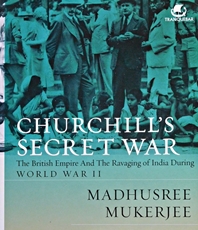
THE BRITISH PRIME MINISTER, Mr Boris Johnson, appears to be strongly dependent on his chief adviser, Mr Dominic Cummings. Mr Johnson’s hero, the late Winston Churchill, was also very reliant on his chief advisor Professor Frederick Lindemann, First Viscount Cherwell (1886-1957), a scientist. Madushree Mukherjee, the author of “Churchill’s Secret War”, wrote:

“On most matters, Lindemann’s and Churchill’s opinions converged; and when they did not, the scientist worked ceaselessly to change his friend’s mind …”

Lindemann created the ‘S Branch’, a group of specialists whose role it was to report to Churchill after distilling “ …  thousands of sources of data into succinct charts and figures, so that the status of the nation’s food supplies (for example) could be instantly evaluated…” (Wikipedia).

Mukherjee noted:

“… the mission of the S branch was to provide rationales for whichever course the prime minister, as interpreted by the Prof, wished to follow.”

It would seem from this that Churchill pulled the strings, and even the great Lindemann was somewhat of a puppet. In contrast, it is difficult to say whether the puppet-master is our present prime minister or his chief adviser.

Two Commonwealth countries, Australia and New Zealand  erected large war memorials to their citizens near Hyde Park Corner and the gardens of Buckingham Palace. A more modest memorial complex, the Commonwealth Memorial Gates (inaugurated 2002), was put up to commemorate the great contribution that people from countries in the Indian subcontinent, the West Indies, and Africa made to defending the British Empire during the Second World War. An information panel informs the viewer that during the First World War, 1,440,500 men and women from the Indian subcontinent and Nepal “Volunteered for military service in the Indian Army”, and during WW2, “…over 2,500,00… “ men and women from the subcontinent fought for the forces of the British Empire. Between about 64,500 and 74,000 of the military personnel from the Indian subcontinent died in combat during WW1, and over 87,000 Indian (that is from pre-1947 ‘British India’) soldiers died during WW2. These figures are of necessity approximate and without doubt horrific. However, during WW2, the number of Indian citizens, who died of starvation in their own country during WW2 is far more difficult to know. The most reliable approximations give the number of Indians dying of starvation in Bengal during WW2 as being at least three million, that is about half the number of civilians who died because of Hitler’s demented racial theories.

The three million or most probably more Indians, who starved to death, lived mainly in Bengal. They did not perish by accident, as Madhusree Mukerjee explained in her book, which has been highly acclaimed. Unlike other famines in India caused by failures of harvest, what happened in Bengal in 1943 and ’44, the starvation of the Bengalis was probably largely man-made. And, as the book suggests using damning evidence that has come to light since WW2, two men who were most significant in its making were Churchill and his chief adviser Lindemann. 

Churchill was quite rightly focussed on winning the Second World War and at the same time preserving the integrity of the British Empire, which was being challenged by Indian nationalists throughout the two decades leading up to the outbreak of war and after the fighting began. For reasons I cannot explain Churchill did not like the Indian people. To give just one example, he is reported to have said of them in November 1942 that they were:

“… the beastliest people in the world next to the Germans.”

His adviser, the eugenicist Lindeman (Cherwell) was also no lover of the Indians. Mukerjee wrote in her book:

“Inferior as the British working class was in Cherwell’s view, he nonetheless ranked it far above the black and brown subjects in the colonies.”

Later, she wrote:

“All the evidence points to the prime minister and his closest adviser having believed that Indians were ordained to reside at the bottom of the social pyramid …”

Long after India had become independent, Lindemann described (according to Mukerjee who provides reference for this):

“… ‘the abdication of the white man’ as the worst calamity of the twentieth century – more deplorable than the two world wars and the Holocaust”.

The gist of Mukerjee’s book is that important amongst the reasons that the 1943 famine in Bengal was not relieved was that Churchill was not in favour of releiving it. The author wrote that although at times vital supplies and shipping were at critical levels, there were opportunities for famine relief supplies to be sent to Bengal. However, the British government under the leadership of Churchill came up with many excuses to avoid supplying famine relief.

I found the evidence provided in Mukerjee’s book to be reliably persuasive. However, there are many who would prefer not to hear anything but good of the man who helped Britain and its allies win WW2, Winston Churchill. For a defence of Churchill’s behaviour during the Bengal famine, I refer you to https://winstonchurchill.org/resources/in-the-media/churchill-in-the-news/bengali-famine/, an on-line article that tries to demolish an article by Gideon Polya with the title “Media Lying Over Churchill’s Crimes”, published in 2008 (see: https://sites.google.com/site/afghanistangenocideessays/media-lying-over-churchill-s-crimes). 

You can judge Churchill’s possible role in Bengal’s 1943 famine however you wis,  but see what Professor Amartya Sen, a former colleague of my father at the London School of Economics  said. Michael Portillo said to him in a BBC interview on the 14th of January 2008:

“What’s interesting about your description is that it doesn’t appear to rest upon a shortage of rice.”

Sen, who appears to be far more generous than Mukerjee about Churchill’s attitude to the famine, replied:

“No it wasn’t. I think I have to say the British Indian government was callous. I don’t think they were criminal but they were certainly extremely callous and didn’t really worry too much about it. And secondly they were badly misinformed. What had happened is that there was a considerable expansion of demand for food because of the war boom. And with the same supply they were having rising prices. So it wasn’t connected with food deficit at all.”

(https://sites.google.com/site/drgideonpolya/bengal-famine-broadcast).

Seeing the war memorials near Hyde Park Corner and a Holocaust memorial nearby in Hyde Park, and having recently finished reading Mukerjee’s book, inspired me to write this short piece in order to provoke interest in one of the horrible tragedies that happened during WW2, the Bengal Famine of 1943.

Mukerjee’s book presented me with one very superficial resemblance between Churchill and his admiring biographer Boris Johnson. Both had their devoted advisers. Although Churchill might not have done things to everybody’s satisfaction, he did play an extremely important role in suppressing the forces of evil that were threatening Britain and its allies during WW2. Let us hope that Boris will follow in Winston’s footsteps in our fight against another evil enemy, the Corona virus, and lead us to victory.


A river and a canal

THE GREAT BED of Ware is eleven feet long and ten feet wide. Constructed at the end of the 16th century, this four-poster bed dwarfs the modern king size bed (six and a half feet by five feet). The Great Bed was housed in various inns in the town of Ware in Hertfordshire until the early 1930s when it was acquired by the Victoria and Albert Museum in London. A few days ago, we visited Ware, not expecting to see its Great Bed but for other reasons. One of these was that it is a small town not far from Perry Green where the Henry Moore Foundation is located. Another was to see the upper reaches of the River Lea and the point along it where water enters the New River.


BLOG W 10

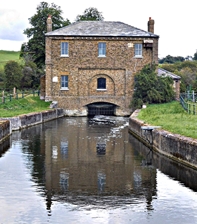
The Gauge House and the New River emerging from underneath it

The 42 mile long River Lea, a tributary of the River Thames, rises near Luton in the Chiltern Hills in Bedfordshire, flows through Hertfordshire, and then makes its way south through parts of  northeast then eastern Greater London, reaching the Thames at Bow Creek. The river flows through the centre of Ware. A short walk (1.3 miles) along the bank of the river westwards from Ware, brings one to the start of the New River, which is not actually a river. It a canal built to bring fresh water from the clean upper reaches of the Lea into London.

The history of the New River involves the London district of Islington, where the reservoir that used to collect water from the New River was located. To quote from something I wrote a couple of years ago (https://londonadam.travellerspoint.com/44/):

“At the triangular Islington Green, Essex Road branches off from Upper Street at an acute angle. At the apex of the triangle, there is a statue of Sir Hugh Myddelton (1560-1631) sculpted by John Thomas (1813–1862). He stands bare-footed, wearing a ruff and breeches, which stop short of his uncovered knees and lower legs. Below his plinth, two carved children sit or kneel with pitchers between their legs. Once, they issued water, but no longer. Myddelton, a Welsh entrepreneur, was the driving force behind the creation of the New River water supply project. The 38-mile-long canal, which he helped to finance, was constructed between 1608 and 1613 …”

Roseberry Avenue in London’s Islington is now best-known for the Saddlers Wells Theatre. However, one of its near neighbours was of great importance in connection with the New River. Quoting from my piece again:

“Across Roseberry Avenue, which flanks Spa Fields, there is a large brick building with white stone trimmings, now a block of flats. Completed in 1920, New River Head House was designed by Herbert Austen Hall (1881-1968) as the headquarters of the Metropolitan Water Board. Above two of its windows, there are carved inscriptions. One reads “Erected MDCXIII”, and the other “MDCCLXXXII”. These dates are 1623 and 1782 respectively, which are carved in archaic lettering. The inscribed stones must have been saved from an earlier building. The land on which the house stands was formerly the ‘New River Head’.

The New River, a canal constructed to bring fresh water from Hertfordshire into London ended at the reservoir called ‘New River Head’. It was high enough above what was the city of London in the 17th century to allow the flow of water from it to be ‘powered’ by gravity alone (see: http://www.british-history.ac.uk/survey-london/vol47/pp165-184). The brick-lined reservoir was constructed in 1623, when the first building at the reservoir, the ‘Water House’, was also built. The architect Robert Mylne (1733-1811), surveyor to the New River Company, repaired, enlarged, and refaced it in the 18th century. The refacing was done in 1782 … The old building, which had been enlarged many times, was demolished by 1915.”

Having seen the site of the destination of water carried by the New River, I was keen to see the point of its origin. Hence, our visit to Ware.

We parked near the centre of Ware in a car park (Burgage Lane) next to a footbridge that crosses the Lea. Then, we followed the riverside path after traversing the river. At first the path runs sinuously beneath trees that line both banks the stream. Their different coloured leaves are reflected in the water that ripples as waterfowl swim past. We met many other people enjoying their morning walks, but the path was never crowded.

After a short distance, the river flows around and between a network of islands and the path loses its lining of trees. Soon, there is open country on one side and on the other a series of modern industrial buildings partially hidden from view by occasional trees including lovely weeping willows. We reached the impressive weir of Ware. To enable boats to pass this hazardous waterfall, a lock exists. Ware Lock was first built in 1855 but looks as if it has been modernised since then.  Continuing west from the weir, we became aware of traffic noise as we approached the concrete bridge that carries the busy A10 dual-carriageway road over the river.

A third of a mile upstream from the road bridge, there is a tall brick house. It is not attractive and can be seen from afar in the flat landscape surrounding it. This building, The Gauge House, was built in 1856 to the design of William Chadwell Mylne (1781-1863), a son of Robert Mylne, who was involved with the terminal reservoir at New River Head in Islington (see above).  The building is constructed on an arch, a bridge that straddles the start of the New River at the point where water enters the canal from the River Lea. The ground floor of the building houses a mechanism for regulating the flow of water from the Lea into the New River. This is explained on the historicengland.org.uk website as follows:

“… [The] ground floor contains the gauge which measures the intake of water from the River Lee; it consists of 2 iron boats 5m long floating at Lee level which are joined by a chordal segmental iron beam 9m long, and the rise and fall with the level of the Lee controls the flow of water over the sluice which can be further adjusted by weights hung from the gate, the daily intake from the Lee being 22 1/2 million gallons.”

Another website, engineering-timelines.com, gives details of the predecessors of the Gauge House:

“At first, the flow from the river was monitored by a wooden ‘balance engine’ – a rocking beam-and-float device. It was later replaced with the Marble Gauge, built by Robert Mylne inside a Portland stone chest. Though now empty, this is still visible a little downstream.”

We were able to see the exterior of the Gauge House including the grille through which water leaves the Lea to flow under the building and that from which it flows from the House into the first stretch of the New River. The canal flows about 300 yards south before making a right angle beyond which it begins flowing east.  Having visited the London terminus of the New River and walked along attractive stretches of the canal lined by parkland in Canonbury, near Islington, I was very satisfied seeing where this historic waterway commences. We retraced our steps along the riverbank to Ware before driving to visit the Henry Moore Foundation at Perry Green.

Returning to the subject of beds, which is associated with the town of Ware, my mind leaps a quarter of the way around the world to Ootacamund (‘Ooty’) in the south Indian state of Tamil Nadu. In January 1994, we spent part of our honeymoon at St Margarets in Ooty, a guesthouse belonging to the ITC company. The room we occupied in this typical colonial style bungalow was huge. And it needed to be to accommodate the enormous bed that we occupied. This bed, whose width rivalled that of the Great Bed of Ware was not so long as the latter. Its sheets must have been specially made to fit this enormous bed.  Although there were only two of us sleeping in it, I think that that it would have been wide enough for four or five couples to sleep in it without it becoming overcrowded.

Both Ooty and Ware have their charms, but the latter is far more accessible from London especially in these times of restricted travel caused by the wholly unwanted presence of the Covid-19 microbe.  


Some like it hot

MANY VARIETIES OF CHILLI, differing in size, shape, and colour, can be seen growing in London’s Chelsea Physic Garden. Seeing them recently, whetted my appetite to write something about these fiery food items and their relationship to Indian cuisine.

JULY 9 chilli

Chilli is widely used in the multitude of different foods consumed in the Indian subcontinent. However, it is most likely that before the 15th century, this hot-tasting food ingredient was unknown in this part of the world.  Before its introduction to India, black pepper was used to add pungency to food. It was the European’s great yearning for valuable spices like pepper that brought them to the shores of the India, beginning with the Portuguese. It was these same seekers of spice who are believed to have introduced chillies to India from far away Latin America.

In early 1994, I made my first of many trips to India. In Bangalore, where I spent most of my time, I discovered the wonderful bookshops that the city still possesses. In one of these, I bought a book that has proved to be a useful mine of scholarly information about Indian food and its history, “Indian Food – A Historical Companion” by KT Achaya. Published in 1994, it cost 750 Rupees (about £12 in those days), which was quite expensive for a book back in 1994, but it has proved to be a valuable and useful addition to our book collection.  Much of the information that follows derives from the pages of this book.

One of the most interesting things I have learnt from Achaya’s book is that in ancient times, the inhabitants of the subcontinent, such as the Harappans and the Vedic Aryans, were keen meat eaters. Achaya wrote:

“No less than 250 animals are referred to in the Vedas, and 50 of these were deemed fit for sacrifice, and by inference eating.”

He added later:

“The abattoirs for domestic animals had specific names, like garaghatanam (beef), and shukarasnam (swine) … In the Rigveda, horses, bulls, buffaloes, rams, and goats were all described as being sacrificed for food… The Jataka tales list the flesh of the pigeon, partridge, monkey and elephant as edible. To this, the Brhat Samhita (6th century) adds buffaloes and lizards. At a shraddha ceremony, use of meat was very meritorious according to the Vishnu Purana (3rd or 4th century), and the meats listed are those of the hare, hog, goat, antelope, deer, gayal and sheep; both priest and performer partook of the meal.”

However, from the earliest of times, there were thoughtful Aryans who questioned the taking of animal’s lives for food, and gradually the trend towards vegetarianism grew.

Returning to chillies, Achaya suggests that they must have entered India quite early, but many centuries after the ‘creation’ of the Vedas. He quotes lines by the south Indian composer of Carnatic music Purandaradas, who lived between 1480 and 1564, which indicate that he was aware of the effects of chilli. The Portuguese, who introduced chillies to India, first landed on the subcontinent (near Calicut) on the 20th May 1498. So, they must have been quite a novelty when the composer wrote the lines (quoted by Achaya):

“I saw you green, then turning redder as you ripened, nice to look at and tasty in a dish, but too hot if an excess is used … fiery when bitten …”

Chilli was well received in India because, unlike pepper, it could be grown almost anywhere and had a pungency far greater than pepper. Unlike the Portuguese and later European invaders, chilli in its various forms was a welcome visitor to the Indian subcontinent.

Thus far, I have not written anything that is remarkably new to the well-informed. Now, I will describe something that fascinated me most in Achaya’s wonderful book. The author dedicates several hundred words including references to scholarly works about this topic. In brief, there is evidence that the continent of South America was visited by predecessors of today’s Indians long before Columbus ‘discovered’ America in 1492.

Amongst the wealth of evidence that Achaya describes, here is a sample. Indian deities feature in pre-Columbian sculpture: Ganesha with his rat; Vishnu’s tortoise ‘kurma’; two elephant heads with typical Indian ceremonial trappings; elephants with ‘mahouts’ wearing turbans; and a portrait of the last ruler of the Incas depicts him wearing a sacred thread the way that Brahmins do. A manuscript discovered in the Yucatan (Mexico) was written in the Kavi dialect of Java, which is derived from the Sanskrit and Pali languages. It records that a merchant, Vusulana, explored the coastline of what we now know as ‘South America’ in 923 AD, that is 569 years before Columbus made his discovery and a few years before Leif Erikson landed in Vinland (probably Newfoundland and New Brunswick). If we accept this and other evidence that there were interactions between the Indian subcontinent and pre-Columbian America, then we should not be surprised if the travellers who crossed the Pacific might have brought foodstuffs back to India.  

Some of these pre-Columbian imports might have been members of the Annona family: the sitaphal and ramphal. Convention dictates that these were imported from Latin America via the Cape of Good Hope, but some archaeological findings suggest that they might have been in India long before the arrival of the Europeans. Achaya cites the  discovery of sculptures of Bharhut (2nd century BC) and frescos painted at Ajanta (about 7th century AD) that depict a fruit looking very similar to custard apple (sitaphal), but points out that George Watt (1851-1930), the Scottish physician and botanist who worked in India, felt that it might be native Indian plants that were being depicted.

More convincing than the Annona fruits is the evidence that maize, a cereal that originated in Central America, was also being grown in India in the pre-Columbian age. Some of the evidence for this is the finding of maize pollen grains in ancient archaeological sites in the Kashmir Valley. Another intriguing discovery was made at the 12th century temple in Somnathpur near Mysore, where 92 female sculptures are all holding in their right hands “… an object looking remarkably like a corn cob.”

What I have written is based on a summary of knowledge published in 1994 in one book. It is likely that since then there has been further research on connections between India and America before Columbus, but I have not yet been able to access it.


Intriguing as the possible relationship between India and pre-Columbian America is, there is little doubt that the chilli, like the potato and the tomato,  only found its way into the Indian diet via the Portuguese and other European colonisers of the New World. So next time, you burn your tongue on a chilli lurking in a curry, you know who to blame.

Wake up call

RETIREMENT OFFERS MANY PLEASURES. One of these is waking up in the morning at whatever time one wishes. I do not want to sound slothful but waking up early rarely appeals to me.

black ring bell alarm clock

Photo by NEOSiAM 2020 on Pexels.com

While I was undertaking research for my PhD in physiology at University College London (‘UCL’), there were no daily time constraints. I could turn up at the laboratory whenever I felt like it and leave whenever I wanted. My timings were entirely up to me. I used to arrive at UCL at about 10 in the morning. At 11 o’clock, I went upstairs for coffee and biscuits in the Starling Room (a departmental meeting place for post-graduates and academic staff; named in honour of the physiologist Ernest Starling). By noon, I had returned to the lab. However, there was not much time to do anything because I liked to have lunch at just before 1 pm. And, after lunch, I often sat in the Ladies Common Room, chatting with Margaret, my supervisor’s wife who also worked in the lab. You can be sure that we never discussed scientific matters over our cups of sub-standard institutional coffee.

By just after 2 pm, I began getting down to work, setting up an experiment. However, everything stopped at 4 pm, when one of us would put the kettle on to boil, the heat being supplied by a gas flame from a Bunsen burner. Tea and biscuits involved me spending another hour chatting, mainly with Margaret. The other PhD students and workers in our lab took tea but were not distracted from their work. At 5 pm Margaret and my PhD supervisor, Robert, set off homewards, followed soon after by the rest of the lab. Between 5 and about 8.30 pm (and on some weekend days) is when I managed to do some ‘solid’ work. Miraculously with this lackadaisical schedule, I managed to do sufficient experimental research to be awarded a doctorate. Then, my life changed dramatically.

Soon after becoming ‘Dr Yamey’, I enrolled in the Dental School of UCL to train to become a dental surgeon (‘dentist’). Compared to my BSc and the PhD studies, this course leading to a Batchelor of Dental Surgery degree was far more demanding of my time. Five days a week, my presence was required at the Dental School at 9 am sharp. The day, which included a lunch break and two brief coffee breaks (if you were lucky), ended at about 5 pm. This seemed to me as bad as being sent back to junior school.

At first, I found this rigorous routine difficult after the relatively laxer times I had enjoyed during my BSc and PhD courses. I remember waking up at 7.00 am on dark autumn mornings and looking out of my bedroom window to see if there were lights on in any of my neighbours’ windows. Often, there were none. To arrive at the hospital by nine in the morning, I had to board the Underground at the peak of the morning rush hour. The tube trains were always crowded, standing room only, at that time. However, in those days in the late 1970s each train had two carriages in which smoking was allowed. Because many people were going off smoking or did not smoke, these carriages always had plenty of empty seats when they pulled into my station, Golders Green. Ignorant of secondary smoking, as I was then, I always travelled comfortably in the smelly, smoke filled carriages. However, by the time I had travelled the thirty minutes to Warren Street, I was always in great need of a quick coffee in the Dental Hospital’s basement canteen before classes began. After qualifying, the early morning routine continued. It lasted for thirty-five years until, at last, I retired.

Waking early in the morning was not confined to dental studies and practice. It is a feature of life that I have got used to in India. Many people in India wake early to take advantage of the cooler early hours of the day. I learned this very soon after arriving in Bangalore during my first visit to India in 1994. For the first few weeks, my wife and I stayed in my in-law’s home. On the second or third morning of our stay, I woke up in darkness. I could hear people rushing about in the house. I woke up my wife and said that I thought that the house was being burgled or attacked. She reassured me that all was okay and told me that the family liked to rise early. It was not quite 5 am. Day after day, my father-in-law tried to encourage me to join him on his early morning walk, to see the sun rise. Eventually, I gave in and we walked around a nearby open space in semi-darkness. It was only when we had returned to the house that we noticed the sun was beginning to rise.

Since those early days in India, I have just about got used to getting up incredibly early if there is a good reason to do so. Driving out of a city as large as Bangalore is one of these reasons. Before 7 am, there is hardly any traffic on the roads, which are usually choc-a-bloc during working hours. Flights to London are another good reason. They often leave India at early hours of the morning so that they can land in Western Europe at an hour that will not disturb those asleep in the UK, where late night/early morning passenger flights are forbidden. Although I can see the benefits of doing things early in the morning in India, I still miss being permitted to sleep until my built-in biological clock gives me its wake-up call. And for those of you who are by now thinking that sleep is all important to me, let me tell you that of late, despite not having any work or travel obligations, that clock of mine is waking me up much earlier than it used to years ago.

A bookshop in my memory

I HAVE LOVED BOOKSHOPS ever since I can remember. In my teenage years, I used to haunt the shelves of Foyles, a multi-storey bookshop in Tottenham Court Road. The store is named after its founders William and Gilbert Foyle, who established their business at Station Road in Peckham in 1903. A year later, they moved it to Cecil Court, an alley near Leicester Square, which still contains several bookshops. By 1906, Foyle’s had a branch on Charing Cross Road, which is where I got familiar with it.

BLOG FOYLES by Tarquin Binary

In the second half of the 1960s, Foyles was a very well-stocked bookstore even if it seemed a bit confusing to its customers. There were separate departments specialising in various topics distributed over at least three floors. I discovered soon enough that behind the bookshelves in some of the departments there were yet more shelves, and these contained second-hand and remaindered books often at reasonable prices. It was amongst these hidden shelves that I found a rather useless but picturesque road atlas to Bulgaria, published in Bulgarian, and a wonderful detailed street map of East Berlin, “Haupstadt der DDR”. This map carefully avoided mapping the city’s contiguous West Berlin. It gave the impression that East Berlin bordered the edge of an area of uninhabited desert.

The language department was very interesting. It stocked books on every language from A to Z. It was there that I discovered a copy of “A Short Albanian Grammar” by SE Mann, published in 1932. This hardback book with dark green board covers was priced at 15 shillings (i.e. 75 pence). I was particularly excited to find this volume as my interest in Albania was already becoming quite well-developed. However, 15 shillings was way beyond my budget in 1968. That year, I began studying biology for the A-Level examinations that had to be passed to enter university. It was then that a chance to obtain this book arose.  

During the first year of the A-Level course, I entered the school’s Bodkin Prize biology essay competition. I wrote a long treatise on the life of the woodlouse. This was my first ever bit of serious research. I visited the Science Library, which was then housed in a part of the then disused Whitely’s department store in Queensway. There, I translated a long article written in French about the reproductive system of the woodlouse. From what I can remember, the woodlouse can reproduce asexually, a process known as parthenogenesis.  I was awarded the second prize. The only other contestant was my classmate Timothy Clarke, whose older brother, Charles, was to become Home Secretary between 2004 and 2006. Tim won the first prize.

Thesecond prize was 15 shillings to be spent on books. I asked the school to spend that money on procuring me the copy of the Albanian grammar book in Foyles. To my great annoyance, my choice was turned down and I was asked to choose again, making sure that at least one book was a hardback, because it was to be embossed with the school’s crest. I chose two books. One was a costly paperback on genetics and the other was the cheapest hardback I could find. To this day, I still do not possess a copy of Mann’s book.

Returning to Foyle’s, let me tell you about its payment system, which resembled, so I was told, the system adopted by shops in the Soviet Union. First, you had to find a book you wished to purchase. Then, you took it to a desk in the department where it was shelved. A shop assistant took the book and wrote out a paper bill. Next, you had to take the bill to one of the few cash desks in the shop. After queuing, you parted with the correct amount of money and then the paper slip was stamped. Following this, you returned to the department where your book was being held and queued up again to exchange your stamped paper slip for the book, which you were then free to take away. This laborious payment system survives today in the government run khadi (home-spun materials) shops in India. These old-fashioned shops, often smelling of moth balls, are picturesque to say the least.

Foyles was bewildering to the newcomer stepping off the street. Like the tiny alleyways in Venice, it was a great place to lose your way. However, if a customer was looking for something specific, this was not helpful. So, quite sensibly, there used to be staff standing near the entrance to help customers find what they were seeking. Some of these no doubt poorly paid staff had poor command of the English language. On one occasion I heard the following:

“May I help, Sir?” asked a young lady with a strong Eastern European accent.

“I am looking for choral music.”

The assistant hesitated and then pointed at the escalator while saying:

“Please try the engineering department.”

That was long ago, back in the late 1960s.

Foyles moved out of its home on Charing Cross Road in 2011 and occupied another building a short way from it on the same street. Its current premises occupy part of the former St Martin School of Art, where my mother used to work in the sculpture studios in the 1960s. I no longer shop at Foyle’s but remember it fondly.


Picture by Tarquin Binary from Wikipedia

Books of choice

Beerwolf_500


I HAVE LOVED READING ever since I was first able to master this skill. During my childhood, we used to drive to Hampstead (in north London) every Saturday morning. We always used to visit the now long-since closed High Hill Bookshop on Rosslyn Hill. Our parents allowed my sister and me to choose one book each Saturday and bought them for us. Week by week, my collection of the adventures of Tintin by Hergé grew until I had all the episodes that had been published in English. There was little, if any, censorship of our choices. However, I had the distinct impression that my parents preferred that we avoided books by Enid Blyton. So, I have not yet had the pleasure of reading any of her extensive literary oeuvre.

I discovered and fell in love with “Mad” magazine, which was not available at High Hill Bookshop. I bought copies of it at a local shop, using my pocket money. My parents appeared not to approve of the magazine, but my father (not my mother) was always happy to read my copies of it when I had finished with them. “Readers Digest”, like Enid Blyton, did not fulfil my parents’ criteria of ‘good’ literature. I enjoyed leafing through this periodical and particularly remember reading and re-reading an article written by someone who was conscious during his brain surgery. I did not need to buy “Readers Digest” at full price as it was possible to buy boxes crammed full of old issues, sold as a job lots for a few pence at local jumble sales.  

There was only one book that was deemed strictly forbidden during my childhood. It was “Struwwelpeter” by Heinrich Hoffman, published in 1845 and reprinted many times since then. It is a series of moral tales about children who misbehave. For example, when Konrad disobeys his mother’s instruction not to suck his thumbs, an itinerant tailor appears and cuts off Konrad’s thumbs. Each tale is illustrated by frighteningly graphic illustrations. On afternoon, my sister and I, who had discovered this book by accident, were interrupted by my mother. She seized the book and tore it into pieces, which she stuffed into the wastepaper basket. Apart from this violent reaction to a book and the hints that Enid Blyton was to be avoided, I could read pretty much anything I wanted.

At school, books were recommended as being worth reading, especially those by famous 19th century British authors. I never read any of these. For some unknown reason, probably contrariness, if someone told me that I ought to read a particular book, this put me off even opening it. I wanted to read what I had chosen myself, not what had been chosen for me because it might be “good for you”. Similarly, if someone tells me that this or that food item is “good for you”, I do not rate that as a positive recommendation.

At Christmas 1963, we were in New York City. A friend of my parents, ‘E’, met us in the book department of FAO Schwarz, a toy store on Fifth Avenue. She wanted her son and me each to choose a book as a gift from her. E showed me a thick encyclopaedia of anthropology, which she had decided either that I would enjoy it or that it would be good for me. Well, I took one look at it and decided to check out the other books on display. I homed in on an illustrated history of the FBI. It was filled with intriguing black and white photographs, some quite gory. I took the book to E, who looked at it disapprovingly and then asked whether I was sure that I did not want the fine book on anthropology. I was sure, and a few minutes later I became the proud owner of the book about the FBI. E’s son, who was clearly more easily influenced by his mother than me, chose to buy the anthropology book. Years later, he qualified as a psychiatrist and I as a dentist. I am not sure what can be concluded from that.

My parents’ suggestion that there was something not quite right about Enid Blyton left a lingering doubt about the author in my mind. In the mid-1990s, I began visiting India regularly. There, I discovered wonderful bookshops, some of which were (and still are) much better stocked than those in London. What surprised me in those shops were the huge numbers of books by Enid Blyton on sale. Clearly, Enid was well-read and her books much purchased in India.  So, when I heard that there was going to be a lecture about Enid Blyton and India at the Nehru Centre in London, I felt that this was not to be missed. The speaker was none other than Enid Blyton’s very articulate daughter. She told us that British educators often frowned upon her mother’s works (just as my parents had done). The reason they were not keen was that it was considered that Enid’s vocabulary was not rich or varied enough. She revealed that when the texts of her mother’s books were analysed numerically, the vocabulary used I them was, in fact, no less rich or varied than that employed by other authors writing for the same age groups.  

In recent years, I have changed. Maybe, I have become a little less stubborn about book recommendations. If someone suggests a book to me, I no longer instantly reject the idea of reading it. There is a good chance that I will look it up to see what others think of it. If it is about a subject that might chime with any of my interests, there is a good chance that I will buy a copy and add it to the ever increasing pile of unopened books waiting to be read by me.  However, you will still not be able to find Dickens, the Brontes, Thomas Hardy, or titles that would “be good for me” on their spines.