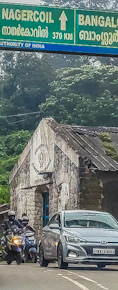
HIGH IN THE WESTERN Ghats on the road, NH85, that connects Munnar in Kerala with Theni in Tamil Nadu, we passed the check post at the border of the two Indian states.
As we drove across the border into Tamil Nadu, I noticed a small greyish building on whose facade there is a crest (with a depiction of an elephant’s head) and the words: “Travancore Custom House. Bodi Meti”. Bodi Meti (now ‘Bodimettu’) is the name of the settlement at the border crossing.
Travancore was an independent kingdom between c1729 and 1949, when it merged with what was to become part of the current state of Kerala. Therefore, the custom house on the busy mountain road is a relic or souvenir of a kingdom that exists no more.
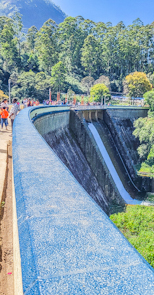
THE SETUPARVARTIPURAM DAM, also known as the Kundala Dam, is a popular spot for tourists. This curved dam, built with masonry blocks, lies near the beautiful road that runs between Munnar and Top Station, a high mountain view point.
Kundala Dam
At the entrance to the narrow roadway that runs along the top of the dam, there are two commemorative plaques. Both of them bear the coat of arms if the former Kingdom of Travancore and the letters V and R intertwined.
One of the plaques informs the viewer that the dam was opened during the twenty-fifth year of the reign of “His Highness Sri Chitra Thirumal Sir Balaramvarma … Maharajah of Travancore”. Born in 1912, he died in 1991. He came to the throne in 1924. Therefore, the twenty-fifth year of his reign was 1948/49.
It was in 1949, that the Maharajah agreed to unite Travancore with Cochin (and the rest of India). Between Indian independence in August 1947 and 1949, Travancore resisted unification with the new republic of India. Between 1949 and 1956 Sri Chitra Thirumal served as the first and only Governor of the newly formed Travancore-Cochin Union. In 1956, this territory was incorporated into the state of Kerala.
As for the intertwined R and V, this has nothing to do with Queen Victoria (VR). Instead, it refers to Rama Varma, a set of rulers of Travancore, Cochin, and other parts of Southern India.
Having established the significance of the letters R and V, I must add that a visit to the dam is a delightful experience.
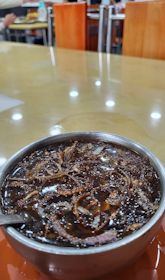
I LOVE FRENCH ONION soup. So, whenever I see it on a menu, I order it. In Munnar (Kerala), there is a vegetarian restaurant called Saravana Bhavan. It has French Onion Soup on its menu. So, I ordered a bowl.
What arrived did not have have cheese laden, or even plain, croutons. The soup was dark brown in colour and contained many thin pieces of fried onion. It was delicious but quite unlike the ‘traditional’ French Onion soup. It was spicier and more peppery.
Today, after having enjoyed a second serving of Saravana’s version of the soup, we asked the chef how he made the soup. Its ingredients include salt, pepper, garlic, ginger, onions, and a tiny amount of soya sauce.
When I return to London, I will try to recreate this Munnar version of the soup.
SOME PEOPLE SAY “save the best till last”. This is what we did accidentally while spending several days exploring the 2025/26 Kochi Muziris art biennale. Much of what we saw at this biennale was far inferior to what we had seen when visiting the four previous biennales. Most of this biennale’s offerings were rich in messaging but insubstantial artistically. The exception to this sad situation is an exhibition held at the Durbar Hall, which is across the sea from Fort Kochi in the city of Ernakulam.
The exhibition at Ernakulam is a large collection of (mostly) paintings by Gulam Mohammed Sheikh, who was born in 1937 in what is now Gujarat. His artistic training took place first at the MS University in Vadodara, then at London’s Royal College of Art.
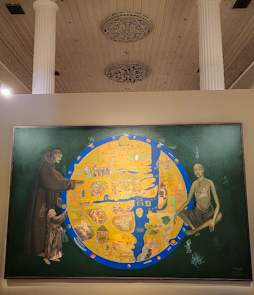
A Mappa Mundi by Sheikh
The exhibition includes works from the various stages of his career from the 1960s until today. Sheikh’s work provides imaginative, creative, original, beautifully executed, refreshing views and interpretations of the world and its inhabitants.
Amongst the many superb creations on display, there is a series of Mappa Mundi paintings, in which, to quote Wikipedia, Sheikh:
“… defines new horizons and ponders over to locate himself in. Sheikh construes these personal universes enthused from the miniature shrines where he urges the audience to exercise the freedom to build up their Mappa Mundi.”
These wonderful artworks that were inspired by mediaeval maps of the world provide the viewer with exciting expressions of Sheikh’s interpretations of the world, past and present, real and imagined. In one room at Durbar Hall, there is a wonderful film that, in a way, brings Sheikh’s Mappa Mundi to life.
Each of Sheikh’s artworks tells a story. However that story is open to each viewer’s own interpretation. The artist’s works are not only vehicles for a story or stories, but they are also aesthetically sophisticated: art at its best.
It was a great pleasure to see Sheikh’s art. Unlike much of the other exhibits in the Biennale, his work does not rely on gimmickry, sound effects, lighting effects, film clips, ‘objets trouvés’, and explanatory notes. Sheikh’s works are the products of a technically competent painter who is able to express his imaginative ideas in ways that are both aesthetically pleasing and highly original.
Seeing the exhibition of Sheikh’s works has revived my enthusiasm for art, which had begun to flag while visiting a seemingly never ending series of mediocre artefacts being displayed at the various sites of the 2025/26 Kochi Muziris Biennale.
THE PARSIS WHOSE religion is Zoroastrianism were prominent in Persia until it was invaded by Arabs. In response to this invasion, they began migrating from Persia. The first wave of migration between the eighth and tenth centuries AD. They arrived by sea on the coast of what is now Gujarat. They were given permission to settle in India, where they have prospered. Many of their descendants became prominent businessmen and politicians. Many of them were generously philanthropic. Over the centuries, the Parsis have zealously adhered to their ancient religious traditions and rituals. During the nineteenth century, a second wave of Zoroastrians arrived in India from Persia. This group are known as Irani Zoroastrians.
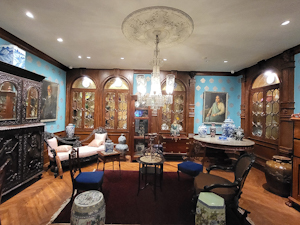
A room in the museum
In December 2025, we visited a wonderful museum dedicated to Zoroastrian archaeology, history, and customs. Near the Babulnath Mandur in Bombay, it is The Framji Dadabhoy Alpaiwalla Museum.
The museum was established in 1954. Between 2018 and 2025, it was renovated. The result is superb. The fascinating exhibits are well displayed alongside interesting information panels.
Sadly, the number of Parsis in the world is declining. When we discussed this with an official in the museum, his view was that the decline is due to the education of Parsi women. He believed that because many Parsi women are getting good educational qualifications, they are too busy developing their careers to give up time to have children. His view might be one reason for the fall in the Parsi population, but there may well be others. Another thing is that traditionally unless the father is a Parsi, a couple’s children cannot be Parsi. So, if a Parsi woman marries a non-Parsi, her children will not be considered Parsis.
In view of the gradual fall in numbers of Parsis (and Iranis), it is fortunate that the fine museum in Bombay exists to remind us of wonderful history and achievements of these people who fled their native land and enriched the land which offered them sanctuary.
AHILYABAI HOLKAR WAS born in 1725. She married Khanderao Holkar (1723-1754), the only son of Malhar Rao (1693-1766), the founder of the kingdom of Indore.
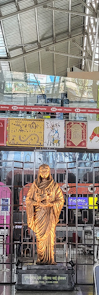
Statue of Ahilyabai Holkar at Indore airport
When Khanderao was killed in battle, his devastated wife wanted to commit sati: to throw herself onto his funeral pyre. However, her father-in-law and the subjects of the kingdom successfully persuaded her not to commit suicide. Following that, her father-in-law trained Ahilyabai in military matters. Khanderao’s only son, Malhar’s successor, Male Rao Holkar, ruled from 1766-1767. After his brief reign, cut short by illness, Ahilyabai became ruler of the Kingdom of Indore, which was part of the Maratha Empire.
Ahilyabai was one of the world’s most remarkable queens. As Wikipedia summarised:
“She is renowned for good governance, social welfare, and humanitarian work along with religious, educational, and cultural advancements. She contributed to the growth of Indian architecture through the commission of various temples, Ghats, and Dharmshalas. Ahilyabai’s Matha, or charitable endowments, spread across India.”
As a result, she is now revered as a saint. Apart from her philanthropic activities, she was also involved with military matters (in 1765, she commanded the artillery during an attack near Gwalior), and transferring her capital from Indore to the holy town of Maheshwar. As if this were not sufficient, she also transformed Indore into a modern city where commerce and industry were encouraged.
In view of the above, it is very apt that Indore’s airport bears her name. It is called Devi Ahilya Bai Holkar Airport. We flew from it to Bombay. A statue of Ahilyabai greets passengers as they arrive in the hall with the airline check-in desks.
The airport is smallish, but lovely. The departure lounges are spacious and airy, and there is a good variety of refreshment counters. Some of the walls of the airport have fine examples of art in the style practised by the tribal Gond people. Compared with many other airports I have used, that serving Indore is one of the most pleasant. Ahilyabai would have been pleased to have this place named in her honour.
AT INDIAN WEDDINGS, money is often gifted to the happy couple, usually amounts of rupees ending in 1 (eg 51, 101, 501, 1001, etc). Today (26 December 2025), by chance, we found ourselves in a part of the city of Indore, Sarafa Bazaar, where jewellery and things for use in weddings are sold.
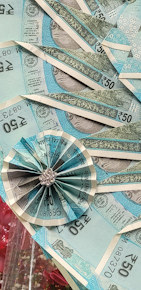
Amongst the numerous shops, we found several that were selling items we had not seen before. They are decoratively made bouquets of genuine Indian banknotes. These are assembled geometrically around colourful decorative ornaments, and, in some cases, flowers.
When we asked a shopkeeper what purpose these amazing, attractive arrays of banknotes served, he said that they were for what sounded like the ‘dulhan’ (bride in Hindi). The prices of these bouquets is the sum of the banknotes contained within them and the ornamentation, as well as the labour costs.
While writing this short piece, I found out that these banknotes bouquets or currency garlands can also be presented to bridegrooms.
I do not know how widespread is the practice of presenting banknotes arranged decoratively. So far, I have only seen it in Indore.
I AM OVER HALFWAY through reading “A Passage to India” by EM Forster (1879-1970). In this exciting novel, which contains the author’s acute observations about the minutiae of India as it was before Independence and to a large degree after, Dr Aziz, an Indian, ill-advised (in my opinion) accompanies two English ladies to the Marabar Caves (a fictional name). Trouble ensues, and Dr Aziz is arrested. I will not give away the rest of what I have read so far, but will mention some caves in Mandu (Madhya Pradesh), which we visited on Christmas Day 2025.
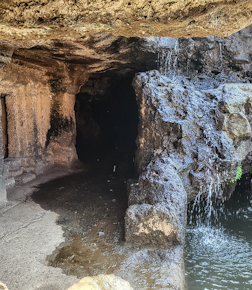
The caves are close to the scant remains of Mandu’s Lohani Gate. Easy to enter, they were excavated and converted into chambers or cells where Hindu priests or yogi might once have resided. Archaeological evidence suggests that the caves were excavated and modified in the eleventh or twelfth century. They predate all of the other archaeological sites in Mandu.
Fortunately, our visit to these caves was less eventful and sinister as is described in Forster’s excellent story. In fact, the Lohani Caves are delightful, and considering how close they are to Mandu’s most visited places, they are ignored by most tourists.
Now, I must leave you and get back to my tattered copy of “A Passage to India”.
PS: by “minutiae” I include Forster’s detailed description of the behaviour of Indian squirrels and the Echo Point at Mandu, which we saw recently, as well as the curious echo effects at the Gol Gumbaz in Bijapur, which I have experienced.
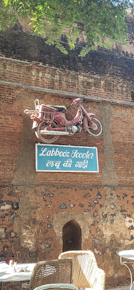
NESTLING BESIDE THE castle walls of Maheshwar in Madhya Pradesh in India, there is an attractive outdoor cafe called Laboo’z. An old motorbike is attached to the castle wall facing the chairs and tables. Below it, there is a sign that reads: “Labooz’s Scooter”.
The cafe was established in 2002 by Richard Holkar, a scion of the Holkar family that ruled the Kingdom of Indore, whose capital used to be Maheshwar.
When Richard and his half sister were children, they used to be ferried around Maheshwar on the bike now adorning the cafe. The driver who took tem on the motorbike was tall (‘lambu’ in Hindustani). Over the years, he became known affectionately by the nickname ‘Labboo”. His motorbike, now attached to a wall, commemorates him.
THE SIKH RELIGION was founded by Guru Nanak (1469-1539). During his lifetime, he made pilgrimages to Mecca. On two of these, he travelled through the port of Lakhpat in Kutch (Kachchh, Gujarat). In his lifetime, Lakhpat was a thriving port, but now it is a ghost town.
Lakhpat contains a fully functioning gurdwara (Sikh place of worship), the Lakhpat Gurdwara Sahib. It was established by the descendants of the Sikhs who hosted Guru Nanak during his two stays in Lakhpat. The sanctuary of the gurdwara contains relics that were used by Guru Nanak while he spent time in Lakhpat.
The sanctuary is housed in a large compound in which one must walk barefoot and with one’s head covered. The place is very clean.
As with all gurdwaras, pilgrims and other visitors are offered (free of charge) vegetarian food and drinks (eg tea) in the ‘langar’ (=kiitchen) hall. We drank tea from metal cups and saw others, seated on the floor, eating food from metal thalis. After finishing ones food and drinks, visitors must was the metal vessels with soap and water so that they are ready for use by others.
Although the sanctuary building is nineteenth century or older, the rest of the gurdwara is newer. We entered a huge new meeting hall to which builders were completing finishing touches. We were told that it was being got ready because there was about to be a great gathering of Sikh pilgrims at a festival.
Lakhpat and its gurdwar are close to India’s border with Sindh in Pakistan. The whole area around the erstwhile port is full of military personnel and camps. Many Indian regiments contain Sikh members. Some of these regiments have donated things to the gurdwara at Lakhpat. As one walks around, one can see plaques put up by, and to commemorate these regiments.
I enjoyed visiting the gurdwara, and we were happy to make a donation. Whatever the size of the donation, the donor receives a receipt that states the reason for making the gift. We wrote that our money was in gratitude for the refreshment offered to us in the langar hall.
By visiting the gurdwara at Lakhpat, we can truly say that we were following in the footsteps of Guru Nanak, even though our journey was most probably more comfortable than his.

 yamey
yamey 