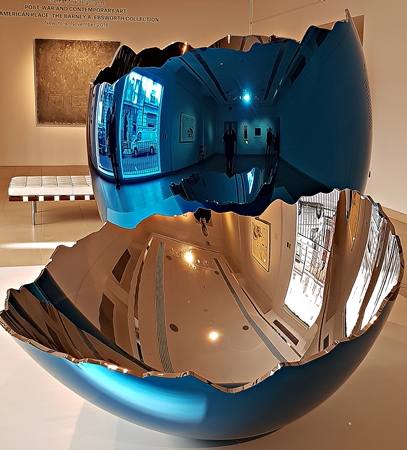
The imagination of an artist and artificial intelligence (AI)

DAVID SALLE WAS born in 1952 in Oklahoma (USA). Between 1970 and 1975, he studied at the California Institute of the Arts. A painter, he lives and works in Brooklyn, New York. There is an exhibition of his strange, colourful paintings at the Thaddeus Ropac Gallery in London’s Dover Street until 8 June 2025. 

The paintings on display are strange compositions in which everything seems to be in the wrong place, perspective is confused, and the laws of gravity seem to have been forgotten. Yet the objects and people in the paintings have been depicted in a straightforward way, without distortion or abstraction. What was going on in the artist’s mind?

Salle, an innovative artist interested in developing new techniques, has employed artificial intelligence (‘AI’) to help him compose these images. Let me explain. Between 1999 and 2001, Salle produced a series of paintings inspired by a nineteenth century opera backdrop. He scanned these images into a machine with AI capabilities, and then, without providing any text prompts or instructions, he got the machine to use its AI to warp the scenes on his paintings to create new images that contain and reconfigure all the elements in his original pictures. In this way, he obtained new compositions, on which he has based his new paintings – those on display at Thaddeus Ropac. Regarding Salle’s innovation, the gallery’s press release noted:

“Painting is a technology in its own right, one that, as the history of art attests, has advanced over millennia through relentless modification and reinvention. For Salle, it is incumbent on the artist to make use of the tools available in their time, whether egg tempera, oil paint or photography. AI is useful ‘since it doesn’t know what it’s doing,’ he says. ‘It can violate all the rules of depiction without a pang of conscience.’ Like the human eye, it rapidly scans, processes and distils an endless stream of visual information … Avoiding the pitfalls of ‘generic’ digital imagery, the result is a highly concentrated visual vocabulary, which is enriched and intensified by further layers of overpainting. In concert with the reverberations of his past pictorial invention, Salle stages what curator Nancy Spector describes as a ‘duet for one’.”

This exhibition show how AI can be used intelligently and imaginatively by those working in the arts. Even if one had no inkling that Salle had created the paintings with the help of AI, what can be seen of his work at Thaddeus Ropac is both attractive and intriguing.

Inspired in the twenty-first century by fifteenth century art

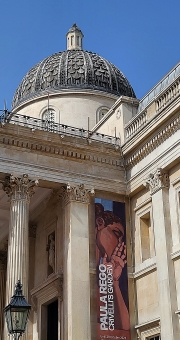
THE WORD ‘INSPIRATION’ has at least two meanings. One of them is ‘to breathe in (i.e., inhale air). When air is inhaled, many of the oxygen molecules it contains are converted to become other substances, some of which is carbon dioxide that is exhaled. Another meaning of the word is to be mentally stimulated, often by something one has perceived in the world around us. What results from this form of inspiration might not much resemble whatever it was that caused it. Today (the 6th of August 2023), we visited a small exhibition in one room of London’s National Gallery. Showing until the 29th of October 2023, the exhibition is called “Paula Rego: Crivelli’s Garden”.

The exhibition contains two major works: “La Madonna della Rondine (The Madonna of the Swallow)” painted in about 1490 by Carlo Crivelli (c1435-1495); and “Crivelli’s Garden” painted in the early 1990s by Paola Rego (1935-2022) when she was the National Gallery’s first Associate Artist between 1990 and 1992. There are also some sketches that Rego made for her enormous painting, originally designed to be a mural.

Both the Crivelli and the Rego paintings are excellent, but quite different in style. However, Rego was inspired to create her mural after seeing Crivelli’s altarpiece. Although both paintings are of religious subjects, there is no obvious similarity between the two of them. As Paola Rego said in 1992:

“If the story is ‘given’ I take liberties with it to make it conform to my own experiences and to be outrageous.”

And that is what she has done after having been inspired by Crivelli’s masterpiece.

The paintings at the base of Crivelli’s altarpiece (the ‘predella’) include scenes set in gardens. According to the National Gallery’s website, what Rego did was to reimagine:

“…Crivelli’s house and garden to explore the narratives of women in biblical history and folklore based on paintings across the collection and stories from the medieval Golden Legend. Her figures inspired by the Virgin Mary, Saint Catherine, Mary Magdalene and Delilah, share the stage with other women from biblical and mythological histories.”

She has populated her picture with portraits of people she knew including (to quote the website again):

“…friends, members of her family and staff at the National Gallery whom she asked to sit for her, including Erika Langmuir, Lizzie Perrotte and Ailsa Bhattacharya who were members of the Education Department at the time.”

The resulting work is both beautiful and fascinating, but quite different from the 15th century work which had inspired her.

Whether your artistic preferences are for art created during the Italian Renaissance or in the late 20th century, this small exhibition will not disappoint you. If you enjoy both, as I do, then this inspiring show of artistic inspiration is a ‘must see’ event.

Me and maps

MY LOVE OF MAPS started soon after I was able to read. I was given a book that fascinated me for many years. It was called “The Map that came to Life” by HJ Deverson and R Lampitt. First published in 1948, it follows a couple of children walking through the countryside with their dog, guiding themselves with an Ordinance Survey map. On each page, there is a bit of their map and an illustration showing the terrain which is on that portion of the map. Not only did it teach me something about map reading but it helped me to visualise in three dimensions what is being represented in two dimensions on a map. It was one of my favourite books during my childhood.

MAP 1

From the age of eight years onwards until I was thirteen, I attended the Hall School, which is near to Swiss Cottage (in northwest London). Although there was a lot that I did not like about this academically top-rate establishment, I am grateful for at least one thing. One day when we were learning about Ordinance Survey maps in a geography class, our teacher gave us an exercise that stimulated a hobby that lasted until my late teens. The exercise was to draw an Ordinance Survey map of an imaginary place making correct use of the various symbols that appear on the real maps. Of all the academic tasks I was required to perform at the Hall School, this was the best.

Inadvertently, our geography teacher had sparked off a new craze for me. That was drawing maps of imaginary places. I was inspired not only to emulate Ordinance Survey maps but also to create maps of imaginary places in the styles of the ever-increasing number of maps that I had begun acquiring as a passionate map collector. I drew these maps using pencils, water-colour paints, biros, and fine-tipped Rotring pens (such as are used by architects and technical draftsmen).  Drawing maps occupied much of my precious spare time, time which my friends spent socialising and meeting members of the opposite sex.

After a while, I began drawing maps of an imaginary country, a socialist republic behind the so-called ‘Iron Curtain’. In addition to creating maps of my geographic invention, I produced illustrations, tourist brochures, and so on. Be patient because  I shall say much more about this imagine land in future postings.

When I began studying at university in 1970, my map drawing activities ended. However, my fascination with maps has never diminished. While sorting things at home, I have found the maps and drawings I made during my teenage years. Gradually, I will share some of these with you, dear readers.

I began this piece with a mention of a book that described a map that came to life. It was first published before I was born. Today, the authors’ concept has almost become reality with Google Maps. This useful service provides fairly detailed maps, which at the click of a ‘button’ become aerial views of the area that has been mapped out. At the click of another button, you can travel (virtually) along the streets on the maps and see the buildings and other things along them. While the maps do not really come to life, the Google mapping service has brought us closer to that happening for real. Let us wait and see what the future brings in the way of remote realisation of life in places on the map.

What is in a name

When I was a young child, I used to love eating slices of tongue. It was a cold meat that I really enjoyed. In those days, I never thought about the name of the meat, that is ‘tongue’.

When I was about 10 years old, I put ‘two and two together’ and realised that what I had been eating was once a living animal’s tongue. This realisation put me off eating tongue. I have hardly ever eaten tongue since that discover of what is in its name.

The curious thing is that, with plenty of knowledge of anatomy, I have no difficulties eating, say, liver or pancreas (‘sweetbreads’) or stomach (‘tripe’).

Picture from Wikipedia

One body with two heads

HAPPY NEW YEAR

THE DOUBLE-HEADED EAGLE (‘DHE’) is a creature with a single body, two wings, and two heads each with its own neck. Of course it does not exist in nature but it is used quite widely as a symbol or emblem. I first became interested in the DHE after I became fascinated by Albania. The DHE has appeared as its national symbol for several centuries. It is also an emblem of Russia, Montenegro, Serbia, and the Indian state of Karnataka. In times past, the DHE was associated with the Hittites, several families in Cornwall, and the Byzantine Empire. It has also been used by some people in pre-Columbian America.

The DHE is an unusual symbol because it required considerable imagination to create it. Symbols like the cross, the crescent, the star, the swastika, and the circle are simple geometric emblems that could have easily arisen from thoughtless doodling. Likewise with emblematic animals like the lion, the eagle (with one head), and other creatures are based on observation of nature. The DHE, on the other hand, is neither an accident of geometry nor based on real life. It is, like the multi-limbed Hindu gods and the Egyptian sphinx, the result of human imagination.

The earliest archaeological evidence of the DHE is on rings used by the ancient Babylonians to mark ownership of containers of oils and other liquid goods. These seals have been dated as having been in existence between two and three millennia before the birth of Christ.

It is interesting to note that the DHE was not the only two headed creature conceive by the ancient Babylonians. There is plenty of archaeological evidence that shows that they created emblems depicting other creatures with a single body, two necks, each supporting a head.

In the future, I hope to explore the origins and the distribution of the DHE in far greater detail, maybe I will make this the subject of a book.