A pianist in London’s National Gallery during wartime

THE SAINSBURY WING of London’s National Gallery is stark, almost clinical, compared with the older nineteenth century rooms in the rest of the place. Although the pictures in the new wing can be seen without the eye being distracted by the rooms’ decorative features, I found that the paintings felt more ‘at home’ in the older, highly decorated galleries. One of these rooms, Room 36 has a central octagon topped by circular, glazed dome. In contrast to the Sainsbury Wing, this octagonal and the rooms leading of it, the Barry Rooms, are gloriously decorative in a Victorian baroque style. This and the rooms adjoining it were designed by the architect Edward Middleton Barry (1830-1880). His creations in London include The Royal Opera House and the Charing Cross Hotel.
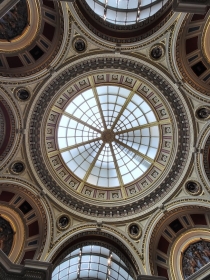
There are several paintings by great artists such as Claude and Turner in the octagon. If you avert your eyes from these masterpieces, you might notice a small commemorative plaque that reads:

Dame Myra Hess. On 10 th October 1939 in this room the pianist Myra Hess performed the first of many music concerts for the enjoyment of Londoners during wartime”.

Myra Hess, who was born in South Hampstead in 1890, died in London in 1965. She studied music at the Guildhall School of Music and at the Royal Academy of Music. Her concert debut was in 1907. During WW2 when most concert halls were out of action, she organised almost 2000 lunchtime concerts in the National Gallery: Monday to Friday for six years. She played in 150 of them, and never took a fee for her playing. In recognition of her work in keeping up the morale of those who heard her, King George VI made her a Dame Commander of the Order of the British Empire in 1941.

At the time of her death in 1965, Myra Hess was residing at 48 Wildwood Road in Hampstead Garden Suburb. Although I lived not far from her in the Suburb during my childhood, then I was unaware of both her existence and the fact that she was almost a neighbour. It was only during the twenty-first century that I spotted her creeper covered commemorative plaque on the house in Wildwood Road. Although I am glad that I did not have to live through WW2, I would have enjoyed listening to a concert in the gloriously decorative octagonal room at the National Gallery.
Art Deco in a north London Suburb

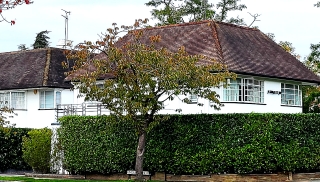
EXAMPLES OF THE ART DECO style that was popular during the era between the two World Wars can be found all over London. In the newer part of Hampstead Garden Suburb (north London), there are a few examples of this style.

Kingsley Close, which leads west from Kingsley Way, contains only houses built in the Art Deco style.

You can read more about these and other examples of this style in Hampstead Garden Suburb in my book about the Suburb, which is available from Amazon: https://www.amazon.co.uk/GOLDERS-GREEN-HAMPSTEAD-GARDEN-SUBURB/dp/B0BHG873FB/

Information for the servants of the house

NEXT TO THE KITCHEN in our family home in Hampstead Garden Suburb, there was a wood framed bell board. It consisted of a set of circular windows, each labelled with the name of a room in the house. There was an old bell button in my bedroom. If you pressed it, a pendulum hanging behind the circular window labelled for my room would begin to swing in the bell board. Had we had domestic servants, a servant would have heard the bell ring, then looked at the bell board to see which room’s pendulum was swinging, and then attend to whomever was in that particular room.

Part of the bell board at Ightam Mote

I was reminded of this antiquated bit of domestic equipment when I saw a similar one at Ightam Mote, a lovely old mansion owned by the National Trust.

Our house was built in 1908. This was during the era when these bell boards were popular. Although we did not have servants at home, earlier occupants most probably did.

When our daughter was much younger, she had an elderly babysitter called Bridie. Before WW2, Bridie worked as a domestic servant at a house in Golders Green. She told us that she had to wear uniforms: one during the daytime, and a different one in the evenings. I never asked her, but I would not have been surprised if that house in Golders Green also had a bell board.

My wife remembered that her family home in Kolkata had a similar bell board. There were servants in the house, but to discourage laziness, her parents had the bell in her bedroom inactivated.

It is always gratifying if any of my books are reviewed

IN EARLY OCTOBER 2022. I published a book about London’s Golders Green and its neighbour Hampstead Garden Suburb. It was the part of northwest London where I spent my childhood and early adult life.  I wrote about areas’ past and present, and my memories of living there. The book sells reasonably well by my modest standards, but was not reviewed until early September 2023. Then someone in Germany awarded the book 5 stars (out of 5 stars), and reviewed it on Amazon as follows:

“A very informative and often funny book! I immensely enjoyed reading it.”

Brief as it is, this reviewer encapsulated what I was aiming to do when writing my book. That was, to write something that was both elucidating and amusing.

I am always happy when someone takes the trouble to review one of my books. Naturally, I would prefer a favourable review, but a critical one is also welcome. That a reader bothers to post a review shows that he or she has read the book and reflected on its contents. I find that very gratifying.

The book about which I have been writing is called “GOLDERS GREEN & HAMPSTEAD GARDEN SUBURB: VISIONS OF ARCADIA” and is available as both a paperback and a Kindle from Amazon websites, such as:

A tiny stream feeding the River Thames

NORTH LONDON IS riddled with rivers, rivulets, and streams. Some of them have been covered over and built upon, and others are still visible. One of these is Mutton Brook, which rises near East Finchley, flows through Hampstead Garden Suburb, and then merges with another watercourse – Dollis Brook – to become the River Brent. The Brent flows from near Golders Green through northwest and then west London to its mouth at Brentford, where its waters flow into the Thames.Although I did not know it when I played beside the stream as a child, the tiny Mutton Brook helps feed the mighty Thames with water.Minute as it is, as far as watercourses are concerned, it made a large impression on me in my childhood.

For much of its course, Mutton Brook flows through open spaces, such as Lyttleton Playing Fields, Fletcher’s Gardens, Northway Gardens, and a long stretch of parkland flanking the south side of the North Circular Road. Despite being fringed by suburbia and busy roads, the Brook is well separated from them by nicely planted green spaces along which walkers can enjoy the feeling of being in the country despite being in the heart of northwest London.

Until 1907, Mutton Brook would have flowed through what was then rural Middlesex countryside – fields, meadows, and woods. From then onwards, Hampstead Garden Suburb was established, and its neighbour Golders Green grew from being a small hamlet to become a large, mainly residential urban area. My recent book (see: https://www.amazon.co.uk/GOLDERS-GREEN-HAMPSTEAD-GARDEN-SUBURB/dp/B0BHG873FB/)  describes Mutton Brook in detail. It also as provides an informative description of life in Golders Green and Hampstead Garden Suburb past and present. These are places I know well because I was brought up in them, and lived there until I was thirty. My book also contains reminiscences of my life there as a child and a young man. I still visit the area frequently because some of my friends and family live there.

Edwin Lutyens and a London suburb

THE ARCHITECT EDWIN LUTYENS, who designed a set of important government buildings in India’s New Delhi, was also one of the principal planners of Central Square and its surroundings in London’s Hampstead Garden Suburb (‘HGS’). Here is a little bit about this that I have published about this in my book “Golders Green & Hampstead Garden Suburb: Visions of Arcadia”:

Designed to be the throbbing communal heart of HGS, Central Square is a failure. Pevsner and Cherry noted in their “Buildings of England: London 4: North”:

“Unwin’s first plans had included shops along the approaches, but as built by Sir Edwin Lutyens, appointed consultant architect in 1906, the shops were omitted and the square became a high-minded enclave of churches and public buildings with a fringe of smart houses.”

The writers pointed out that without shops, the square never became a true social centre. In fact, most of the time it is an almost deserted open space.  Lutyens (1869-1944) did not get on well with Henrietta Barnett. In her book “The architect and his wife: a life of Edwin Lutyens” (published in 2002), Jane Ridley wrote:

“Lutyens was no progressive. He had no interest in using architecture to change the way people lived, to eliminate servants or smooth social divisions … He disliked the bossiness of social reformers such as Mrs Barnett. Ugly, squalid towns such as Manchester depressed him, but he didn’t see town planning as a motor for change. All he wanted was to build beautiful buildings: ‘Loveliness alone is akin to godliness and whilst ugliness is countenanced and excused Hell is possible.’”

Later in her book Ridley recorded that Lutyen’s wife Emily had written to him after he had fled abroad in 1908 (having had disagreements with Henrietta):

“‘I am glad you went,’ she wrote, ‘as you needed rest and change, only you must work up the Hampstead affair and not let grass grow under your feet, or Mrs Barnett will put you in the wrong again.’”

Despite his differences with Mrs Barnett, Lutyens left his architectural mark on the square. These are his buildings built before he drew up plans for most of his buildings in British India, notably in New Delhi. As Mary Lutyens described in her book “Edwin Lutyens” (published in 1991), his work in the suburb was of importance for his future career:

“At the beginning of 1912 Lord Crewe, Secretary of State for India, approached Reginald Blomfield, President of the Royal Institute of British Architects, to recommend an architect to serve on a commission of three experts to advise the Government of India on the siting and laying out of the new capital. Blomfield recommended Lutyens on the strength of his country houses …his work in Johannesburg … and for Hampstead Garden Suburb. Sir Richmond Ritchie, Permanent Secretary for India, then sent for Lutyens and asked him if he would be willing to serve on the Commission. Incidentally, in connection with the above, Lutyens was already married to the daughter of a Viceroy of India…”

Central Square and its surroundings remain a rather sterile centre of what its founders hoped would be a garden suburb with a vibrant community spirit. If you are lucky, you can spot someone walking a dog or a few children playing on the lawns. Otherwise, this part of London is peaceful and, dare I say it, rather dull.

You can read more about Hampstead Garden Suburb in my book, which is easily available from Amazon:

A bigger pool

IN COMMON WITH most people, I have little or no memory of the first two or three years of my life. My earliest recollections are the birth of my sibling when I was four years old, and walking with my parents to St Albans Church Hall in Golders Green to collect the free orange juice that the government provided in the 1950s. That was issued to children under the age of two, so it must have been for my sibling within the first two years of her life. At that time, I would have been less than six years old.

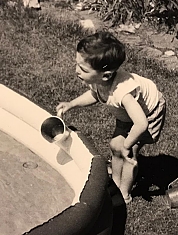
Recently, a cousin sent me scans of some family photographs. They include several of me before I was four years old. One of them taken of me in our garden in Hampstead Garden Suburb shows me standing beside a circular inflatable swimming pool filled with water. In the photograph, I am bending over the pool with a small jug in my right hand. None of this can I recall, except the crazy paving garden path behind me, which remained in existence until the 1990s, and might well still be there.

Seeing the photograph, which must have been taken before 1956, did jog my memory. I recall that after my sibling was born, my parents bought a bigger paddling pool for use in our garden. This was a rectangular affair. It consisted of a metal framework that had to be assembled and a plastic pool that was hung from its four sides before being filled with the garden hose. At each corner there was a small triangular metal seat. Well, I doubt I would have remembered this had I not seen the image of something I cannot remember at all.

Brief profile of an author: a bit of self publicity!

Adam Yamey is the author of several books, including: “Albania on my Mind”; “Scrabble with Slivovitz;” (Once upon a time in Yugoslavia); “From Albania to Sicily”; “Exodus to Africa”; “Rediscovering Albania”; “Aliwal”; “Bangalore Revealed”; “Indian Freedom Fighters in London (1905-1910)”; “Imprisoned in India”; “Beneath a Wide Sky: Hampstead and its Environs”; “Beyond Marylebone and Mayfair: Exploring West London”.

His latest book is:

“Golders Green & Hampstead Garden Suburb: Visions of Arcadia”

Buy a copy here: https://www.amazon.co.uk/gp/product/B0BHG873FB/

Born in 1952 in London, he attended Highgate School, and then University College London. After a doctorate in mammalian physiology, he became an undergraduate once more and qualified as a dental surgeon. After 35 years in general dental practice in Kent and London, he retired in September 2017.

Adam married a lady from India in 1994, and, since then, has been visiting her native land frequently. India has become his second home. He is a keen traveller. The periods between his journeys are usefully and enjoyably employed with: family, cooking, writing, photography, blogging, cinema, theatre, and exploring the many delights that London has to offer.

A rustic ‘utopia’ in London’s suburbia

MY CHILDHOOD HOME was in the heart of north London’s Hampstead Garden Suburb (‘HGS’). For those of you who are unfamiliar with garden suburbs, here is a definition (from Collins online dictionary) that might begin to help:

“…a suburb of a large established town or city, planned along the lines of a garden city”

And a garden city is (from Collins) is:

“…a planned town of limited size with broad streets and spacious layout, containing trees and open spaces and surrounded by a rural belt”

In Brentham garden suburv

The garden suburb differs from the garden city in two main ways. (1) The former is part of a city, whereas the latter is separated from other cities by countryside (e.g., Welwyn Garden City). (2) The garden city is exclusively or mainly residential, but the garden city can include all that other cities contain.

The first houses in HGS, which was founded by Dame Henrietta Barnett, were completed in 1907. Our house in HGS bore the date 1908.

Brentham Garden Suburb (‘BGS’) was founded earlier than HGS: in 1901. One of its founders was Ebenezer Howard, the who founded The Garden City Movement in 1899. BGS is located close to the River Brent, where it flows through the Borough of Ealing. Its architecture was influenced by the Arts and Crafts Movement, which was inspired by the philosophy of the social reformer and designer William Morris.

On a recent visit to BGS, the first for me, I was impressed by the similarity of many of its houses to those which I had grown up amongst in the HGS. The similarities are not surprising when you learn that from 1907 onwards for a few years, BGS’s planning was under the supervision of Raymond Unwin, the architect who planned the layout of HGS. Most of the buildings built after 1907 in BGS were designed by Frederic Cavendish Pearson and George Lister Sutcliffe, who were both in sympathy with Unwin’s ideas.

Most of the houses in BGS were built before the 1920s. This was not the case in the larger HGS, where building on a substantial scale continued into the 1930s. So, whereas Art Deco buildings and some other modern designs can be spotted in the HGS, this is not the case in the more architecturally homogenous BGS. A visit to BGS is worthwhile, especially if you are familiar with other garden suburbs and garden cities.

From Piccadilly to New Delhi

APPLE TREE YARD is a cul-de-sac near London’s Piccadilly. It runs east from Duke of York Street and parallel to Jermyn Street. On its south corner where the Yard meets Duke of York Street, there is an interesting monument consisting of three slightly separated carved basalt slabs with letters inscribed in them. The letters make up the following words, all in capital letters:

“SIR EDWIN LUTYENS ARCHITECT

DESIGNER OF NEW DELHI

LAID OUT HIS PLANS HERE IN APPLE TREE YARD”

Although I have never been to Delhi, I am familiar with the work of Edwin Lutyens (1869-1944). I was brought up in north London’s Hampstead Garden Suburb not far from its Central Square, which is surrounded by buildings that Lutyens designed before embarking on his projects in New Delhi. Although the above-mentioned basalt blocks were completed in 2015, I had not been past Apple Tree Yard  until yesterday (13th September 2022). Next to the inscribed blocks there is an attractive figurative bas-relief carving, also in basalt, mounted on a wall.

The carvings were made by Stephen Cox and he describes them in detail on a web page (www.lutyenstrust.org.uk/portfolio-item/apple-tree-yard-sculpture-honours-spirit-lutyens/). Here is a brief summary of what he wrote. The bas-relief sculpture is called “Relief; Figure emerging”. It was inspired by sculptures in Hindu cave temples, especially those around a town near Chennai (Madras): Mahabalipuram. The basalt that can be seen in Apple Tree Yard was quarried near the south Indian temple town of Kanchipuram. Cox, who has a studio in Mahabalipuram, was assisted by local carvers, when he created the bas-relief.  In summary, the monumental slabs and the nearby sculpture have their roots in India, which is highly appropriate as they commemorate an architect, who worked in India.

I must admit that amongst all the foreign architects, who have made significant buildings in India, Lutyens is not my favourite. Those, whose works I have seen in India and liked, include William Emerson (1843-1924), Frederick W Stevens (1847-1900), Le Corbusier (1887-1965), and Louis Kahn (1901-1974).

Lutyens, who was a former Viceroy of India’s son-in-law, drew up the plans for New Delhi in an office at number 7 Apple Tree Yard. Hence, the location of the monumental stones. Number 7 was for a long time the home of the Royal Fine Art Commission, but it exists no longer. It is now covered by a new building. However, his work in both India and the Hampstead Garden Suburb can still be admired by those who like Lutyens’s work. I feel that Cox’s memorial to him is much more elegant than much that I have seen of his buildings.