
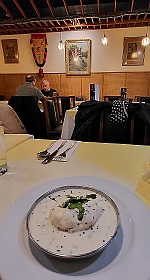
At Arbil City restaurant, Kilburn, London
Tasty lamb shank
Resting on a bed of rice
Is a joy to consume

At Arbil City restaurant, Kilburn, London
Tasty lamb shank
Resting on a bed of rice
Is a joy to consume
WHILE PREPARING A SAUCE for pasta today, my mind shot back to my mother in the kitchen during my childhood. Many people regarded her as being a competent cook. She was an enthusiastic follower of the recipes in cookbooks by Elizabeth David. She bought only the best cooking utensils, and sourced many ingredients in the Mediterranean food stores that used to exist in Soho – a few remain, but many have gone. As a child, I was allowed in the kitchen to watch when my mother was cooking. The more I saw, the greater my desire to try to cook. However, this wish was not to be fulfilled while my mother was alive.

My birth and the first few months of my life were difficult as far as health was concerned. Consequently, my mother was highly protective of me, and then later also of my sibling. My mother saw danger everywhere, and not least in the kitchen. There were sharp knives, razor like tin can lids, and the risk of getting burnt either by the oven or the hot things prepared on it. We had electric hob rings because my mother was anxious about gas explosions and open flames. I was allowed to watch her cooking, but not to touch anything she was using. Curiously, even though knives were involved, I was often asked to wash the dishes, cutlery, and cooking utensils.
Sadly, my mother died at a young age. I was 28 when she went, and still residing in the family home along with my father, who had no interest in cooking. He enjoyed good food, but would have no part in preparing it. With my mother no longer around and a well-equipped kitchen, I began to experiment with cooking, and enjoyed the activity.
Over the years, I have done much cooking, and still enjoy doing it. I am not sure what made me think of my mother today as I prepared the pasta sauce, but it might have been the pan in which I was making it. For, that pan was one that my mother used often. She must have bought it back in the 1960s, and because she purchased only the best, it is still perfectly usable much more than 50 years later.
My wife is a good cook, but I do most of the day-to-day cooking. When she told a friend of ours that I do most of the cooking, the friend asked my wife:
“Don’t you feel diminished as a woman if Adam does most of the cooking?”
My wife, who is quite happy with the arrangement, replied with another question:
“Do I look like an idiot?”
Sometime later when our daughter was a toddler, she and my wife visited some friends. After a few minutes, our little one, used to seeing me cooking, came running out of the kitchen with wide open eyes, and said to my wife:
“Do you know, Mama, but the Mummy is doing the cooking in this house.”
My wife answered:
“Well, I never…”
DURING THE 1970s and 1980s, we used to make visits to a restaurant in north London’s Willesden Lane. Founded in 1964 and specialising in South Indian cuisine, it was called Vijay. It still exists at the same address. Out of curiosity and ‘for old times’ sake’, we paid it a visit last night (the 29th of February 2024).
Entering Vijay was like stepping back in time. It was uncanny; nothing seemed to have changed. The walls are still lined with raffia work panelling, the wooden Kerala-style ceiling, and the pictures on the wall (mostly colourful depictions of Hindu deities) looked exactly as we remembered. Naturally, none of the staff were recognizable.
Back in the ‘70s and ‘80s, we used to eat at Vijay to enjoy South Indian dishes that were not easy to find elsewhere in London. If I remember correctly, in those days Vijay only had this kind of food on its menu. Today, the menu still has South Indian dishes, but also many offerings of food that is definitely not typical of South India. It offers a wide selection of North Indian dishes – such as most British people would hope to find in an ‘Indian restaurant’. One of the hors d’oeuvres, which you would never find on India, but is common in British Indian restaurants is fried pappads (poppadums) served with a tray of chutneys and pickles to accompany them, Vijay now offers this. Probably, Vijay has added North Indian dishes to their menu because, for many potential customers, South Indian dishes are far less familiar.
Yesterday, we ordered a few dishes. They were enjoyable enough but not outstanding, However, it was great fun sitting in a place that had hardly changed since we last visited it at least 30 years ago.
PROPERTY ALONG LAVELLE Road in Bangalore (Bengaluru) is currently the most expensive real estate in the city. The thoroughfare was named in memory of the Irish soldier Michael Fitzgerald Lavelle (1831-1895), who discovered gold, and then established goldmines, at Kolar ), which is about 44 miles east of the centre of Bangalore (see, for example: http://www.advertiser.ie/mayo/article/130402/micky-lavelle-the-gold-king-of-kolar ).

One of the entrances to the Bangalore Club, where I often stay when in the city, is on Lavelle Road. Many a time have I walked from the Club along Lavelle Road towards the delightful Airlines Hotel open-air café. On the way, I pass a four-storey building with a narrow façade facing Lavelle Road. This side of the building has four small balconies. Today, it is an office block, but quite a few years ago, it was the home of Bangalore’s Max Mueller Bhavan (a German cultural centre – a branch of the Goethe Institut). This organisation first established its presence in Bangalore in 1960. It provides lessons in German language and culture, and also puts on events relating to German cultural life.
The building on Lavelle Road has a flat roof. When it housed the German cultural centre, there was a straw canopy covering the roof. Beneath the canopy, there were tables and chairs and a kitchen. This covered area was a restaurant, which was called ‘Café Max’. It served German food. The chef and manager of this eatery was an easy-going, informal, young German man. He served what was described as ‘German breakfasts’ every morning. These consisted of eggs and sausages accompanied by delicious German-style breads and cakes, which he and his team baked. Although we never partook of them, he also prepared lunches with dishes from the repertoire of the German cuisine. He had a bookshelf filled with cookbooks, and every morning he could be seen studying them before deciding the day’s menu. Although the restaurant on the roof was intended mainly for the use of people attending the centre for language courses, it was also open to ‘outsiders’ like me.
When it was located on Lavelle Road and withing a very short distance – two minutes’ walk – from the Bangalore Club, I attended several screenings of German films at the Max Mueller Bhavan. Now that the organisation has moved to Indiranagar, I visit it far less often. Every time I walk past the former Lavelle Road Max Mueller Bhavan, I look up towards its roof and remember the German ‘Früstücke’ I used to enjoy there.
SO FAR – THAT is since January 1994, the very best biryani I have eaten was at Paragon in Calicut (Kerala) in 2006. It was a Moplah recipe – Arabic and Indian flavours combined most harmoniously. Last December, I enjoyed an almost as good biryani in the restaurant of the Sifat International Hotel in Surat (Gujarat).

When in Bangalore, where we find ourselves often, we like to visit Bheema’s restaurant on Church Street. It serves Andhra-style cuisine. I have never been disappointed with the biryani dishes served there. Although not as supremely superb as the two biryanis I have mentioned already, Bheema’s delicious biryanis are way above average – in my humble opinion.
THE DHRABUDI TRMPLE complex is near the sea about 5 miles east of the town of Mandvi (Kutch, Gujarat). It is located ated next a small Freshwater lake, where pilgrims can bathe. Our driver told us that baby boys are brought to be blessed at the temple when they reach their first birth anniversary. When we visited, we saw a group of people doing a puja in the open air. They were respecting the first death anniversary of one of their relatives.
While wandering around the temple compound, we saw a group of Rabari women seated in the shade, under a large banyan tree. The Rabari are nomadic cattle and camel herders, as well as shepherds. In India, they aremost frequently found in Gujarat, Punjab, and Rajasthan.
Worshippers come from far and wide to do pujas at the mandir. The temple offers free meals to pilgrims. These are served in a large dining hall. One wall of this is lined with numerous portraits of people who have died. We were told that diners pick up a thali and other eating utensils before lining up to be served food.
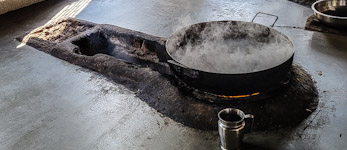
The kitchen, which is next door to the dining hall is vast. It was spotlessly clean. I saw a few gas rings, but what really fascinated me was the other method by which food is heated up. I saw three or four pits sunk into the floor. Each one is shaped like a large spoon. Glowing charcoal is heaped in the bowl of the ‘spoon’, and can ve spread along the stem. Pots are placed above the charcoal. The arrangement reminded me of the Turkish ocakbaşı. I imagine that the cooking speed can be adjusted by varying the amounts of glowing charcoal beneath each of the enormous cooking pots.
We did not stay to join the pilgrims having lunch. Although the temple cooks kindly invited us, we had lunch awaiting us at my wife’s cousin’s home.
I always enjoy visiting place of worship. What made Dhrabudi special for me was being shown its wonderful kitchen.
THE LAW GARDEN in Ahmedabad was developed into a park in about 1997. Previously, it had been a vast triangular vacant plot in the heart of an affluent residential area. Named after an adjacent college of law, it was an undeveloped, rather disreputable bit of land. In 1997, it was tidied up and turned into what is now a pleasant place for people to relax and ‘take the air’.

Market stalls can be found along the street on one side of the park. After dark, a busy night market springs to life. This existed even before the park was completed.
Many of the stalls sell clothing made using colourful traditional patterned textiles – both embroidered and printed. Several stalls were selling cloths embroidered with small mirrors – work from Kutch.
In addition to clothing, there were hawkers selling toys and balloons. Foodsellers pushed small barrows from which they sold fruit, confectionery, and soft drinks.
This lively market reminded me a little of Fashion Street in Bombay, but it is somewhat smaller and offers less variety. The Law Garden night market is well worth a visit.
DURING OUR HONEYMOON in 1994, we travelled around places in southern India. At one point, we had to change trains at Coimbatore in Tamil Nadu state. With a few hours to spare, we ate dinner at a modest small restaurant near the station.

We sat down and banana leaves were placed on the table in front of us. These served as plates. There was no menu. A waiter hurried around the restaurant, stopping next to each diner and placing dollops of vegetarian culinary preparations on the leaves. He returned and placed a pile of steamed rice next to the mounds of vegetable items. He kept running from table to table, replenishing foods as required by the diners. This seemingly endless distribution of food set us back a total of 12 Rupees, which in 1994 was about £0.40 (yes, 40 pence). The coffee we drank at the end of the meal was the same price.
Yesterday, the 9th of November 2023, I was reminded of this experience whilst watching a waiter serving Andhra style vegetable preparations on a banana leaf in Bheema’s restaurant on Bangalore’s Church Street. Naturally, the meal cost a lot more than we paid in Coimbatore in 1994, but it was still very good value.
YESTERDAY (16th SEPTEMBER 2023), we met one of my cousins in Hampstead village. We ate a very satisfactory lunch at The Flask pub in Flask Walk. We chose items from the ‘brunch menu’. Each of the three dishes we ordered was tasty and generous in portion size. The dish with wild mushrooms was exceptionally good.

Long ago, there were two pubs with the word Flask in their names in Hampstead: The Upper Flask and the Lower Flask. The Upper Flask was located close to where East Heath Road meets the top (northernmost) end of Heath Street, close to Whitestone Pond. It was a meeting place for noteworthy cultural figures, but it was closed in 1750. The pub in Flask Walk, where we ate lunch, was known as The Lower Flask. Here is something about it from my book “Beneath a Wide Sky: Hampstead and its Environs”:
“Once upon a time, Hampstead had two pubs or taverns whose names contained the word ‘Flask’. This is not surprising because the word ‘flask’ used to be common in the naming of pubs. One of them, the erstwhile Upper Flask, has already been described. The other, the once named ‘Lower Flask’, now renamed, is on Flask Walk, not far from Hampstead high Street. The Upper Flask was a remarkable establishment, as already described. It figures several times in ‘Clarissa’, a lengthy novel by Samuel Richardson (1689-1761), first published in 1747. The Lower Flask pub (in Flask Walk) is also mentioned in the novel, but unflatteringly, as:
“… a place where second-rate persons are to be found often in a swinish condition …”
Unlike the Upper Flask, the Lower Flask is still in business, but much, including its name and clientele, has changed since Richardson published his novel. Located at the eastern end of the pedestrianised stretch of Flask Walk, the Lower Flask, now The Flask, was rebuilt in 1874. Formerly, it had been a thatched building and was a place where mineral water from Hampstead’s chalybeate springs was sold. Oddly, despite visiting Hampstead literally innumerable times during the last more than 65 years, it was only on Halloween 2021 that I first set foot in the Flask pub, and I am pleased that I did. The front rooms of the pub retain much of their Victorian charm and the rear rooms, one of them with a glass roof, are spacious.”
Although the Flask Pub is interesting enough, there are plenty more interesting places to see along Flask Walk and in other parts of Hampstead. You can discover these by reading my book, which is available from Amazon websites such as:
https://www.amazon.co.uk/BENEATH-WIDE-SKY-HAMPSTEAD-ENVIRONS/dp/B09R2WRK92/
DURING THE LATE 1950s and much of the 1960s, my mother created artworks in the sculpture workshops of St Martins School of Art, which was then located on Charing Cross Road near to Foyles bookshop. My mother was a keen follower of the recipes of Elizabeth David (1913-1992), who introduced Mediterranean food to British kitchens. Near to St Martins in Old Compton Street, there were many food shops that supplied the ingredients that were required to follow Ms David’s recipes accurately. There used to be a French greengrocer between Charing Cross Road and Greek Street. This was one of the only places where ‘exotic’ salads such as mâché (lamb’s lettuce) could be purchased. Further west along Old Compton Street, there was a Belgian butcher, Benoit Bulcke, which cut meat in the French style, which my mother preferred. She claimed that English butchers were not ‘up to scratch’. Both these shops have long since disappeared. Another Soho establishment, which we used to visit regularly, was Trattoria da Otello in Dean Street. We went there so often that we were treated like old friends. Now, sadly, that wonderful restaurant is no more.

Three Old Compton Street shops frequented by my mother are still in business. They are the Algerian Coffee Stores, whose appearance has barely changed since the early 1960s when I first remember entering it; and a supplier of Italian foods: I Camisa & Son. Lina Stores, which my mother also used to visit still exists, but its branch on Brewer Street (and other newer branches) seems to have become more like restaurants than Italian delicatessens.
During school holidays, I used to accompany my mother on trips from Golders Green, where we resided, to the West End. On most of these excursions, food shopping in Soho was on our itinerary. So, as a youngster I got to know these various food shops quite well. As an innocent child, I associated Soho with food shopping rather than its other more colourful activities.
Every visit to Soho involved a stop at Bar Italia on Frith Street. There, I would be treated with a cappuccino while my mother drank an espresso. From when I first knew it in the early 1960s (or possibly the late 1950s), the overall appearance of Bar Italia has barely changed. As a friend remarked on a recent visit, the cracked Formica counter opposite the bar is typical of how cafés would have been fitted out back in the 1950s.
Bar Italia is almost three years older than me. It was founded in late 1949 by Lou and Caterina Polledri. Lou was born in the Italian city of Piacenza. According to the Bar’s website, some of the above-mentioned Formica was put in place in 1949, when the establishment was for its time ‘state-of-the-art’. The floor is that which was laid down by members of the Polledri family in 1949.
When it opened, Soho had a large Italian community, which much appreciated the Bar Italia as a home-away-from-home. At the far end of the small establishment, there is a television that broadcasts Italian TV, mostly sporting events. Each time I visit the place, the screen sems to have been replaced by a larger one. However, I cannot recall whether there was a television in place when I visited as a child. What I do remember is that next door to Bar Italia, there used to be a Greek restaurant called Jimmy’s, which, for some reason, my mother never took us there.
Once a local for the Italian community, Bar Italia has become somewhat of a Soho landmark and tourist attraction. In addition to coffee and alcoholic drinks that would be available in any local bar in Italy, Bar Italia now also serves hot meals. It also sells Portuguese ‘natas’, which are not typical fare in bars in Italy. Apart from this change, the prices of its excellent coffee have shot up to levels higher than most London cafés charge. Whereas one can expect to pay from on average £2.80 to “£3.20” for an espresso, Bar Italia is now charging over £4.20. I mention this, but do not begrudge them because by patronising Bar Italia we are helping to preserve a delightful historical London landmark.
NOW watch this lovely little video about the place:
 yamey
yamey 