In Germany, we only eat…

High up in the sky,

a compartmented tray,

consuming airline food 

FLIGHT 1


Since I was a little boy (many decades ago), I have been travelling on aeroplanes, usually to and from holiday destinations. The food served during flights has always intrigued me. As a child, I used to collect the miniature containers of salt and pepper that appeared on the compartmented food trays. I can remember these better than the far from memorable food served with them.

In 1963, we took an overnight flight from New York to London. When the breakfast tray arrived, I remember that there was a hot, foil-wrapped item on the tray. Cautiously, I unwrapped it to reveal a long spindle of something yellow and rubbery. I hit it with a knife. The knife bounced off it. My mother told me that what I had revealed was an omelette. To this day, omelettes on ‘planes have repelled me. I love freshly made omelettes, but one made several hours earlier and reheated has no appeal for me.

The best food I have eaten in the air was on Air Lanka ‘planes in the mid-1990s when we were travelling between London and Colombo. The food was served in large foil containers, rather than in in tiny neat plastic dishes. Delicious Sri Lankan curries were served. They tasted as if they had been lovingly prepared in someone’s home rather than in an industrial kitchen. My wife recalls eating whole steaks and caviar on an Aeroflot flight between Moscow and New Delhi in the late 1980’s. The burly stewardesses served the food on real porcelain plates.

More recently, I have been travelling regularly to India. There is a direct flight between London and Bangalore operated by British Airways (‘BA’), on which we used to travel. The staff on these flights were coolly efficient. The meals were not so good. For some years I had a dental patient, a friendly fellow, who worked for BA as a cabin crew member. When I told him that I was not keen on what was served on BA, he suggested that I pre-order the seafood meals. These turned out to be better than the regular meals, and we ordered these on several successive flights. Then, on one BA flight I was seated next to a very devout Muslim couple, who did a lot of praying during the ten-hour flight. When their meals arrived, a delicious aroma spread from their trays. When they removed the foil from their hot dishes, I saw that they had been served with what looked like really nice curries and biryanis.

After seeing these halal meals, that is what I pre-ordered on all our subsequent bookings with BA. We were not disappointed. BA used a good quality halal caterer. Many people who order halal food are teetotal. The BA crew did not raise an eyebrow when we ordered gin and tonic or bloody Mary cocktails with our so-called ‘Muslim meals’.

FLIGHT 2

Before BA operated the direct flights between London and Bangalore, we had to make the journey with one change of ‘plane. The German airline, Lufthansa, ran a convenient flight from Frankfurt (Main) to Bangalore. On one occasion, we were served two meals on the flight. The first meal included some meat. Several hours later, the second meal arrived. It was a selection of vegetarian food items. Now, I have nothing against vegetarians and vegetarian food, but I like a bit of meat or fish with my veg. I called the stewardess and asked if there was a non-vegetarian option as there had been during the earlier meal.

“No,” she said abruptly.

“Why?” I asked.

“In Germany,” she explained, “we only eat meat once a day.”

What nonsense, I thought. Whenever I have visited Germany, I have seen people eating meat at breakfast, lunch, dinner, and in between these repasts. I was not going to put up with her inaccurate reasoning.

“Well,” I replied, feeling a little bit hypoglycaemic, “I shall be ill if I eat this vegetarian offering. You must find me some meat.”

“One moment, please.”

She disappeared out of our cabin. Maybe, she was worried that I might eat her. After some minutes, she returned with a tray containing some very tasty pieces of fish.

Apparently, Germans who travel business class eat non-vegetarian food more than once a day.

POSTSCRIPT:

I cannot understand why airlines feel that they have to serve hot dishes mid-air. Most of these dishes are shoddy versions of the descriptions given to them on the tiny menus handed out to fool you into thinking that the airline will treat you to ‘fine dining’. I believe that many people would be happy with a selection of tubs of what the Greeks call ‘meze’. These could include things like hummus, taramosalata, tzatziki, olives, cole-slaw, nuts, mutabel, guacamole, salsa, etc. No cooking required, and fun to eat.
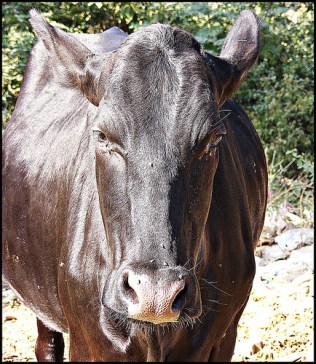
Mad cow

we don’t see ev’rything

that we consume:

might be germs with any bite


Bovine_500

From time to time, the United Kingdom is subject to agricultural diseases that need to be accompanied by nation-wide restrictions to limit spreading. A frequently occurring example of this is so-called foot-and-mouth disease. During such epidemics, those not involved in agricultural activities, such as hikers and tourists, are confined to roads, told to keep out of fields where traces of the disease may be lying.

During one outbreak of foot-and-mouth, we were spending a holiday in Wales. Wherever we went, we saw signs and barriers that prevented free movement across the countryside. What with the incessant rain, it made our trip rather dreary. We stopped for lunch in an ugly little town in central Wales. The most attractive looking eatery was a dowdy pub, devoid of any architectural merit. We sat down in its ageing dining room, trying to avert our eyes from the peeling wallpaper and a horrible worn carpet that badly needed to be replaced. Things looked up when the inn-keeper arrived to take our food order. We were attracted to beef steaks. There was a bewildering range of options for this on the menu.  Our host patiently explained the differences between the different types of beefsteak, explaining how the tastiness of the meat itself was related to its fat content and distribution within the cut. Fillet steak, for example, has little fat, not much taste without sauces, but wonderful texture. He recommended rib-eye as being the cut with just the right amount and distribution of fat to be tasty on its own. He was quite right, we discovered in that unattractive dining room in rainy Wales.

bovine

Some years later, Mad Cow disease (Bovine spongiform encephalopathy) became a concern in the UK. One evening, when we were going to a theatre near St Martins Lane in London, there were large headlines about the disease on the front page of the latest issue of the Evening Standard newspaper. Before the performance, we entered a branch of McDonalds for a quick snack. Almost everyone in the café was eating beef burgers, despite the headlines on the newspapers that some of the customers were reading!

Shortly after this, we went on a driving trip through France. In one small town, we walked passed a small restaurant with a sign hanging in its glass-fronted door. It read (in French): “We might be mad, but our beef is not.”

While the Mad Cow scare was at its height, we were invited to stay with some friends in Belgium. We had stayed with them often before. We asked them what they would like us to bring from London. They said they would love a home-made curry, enough for about twelve people. Although I am married to an Indian, it is I who makes the meat curries in our family. I prepared and cooked a huge lamb curry. As it is only a few hours’ drive between London and Belgium and the curry would have to be re-heated before being served, we thought it safe to transport the casserole containing it without refrigeration.

There were more security checks than usual at the English end of the Channel Tunnel. After our car had been examined, and the engine checked for hidden items including explosives, we were asked if we were carrying any meat products across the English Channel. We mentioned that we were transporting a casserole of cooked lamb curry. The security officials looked puzzled, told us not to move, and then walked away towards an office. One of them returned, and asked:

“It’s lamb, not beef is it?”

We confirmed that it was not beef.

“And thoroughly cooked?”

“Yes.”

“Well, what with all those spices, we’ll let you take it through the tunnel.”

Nobody asked us about meat when we arrived in France. We drove through a bath containing disinfected, and then headed for our destination.

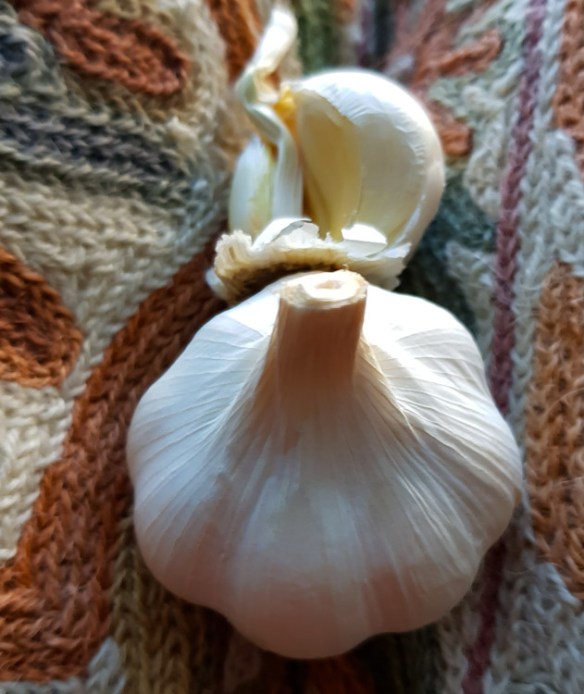
Garlic and parsley

PSX_20180917_175556.jpg


My late mother was a good cook. I know that you will think that often children praise their mother’s cooking however awful it is. In the case of my mother, her cooking was praised by many people, who still remember her skills in the kitchen many years after her demise at an early age. My mother was a keen disciple of the pioneering food writer Elizabeth David, who helped introduce Mediterranean cuisine to the British. Many recipes from the Mediterranean involve the use of garlic and parsley.

Although my mother did not permit my sister and me to cook in her kitchen, we were ordered to be in the kitchen with her either to keep her company and/or to do the washing-up. Our presence in the kitchen and proximity to a skilled cook engendered a life-long love of cooking in both my sister and me. When my mother died, I took over her kitchen and learned, by trial and error, how to cook. My sister did the same and ran a restaurant successfully for quite a few years.

Many of the dishes I cooked, and still make, contained copious amounts of garlic. This was not a problem until I qualified as a dentist, and moved to a practice in Kent, about 80 kilometres from London in distance, although it felt much further culturally and in many other ways.

Friends have often asked me whether the mouths that I treated emitted bad smells. The short answer is that although they might be malodorous occasionally, the dentist rarely smells them while treating the patient. However, the converse is true for the patient. In modern practice, the patient is often almost horizontal on the treatment chair. He or she can easily smell the dentist’s breath.

Soon after I began practising in Kent, I lived in local rented accommodation. I cooked for myself in the evenings, often preparing dishes with large amounts of delicious garlic.

One morning, Mrs G, a late middle-aged woman, attended my surgery. Soon after I had lowered the chair to a semi-reclined position, I commenced working on her teeth. In those days, the early 1980s, dentists did not routinely wear surgical gloves, nor did they wear facemasks. A paper facemask such as became ‘de rigueur’ after the beginning of the AIDs (HIV) epidemic, would not have prevented what was to occur after I began treating Mrs G.

After I had been at work for about a minute, Mrs G swept her hand in front of her mouth, and exclaimed: “Ooooh, Mr Yamey, you’ve been eating garlic.” I apologised, and from that day onwards I never ate garlic on a day before I was due to work.  

After I had been in practice for about twelve years, I began working in inner London instead of ‘extra-terrestrial’ Kent. My patients in London came from all over the world, and most of them ate at least as much garlic as I do. The garlic restriction that I exercised in Kent became unnecessary.

Parsley was another problem I faced when I first arrived in Kent. I used to buy my lunch at the local Tesco supermarket. Many of its employees were patients in the practice where I worked. In addition to sandwiches and potato crisps, I enjoyed eating something containing chocolate with my midday meal. Many was the time when the lady at the check-out till would hold my Mars bar or Crunchie up in the air, and then shout at the top of her voice: “Look what the dentist is eating.” I digress.

One summer’s day, I needed some parsley for something I wanted to cook. I entered the local Tesco and asked an assistant where this herb was kept in the shop. Surprised by my request, she answered: “Sorry, love, we only get that in at Christmas.” I was shocked. Only an hour and a half’s drive away in London, parsley was available throughout the year. The Medway Towns, where I worked, were trapped in a 1950’s time-warp when I first arrived there. By the early 1990s, when I shifted to London, the area was emerging gradually into the present.