Creating art with wood and a chainsaw

BORN IN WHAT BECAME EAST GERMANY in the town of Deutschbsaselitz, the artist christened as Hans-Georg Kern (b. 1938), is better known by the name of Georg Baselitz. His first education in art was at Hochschule für Bildende und Angewandte Kunst in East Berlin, commencing in 1955. After two semesters, he was expelled from this academy because of his lack of compliance with the socialist diktats of the German Democratic Republic. By 1957. he was a student at the Hochschule der Künste in West Berlin. In 1961, he changed his name to Georg Baselitz in honour of the town where he was born. In 1979, he began creating sculptural works, some of which are on display at London’s Serpentine South Gallery until the 7th of January 2024.
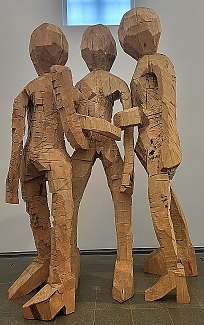
The works being shown at the Serpentine are all made of wood. They were created between 2011 and 2015 as models (maquettes) for finished works, and as such were not originally intended for public display. The wood has a rough finish and is pitted with many saw marks. After making preliminary drawings, some of which are displayed at the exhibition, Baselitz used axes, chisels, and chainsaws to fashion huge bits of timber into intriguing sculptural forms. These works are beautifully displayed in the various spaces of the gallery.

Although Baselitz’s timber sculptures are more figurative and much more complicated than those produced by my mother, seeing them reminded me of her. After leaving the sculpture workshops of St Martins School of Art, my mother hired a garage near Golders Hill Park, and used it as her studio. There, she worked on huge pieces of wood, creating abstract sculptures. Unlike Baselitz, she had no power saws, but only chisels and a power drill. I recall that when she wanted to create a ring-shaped piece of timber, she would first trace circles on the wood and then using a power drill she would drill holes around the circumference until the circle was complete. After that, she had to smooth the edges to produce a perfect circle. It was laborious, and lifting the heavy timber (without lifting gear) damaged her back.

The works on display in the Serpentine  (and one outside it) appear to be crudely finished when looked at closely, but as semi-abstract sculptures they seem to mock the grandeur of classical Greek or Roman sculptures. Born a rebel, the artist has produced attractive works that comfortably go against the grain of traditional sculpture.
Wild silk beside the East Sussex sea shore

THERE IS A NIGERIAN woven fabric called ‘sanyan’. Made mostly by the Yoruba people, its principal ingredient is a type of wild silk. The fabric is thick and resembles denim or canvas in texture. Strips of sanyan are sewn together to make garments and other items. During a recent visit to the Hastings Contemporary Art Gallery, which stands close to the seashore, we saw an exhibition of paintings made on sanyan cloths.

The creator of these images is Nigerian born Nengi Omuku who was born in Lagos (Nigeria) in 1987. It is there that this artist, who trained at the Slade School of Fine Art in London, now works. Before becoming an artist, Nengi worked in her mother’s florist shop, eventually coming into contact with art when she began making preparatory drawings for customers’ garden planning.

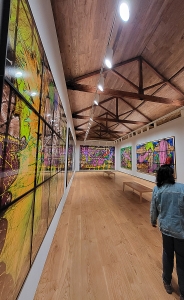
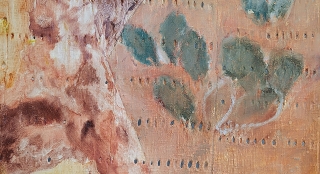
Nengi’s exhibition at Hastings is called “The Dance of People and the Natural World”and is on until the 3rd of March 2024. The artist took large sheets of sanyan fabric, consisting of strips of sanyan sewn tightly together, and then coated them with a gesso ground. When this was ready, she then used oil  paints to create images. Whether it was her painting technique or some property of the material upon which she applied the colours, the resulting images have a uniquely haunting, other-worldly quality that I have not seen in other artists’ works.  

The paintings are well displayed. They have been hung away from the walls so that one can look at their backs. By looking behind the paintings, you can see the stitching that holds the pieces of sanyan together as well as beads of the gesso ground that had oozed between the adjoining strips. By looking closely at the paintings, the joins between the constituent strips of sanyan can easily be detected (see photograph above). These create an interesting surface texture quite unlike the canvas usually used by painters.

I enjoyed the exhibition not only because the artwork was attractive but also because I became aware of an interesting fabric, which is in common use in Nigeria.

From Lagos in Nigeria to Peckham in London

UNTIL I VISITED THE SOUTH LONDON GALLERY (‘SLG’) yesterday, the 11th of October 2023, I had no idea that Peckham in south London is home to one of the UK’s largest Nigerian diasporic communities. Some even call the district ‘Little Lagos’ after the capital city of Nigeria. Until the 29th of October 2023, the SLG is hosting an exhibition of artworks, called “Lagos Peckham Repeat: Pilgrimage to the Lakes”, by Nigerian and British Nigerian artists. Lagos means ‘lakes’ in Portuguese, and the Nigerian city of Lagos developed on an area with several lakes. Part of the show is housed in the same building as the Camberwell School of Art, and the other in a nearby repurposed, former fire station, which was purchased in 2010 and donated to the SLG by the artist Raqib Shaw (born in Calcutta in 1974). The two venues are a few paces from each other, and both are well worth visiting.

The exhibition consists of photographs, videos (including an excellent one showing a woman in Nigerian clothing riding through Peckham on a black horse), sculptural assemblages, and coloured drawings. Words are inadequate to describe the imaginative exhibits, but if you are unable to visit the show, there is a good verbal summary of the artworks on https://www.southlondongallery.org/exhibitions/lagos-peckham-repeat/ . To give you some idea of the ideas that link the various works on the display, I will quote from the gallery’s guide:

“This exhibition brings together thirteen contemporary Nigerian and British-Nigerian artists to explore links between Lagos, meaning ‘lakes’ in Portuguese, and Peckham as a channel through which to address wider issues of migration. It is framed around ideas of pilgrimage, meaning journeys to a sacred or special place and, in this case, migration motivated by a search for a better life. At the heart of the exhibition is an exploration of the complexities of shifting notions of home and identity as generations of Nigerians settle in London permanently, return to Lagos, or move elsewhere.”

And I feel that this summarises the show very well. All of the exhibits are visually engaging in an exciting way, and if you bother to read the guide carefully, all of them convey the artists’ concepts with great lucidity and originality.

After seeing the show, you can obtain good refreshments in the SLG’s simple but attractive South London Louie café. The SLG also has a bookshop with many intriguing titles on offer.

Visiting an exhibition of outdoor sculptures in a London park

I ALWAYS ENJOY seeing sculptures displayed in the open-air. Until the 29th of October (2023) the annual outdoor Frieze Sculpture exhibition is being held in the south-east corner of London’s Regents Park. As with all the Frieze Sculpture exhibitions I have seen, this one is no exception – it displays a ‘mixed bag’ of artworks. Although many of this year’s exhibits are colourful, creative, and often playful, few of them are exceptional.

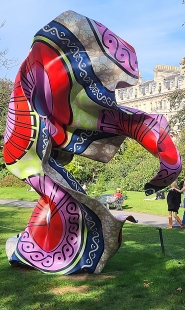
Two works struck me as standing out from the crowd. One of them, created in 2023 by Yinka Shonibare, is a folded work called “Material (SG) IV” (see photograph). This shape of this work resembles a flickering flame frozen in time. Covered in colourful patterns, the artist wanted to depict a piece of printed fabric, such as a sail, blowing in the breeze.  According to the Frieze Sculpture 2023 website, this artist:

“… creates work that explores issues of race and class through the media of sculpture, painting, photography, film, pictorial quilts and public works.”

The website explained that in the work in Regents Park:

“The fabric was originally inspired by Indonesian designs, mass-produced by the Dutch and eventually sold to colonies in West Africa. In the 1960s the material became a signifier of African identity and independence and, in Shonibare’s hands, the ‘perfect metaphor for multi-layered identities’.”

Even though it is interesting to know what was in the artist’s mind when he created the sculpture, it is a visually fascinating and satisfying piece in its own right.

The other work that particularly attracted me was created in 1976 by the artist Louise Nevelson (1899-1988). Born in a city now in Ukraine, she emigrated to the USA in the early 20th century. It was in the States that she studied art, and then created most of her artworks. Painted black, and called “Model for Celebration II”, it is a tall abstract piece, which was:

“… Inspired by the cubist innovations of Pablo Picasso and Henri Matisse, Nevelson reimagines painterly cubism as a sculptural opportunity.” (see https://viewer.mapme.com/frieze-sculpture-2023/location/ca758a4f-1328-48d2-a3cf-6c6b65edf794).

Unlike the other works on display in the park, Nevelson’s work has stood the test of time. So, maybe it was unfair of the curator to include such a work amongst the works of so many newcomers to the ‘art scene’. However, I was pleased to see it, as it is one of the only exhibits that I felt had profundity rather than the immediate and often short-lasting aesthetic appeal of many of the other exhibits.

Art from India displayed amongst the plants

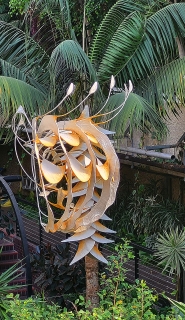
I ENJOY SEEING SCULPTURES displayed in gardens or other plant-filled locations. Until March 2024, the wonderful conservatory in London’s Barbican Centre is hosting a selection of sculptures by Ranjani Shettar. She was born in Bangalore (Bengaluru, India)) in 1977, and now lives and works in rural Karnataka. Her current exhibition in the Barbican is called “Cloud Songs on the Horizon”. The works on display were made especially for this site.

Her works are made of various materials (wood, stainless steel, muslin, and lacquer) and she employs techniques that have been adapted from traditional Indian crafts. Ms Shettar’s organic sculptures look like magnified plants or parts of plants. As she said once:

“Nature’s beauty is ever present, art helps to uncover, perceive and appreciate it.”

Seeing her exhibits in the Conservatory, certainly confirms this. However fine the artworks, putting them amongst plants helps emphasise the greater beauty of nature’s creations. The beauty of the sculptures competes with that of the plants, but the latter almost always win. So, placing one’s artworks within an area rich in plant life is a brave thing to do. I felt that Ms Shettar had done it successfully. Her creations have a harmonious relationship with the plant life surrounding them.

Whether or not you visit the exhibition, which I enjoyed, seeing the Barbican’s Conservatory – the second largest in Greater London – is always a worthwhile experience.

Embroidering in Palestine past and present

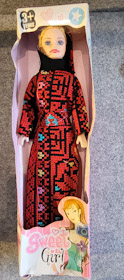
THERE IS A SUPERB exhibition at Cambridge’s Kettles Yard until the end of October 2023. The beautiful exhibits are mainly garments embroidered by Palestinian women before and after 1947. There are also a few other items including Palestinian propaganda posters depicting women wearing embroidered garments. The labels next to the exhibits are full of interesting information. Several of the topics particularly interested me.

Some of the garments were made using scraps of pre-used materials – for example bits of old clothes or even sacking and other packing materials. These old textiles were stitched together to create new clothes. This reminded me of a similar recycling of old materials which I saw at an exhibition of Japanese recycling at London’s Brunei Gallery.

I saw examples of Palestinian dresses which seemed very long. The length of these skirts was for a purpose. The cloth could be raised up to produce pocket like folds in which objects could be carried. These dresses were worn by Bedouins living in the Bethlehem and Jerusalem areas.

There was a widow’s dress. It was dark blue – the colour signifying grieving – and trimmed with red threads, which signified that the wearer was ready to be remarried.

One room was dedicated to embroidery and how the troubled situation in Palestine affected it. In refugee camps, some of the traditional materials were unavailable, and women had to embroider using whatever threads they could get hold of. There were several embroidered dresses adorned with decorations including the Palestinian flag and other patriotic motifs. These were displayed in the same room as the pro-Palestine propaganda posters that show women wearing embroidered garments.

I hope that what I have written gives you something of the flavour of this fascinating exhibition. Despite the intense reactions that discussing the plight of the Palestinians often arouses, the exhibition at Kettles Yard takes a reasonably balanced view of the situation. Its emphasis is on the skills of the Palestinian embroiderers rather than the politics of the part of the world where some of them still reside.

Anselm Kiefer at the White Cube in Bermondsey

TODAY, I MADE MY second visit to the Anselm Kiefer exhibition, which is on at the Bermondsey White Cube gallery until the 20th of August 2023. I was pleased to visit it again because after my first visit, I left it feeling oppressed and somewhat depressed. This might be what the artist (born at the end of WW2 in Germany) intended when he created the extraordinary series of scenes of dereliction and decay on show in Bermondsey. My second visit (on the 15th of August 2023) left me with a slightly more favourable impression, but my opinion that the artist has depicted an image of a world of confusion, conflict, and decay, remains unchanged.

The works, which are distributed in several rooms and the central corridor of the gallery, are, so I read in an information sheet, Kiefer’s reactions to, and representation of, a novel by James Joyce – “Finnegan’s Wake”. The artist has written short quotations from the book on many of the items that together make up the amazing art installations. As I have not read the book, I cannot comment on the appropriateness of what he has created.

In one room of the gallery, there are mainly huge paintings, which I found attractive. On close examination, one can see that the paint has been applied to that it is far from flat. The three-dimensional surfaces create interesting illusions, which change according to from where you view the pictures.

Another room has a huge pile of sand littered with discarded, corroded supermarket trolleys – an impressive but sad sight. In yet another room, most of the floor is covered with barbed wire and huge pieces of concrete – the ruins of a large building. As a friend of ours said, it looked as if it had been imported straight from a bombsite in Ukraine.

Would I recommend visiting this exhibition? It is certainly inappropriate for people who suffer from claustrophobia or depression. However, if you are of an adventurous frame of mind, do head for this show before it ends.

White and nutritious – milk and racism

UNTIL I WAS ABOUT 18, I drank a pint of chilled milk in the morning and another when I came home from school. I did not drink all the varieties of milk that were supplied by the milkmen who worked for the Express Dairy Company, but chose the ‘homogenised’ variety, which did not have cream at the top of the bottle. Never once whilst drinking this refreshing slightly watery liquid did I ever imagine that I would one day visit an exhibition about milk. Today, the 29th of July 2023, I viewed an exhibition called “Milk”, which is being shown at the Wellcome Collection in London’s Euston Road until the 10th of September 2023. Amongst the numerous exhibits displayed in this beautifully curated show, the following particularly interest me.

  1. There was a collection of decorated porcelain cream jugs.  Each one was shaped like a cow. Cream used to be poured into the hollow cow via a hole in its back. Then, a lid was placed to cover that orifice. To use the cream jugs, the cows were tilted so that the cream could flow out of another hole through creatures’ mouths.
  2. There was a terracotta model of a mule carrying two trays laden with cheeses. This Ancient Roman artefact dating back to the 3rd or 2nd century BC was found by archaeologists in Southern Italy. In times long before refrigeration, making cheese was one way of preserving milk for future use.
  3. I saw a metal lactometer, which was used to determine the amount of water in milk. My wife said that when she was a child in India, milk used to be delivered to the door. To check whether the milkman had watered it down, her mother used a lactometer just like the one on display at the exhibition.
  4. Our daughter spotted an 18th century etching depicting St Bernard of Clairvaux kneeling before the Virgin holding the Christ Child. As the saint knelt before the Virgin, he received a squirt of her milk from her breast. This was supposed to grant him wisdom and eloquence. When she was studying History of Art, our daughter wrote a thesis about this curious episode – The Lactation of St Bernard’.
  5. A rather uninteresting looking exhibit proved to be most fascinating. It consisted of two milk testing forms, which had to be completed after a farmer’s batch of milk had been tested for diseases, bacteria, fat content, and protein content. The forms on display related to milk produced by cattle on the Dartington Hall Estate in Devon. The Estate was founded to research the merits of various scientific farming methods. One of the founders of the Estate was the agronomist Leonard Elmhirst (1893-1974). What made him special in my mind was that after meeting the great Rabindrath Tagore (1861-1941) in the USA in 1913, he later (in 1922) set up for Tagore an Institute of Rural Reconstruction near Tagore’s university at Shantiniketan (now in West Bengal). After marrying Dorothy Straight, Elmhirst and his wife established the Estate at Dartington in 1925. It was modelled on what he had founded near Shantiniketan.

There were plenty of other exhibits that were both visually interesting and thought provoking. A theme that I felt pervaded the exhibition is related to the colour of milk – white. Because milk is often perceived as being healthy, pure, and virtuous, it may also nourish the malevolent ideas of white racists. One of the exhibits showed a video of Trump supporters cavorting around, each one of them waving large bottles of white milk whilst shouting racist and anti-Semitic slogans. Yet, the ancestors of racists like these were perfectly happy to snatch the newborn babies of black slaves away from their mothers, so that these unfortunate women could be forced to breast-feed the babies of the white women of the families who owned them. Their milk was white, but not their skin colour. To compensate for these and other harsh reminders that all is still not well in the racial tolerance scene, the exhibition includes a satirical film from You Tube ( https://youtu.be/cevXg_SlT-Q ), which makes fun of people with racist tendencies.  

Well, it never occurred to me that milk and racism might be considered in the same brackets until I visited the splendid show at the Wellcome Collection. It is well worth seeing not only because of its historical and scientific aspects, but also for its artistic and sociological content.

Artists as artworks in London’s East End

BRICK LANE IN east London has been home to immigrants from various parts of the world. Currently, many of the people who live and work in the area are of Bangladeshi heritage. In the last few years, the area has attracted the ‘trendy’ set, whose interests are mainly in the attractions north of the former Truman Brewery. Some years ago, my friend David, visiting from Atlanta (Georgia), and I paid a visit to Brick Lane and were surprised to find a bit of ‘Ye Olde England’ almost hidden amongst the predominantly Asian businesses. It was the The Pride of Spitalfields London – a real old-fashioned ‘boozer’. Stepping into it, it was difficult to imagine you were not in a country pub, but in the heart of east London. It is on Heneage Street next door to what had once been part of a brewery.

In 2015, the Trustees of the Gilbert & George Centre, a charity, acquired the building next door to the pub. On the 1st of April this year (2023), the converted buildings were opened to the public. They have been beautifully transformed by the SIRS Architects practice and they house artworks by the duo Gilbert and George (‘G&G’), who both trained at London’s St Martins School of Art. According to the G&G website (gilbertandgeorgecentre.org):

“The property was purchased with the idea to create a permanent home for works of the artist and to enrich London’s cultural offering thus further.”

G&G produce often very colourful works, all of which include the pair of creators within their images. As artists, they are also the subjects of their creations – they are almost always depicted in all their works. Their works deal imaginatively with a wide variety of things that we all face in our daily lives – some of them often considered too distasteful to be discussed or displayed. But G&G boldly bring them to our notice in a dramatic way.  As Michael Bracewell, a Trustee, wrote on the website:

“Gilbert & George maintain an ideological opposition to formalistic art theory and the reference of art to the history or theory of art. Asserting instead the power of emotion and actuality, their art addresses subjects that are culturally excluded, neglected or disowned. Their art questions social taboos and morality. By looking at difficult subjects the art and vision of Gilbert & George is intended to ‘de-shock’ rather than seeking to shock. Its aim is not the simple task of ‘shocking’ a viewer, but the difficult task of interrogating a subject and themselves … Unchanging, they have the appearance and countenance of modern sober-minded, anonymous citizens, who have embarked on the astral journey of their own Divine Comedy: purgatory, Heaven and Hell as they find it and perceive it in our world, in nature and in themselves.”

Whether or not you like the creations of G&G, the new Centre is well worth visiting, even if only to see the fine design of the buildings containing it. If the art is all too much for you, you can pop into the pub next door and seek liquid relief. And if you loved the place, which we did, you can visit the boozer to celebrate the arrival of this superb new addition to the London art scene.

Quilts in a wonderfully designed library

OUR FRIEND MIKAEL is an accomplished creative quilter (maker of quilts). Some of her artistic quilting is on display alongside works by other quilters in London’s Swiss Cottage Library until the 26th of July 2023. I must admit that when I learned that we were going to see an exhibition of quilts, my heart sank a bit. However, I am glad we went. I had no idea how creative and imaginative quilt makers can be. Well displayed in Swiss Cottage Library, there is a collection of extremely artistic contemporary quilts, which are well worth seeing. Far from simply being scraps of material stitched together, the quilters have used their imaginations and skills to create artworks which are not only beautiful but superbly innovative.

Until I entered Swiss Cottage Library today, I cannot recall having been inside it since about 1965 when I left the nearby Hall School, aged 13. I have passed its distinctive exterior often but never bothered to go inside. I was at the school between 1960 and 1965, and I remember visiting the then new library after it opened in November 1964. It was designed in the Modernist style by Basil Spence (1907-1976), who was born in Bombay. He based his library on the design of several that he had visited in Scandinavia. All that I can recall of the new library was that its shelves contained a far better range of books than our local library in Golders Green. Being a pupil in the area, I was able to borrow books from the Swiss Cottage Library, which I used to visit often because I found it to be so wonderful.

Although I can remember the superb collection of books that existed in 1964-1965, I could not recall the appearance of the library’s interior. It was only today when we visited the quilting show that I appreciated what a superb job had been done by Basil Spence and his team. Even though it was designed in the early 1960s, the style of the well-lit spacious interior has not dated at all. The interior of the library is far more intelligently conceived than most new British buildings created in the last few years. It is uplifting to wander around the various peaceful spaces within the library. If it were nearer home, it would be a place where I would want to go regularly to read and write.

I am grateful that Mikael invited us to see the quilting exhibition not only because it contained aesthetically pleasing works of art but also because I got to go back inside the library. Although I was not particularly interested in architecture when I was 11, my fascination with it began to grow a few years later. There was even a brief period in my life when I toyed with the idea of becoming an architect. Even though I did not pursue that profession, my love of good architecture – both modern and historical – has persisted. I believe that now, in my retirement, my appreciation of great buildings (such as Swiss Cottage Library) is greater than it has ever been. Even if you miss the quilting exhibition, it is worth making a detour to see Spence’s wonderful creation – both inside and outside.