Before becoming one of India’s most famous artists he worked in a bank

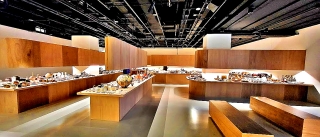
KRISHEN KHANNA CELEBRATED his one hundredth birthday in July 2025. The NGMA (National Gallery of Modern Art) in Bombay is currently holding a superb exhibition showcasing his paintings. The show is beautifully displayed and the artworks are skilfully illuminated.

Khanna was born in Lyallpur, now in Pakistan. After the Partition of India in 1947, he worked as an official in Grindlays Bank in Bombay. However, before Partition, he had already begun painting. The bank job was just to help keep him and his family going after they had left/fled what became the Pakistani part of Punjab.

Soon after arriving in India, Khanna began associating with members of Bombay’s Progressive Art Group that included notable creators such as FN Souza and MF Hussain. Thereafter, his painting career took off, and his reputation soared.

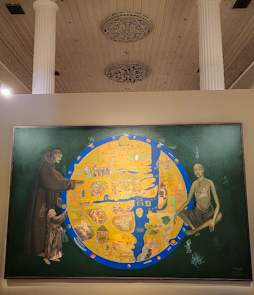
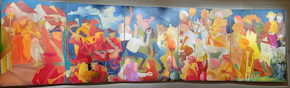
The exhibition at the NGMA surveys Khanna’s extraordinary range of paintings. Their subject matter ranges from political to historical to religious … and much more. The show, which demonstrates the artist’s amazing versatility and great artistic skill, continues until 12 December 2025, and should not be missed if you are in Bombay.

On display outdoors in London’s Regents Park

I ENJOY VIEWING sculptures displayed in the open air. Every autumn, there is an exhibition of sculptures in London’s Regents Park.  It is part of the annual Frieze art fair. Sculptures by various artists are provided by the commercial galleries who deal with them.

This year’s exhibition was small and somewhat disappointing. It seemed to me that the galleries had not exhibited their better works or works by their better-known artists. Maybe they are worried about them being vandalised or stolen. Whatever the reason, the 2025 outdoor show is not nearly as exciting as similar shows in previous years.

Displaying and selling works of art in London for forty years

VICTORIA MIRO WAS born in London in 1945, Her parents, who were keen on cultural pursuits, saved their money and took Victoria for holidays in Italy to see art there. My parents did the same thing for me and my sibling. Victoria studied painting at the Slade School of Fine Art (at UCL), and then became an art teacher at a secondary school. In the 1970s, she married a businessman, Walter Miro. After bringing up her children for a few years, she opened an art gallery in 1985. It was in Cork Street. In 2000, she moved to larger premises near Hoxton and Old Street. The gallery is housed in a converted former furniture factory. Since then, Mrs Miro has opened another smaller gallery in Venice.

To celebrate the fortieth anniversary of her gallery, the Victoria Miro has put on a special exhibition in her London establishment.  It will continue until 1 August 2025. The show includes works by many of the artists that have exhibited at Victoria Miro since 1985. They are displayed beautifully in the large galleries within the converted factory. The list of artists can be found at https://www.victoria-miro.com/exhibitions/656/ . Some of the works, for example by Paula Rego, are now old, but many of the other artworks were created especially for the exhibition.

To see the entire exhibition, you must be prepared to climb many stairs, including an impressive 72 step staircase, because some of the works are on the upper floors of the building, which have never before been used as exhibition spaces. It is worth seeing the whole show because moving through the gallery spaces allows one to appreciate the converted factory’s elegant architecture.  The interior was designed by architect Michael Drain in collaboration with Claudio Silvestrin. At the rear of the building, there is a terrace beside a pond shaded by trees.  

Although the works in the anniversary exhibition are wonderful, it is the gallery’s interior design that steals the show. It does not overpower the artworks, yet it does compete with them for one’s attention. I must admit that the design of the spaces and the way they interconnect fascinated me more than what was on display. Whether your interest is modern art or modern architecture, a visit to the gallery will be well worthwhile. Its precise address is 16 Wharf Road, London N1 7RW.

A photographer and his works exposed at a garden in Chennai

SUNIL GUPTA IS a renowned photographer. He was born in 1953 in New Delhi, and migrated to Canada with his family in 1969. With a degree in accountancy and a diploma in photography, he moved to London (UK) in 1983. There, he married another photographer Charan Singh. Much of Sunil’s work relates to themes of sexual identity, migration, race, and family.

While we were in Chennai, the parents of another photographer, Varun Gupta, told us about the exhibition of Sunil Gupta’s works currently (January 2025) being held in the garden of the Government Museum in Chennai. The show is part of the Chennai Photographic Biennale, of which Varun is one of the founders.

The show is being held in the open air. We saw it when the air temperature was hovering around 29 degrees Celsius. In addition, crowds of schoolchildren were enjoying their packed lunches on the ground amongst the walls upon which the photographs were hanging. The show has been arranged to produce what could be termed an autobiography expressed by photographs.

There is no doubt that Sunil’s photographs are visually superb as well as being of great interest.

While I was looking at the images, many of which are artistic as well as informative, I began to wonder whether photography limits the expression of a photographer’s innermost feelings more than is the case for a creator who is painting or sculpting. The photographer, like other visual artists, can compose his/her pictures, regulate their appearance, and edit them. However, the light coming through the camera lens dictates the final product however many adjustments etc are made. In contrast, the light coming through the eyes of a sculptor or a painter (or a printmaker) impinges on the artist’s brain, and what eventually results reflects the effect that the image projected into the brain has on the creator’s innermost feelings about the subject matter.

Having said this, which I hope makes at least a little sense, I must admit that I do enjoy making photographic images and I hope that my photographic skills will be improved by viewing great works such as we saw at the exhibition of Sunil Gupta’s photographs in Chennai.

An artist who works and lives in Kolkata

WHEN VIEWING ARTWORK or listening to music, my reaction  to, and enjoyment of it is governed by my initial visceral feelings that it evokes. If these feelings are satisfactory, my interest and enjoyment of the art increases, and I might begin to delve more deeply into understanding what the creator is trying to convey with his or her work.


My initial reaction to the oil paintings and ink drawings by Kolkata based artist Debajyoti Roy were very positive. Each of his works on display appealed to me. Many of the images are in black ink on white paper. A couple of larger paintings were more colourful, created with oil colours and inks.


 Some of the works in ink reminded me a little of Chinese or Japanese calligraphy. The works are both abstract and at the same time somewhat figurative. Yet, as I studied them, they gave me the feeling that they are abstractions of reality, often of biological phenomena.  As Roy explained in the exhibition catalogue:

“When someone engages with a piece of art, it is inevitable to interpret its visual aspects. Still, the essence lies in deeper inquiries that provoke interpretation of the perception and reality.”

I felt that this was certainly the case with what I saw of his creations.


Debajyoti Roy has created a set of images that are intriguing both visually and intellectually. It is a shame that his exhibition at the Jogen Choudhury Centre for Arts in south Kolkata is ending soon (on 11 January 2025). If you happen to be in Kolkata before it ends, it is well worth viewing.

Narrative art in the round at London’s Barbican Centre

THE CURVE AT London’s Barbican Centre is as its name suggests, a curved space. When the Centre was built, the Curve was designed as a space to act as a sound barrier or buffer to contain the sounds emanating from the concert hall that it surrounds. Nowadays, it is used as a space for temporary exhibitions. Until the 5th of January 2025, the Curve will contain an exhibition, “It will end in tears”, of paintings Pamela Phatsimo Sunstrum, who was born in Botswana in 1980.

Ms Sunstrum’s paintings are on grainy wooden panels, and are truly wonderfully executed. The series of paintings are all linked by a narrative – an imagined story of a woman who lands in a colonial country in Africa in the early to mid-20th century, and has an adventure that ends up with a court case. For this exhibition, the Curve has been divided by wooden partitions into a series of rooms, connected to each other by an elevated walkway. Each room is designed to resemble a different stage set. For example. one is a kitchen. and another is a courtroom. The viewer walks along the walkway from room to room, seeing the series of paintings arranged in the order that the story unfolds. The heroine of the story is an imagined woman named Bettina. The artist created Bettina in her own image – each depiction of Bettina is the artist’s self-portrait. The resulting set of pictures along with the wooden partitions makes for an enjoyable and intriguing experience.

The paintings are like ‘stills’ from a movie. Although their style and subject matter is completely different, I was reminded of series of paintings such as those by Vittore Carpaccio (c1460-c1525) in Scuola di San Giorgio degli Schiavoni (in Venice), which show scenes from a legend with a Christian religious theme.

Ms Sunstrum’s site-specific exhibition at the Curve is what the series of guidebooks issued by the Michelin tyre company would describe as “vaut la détour” (‘worth the detour’).

An artist from Belgium at a gallery in London’s Mayfair

MICHAËL BORREMANS WAS born in Geraardsbegen in Belgium in 1963. He studied art in Ghent. This city and others nearby are rich in fine paintings by great Flemish artists such as Jan van Eyck, the Brueghels, Rubens, and Hugo van der Goes. These famous painters worked in the 14th, 15th, and 16th centuries. Their work often has a particular kind of clarity, which is especially evident in the portraits they painted.

Two paintings by Borremans

The works of Borremans, which are on display at the David Zwirner gallery in London’s Mayfair until the 26th of July 2024, include portraits painted recently. Although they depict modern subjects, their visual quality and fine execution reminded me of the Flemish artists, who worked many centuries ago. Borremans paintings are not imitations of the works of the earlier Flemish artists but the effect his paintings have on me does not differ markedly from what I experience when viewing the Flemish art of many centuries ago.

Some of the paintings by Borremans depict the faces of monkeys dressed up in human clothes – 18th century painter’s garb. These paintings were inspired by a work created by Jean Siméon Chardin, who worked in the 18th century. The monkey depicted was not a real one, but a glazed porcelain model. I am not sure what message is being portrayed in these intriguing works.

The exhibition at Zwirner was well worth seeing. The pictures were well hung and beautifully lit, and a breath of fresh air, artistically speaking. Sadly, by the time you read this, it will be over.

Dreamlike but almost realistic from Japan

IT IS OFTEN a pleasure to see an exhibition of works by an artist, whose existence was hitherto unknown to me. In this case, the artist is the Japanese born Minoru Nomata, who was born in 1955 and lives as well as works in Japan. The exhibition of his works, currently at White Cube in Masons Yard (near Piccadilly) until the 24th of August 2024, consists mainly of paintings (acrylic on canvas).

At first sight, his paintings look almost like photographs. However, after a few moments’ contemplation, they can be seen to depict subjects – often structures and aspects of nature – that are at the same time unreal and almost but not quite real.  His subject matter is not quite surreal, but is an unusually dreamy interpretation of the real world. None of the paintings on display contained any signs of human presence. The gallery’s website (www.whitecube.com/gallery-exhibitions/minoru-nomata-masons-yard-2024)  includes the following:

“According to the artist, ‘construction, repair and demolition’ occur simultaneously in his paintings; they confer, too, upon the simultaneity of past, present and future distinct to Nomata’s work. As he states, he sets out to create worlds that ‘are not “somewhere”, but “nowhere”, in a position that helps [him] find a place to head for’. Devoid of identifiable temporal or geographical markers as they may be, Nomata’s ambivalent landscapes speak directly to humankind’s long-standing existential concerns about what place, if any, it has in the world.”

As I viewed the pictures, which I found aesthetically pleasing, I felt they had the ‘realness’ of images that appear in dreams, yet at the same time they seemed as if they could almost be depictions of reality. In brief, I found them both attractive and intriguing, and can recommend this show to everyone.

Kandinsky, Chicago, music, and visual arts

AT THE EXPRESSIONIST exhibition, currently showing in London’s Tate Modern until the 20th of October 2024, I was suddenly reminded of something that I did in the last three months of 1963. During those months, my father was a visiting academic in the economics department of the University of Chicago. I spent that period as a pupil in the University of Chicago’s Laboratory School. It was in that time that President John F Kennedy was assassinated.

Once a week, we had a lesson during which the teacher played us a recording of classical music – some Beethoven, for example. Each of us students were given a large sheet of white paper and some coloured crayons. While the music was playing, we could draw whatever the music inspired us to do. I cannot recall what I drew, but I do remember these lessons.

Kandinsky and his siblings

Today, the 15th of July 2024, we visited the Expressionist exhibition at the Tate Modern. In one small room, there was music by Arnold Schoenberg playing in the background. There was also a photograph (taken about 1888) of the artist Wassily Kandinsky (1866-1944) playing chamber music with his two siblings. Opposite the photograph, I saw a framed painting created by Wassily Kandinsky in 1911. It is called “Impression III (Concert)”. He painted it after hearing a concert of music by Arnold Schoenberg. This painting was his response to the music.

It was seeing this painting by Kandinsky that reminded me of our music-inspired art sessions in Chicago back in 1963.

Paintings by artists in India who escaped from western European artistic traditions – at the Brunei Gallery

WHENEVER I VISITED my in-laws in India, I used to admire the painting by the Bengali artist Jamini Roy (1887-1972), which used to hang in their flat. His style of painting was both modern (20th century) and at the same time almost folkloric. When our friend Bob Annibale posted on Facebook about an exhibition at the Brunei Gallery (in London’s Bloomsbury) that included Roy’s works, we could not resist visiting it, and we were glad we viewed it.

The exhibition, which continues until the 22nd of June 2024, not only contains a good selection of Roy’s works, but also others by Bengali artists working mainly between the late 19th century and the 1950s. Apart from works by Roy’s contemporaries including various members of the Tagore family, Hemendranath Mazumdar, Nandalal Bose, and Qamrul Hassan, there were also paintings by lesser-known or unknown artists who painted in the traditional late 19th century Bengali (Kalighat) style, rather than in experimental styles of the 20th century.

The emergence of modern Indian painting was a consequence of the establishment of The Government College of Art in Calcutta (in 1854). As the website of the Brunei Gallery explained, it was:

“… established by a benevolent government for the purpose of revealing to the Indians the superiority of European art.”

In the late 19th century, Indian artists working in the college began questioning the validity of Indians painting in the alien Western European fashion that was being taught them. The gallery’s website continued:

“Academic art, introduced by the British Raj, was challenged by the nationalist art movement, the Bengal School of painting, led by Abanindranath Tagore (1871-1951) and his disciples who dominated the art scene in the first decades of the twentieth century.”

It is works by these artists, who used their creations as part of their expressions of desire to see India free of British rule, that form the greater part of the show at the Brunei.

Several things particularly interested me whilst viewing the excellently curated and displayed exhibition. One was three paintings by Jamini Roy that illustrate Christian themes (e.g., the Crucifixion, the Last Supper, and the Flight to Egypt). I had not before seen any of Roy’s paintings depicting Christian stories.  Another exciting discovery for me were a selection of paintings by Sunayani Devi (1875-1962), who was the sister of the artists Abanindranath Tagore and Gaganendranath Tagore, some of whose pictures are also hung in the show. These 3 siblings had a famous uncle, Rabindranath Tagore, some of whose paintings were also on show. At the exhibition, there were portraits of Rabindranath Tagore by each of his above-mentioned relatives, and one by Jamini Roy.

Yet another artist on show, whom I had never encountered, is Qamrul Hassan (1921-1988), who was born later than the other artists. Born in Calcutta before independence and the Bangladesh War (1971), he died in what is now Bangladesh. He studied at The Government College of Art in Calcutta in the late 1930s, and afterwards became involved with left wing political activities as well as his art. Later, he was active in the struggle for East Pakistan (now Bangladesh) to become independent of what was then West Pakistan. Beneath one of his creations at the Brunei, there is a quotation by Qamrul about his style of painting:

“… where Jamini Roy ends , I begin …”

And this is so easy to see in the excellent exhibition at the Brunei Gallery

I have told you what stood out for me, but although I have highlighted a few things, the rest of the exhibits are wonderful, and not to be ‘sniffed at’. After seeing the show, I thought that never before had I seen such a fine and large collection of paintings by the liberated artists either here in the UK or in India. The curators of this show deserve hearty congratulations.