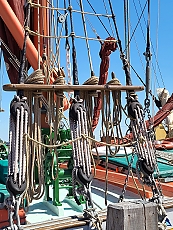
At the quay side
See the neat ropes and rigging
Of the moored river barge

At the quay side
See the neat ropes and rigging
Of the moored river barge
NOT FAR FROM the busy A13 road that links London with Tilbury and places further east, and surrounded by a sea of unremarkable dwelling houses in the London Borough of Barking & Dagenham, stands an unexpected historical Tudor architectural treasure: Eastbury Manor.

This beautiful Tudor mansion, built between 1560 and 1573 for Clement Sisley (or Sysley) and his family, stands on land that had been owned by Barking Abbey until its dissolution in 1539. He was a wealthy businessman connected with high-status families. Married thrice, each of his wives’ dowries added to his prosperity. The manor house remained connected with his extended family until it was sold in 1628. After that, the house and its associated extensive land had a series of owners and tenants until sometime in the 19th century when the building began to deteriorate. The various inhabitants made use of the place’s formerly large grounds for agricultural purposes: principally, grazing. The National Trust (‘NT’) bought the house in 1918, and this purchase is responsible for its survival. Owned by the NT, it was Barking’s local museum between 1935 and 1941. Now, still the property of the NT, it is maintained by the London Borough of Barking and Dagenham.
According to an article written by Hazel Stainer (https://hazelstainer.wordpress.com/2019/05/17/eastbury-manor-house/), Eastbury Manor was noted by the author Daniel Defoe during his travels in 1724:
“A little beyond the town, on the road to Dagenham, stood a great house, ancient, and now almost fallen down, where tradition says the Gunpowder Treason Plot was first contriv’d …”
I checked my copy of Defoe’s book and discovered that the editor of my edition (Pat Rogers) had doubts about this connection with Guy Fawkes et al. Rogers noted that the conspiracy was largely planned in Northamptonshire.
The house, which stands on land rich in clay, is built of bricks made locally, on-site. It is built to an H-shaped plan: two parallel wings are linked by a central portion perpendicular to near their northern ends. The central part and the two wings enclose a charmingly intimate courtyard, whose fourth (southern) side is bounded by a wall connecting the two wings. Although a modern staircase and lift have been added, the house’s original timber spiral staircases were housed in octagonal towers that encroach onto the northwest and northeast corners of the courtyard: they are classed as ‘external staircases’.
The house and its garden have many fascinating features typical of Tudor architecture. For example, in the Great Hall on the ground floor, there is a huge fireplace. It is large enough for several adults to stand within it. Our informative guide directed us to look up into the large chimney. There, we could see platforms that were built to allow workmen to climb into the chimney to clean it in the era long before there were chimneysweeps with special equipment. The Tudor brick wall surrounding one of the gardens has 17 small niches. These were designed as bee boles, in which skeps, baskets where bees lived, were placed. Interesting as these and many other things are, the most amazing feature is to be seen in the so-called Painted Chamber on the first floor, which we reached using the original timber staircase.
Discovered beneath layers of paint after a fire during the 19th century, are the sizeable fragments of two exceptional wall paintings. It is believed that these were commissioned by the London Alderman Sir John Moore who died in 1603. His coat of arms is depicted on one of the pictures. Moore, who took an interest in international trade and the then proposed East India Company, used the house as his country home.
The paintings depict trompe-l’oeil walls with columns, classical figures, and archways. The latter frame depictions of countryside and nautical scenes. Apart from their great age and skilful execution, these frescos are remarkable for their use of perspective. The lady who was showing us around the Manor mentioned that these wall paintings are some of the earliest surviving examples of pictures in England displaying the kind of perspective that is now commonly used in Western European art. So-called ‘true geometric perspective’ was developed by Italian painters during the 14th and 15th centuries. Its use spread to other parts of Europe and would have been known in England by the time of Moore’s occupancy of Eastbury Manor. The surviving wall paintings were executed before his death in 1603, but by whom we might never know. It is quite possible that the artist had either been abroad or had come from overseas. Whoever painted these lovely images had a good grasp of what was then regarded as the latest way of portraying the illusion of depth and distance. Whether there are earlier examples of surviving paintings created in England (using tru perspective) than those at Eastbury Manor, I do not know. So, until I am wiser on the subject, I will accept what we were told. I have seen older surviving wall paintings in English churches, but none of them display even the slightest hint of true geometric perspective.
All in all, it is well worth venturing into the rather dull suburbs of Dagenham and Barking to visit Eastbury Manor. It might not be as glorious as other surviving Tudor edifices, such as Hatfield House, but it is no less a wonderful reminder of an era long-since passed.
THE FIRST DENTAL practice in which I worked was in the village of Rainham in north Kent. Although I practised there from 1982 until about 1994 and knew that there is another place called Rainham in east London, I never ever visited it. It was only in August 2022 that we drove to Rainham, formerly in Essex, and now in the London Borough of Havering. Situated between Dagenham and Tilbury, the former Essex village contains a few reminders of its past: several cottages; a fine old parish church; and Rainham Hall. It was to see the latter that we travelled through the industrial areas of east London to reach Rainham.

Rainham Hall, now beautifully maintained by the National Trust (‘NT’), was built in about 1729 by John Harle (1688-1742), who was buried in the nearby parish church. Son of a successful mariner of South Shields, who had made his fortune shipping coal from South Shields to London, John became a prosperous businessman in London. Harle came to Rainham (Essex) in 1728, and built the fine brick house, which we see today. As the NT’s guidebook pointed out:
“By aristocratic standards, the Hall is a modest house … The Hall is a rare survivor and a wonderful example of early 18th-century architecture. It was designed as a home, not for the super-rich, but for the ‘middling sort’ of successful marine merchant.”
Between Harle’s death and WW2, the Hall became the property of a series of different people, and occupied by many owners and tenants. During WW2 and until 1954, the Hall was requisitioned by Essex County Council, who used it for various purposes including as a nursery for the children of working women. The Hall was offered to the NT in 1945 and the organisation adopted it 4 years later.
Until the 1990s, the Hall had a series of tenants. Each of them had interests in arts and design. First, the place was leased to the architectural historian Walter Ison (died 1997) and his wife, the artist and architect Leonora Payne. In 1962, they left, and the Hall became home to Anthony Denney (1913-1990). Denney, who trained at the Royal College of Art in London was already an established fashionable fashion photographer and collector of modern art by the time he came to live in the Hall. He helped restore the house. After Denney left the house in 1969, it became home to the architect Adrian Sansom and his wife Marilyn, a cellist. In the 1980s, the Hall’s tenants were the viola player Paul Silverthorne and his wife Mary. They encouraged local residents to use the Hall’s extensive gardens and also did restoration work. Stefan Roman, the film-set designer and his family followed the Silverthornes, and the last tenants were the painter David Atack and his family.
The visitor to Rainham Hall can wander through rooms on the ground, first, and second floors. The various inhabitants of this large but intimate family dwelling have all made modifications to the building, but mostly in keeping with the age and character of the Hall. When we went around recently, many of the rooms were being used to house exhibits relating to the life and work of Anthony Denney. We entered the garden, which was in a sad state because of the lack of rain and the heatwaves affecting most of England. The recently restored stable block will be discussed in a future essay. I am glad that we visited Rainham in Havering. Although it cannot be described as being one of England’s most picturesque places, it is certainly more pleasing to the eye, and has more redeeming features, than Rainham in Kent.
DURING AN INTERVAL of a concert given in Thaxted’s parish church, someone sitting close to us asked whether we hade ever been to a performance in what she described as the ‘superb concert hall’ in nearby Saffron Walden. We had no idea that the small Essex town had a concert hall of note. Always keen to enjoy classical music and to have an excuse to visit Essex, we booked for a concert given on the 12th of August 2022 by both the Essex Youth Orchestra and the Essex Young People’s Orchestra.
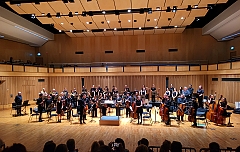
The concert hall, which has seating for audiences of over 700 people, was opened in late 2013. It is attached to Saffron Walden county high school, and was financed by a private donation of at least £10 million. This is believed to be the largest private donation to have been made to a state school. The hall is used both for school purposes and for public performances. The venue attracts ‘big names’ in both the classical and non-classical music worlds. For example, the Autumn 2022 programme includes concerts by: the Hallé Orchestra, Isata Kanneh-Mason, the London Philharmonic Orchestra, Lady Smith Black Mambazo, Courtney Pine, The Sixteen, the Pasadena Roof Orchestra, and so on. In addition to these better-known performers, there is a host of others.
The air-conditioned hall is beautiful. It is spacious, and fitted with adjustable acoustic panels and its walls are lined with birch wood. We heard a wide range of compositions beautifully performed by the two orchestras. The acoustics were fantastically good. The sound quality within the hall rivals that of the best concert halls in London. A small grumble is that the seating is not overly comfortable, but that did not detract from our enjoyment of the music performed by some of the best young musicians in Essex. Saffron Walden is not far from London, but it feels like it is much further away. If you do not mind night driving, it would be feasible to drive to and from Saffron Hall to enjoy an evening concert, but my suggestion is to spend a night somewhere near the hall and to enjoy Saffron Walden, its concert hall, and its rustic surroundings.
PARADISE IS A café in Great Dunmow, a small town in Essex. With several small eating areas and a cool breeze blowing through it, this comfortable eatery was a good place to eat lunch on a day when the air temperature was 32 degrees Celsius. Judging by its menu, which includes gözleme and shish kebabs, and the fact that the staff were speaking Turkish, it would be correct to say that Paradise is a Turkish run establishment.
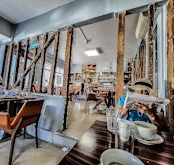
Having noted that, it would be fair to say that this place is a well above average “greasy spoon caff”. However, the food is not at all greasy. In addition to food items usually associated with Turkey, Paradise offers the full range of English breakfast items, as well as wraps, burgers, sandwiches, and chicken curry.
One impressive feature of Great Dunmow’s Paradise, apart from the attentive and efficient staff and tasty food, was flexibility: we were able to order exactly what we wanted even if it was not on the menu.
It is always fun to discover reasonably priced, unpretentious places like Paradise. We will return there next time we are in the area.
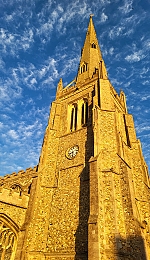
Reaching for the sky
A place for hopeful souls
The holy House of God
MUSEUMS OFTEN CONTAIN interesting surprises for visitors. The small museum in Burnham on Crouch (in Essex) is no exception. It amused me to see that amongst the exhibits there were several early examples of so-called pocket calculators – too large to fit most pockets. I was given one of these (made by Casio) in about 1974, and at the time this was a wonderful gift as well as being a useful tool. I was able to replace my slide-rule with my Casio. These calculators, along with other things that were regarded as being ‘the latest thing’ in the 1960’s and ‘70s, were not what surprised me most at the museum. Hanging on the wall of one side of a staircase, there was a huge piece of cloth with advertisements printed on it. It is part of the fire safety curtain that was used in the local cinema, The Rio (see: https://adam-yamey-writes.com/2021/11/13/a-small-cinematic-survivor/) , in the 1930s.

Fire curtains are usually made of metal or heavy materials containing asbestos (or some other fire retardant). They are designed to be lowered (often automatically) should a fire break out on the stage of a theatre or cinema in order to prevent the fire spreading to the auditorium. In 1613, a cannon misfired on the stage of Shakespeare’s Globe Theatre, causing the thatch on the building’s roof to catch fire; the theatre was destroyed. There were no fire curtains in those days.
The first fire curtain (it was made of iron) to be installed in the UK was in 1794 at the Theatre Royal Drury Lane in London. A large fire at the Theatre Royal in Exeter in 1887 led to the wider use fire curtains in British theatres, and later in cinemas. However, these safety devices were not infallible. A fire that began on the stage of the Iroquois Theatre in Chicago (USA) led to the deaths of about 575 people when the fire safety curtain snagged and could not be fully lowered. This led to the invention of an improved automatic fire curtain by John Clancy a year later in 1904.
Fire curtains, which must be lowered at least once during every performance in the UK can be plain or decorated. Plain fire curtains, when lowered, can serve as screens on to which advertisements are projected. The example at the museum in Burnham has advertisements printed or painted on it. Local businesses paid the cinema to have their adverts printed on the curtain that hung in the Rio during the 1930s. The Treasurer of the museum explained that of the many Burnham firms, who placed adverts on the fire curtain, only one of them is still in business. Thus, the old fire curtain (or at least the half of it that is in the museum) not only protected Burnham’s cinemagoers from burning but also serves as a valuable record of the town as it was almost 100 years ago.
BURNHAM-ON-CROUCH in Essex is a picturesque port on the River Crouch. Currently, it is a leisure resort and a centre for ship maintenance and boating. It was once famed for what grew in great numbers on the muddy bed under the water of the Crouch: oysters. For several centuries before the river became polluted in the 19th century, the oyster beds in the Crouch (and a few other places in Essex) were very profitable, providing much employment.
“On the shores of England the principal nurseries of oysters, not only for the English markets, but also for the foreign, are those on the coast of Essex and the estuaries adjoining: those taken there are called ‘ Natives/ Mr. Sweeting claims the name as peculiarly applicable to his fishery, as within his memory no strange oysters have ever been introduced…”
Men were required both to dredge the oyster beds and process the molluscs as well as to protect the precious creatures from thieves based in other places on the Essex coast.
Today (11th of July 2022), we visited the small but excellent museum in Burnham-on-Crouch. On the ground floor, we saw a retired mechanised oyster grading machine (made in France and capable of sorting 7000 oysters per hour) amongst the exhibits. On the upper floor of the museum, which is housed in a former boat repair building, we met the museum’s treasurer, who is a mine of interesting local history. He told us several things about Burnham’s oyster heydays. I hope that what I am about to tell you is a reasonably accurate summary of what he told us. If it is not totally accurate, I hope that he and you, dear reader, will forgive me.
For 10 years, I used to live in north Kent and often visited Whitstable to enjoy eating oysters for which this Kentish seaport is famous. The treasurer in Burnham told us that many of what are described as ‘Whitstable oysters’ were born in the mud beneath the river in Burnham-on-Crouch. From what I can recall, the young oysters, which grow in the mud beneath the Crouch, are dredged and then placed on boards to which they attach themselves. Keeping them submerged in seawater, the boards to which the young oysters are attached, were transported to Whitstable where they matured in its waters. The Burnham oysters were ‘native’, meaning that they began their lives there; they were not imported, as Thomas Campbell Eyton described in “A history of the oyster and the oyster fisheries” (published in 1858):
“On the shores of England the principal nurseries of oysters, not only for the English markets, but also for the foreign, are those on the coast of Essex and the estuaries adjoining: those taken there are called ‘Natives’. Mr. Sweeting claims the name as peculiarly applicable to his fishery, as within his memory no strange oysters have ever been introduced.”
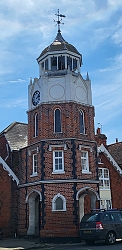
One of the exhibits in the museum is a large model of the octagonal Victorian clock tower that dominates Burnham-on-Crouch’s High Street. The tower stands next to the building that used to house the former St Mary’s School. It was erected in 1877 to honour the local philanthropist Laban Sweeting (1793-1876). So, what, you might ask, and what has he got to with what I have been writing about?
Laban Sweeting, mentioned in the quoted from Eyton’s book, was a philanthropist; a member of The Burnham River Company; and he was one of the town’s oyster merchants. The museum has amongst its exhibits a small barrow, which used to be wheeled around Burnham by a member of the Sweeting family. It would have carried baskets of oysters ready for sale to the town’s populace.
We had visited Burnham once before, and although I was impressed by the clock tower, I knew nothing of its history. Neither did I know about the town’s association with oysters, which were poor people’s food in the 19th century, when chicken was a luxury. How times have changed.
ENGLISH PARISH CHURCHES are full of surprises. The church of St Mary the Virgin in the Essex village of Hatfield Broad Oak (once known as ‘Hatfield Regis’) is no exception. Its nave is a surviving remnant of a Benedictine priory founded in 1135 by Alberic De Vere (c1085-1141) The highlight of this church is a recumbent stone effigy of Alberic’s grandson, Robert de Vere, 3rd Earl of Oxford (c1155-1221), who was born in Hatfield Broad Oak. He was one of the barons who forced King John into signing the Magna Carta at Runnymede in 1215. The effigy was placed in the church either by his son or his grandson. It lies on the floor of the chancel in front of the nave and close to the high altar. Whereas in many churches, there is an unobstructed view of the altar (or a rood screen) from the western end of a church, Robert’s effigy sticks out like a sore thumb when you are looking along the length of the nave

The effigy, which is in remarkably good condition given its age, depicts Robert lying with his legs crossed. His right hand clutches a sword and there is a shield attached to his left arm. His left foot rests on something that is not easily identifiable as it has been damaged. What is most remarkable about this funerary sculpture is that Robert is almost entirely clad in chain mail. Part of his face peers through a circular gap in the armoured head dress. The carver of this monument took great pains to show the chain mail in fine detail. For me, this is what makes the effigy quite wonderful.
Fascinating as is the effigy, Robert’s family interested me because of its connection with Kensington in London. Robert’s great grandfather Alberic (or Aubrey) De Vere (1040-1112) was a tenant-in-chief of William the Conqueror. The Domesday Book records that he was a great landowner with properties in nine counties. One of these was the manor of Kensington in the County of Middlesex. His name is remembered today in the Royal Borough of Kensington and Chelsea by the street name Aubrey Walk, which leads to Aubrey House, currently a private residence.
The day before we visited Hatfield Broad Oak, we were in Coggeshall (Essex), where I spotted a memorial to a protestant martyr, Thomas Hawkes (see: https://adam-yamey-writes.com/2022/06/26/burnt-rather-than-baptised/), who had worked for the De Vere family. Had Hatfield Broad Oak not been such a pretty village, I doubt that we would have stopped there. That would have been a pity because then we would have missed seeing the chain mail clad effigy and its interesting connection with a part of west London, with which I am quite familiar.
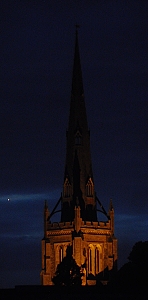
WHILE ELTON JOHN was performing in front of thousands in London’s Hyde Park in late June 2022, a small ensemble was performing works by the baroque composers Pergolesi and Purcell in the large medieval gothic church in Thaxted (Essex). The superbly performed concert in Thaxted starring the Armonico Consort ended well after 9 pm. This was not a problem for the many well-healed members of the audience in the church, who lived locally and were able to feed themselves in their own homes.
We could have eaten before the concert, which commenced at 7 pm, but were not hungry before that early hour. The pubs in Thaxted informed us that their kitchens stopped taking orders for food before 845 or 9 pm.
At a pub called the Star, someone hearing us asking about food after 9 pm, recommended we should head for Farouk’s. The bar attendant and several bystander’s agreed with our informant. The bar attendant kindly said that we could bring food from Farouk and she would save a table for us at which we could sit and eat after the concert.
Farouk is the owner of a caravan parked in a yard behind a petrol filling station in Thaxted. He and his colleagues, all from Turkey, prepare and sell Turkish food in the caravan. And, his eatery closes not at 845 or 9 pm, but at 11 pm.
After hearing superb renderings of Pergolesi’s “Stabat Mater” and Purcell’s “Dido and Aeneas” (semi-staged), we headed for Farouk’s caravan and the Star pub.
While waiting for our food to be prepared at about 9.40 pm, Farouk explained he had come from Gaziantep. He said that in his part of Turkey, which is quite close to Cyprus, Turkish is spoken with an accent that is very similar to that spoken by Cypriot Turks. During the ten minutes it took to prepare our food, Farouk took many food orders over the phone, which goes to show that in Thaxted there is a healthy demand for food after 9 pm.
We enjoyed our food at the table reserved for us at the Star. This welcoming pub is popular with locals. I suspect that its lively clientele was a different segment of Thaxted’s population from that which attended the concert in the church.
 yamey
yamey 