Packed with art in St Ives, Cornwall

THE TATE GALLERY has two branches in the picturesque fishing port of St Ives in Cornwall. The artworks displayed at Tate St Ives are contained in a building overlooking Porthmeor Beach, constructed between 1983 and 1993. It replaced a disused gasworks, but I feel that the gallery’s almost fascistic architecture neither does anything to enhance the town or to match the beauty of many of the items displayed within it. The other part of The Tate in St Ives is house and gardens of the sculptor Barbara Hepworth (1903-1975). A visit to her former home and its garden, filled with her sculptures, is a delightful experience.


Barbara Hepworth and her sculpture in the Penwith Gallery

Not far from the Tate St Ives, there is another ‘must-see’ attraction for lovers of modern and contemporary art. This is the Penwith Gallery on Back Road East. Less visited than the two Tate institutions in St Ives, the Penwith is the home of the Penwith Society of Arts, one of whose founders was Barbara Hepworth. The gallery contains one of the loveliest Hepworth sculptures that I have seen to date. Maybe I like it because it recalls the works of the Romanian born sculptor Constantin Brancusi (1876-1957), a sculptor whose works are much to my taste. To be frank, I am not a great lover of Hepworth’s sculpture and this piece in the Penwith is less typical of what I do not like about her work.

Returning to the gallery itself, its website reveals (https://penwithgallery.com/):

“The society was founded in 1949 by Barbara Hepworth,Ben Nicholson, Peter Lanyon, Bernard Leach, Sven Berlin and Wilhelmina Barns– Graham, amongst others. Later members have included Patrick Heron, Terry Frost and Henry Moore (honorary member). This association with so many progressive and influential artists has given the Penwith Society a unique place in British art history.

Today the society continues to play a central role in the thriving and vibrant St. Ives art community, exhibiting contemporary art from Cornwall and beyond.”

The gallery is housed in a former pilchard packing factory. Its ceiling is supported with roughly hewn granite pillars, painted white. Part of the ceiling is glass-covered, allowing natural light into the largest of the three main display areas. The rest of the ceiling does not transmit light.

The gallery displays an ever-changing collection of artworks, which are on sale. Created by members of the Society or artists, who have worked in the Society’s studios, they include sculptures, prints, paintings, and ceramics. Some of the works are figurative and many of them are abstract. Some are halfway between the two extremes. I have enjoyed abstract art since my childhood. This is probably because my mother, who was a sculptor who enjoyed creating abstract pieces. The lovely Hepworth piece that stands next to a fine photograph of its sculptor, and several other works, form part of the Penwith’s permanent collection. A small range of books and cards are available for visitors to purchase.

Every time I visit the Penwith, I enjoy the gallery’s spaces and the works displayed within them.  Instead of being packed with pilchards, as it was in the past, and other tourists, as are the two Tate establishments, the Penwith is comfortably packed with pleasing works of art, which you can take home if you can afford them, and some of them are not excessively costly.

Crossing the Camel

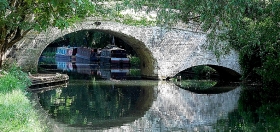
THE CONSERVATIVE CLUB in Cornwall’s Wadebridge has opened its doors to the general public. Visitors to the club of any political persuasion can enjoy superbly cooked food in its bar and dining room, which bears the name ‘Winstons’. The club, which is located at the higher end of Molesworth Street, is housed in a building that is far more than 100 years old. The street runs gently downhill towards a multi-arched stone bridge that crosses the River Camel.

Before there was a bridge across the river, the town now known as Wadebridge was called ‘Wade’ and stood beside a ford across the Camel, whose name probably means ‘crooked one’. Crossing the river by means of the ford was perilous. Before the bridge was built, a ferry became available as an additional means of traversing the wide stream. Becoming distressed by the number of people and animals that died whilst attempting to cross the river, the Reverend Thomas Lovibond, Vicar of Egloshayle, had the idea of building a bridge. This bridge was constructed between 1468 and 1485. It is said that its supporting piers rested on packs of wool. With the arrival of the bridge, the town of Wade became renamed ‘Wadebridge’. The chronicler and topographer William of Worcester (1415-c1482) mentioned the bridge as ‘Wade-brygge’ in 1478’.

 The bridge was widened in 1853 and again in 1963. It was refurbished in 1994. Although the stonework of the arches looks old, I am not sure how much of it is part of what was constructed in the late 15th century.

During the Civil War (1642-1651), Cornwall was a Royalist stronghold. Much of the rest of the southwest of England supported the Royalist’s opponents, the Parliamentarians. Wadebridge’s bridge was an important strategic location. In 1646, the Parliamentarian Oliver Cromwell (1599-1658) led 500 dragoons and 1000 horsemen successfully to take control of the bridge. The story goes as follows (www.cornwalllive.com/news/history/oliver-cromwell-came-person-take-511634):

“After losing the decisive Battle of Torrington in Devon on February 16, 1646, the Royalists escaped into Cornwall … [the] Parliamentarians, led by Thomas Fairfax, hunted them down and reached Launceston on February 25 and Bodmin on March 2 … On March 5 the Cornish Royalist leaders realised they were fighting a losing battle and surrendered the east of Cornwall to the Parliamentarians at Millbrook … A day later, as the battle moved westwards, Parliamentarian commander Oliver Cromwell and 1,500 of his soldiers descended onto Wadebridge to take control of the bridge and prevent its use by the Royalist army. The route across the bridge was considered to be of such strategic importance that Cromwell, who had been spending months mopping up resistance in Devon and Cornwall, personally led his troops there to capture it.”

The huge forces brought by Cromwell were either unnecessary or an effective deterrent because the Royalists withdrew without putting up a fight (www.wadebridgemuseum.co.uk/bridge.html).

The first motor car to cross the bridge did so in 1901. The crossing continues to play an important role in the transport network of Cornwall. The town is a charming small centre, well supplied with pubs, independent shops, and branches of supermarket chains. It is a part of the Parliamentary constituency of North Cornwall. Diners at, and members of, Wadebridge Conservative Club might (or might not) be pleased to know that the local MP since 2015 is Scott Mann, a Conservative. He was born in Wadebridge and attended its local state secondary school. I suppose that he must have dined or drunk at the Conservative Club where we enjoyed first class food. So, next time you are in Wadebridge, sweep aside any political prejudices you might harbour and head for Winstons at the Conservative Club and enjoy a great meal.

Imitating the great: gothic in Winchester

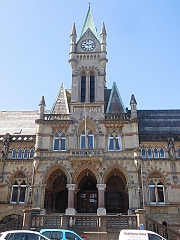
THE CITY OF WINCHESTER has one of the longest gothic cathedrals in the continent of Europe. Built from 1091 onwards under the auspices of Bishop Walkelin, a relative of William the Conqueror, the bulk of the gothic part of the edifice was erected in the 14th century in the Perpendicular style of gothic. What was created, is exceedingly beautiful and gives a great sense of space. It is a masterpiece of gothic stone masonry. The cathedral stands not far from another large building, also built in a style of gothic inspired by what was achieved during mediaeval times.

This near neighbour is far younger than the cathedral. It is the 19th century Winchester Guildhall, which was constructed between 1871 and 1873. It stands on the site of St Marys Abbey, which was taken over by Henry VIII in the late 1530s during the Dissolution of the Monasteries. The remains of the abbey, which was known as ‘Nunnaminster’, persisted until the 17th century, after which they were removed. Today, some excavated remnants can be seen behind the Guildhall.

Guildhall, Winchester

The Guildhall was built in the gothic revival style to the designs of the architects Albert William Jeffery (1840-1915) and William Skiller (1838-1901), who also submitted a design for a town hall for Hastings in Sussex. Tragically, Skiller committed suicide in 1901 (http://hastingschronicle.net/archives/architect-hangs-himself/). The Guildhall was later extended by J. B. Colson (1820-1895), who was the surveyor of Winchester Cathedral.  The original building is rich is features borrowed from mediaeval gothic, but it is topped by roofing styles that remind the viewer of French ‘chateaux’. One source summarises the Guildhall’s appearance as:

“ Gothic, symmetrical, with a middle tower and this as well as the angle pavilions provided with French pavilion roofs”; and as having a “deeply vaulted porch” at the entrance — for all this part “[t]he style is Second Pointed,” while Colson’s long extension is “much plainer”” (https://victorianweb.org/art/architecture/winchester/1.html).

Without doubt, the cathedral is a far finer building than the Guildhall, but both are impressive in their own ways. The cathedral’s integrity depends on its gothic features that have both structural and aesthetic functions, whereas in the case of the Guildhall these features have a greater decorative than structural purposes.

The Guildhall is an example of so-called ‘gothic revival, which lovers of London’s St Pancras Station and Bombay’s Victoria Terminus (Chhatrapati Shivaji Maharaj Terminus) will appreciate’. Years ago, I read “The Gothic Revival: An Essay in the History of Taste”, written by the art historian Kenneth Clark (1903-1983) in 1928. One thing that impressed me was, if I recall correctly, that the author queried whether the gothic style of architecture ever really died out in England, as it did elsewhere in Europe. Clark suggested that the gothic style continued to be used. In other words, what is described as ‘gothic revival’ is simply a continuation of the early use of this style. It is my impression that by the 19th century, when, for example, the Winchester Guildhall was built, architects were often simply borrowing features of earlier gothic buildings, as, for example Winchester Cathedral, and applying them often more mechanically than artistically. Often when the gothic style was being used structurally, as is the case in many churches built during the Victorian era, it tends to be imitative rather than creative, as is the case in the great mediaeval cathedrals and other churches. There are a few exceptions, where the 19th century architect manages to use the gothic style both structurally and artistically, as for example in the Church of St Augustine in London’s Kilburn.   Be that as it might be, The Guildhall does not lack in good aesthetic features and adds positively to the rich tapestry of the architectural scene in the historic centre of the city. I recommend visitors to Winchester not to concentrate all their time at the Cathedral but to spare some to view the Guildhall before seeing the other sights of the city.

King Alfred gazes over Winchester

KING ALFRED RULED the West Saxons from 871 to c886 and king of the Anglo-Saxons from c886 to 899. He was known as ‘Alfred the Great’. Amongst his many achievements was encouraging education and proposing that primary education was taught in (Old) English, rather than Latin. Winchester was Alfred’s capital and the place where he was buried there for a while. After the Norman Conquest in 1066, his remains were removed to Hyde Abbey near Winchester. This was destroyed in 1538 during the Reformation. Despite this, his grave remained intact until 1788, when the land where he was interred was redeveloped to build a jail. Since then, the whereabouts of his remains is unknown.

Despite, the disappearance of his bones, King Alfred dominates the centre of Winchester in the form of a huge statue near to the city’s cathedral, rich in gothic features, and its Guildhall, which is richly adorned by Victorian gothic features. The statue was erected in 1899. A plaque at its base reads:

“To the founder of the kingdom and nation D. October DCCCI. Winchester and the English name MDCCCI”

DCCCCI, being Roman for 901 and MDCCCCI, being Roman for 1901.

The tall bronze statue was designed by Sir William Hamo Thornycroft (1850-1925), a sculpto who might have been unknown to me had I not become aware of him whilst walking near London’s Holland Park back in 2017. He was an important figure in the New Sculpture movement, whose members’ oeuvres bridged the gap between the neo-classical tradition, popular during the 19th century, and early modernist trends at the end of the 19th century and beginning of the next.

I was roaming around Kensington taking photographs of buildings of interest prior to writing a piece about them when I spotted a plaque on a house in Melbury Road. Number 2a was Thornycroft’s studio, which was designed by his friend, the architect John Belcher (1841-1913).

Although I did not realise that they were created by Thornycroft before I wrote this today, I am familiar with two of his other creations: the statue of Oliver Cromwell outside The Houses of Parliament and “The Sower” at Kew Gardens. His Alfred statue is far larger than the other two.

I wonder what the great king would have thought if he knew that at his feet today, there is a short-term car park and that his capital’s cathedral now charges a fee for visitors to enter within it.

A chapel that became a barn

PHILIP’S NAVIGATOR BRITAIN is a detailed (1 ½ miles to the inch) road atlas covering England, Scotland, and Wales. It is extremely useful for finding one’s way through Britain’s maze of narrow country lanes if, like us, you do not make use of GPS systems. One of the many features of the maps in this atlas is that it marks old buildings and other sites of interest in both towns and deep in the countryside. Recently (June 2021), we were driving around in rural Wiltshire, having just visited the small town of Bedwyn when I spotted that there was an old chapel nearby, close to the hamlet of Chisbury.

The area in which Chisbury is located is the site of an ancient hill fort in which archaeologists have found artefacts from the Palaeolithic era, as well as the Neolithic and Bronze Ages. The fort, whose earthworks are still discernible, was later used by the Romans. Long after the Romans had left England, the manor house of Chisbury was built within its site.

In the 13th century, the Lord of Chisbury Manor built a ‘chapel of ease’, St Martin’s, close to his manor house. According to Wikipedia, such a chapel is:

“…a church building other than the parish church, built within the bounds of a parish for the attendance of those who cannot reach the parish church conveniently.”

The chapel of ease at Chisbury was built to serve the household of the Manor House as well as villagers nearby, to save them having to travel to the nearest parish church which was in Great Bedwyn.

In 1547, during the Reformation of The English Church, the chapel, like many other places of worship in Henry VIII’s realm, ceased to be used. Instead of being demolished, as so many ecclesiastical buildings were at that time, the chapel was re-used as a barn. The barn continued to be used over several centuries until 1925, when it was designated a building of historical importance. Now, it is maintained by English Heritage. This re-purposing of a place of worship reminded me of what I saw when I visited Albania in 1984. At that time, religion of any sort had been made illegal by the Stalinist regime led by Enver Hoxha. Mosques and churches had either been demolished or re-purposed as sports halls, cinemas, and for other non-religious uses.

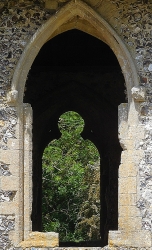
The chapel of Chisbury is beautiful. The glass has been long lost from its windows. Trees can be seen from within the chapel through its carved stone gothic windows. The ceiling of the chapel is timber framed, but I suspect that these are no longer the original timbers. The roof is thatched. The floor is at two levels, higher at the west end than the east. Steps lead from one level to the next. The two levels might reflect the fact that the chapel is built on a steeply sloping hill.

On the inside of the west wall of the building, close to the way into the chapel, there is a faded red painted circle enclosing a cross. Symbols like this were painted on to the walls of buildings during the consecration ceremonies of building about to become churches. What you can see in the chapel at Chisbury must have survived many centuries. Maybe, it has been touched up from time to time.

It is written that Jesus Christ was born in a kind of barn surrounded, as the story goes and many artist have depicted, by farm animals. I wonder whether this went through farmworkers’ heads as they used the former chapel as a barn for a variety of agricultural purposes.

Had it not been for builders working nearby, the chapel would have been silent except for birdsong. I am glad we made the small detour to see this delightful relic of mediaeval life in England.

Afternoon by the canal

THE VILLAGE OF APSLEY, now a suburb of Hemel Hempstead in Hertfordshire, has no connection with Apsley House at London’s Hyde Park Corner. The house, once home to The Duke of Wellington, derives its name from Apsley in Sussex. The place in Hertfordshire, which we visited with friends today, derives its name from an Anglo-Saxon word meaning ‘aspen’ (a kind of tree). We had lunch with our friends at a waterside pub called The Paper Mill.

Although the pub appears to be of recent construction, its name recalls the fact that it is built near the site of a once innovative paper making establishment. John Dickinson (1782-1869) was the inventor of a machine that made paper continuously as opposed to the previous manual methods that produced sheets of paper rather than rolls of it. He also invented a range of other practical products including security paper impregnated with silk threads, which was known as ‘penny post’, and, still in use today, the envelope with a gummed flap.

During the early part of the 19th century, Dickinson bought several mills in and around Apsley. He converted these for the manufacture of paper products. Only one of his three mills still stands today. The mills were located close to the then recently built Grand Junction Canal (now ‘Grand Union’). The canal provided a practical mode of transport for raw materials and finished products. The pub where we ate lunch is named to honour the memory of what was once a thriving industry in Apsley. It is located next to the canal and contains a framed family tree of John Dickinson’s family.

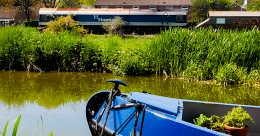
After a lazy lunch in the sun by the waterside, we took a leisurely stroll along the canal. Modern housing developments line parts of the stretch of water flowing through Apsley. Other parts are lined with shady trees and dense bushes, which hide modern office buildings that are served by a main road running parallel to the canal. Unlike other stretches of the canal, which we have walked along, there was a notable absence of waterfowl, except for a couple of swans with their four cygnets, and a pair of ducks. Other signs of life on the canal were the occasional slow moving narrow boat and the inhabitants of stationary craft moored along the banks and in a marina near the pub.

It was a hot afternoon and being beside the canal was pleasant. Occasional gentle gusts of cool air added to our enjoyment.

Take me to the Tivoli

WIMBORNE IS A CHARMING small town in Dorset, a little north of Poole and Bournemouth. Famed for its Minster church with its mediaeval chained library, the place is rich in old buildings. One of these, looking less old than many of its neighbours, houses the Tivoli Theatre. It attracted my attention because of its (heavily restored) art deco features.

Housed in what was originally the 18th century Borough House, the theatre-cum-cinema was created in 1936 to the designs of Edward de Wilde-Holding, a prolific architect. The cinema was closed in 1980 and was threatened with demolition for a road scheme, which fortunately was abandoned. It was restored by a group called ‘Voluntary Friends of the Tivoli’ and reopened in 1993. In addition to showing films, the theatre is used for live events on its stage.

The Tivoli was not the only art deco cinema we spotted on our recent trip to the area around Winchester. 28 miles northeast of Wimborne, there is another one, The Plaza in Romsey, which was built in 1931 as a cinema but is now used as a theatre. Unlike the Tivoli in Wimborne, which occupies an old building, the Plaza in Romsey was purpose-built as a cinema.

A peculiar post office

WHEN I WORKED AT MAIDENHEAD, I used to travel there by train from London Paddington. Many of the trains terminated at a station called Bedwyn, which serves Great Bedwyn. I visited this small town on the Kennet and Avon Canal for the first time only recently.  While driving through the place, I noticed a building covered with gravestones and other ornamental carving. My curiosity was aroused.

The name ‘Bedwyn’ might have been derived from ‘Biedanheafde’, an Old English word meaning ‘head of the Bieda’, which referred to a stream in the area. In 675 AD, “The Anglo Saxon Chronicle” recorded the battle of ‘Bedanheafeford’ between Aescwine of Wessex and King Wulfhere of Mercia, which is supposed to have been fought near the present Great Bedwyn. The will of King Alfred the Great (c848-899) makes reference to Bedwyn. In short, Bedwyn has been a recognizable settlement for a long time.

Bedwyn’s combined post office and village shop can be found in a long, rectangular brick building on Church Street. The wall at the east end of the edifice carries a depiction of the Last Supper and above it, God on a throne, surrounded by saints and angels. These sculptural panels are in white and blue and somewhat resemble the kind of things produced by the Florentine sculptor Luca della Robia (1400-1482). Three gravestones are attached to the west facing end of the post office. A wooden gate next to this end of the building is labelled ‘Mason’s yard’. The front of the building, facing the street, is adorned with carved funerary monuments including gravestones, some of which bear humorous inscriptions.

The shop is attached to a house with a front door framed by a gothic revival porch. A carved panel in the porch reads: “Lloyd. Mason.” I asked some of the customers queuing up to enter the shop/post office if they knew anything about the curious decoration of the building. I was told that the place had once been the workshop of a stone mason who specialised in funerary items. My informant said that most of the carvings attached to the building were test pieces made by the stonemason’s apprentices; rejected or uncollected items; and offcuts.

Benjamin Lloyd (1765-1839), who died in Bedwyn, started his stonemasonry business in 1790 (www.mikehigginbottominterestingtimes.co.uk/?p=2825). He was responsible for some of the work done during the construction of the Kennet and Avon Canal, which began before he was born and was eventually completed in 1810. The company still exists. Now, it is run by John Lloyd, the seventh generation of the family to maintain the business (www.johnlloydofbedwyn.com/about-us). However, his premises have moved away from Bedwyn’s post office.

Benjamin Lloyd is buried alongside his wife Mary (1764-1827) in St Mary’s Church Burial Ground in Great Bedwyn. I do not know, but I would like to imagine, that their gravestone was made in the company Benjamin created.

Lady with the lamp

ROMSEY IN HAMPSHIRE is a delightful small town with a spectacular parish church, Romsey Abbey, with many Norman and gothic architectural features. The edifice that stands today was originally part of a Benedictine nunnery and dates to the 10th century, but much of its structure is a bit younger. It rivals some of the best churches of this era that we have seen during travels in France. That it still stands today, is a testament to the good sense of former citizens of the town.

During Henry VIII’s Dissolution of The Monasteries in the 16th century, much of the nunnery was demolished. However, the establishment’s church was not solely for the use of the monastic order but also served as a parish church for the townsfolk. As Henry VIII was not against religion per se, and the need for a parish church was recognised, the townsfolk were offered the church for sale. In 1544, the town managed to collect the £100 needed to purchase the church and what remained of the abbey from The Crown. Thus, this precious example of church architecture was saved from the miserable fate that befell many other abbey churches all over England. However, what you see today was heavily restored in the 19th century, but this does not detract from its original glory.

The town of Romsey is 3.4 miles northeast of East Wellow, the burial place of Florence Nightingale (1820-1910), the social reformer and statistician as well as a founder of modern nursing. I had no idea that Florence was famous in the field of statistics. Her biographer Cecil Woodham Smith wrote:

“In 1859 each hospital followed its own method of naming and classifying diseases. Miss Nightingale embarked on a campaign for uniform hospital statistics … which would ‘enable us to ascertain the relevant mortality of different hospitals, as well as different diseases and injuries at the same and at different ages, the relative frequency of different diseases and injuries among the classes which enter hospitals in different countries, and in different districts of the same countries.’”

In 1858, she was elected a member of the recently formed Statistical Society. So, there was much more to Florence than the commonly held image of ‘the lady with the lamp’ during the Crimean War.

Florence was christened with the name of the Italian city, where she was born. Part of her childhood was spent at the family home of Embley Park, which is 1.8 miles west of Romsey Abbey church and close to East Wellow. Now a school, it remained her home from 1825 until her death.

Broadlands, which was built on lands once owned by the nuns of Romsey Abbey, is a Georgian house on the southern edge of Romsey. It was home to Lord Palmerston (1784-1865), who was Prime Minister in 1856 when the Crimean War came to an end. Broadlands was Palmerston’s country estate. It is maybe coincidental that both Palmerston and Nightingale were associated with both Romsey and the Crimean War.

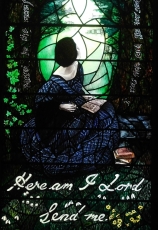
Palmerston is celebrated in Romsey by a statue standing in front of the former Corn Exchange. Florence has a more discreet memorial in the town. It is a stained-glass window within the Abbey church. Placed in the church in 2020, it was formally dedicated in May 2020. It depicts a young lady seated by a tree, her face turned away from the onlooker. Created by Sophie Hacker, the image depicts Florence seated on bench beside a tree in Embley Park. The tree in the window, a cedar, still stands in Embley Park’s grounds. The image is supposed to recall the moment when, as a young girl, she received her calling. Woodham Smith wrote:

“Her experience was similar to that which came to Joan of Arc. In a private note she wrote: ‘On February 7th, 1837, God spoke to me and called me to His service’”.

The window includes the following words above her head:

“Lo, it is I.”

And beneath her:

“Here am I Lord. Send me.”

There are a few other words on the window, some in English and others in Italian.

A visit to Romsey Abbey church is highly recommendable. We thought that we had visited it many years before 2021 and arrived expecting to see an abbey in ruins. We were delightfully surprised to realise that we had mistaken Romsey with some other place, whose name we have forgotten, and instead we had discovered a church that was new to us and unexpectedly wonderful both architecturally and otherwise. Anyone visiting nearby Winchester with its fine cathedral should save some time to come to see the magnificent ecclesiastical edifice in Romsey.