Foot and mouth

Wales 1 SMALL

Before she died in 2012, we used to make annual visits to a dear friend, whom I had known since my childhood, in South Wales. She used to live in London, but when she retired, she moved to a village in the Brecon Beacons, near the River Usk. We stayed in her cottage but were encouraged to leave her in peace from after breakfast until about four in the afternoon. We did not mind this because there is plenty to explore in the area and often the weather was good at the times of the year that we visited her.

In 2001, disaster hit Wales in the form of a vicious outbreak of foot and mouth disease. In order to prevent its spread, all footpaths and many open spaces were closed to visitors. This and the appalling rain that fell relentlessly during our visit, restricted what we could do while we were allowing our guest a few hours relief from her guests. We drove around the countryside not particularly having much fun.

One day, we arrived at a small town with a name I am unable to pronounce correctly:  Llanwrtyd Wells. It was lunch time. We parked outside a hotel near the town centre. The floor of the lobby was covered with a grubby, well-worn carpet. We were shown into an unattractive dining room. Our hopes for having a decent meal fell as we surveyed the room’s dingy uninviting décor. The sight of incessant rain falling outside did little to enhance the dreary mood that this unappealing room was inducing.

The hotel’s owner brought us menus. We asked what he recommended. He said “steaks” and showed us the large range of meats listed in the menu. We asked his advice about which steak to choose. Then, he did something that transformed the dingy place for us.

He gave us a ‘tutorial’ about the relative merits of different kinds of beefsteak and their tastes. The least tasty, in his opinion, was the costliest cut, fillet steak. Sirloin steak was, he advised us, tastier and cheaper than fillet. However, he considered that the tastiest cut was rib-eye. He explained that the latter was marbled with fine streaks of fat, and it was this that gives it its superior taste. We ordered it and discovered he was right. He regretted that he was unable to serve the local, and in his view far superior, Black Mountain beef. This was because of the problems connected with the foot and mouth outbreak.

Whenever I buy steak, I look for rib-eye first, and if this is not available, I go for sirloin. Whenever I think of beefsteak, I always remember that dreary eatery in Llanwrtyd Wells and its helpful landlord. For a long time, I could not remember in which town in Wales, we were given our tutorial about steaks. Recently, I discovered some photographs I had taken there almost twenty years ago. In one of them, there was a pub sign that read “Neuadd Arms Hotel”. Seeing this helped me discover where we had been.
What is in a name

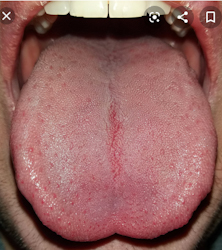
When I was a young child, I used to love eating slices of tongue. It was a cold meat that I really enjoyed. In those days, I never thought about the name of the meat, that is ‘tongue’.

When I was about 10 years old, I put ‘two and two together’ and realised that what I had been eating was once a living animal’s tongue. This realisation put me off eating tongue. I have hardly ever eaten tongue since that discover of what is in its name.

The curious thing is that, with plenty of knowledge of anatomy, I have no difficulties eating, say, liver or pancreas (‘sweetbreads’) or stomach (‘tripe’).

Picture from Wikipedia

A powerful smell

Years ago, before the Berlin Wall was breached in 1989, I was visiting Budapest in Hungary with my friend the author, the late Michael Jacobs (he wrote Budapest, A Cultural Guide, published in 1998). We decided to eat dinner in a large restaurant called the Kárpátia, which was founded in 1877 and is one of the city’s longest surviving eateries.

cheese

The dining hall was very spacious. Its decor is Victorian Gothic revival. Diners are serenaded by a small band. As far as I can remember we ate well, as was often the case in Communist Hungary. One could enjoy the restaurants in Budapest if you were a western tourist, but for most Hungarians, who were low paid, eating in fancy restaurants was way beyond their means.  I remember eating a magnificent lunch at another restaurant and paying less than £5 for a gargantuan spread. When I told my Hungarian hosts that I had been to that place to eat, they could not believe that I was able to afford it. I was going to tell them what good value it was, but held my tongue.

At the end of the meal at the Kárpátia , I decided to try a cheese, which I had never heard of  and was on the menu. It was called Pálpusztai. I ordered a portion, and waited. The doors to the kitchen were at the far end of the large room in which we were dining. Our table was as far from the kitchen as was possible. Before the waiter re-entered the dining hall, a strong pungent odour could be sensed. The smell filled the entire dining hall. It was my cheese. Michael was horrified that first, I was prepared to try it, and then, second, that I liked it. Actually, I like most pungent cheeses. 

Pálpusztai is a cow’s milk cheese, which was first made by Pál Heller of the Derby és Vajtermelő Cheese Company in the 1890s. According to Wikipedia, the bacterium, Brevibacterium linens, that gives the cheese its odour is the same as that found on human skin, which contributes to body odour. Maybe, it was lucky I did not know that when I was looking at the menu at the Kárpátia!

Buttered buns in Bombay

LOOKING A BIT LIKE A GRUBBY SWISS chalet, Yazdani Restaurant and Bakery is in a busy lane within a stone’s throw of Bombay’s elegantly designed Horniman Circle. Named after the Persian city of Yazd, where one of the nine Athash Behrams (the highest grade of Zoroastrian fire temples) still stands, this establishment was founded by a Parsi family in the very early 1950s. It has been suggested that the premises occupied by Yazdani were previously occupied by a Japanese bank.

Yazdani, which looks as if it has not been redecorated for many decades is one of Bombay’s many ‘Irani cafés’, which were founded by Iranian zoroastrian refugees, who had fled to India (in the early 20th century) from other parts of Asia to escape religious persecution. Irani cafés, like Yazdani, retain a nostalgic charm, providing an atmosphere that transports the customer’s imagination back to a gentler and simpler past. Sadly, the number of Irani cafés in Bombay is diminishing.

It was at Yazdani, when I first visited it a year ago, that I bit into my first bun maska. It was love at first bite. What is it, you may well ask, that gave me so much pleasure? It is simply a round bread bun, often very soft, filled with a generous, if not excessive, amount of butter. Some of the buns available at Yazdani contain bits of raisin and others, the brun maska, have crisp crusty coverings (similar to ‘crusty rolls’ available in England).

Bun maska has become popular outside Bombay.For example, I have discovered good ones in Ahmedabad (at Lucky’s and also at the New Irani Restaurant).

In addition to bun maska and brun maska, Yazdani sells bread, apple pie, and a variety of delicious biscuits. Everything is baked on the premises at Yazdani, which calls itself “La Boulangerie”. Tea is served at simple tables within sight of the aging glass fronted cabinets that are constantly being restocked with freshly baked products. It is common for customers to dip bits of bun maska into the tea.

On one wall, there is a large poster in German advertising Bauernbrot. Apparently, Yazdani is popular with German visitors to Bombay. Portraits of various Parsi personalities also hang on the walls.

Unless you are gluten intolerant or trying to lose weight, a visit to Yazdani is a real treat, and not a costly one.

A few footsteps away from Yazdani, stands another treat. This is the Peoples Book House. It is a small extremely well stocked bookshop which supplies mainly, but not exclusively, left wing books. Whatever your political leaning, you are likely to find fascinating books here (in English, Hindi, and Marathi, mainly). In its window, you can spot, for example, “Das Kapital” and books about Karl Marx translated into Marathi. I bought what promises to be an interesting book about the naval mutiny in Bombay that occurred just after the end of WW2 (early 1946), an event that hastened the British decision to quit India for good.

So, visit Yazdani to fill your stomach and Peoples Book House to feed your brain.

Italian abroad

I ENJOY ITALIAN FOOD. Very occasionally, I discover Italian restaurants abroad that serve authentic Italian dishes, food that makes no compromises to non-Italian tastes.

Back in the 1980s, Giovanni’s in Chatham (Kent, UK) was an oasis of superb food in the then desert of mediocrity, the Medway Towns. Apart from other beautifully prepared dishes, his spaghetti with pesto was perfect. Unfortunately, Giovanni’s, a justifiably expensive place pf good taste, went out of business several years before I ceased practising as a dentist in the Medway Towns in about 1993.

Grahamstown in South Africa was another surprising place where, in 2003, we discovered a remarkably good Italian eatery rin by an Italian family. I do not remember its name but it was near where we were staying on Somerset (?) Street. I doubt tje restaurant still exists.

Manhattan is rich in Italian eateries. One which we visited by chance on a street in East 50s, was superb. I forget what we ate, but after we had eaten we read the reviews hanging on the window. We might have missed this restaurant’s gastronomic treats had we read the review which related that the establishment’s prices were “vertiginous”. The reviewer was not kidding.

When Unity Mitford was in Munich in the 1930s, she developed a crush on Adolf Hitler. His favourite restaurant in Munich was the Osteria Bavaria, an Italian restaurant, which still exists but has been renamed Osteria Italia. Unity used to sit in the Bavaria at a table near to that occupied by Adolf, and was often invited to join him and his dining companions. In the early 2000s, I had a meal at Adolf’s renamed restaurant, which has retained much of its original decor. The Italian food served there was magnificent. I was amused by the establishment’s apt motto: “In touch with history”.

One of the best Italian meals I have eaten in London was at Asaggi near Westbourn Grove. Another memorably good Italian place I have tried is Zafferano near Knightsbridge. I forget what I ate, but that evening Sean Connery also ate there as well as the shorter of the Two Ronnies (British comedians). Sean Connery ate in a private room, guarded by a waiter, who told us: “We ‘ave to be careful this evening. We don’t want no trouble with James Bond.”

In India, there are plenty of restaurants offering Italian inspired food, but most of them produce disappointing dishes. Chianti in Koramangala (Bangalore) is one notable exception. I have eaten there at least twice, always most satisfactorily. Their food is very close to authentic Italian cuisine. However, the branch of Chianti in MG Road is disappointing.

It was two visits to Baroda (Vadodara) in Gujarat that prompted me to write this piece. The Fiorella in a hotel in the Alkapuri district serves truly excellent Italian food. It was set up by an Indian chef, who had trained in Italy and worked in restaurants there for more than fourteen years. Ravichandra, who became a master chef in Italy, qualified to supervise the running of kitchens in Italian restaurants, was employed by the hotel in Baroda. His brief was to set up a restaurant serving Italian food that made no compromises to pander to local tastes.

Fiorella is the successful result. We first ate there in early 2019, when Ravichandra was in the kitchen. Then, we returned in January 2020, by which time he had left. We were sad to miss him, but overjoyed to discover that, even without him, the food is still a great gastronomic delight. It is a case of ‘when in Baroda, eat as the Romans do’.

Rice and meat

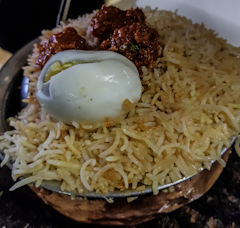
Hyderabad is justifiably renowned for tasty biryani although the very best version of this rice based dish that I have ever eaten was at Paragon in Calicut. There, they serve Moplah biryanis, which are both Arabic and Indian in taste.

The biryani we ate at the Café Bahar in Hyderabad was delicious. It was delicately flavoured and cooked with a light touch. To enter Bahar at lunchtime it is necessary to join a long queue that extends from the top of tje stairs at the doorway to the first floor dining room down on to the busy street outside. It is worth the wait.

The restaurant itself is very noisy and as busy as London’s Oxford Circus at rush hour. We shared a table with a charming couple, who let us try their ‘double masala’ chicken biryani which is richly laden with extra spices. I preferred the less spicy ‘special lamb biryani’. It is made special by adding hard boiled egg and meatballs made with minced chicken.

One should not visit Hyderabad without eating at least one biryani, but avoid the much advertised Paradise restaurant chain, which is ok but nothing like as good as Bahar or Shadab (near the Charminar)

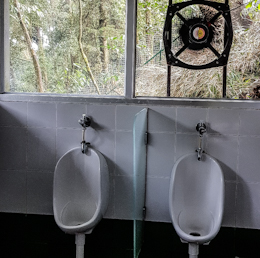
Check the toilet!

One of my cousins in France gave me a useful tip.

He said that clean toilet facilities are often associated with satisfying restaurants. What he meant was that if the restaurant’s management took care of small details such as the toilets, it was likely that they would take care over the more savoury aspects of the business such as the food and customer care.

Since I was given that tip, I have noticed that there is a remarkably high correlation between my degree of satisfaction with the restaurant and the state of their ‘loos’.

Dinner dates

A few days ago, some friends invited us to visit them one evening. We sat with them for several hours, drinking and eating light snacks. As time passed, my stomach began rumbling and I wondered when we were going to eat dinner. This reminded me of an evening many years ago when I lived in Kent (UK).

Some Americans invited me to dinner. To reach them, I had to drive through the countryside for two hours. When I arrived at about 7 pm, I was offered a sandwich. I refused this, muttering that I would wait for dinner.

Another guest arrived. We sat talking and the time passed pleasurably. However, there was no mention of dinner or any food at all during the rest of the evening. At 10 pm, I began my two hour return journey without having eaten. As I drove home, it dawned on me that the sandwich I had been offered was actually the only evening meal that my hosts were planning to serve.

When I reached home at midnight, starving, I prepared a hasty snack.

On reflection, on the recent occasion, we had visited our friends assuming that we would have a pre-dinner drink before going out to dinner. In reality, they had only invited us for a drink; they had not mentioned dinner.

Moral: don’t assume anything!

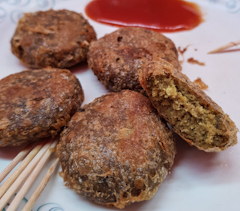
Photo of shaami kebabs