A small village near Cambridge

SINCE THE FOURTH OF JULY 2020, the anniversary of the day Britain lost a large American colony and when our worldly wise Prime Minister deemed it safe for all of us to be liberated from the constraints of ‘lockdown’ and encouraged us to ‘eat out to help out’, a policy that appears to have helped to spread the covid19 virus as well as restaurant owners, we have been roaming around the countryside, discovering what a beautiful country we inhabit. What has struck me when driving from A to B is the number of exceptionally attractive, yet not well-known, villages we have passed through. The village of Comberton in Cambridgeshire was one of these, which we nearly drove past without examining it. However, as time was on our side and it looked so lovely, we stopped there for a few minutes and took a stroll around.

We parked next to an oddly shaped small village pond in which clumps of reeds were growing. A small family of ducks wound its way between the vegetation, occasionally disappearing from view. At the far end of the pond, there is an old low brick wall. Behind it, there is a long two-storey house with a brick roof and decorative chimney stacks. Before describing some of the other lovely buildings in the village, let me give you a flavour of its history.

Sometime between 4000 BC and 2500 BC, someone dropped a polished Neolithic stone axe near where the village stands today. Somewhat later, the Romans built a villa near Comberton. Even later, the village’s name began to evolve, as is described on the village’s website (http://www.comberton.org/home/about-comberton/history-of-comberton/):

“A lot is said about the name of the village and its origins. It is believed that the name is of Celtic origin, possibly named after a landowner by the name of Cumbra. The Domesday Book (1086) has it recorded as Cumbertone. According to William Kip’s map of the area in 1607 Comberton is spelt as it is today and interestingly Barton is spelt Berton”

The village has several churches, which we will visit in the future. One of these is St Mary’s, is in the Early English style with later modifications. Another still extant place of worship is used by non-Conformists. There have been associations between non-Conformism and Comberton since as early as the 17th century. The Puritan William Dowsing (1596-1668), an iconoclast, visited the village in March 1643, and recorded:

“‘We brake downe a crucifix and 69 superstitious pictures we brake downe, and gave order to take downe 36 cherubims, and the steps to be taken down by March 25.’”

Prior to 1772, when a new road, a turnpike (now the A228), was built, Comberton was on the road connecting Oxford with Cambridge. Apart from the usual activities found in villages, such as butchery, bakery, saddlery, harness-making, inn keeping, blacksmithing, and so on, the place had one industry for a while. That was in the 19th century when Comberton became a small centre for mining coprolite, fossilised dung. This material used to be ground in a mill to produce a powder that made a good crop fertiliser. Judging by the good state of the houses and the high-quality cars parked near them, the inhabitants of Comberton appear make their living in reasonably well-paid jobs. Were I to have had a profitable career in or near Cambridge, this village might have been a good place to live.

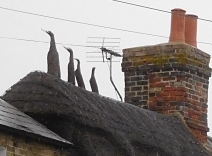
Every village is unique, but many share the same features. In Comberton, we saw several houses with well-maintained thatched roofs. However, we also saw something I had never noticed before. Some of the houses had what you might describe as ‘hybrid’ roofs: partly thatched and partly tiled. One house near the village pond had something we have seen on thatched roofs in many other villages. That is, the ridge of the thatch is decorated with animals made of thatch. Here in Comberton, this one roof was adorned with thatch sculptures of four birds with long necks, that made me think they are supposed to be depicting geese rather than ducks or swans.

The village pond, which is across the road from a dental surgery and ‘Millionhairz’, a hairdresser’s salon, is encircled by an attractive low, neatly built stone wall that curves around the water in a visually pleasant way. On the green next to the pond, there is a timber post that supports a sign (erected 1977) with the name of the village and a two-sided picture above it. On one side, a priest is depicted handing fishes to three people with outstretched arms. This refers to years long past when herrings were handed out to the poor in the village soon before Easter. The other side of the picture above the village name depicts a farmer ploughing his field with a plough drawn by a horse. Behind the farmer high on a hill, there is a white coloured wooden windmill. This reminds us that once Comberton had two working mills.

Our visit to Comberton lasted no more than ten minutes partly because we had to reach somewhere to meet my cousin and because the weather was miserable: grey, cold, and wet. However, what little we saw of this delightful place made us realise that it was well worth stopping en-route to our destination. We have already driven through so many intriguing villages on our excursions through the English countryside. I would have liked to spend time in all of these, and hope to return to some of them in the future. I would rather spend time wandering around picturesque villages than sitting for hours in traffic jams, as happens so often these days.

Pig on the roof

THE FRENCH COMPOSER Darius Milhaud (1892-1974) composed the music for a surrealist ballet, “Le Boeuf sur la Toit” (i.e. ‘The Ox on the Roof’) which had its premiere in February 1920 in Paris. Today, the 4th of September 2020, I saw a pig on a roof and on other roofs I saw birds and dogs. None of them moved a muscle. They just sat or stood where they were without moving. No, I have not been taking hallucinatory drugs or daydreaming. These creatures are made of straw and sit on the ridges of thatched roofs in country villages north of London including Abbington Piggot in Cambridgeshire. On previous occasions I spotted these straw animals on the ridges of roofs in Suffolk villages including Stoke by Clare.

In many parts of England, thatchers, proud of their skills, sometimes add decorative straw creatures as finishing touches to their fine handiwork. These ornaments are variously known as ‘dollies’ (not to be confused with ‘straw dollies’) and ‘straw finials’. Many contemporary thatchers are still willing to add a straw finial to a thatched roof.

There are records of sightings of straw ornaments such as I have described dating back to 1689. The use of thatching probably goes back many thousands of years. However, because of its organic composition, thatch does not usually survive long enough to be detected by archaeologists. The remains of some buildings found on archaeological sites have structural features that are strongly suggestive of their suitability to support thatched roofing. Thatching is not confined to the British Isles. It can be found almost all over the globe.

Thatch, being made of straw and other related material does not last forever. It has to be replaced periodically. The same is true of the straw finials. They look great when they are relatively new, but like the thatch, they decay gradually and become deformed. In one village that we visited today, we saw what looked like a squirrel perching on the ridge of a thatched roof. On closer examination, what we were looking at turned out to be the tattered remnants of what might once have been a fine straw animal.

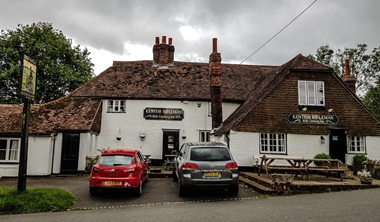
We saw the straw pig on a roof in Abbington Piggott. Having seen this and having had a drink in the village’s pub, the Pig and Abbott, I wondered if the place’s name had anything to do with pigs. The Domesday Book of 1086 list the village as ‘Abintone’, which means ‘estate associated with a man called Abba’. The village became known by its present name by the 17th century, the name being taken from the Pykot or Pigott family who owned the manor between the 15th and 19th centuries. And, just in case you are wondering whether the surname Pigott has anything to do with swine, it does not. It is derived from the Old English word ‘pic’ meaning a hill topped with a sharp point.

We would never have discovered the village of Abbington Piggott had we not been advised by our cousins in Baldock (Hertfordshire) to visit nearby Ashwell, a very attractive village. It was in Ashwell, where there was only one pub open (and it did not serve food), that we were advised that we should continue to Abbington Piggott where we found the welcoming Pig and Abbott as well as the pig on the roof.

You can listen to “Le Boeuf sur la toit”  by Darius Milhaud on: https://youtu.be/Bv9ii_uc2Rc

Far from the maddening crowd

THROUGHOUT THE ‘LOCKDOWN’, our wise leader, Mr Johnson, has encouraged us to take exercise, to get out and breathe some fresh air. And, we have been following that sound advice, walking in our neighbourhood anything from two to five miles every day. Since the ‘lockdown’ has been eased recently, we have been driving out of London far enough to escape from the hurly-burly of the city.  Our latest excursion took us out westwards to a village on the River Thames called Hurley, which is upstream from the small town of Marlow. We chose our destination, the starting point for a riverside walk, almost randomly and had no idea what to expect when we arrived.

HU 12 temple lock

Temple Lock

Hurley is a gem of a village. A ford across the River Thames might well have existed at Hurley before the Norman Conquest of 1066. Many of the older buildings near the river and including the heavily restored Norman church formed part of a Benedictine priory that was established by Geoffrey de Mandeville, who died in about 1100 and was one of the richest men during the reign of William the Conqueror. His pious action at Hurley was strongly influenced by his second wife, Lescelina. The monastery was ‘dissolved’ during the great Dissolution of religious institutions carried out by Henry VIII, Some of the buildings including the priory’s cloisters have been picturesquely incorporated into newer buildings, most of which are used as dwellings.

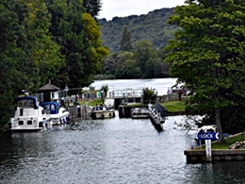
A wooden bridge crosses a stream of the river to reach an island where Hurley Lock is located. We watched pleasure boats being lowered in the lock that allows ships to avoid the weir nearby. At the end of the island, another wooden bridge crosses back onto the right bank of the Thames. We walked beside the river, enjoying glimpses of it between trees whose branches dipped down towards the water. In addition to boats of all sizes from canoes to large cruisers and barges, the water is populated by ducks, andgeese. We also spotted plenty of insects that rest on the water’s surface and flit about hither and thither: water boatmen and pond skaters. Much of the path was flanked by deciduous woodland, mostly private property.

Another bridge, a long sweeping wooden structure took us to the left bank of the river. A short distance downstream from it, we reached Temple Lock. The river was so busy that boats had to queue up to wait for admission to the lock. With the river on our right and fields on our left, some with grazing cattle and sheep, we headed towards Marlow. The path was flanked by a profusion of wildflowers, many of them being ‘serviced’ by a rich variety of different kinds of insects. Before reaching Marlow, we had good views of Bisham Abbey across the river. The former Abbey was built in about 1260 as a manor house for the Knights Templar. Now, much of it remains, and is used as one of the UK’s National Sports Centres.  Close by, the reflection of the tower of All Saints Church, Bisham, shimmers in the water of the river that flows close to its western end. The tower was built in the 12th century, and, later, in the 16th century other parts were added to the original church.

Soon after seeing Bisham’s church, the elegant suspension bridge across the Thames at Marlow came into view. The present bridge was built between 1829 and 1832 and designed by William Tierney Clark (1783-1852), who also designed Hammersmith Bridge. The famous Chain Bridge in Budapest (Széchenyi lánchíd), which is a larger version of Marlow Bridge, opened in 1849 was also designed by WT Clark. It was built by the Scottish engineer Adam Clark (1811-1866).

A slightly sensuous statue of a naked woman, apparently a nymph, can be seen near the Marlow Bridge. This early 20th century sculpture (1924) commemorates Charles Frohman (1856-1915), an American who was a famous theatrical manager who was drowned in the sinking of the Lusitania in May 1915. According to a notice next to the statue, it was erected on the spot from which Frohman used to enjoy watching the Thames.  Apart from the bridge and the statue, there was little in Marlow’s High Street that attracted us, and we walked back to Hurley the way we came. On the way back, we caught good views of Harleyford Manor, a handsome Georgian home on a grassy rise overlooking the Thames. Designed by Robert Taylor (1714-1788) for its owner William Clayton (1718-1783), a Member of Parliament for Bletchingley and then Great Marlow, it remained in the Clayton family until 1950. Currently, this protected building houses offices.

We returned to Hurley, having had a hugely enjoyable stroll along the river and plenty of fresh air. We met numerous people along the way, all of them greeting us friendlily. Many of them had dogs, and almost all of them took care to maintain ‘social distancing’. We drove away from Hurley and about half an hour later we were caught up in the hurly burly of London traffic, which was moving at barely snail’s pace around the Hammersmith one-way system. Annoying as it was, it was worth enduring after having had such a wonderful day by the river, so far from the maddening crowds.


Poetry

Steaming_240


I have never been able to enjoy reading poetry and enjoy it. However, if it is read out aloud by someone else, I usually love what I hear.  Poetry is like music made with words.

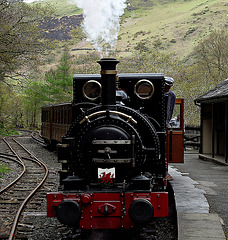
Here is a poem that I have enjoyed ever since I was a young teenager. It is Adlestrop by Edward Thomas (1878-1917). He was killed in France during WW1. His poem captures the essence of the world that reveals itself gradually when a train stops at a small country station.


Yes. I remember Adlestrop—

The name, because one afternoon

Of heat the express-train drew up there

Unwontedly. It was late June.

The steam hissed. Someone cleared his throat.

No one left and no one came

On the bare platform. What I saw

Was Adlestrop—only the name

And willows, willow-herb, and grass,

And meadowsweet, and haycocks dry,

No whit less still and lonely fair

Than the high cloudlets in the sky.

And for that minute a blackbird sang

Close by, and round him, mistier,

Farther and farther, all the birds

Of Oxfordshire and Gloucestershire.