For the deserving poor of Padstow

THE CONVOLUTED COAST of Cornwall is dotted with picturesque little ports. One of these is Padstow, which has become well-known because it contains restaurants and other food-related establishments connected with the TV celebrity chef Rick Stein. It is also famous for its centuries’ old annual Oss celebrations held on May Day.

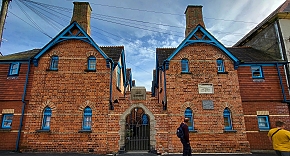
While walking around the streets of the tiny town of Padstow, I came across a disused cinema, which bears a commemorative plaque. Opened in 1924 as the Cinedrome, this became the Capitol cinema. It closed in 1996. However, another relic of the past is still in use around the corner in Middle Street. I am referring to the Padstow Almshouses. This is a small two-winged complex of brick-built houses with some Victorian gothic features.

The main entrance to the complex is surmounted by a granite block carved with the following: “1875 Almshouses”. A plaque located on one of the two facades of the complex informs the viewer that these almshouses were financed by subscriptions raised by friends of John Tredwin to remember him. John Tredwin, who was born in 1818 in Padstow, died at St Columb in Cornwall in 1870. Tredwin, who was a timber merchant and shipbuilder, was involved in the construction of various public works in Padstow. He was also enrolled in the 1st Cornwall Artillery Volunteer Corps, and by 1861 he had become a Captain.  The 1851 Census revealed that by then he and his family were living in St Columb.

John Tredwin was mentioned in a book, “The Cornish Overseas. A history of Cornwall’s ‘Great Emigration’” by Philip Payton:

“The ‘John & Mary’, owned by the Padstow shipbuilder John Tredwin, was engaged in the classic export of immigrants and import of timber that made the Atlantic trade so lucrative in North Cornwall …”

Since the days of the likes of John Tredwin, Padstow has become a relatively insignificant port. Instead, it has become a popular destination for tourists. Although it is undoubtedly an attractive little place, it is outrivalled in charm by other Cornish ports such as Polperro, St Ives, Mousehole, Port St Isaacs, Fowey, and Falmouth. Padstow deserves a visit, but not a long one.

Game of cones in Cornwall

SOME BUSINESSES HAVE chosen names that amuse me. There are plenty of fish and chip shops called ‘The Codfather’. In the small Essex town of Coggeshall, there is a fish and chips shop named ‘Coddes Hall’. And Royal Tunbridge Wells (in Kent) has one of these outlets, which serves fried fish and chips, with the name ‘Happy Friar’. If they have not already been used, I will suggest the following as appropriate names for seafood outlets: ‘Upon my Sole’, ‘The only Plaice’, ‘The Prawn Broker’, and ‘Get on your Skate’.

There is a hair salon in west London’s Ealing district called ‘Pure Barberism’. And when we are in London, one of our favourite coffee shops in Kensington calls itself ‘Perky Blenders’.

You may be excused for asking where this collection of gimmicky names is this leading to? Well, I was inspired to write this short piece after eating some ice cream in the charming Cornish seaport called Fowey (pronounced ‘foy’). The ice creams were sold at a shop called ‘Game of Cones’. I enjoyed the ice cream much more than the only two episodes of the TV show that inspired the ice cream parlour’s name.

A poet in Highgate and Cornwall

IN 1916, A FAMOUS poet, TS Eliot (1888-1965) taught at Highgate School in north London. I was a pupil at this establishment much later, between the year when Eliot died and 1970. One of Eliot’s pupils during his short spell at Highgate was to become one of Britain’s Poet Laureates: John Betjeman (1906-1984). Betjeman wrote (quoted in https://bradbirzer.com/2015/07/06/john-betjeman-remembers-t-s-eliot-as-teacher/):

“In 1914-15 I spent two unsuccessful terms at Highgate Junior School. Mr Eliot was a tall, quiet usher there whom we called ‘The American Master.’ Some of the cleverer boys from Muswell Hill (I was from Highgate) knew he was a poet. How? I have often wondered, for I cannot imagine him telling them or anyone that he was a poet, and I did not know that he had published any poems in England as early as that.”

Betjeman’s association with Highgate where he lived as a child briefly and was educated for less than one year was much shorter than his association with the county of Cornwall.

Betjeman’s family had a house in Trebetherick, near Polzeath in Cornwall, where many holidays were spent. In later life, the poet resided there. The small church of St Enodoc is about 930 yards south of Trebetherick. In the middle of a golf course overlooking the sea, the church dates from the 13th century. Much of it was built by the 16th century. Over the centuries, St Enodoc has often been submerged by drifting sands from the nearby beaches. Between the 16th century and the mid-19th century, the church was completely submerged. In 1863-64, the church was freed from the sand and restored under the supervision of James Piers St Aubyn (1815-1895).

When staying or living at Trebetherick, Betjeman visited St Enodoc regularly. In 1945, he published a poem “Sunday Afternoon Service in St Enodoc Court, Cornwall”, in which he describes his impressions of the church affectionately. Author of much poetry and several books about Cornwall, Betjeman died in his home at Trebetherick. He was buried in the small graveyard that surrounds St Enodoc, a building that still appears to be partially buried in the hillside. His grave is marked by simple stone with a beautifully carved inscription. Born in Lissenden Gardens, now in the Borough of Camden, Betjeman lived briefly in Highgate’s North Road in a house opposite Highgate School. However, it is with Cornwall rather than Highgate that most people connect with the former Poet Laureate. As a former pupil at Highgate School, I was pleased to pay my respects at Betjeman’s grave in Cornwall.

Up and down Molesworth Street

YOU CAN BYPASS the small town of Wadebridge in Cornwall by speeding along the A39 road, which extends from Bath in Somerset to Falmouth in Cornwall, but that would be a pity because it is a charming town. Wadebridge thrives because of its fine bridge across the River Camel. The great writer Daniel Defoe (c1660-1731) wrote about the town and nearby Padstow in his “A Tour Through the Whole Island of Great Britain”, published 1724-26, as follows:

“Padstow is a large town, and stands on a very good harbour for such shipping as use that coast, that is to say, for the Irish trade. The harbour is the mouth of the river Camel or Camal, which rising at Camelford, runs down by Bodmyn to Wodbridge or Wardbridge [sic], a large stone bridge of eight arches, or thereabouts, built by the general goodwill of the country gentlemen; the passage of the river there, before, being very dangerous, and having been the loss of some lives, as well as goods…”

Defoe noted that the passage from Wadebridge to Ireland via Padstow could be achieved in 24 hours. Thus, Wadebridge and its river crossing, now much widened since Defoe’s time, was an important stage for vehicles carrying passengers and goods between England and Ireland. The route for this transport would have been to first cross over the Camel on the bridge and then to proceed north westwards up the slope of Wadebridge’s then main thoroughfare, Molesworth Street. During daylight hours, most of this road is closed to motorised vehicles and provides a pleasant pedestrian precinct.

Molesworth Street is lined with shops, eateries, and some pubs. The Molesworth Arms, a former coaching inn, has existed since the 16th century. It was previously known by other names including The Fox, The King’s Arms and The Fountain. It got its present name in 1817. Nearer the bridge, there is The Swan Hotel near the old bridge, originally named ‘The Commercial’, is much newer than the Molesworth Arms. It was constructed the late 19th century.

I cannot explain why, but spending time on Molesworth Street always satisfies me. The recently opened (late 2021) Dollies café provides good coffee and exceptionally wonderful English breakfast items; everything is prepared freshly after ordering. Up the hill, stands Churchill Bars. Housed in the premises of the still functioning Wadebridge Conservative Club, it comprises a bar and a small restaurant named Winston’s. Popular with locals, this eatery serves generous helpings of lovingly prepared, tasty food. Its speciality, which is well worth trying, is roast belly pork served with roast potatoes, gravy, and vegetables (not overcooked). Unlike so many other places serving food in Cornwall, this place is good value and not pretentious.

Apart from several charity shops, a good newsagent, two butcher’s shops, a hardware store, banks, and so on, there is a small bookshop on Molesworth Street. This independent bookstore stocks a superb range of Cornwall-related books, both fiction and non-fiction. In a backroom, there is a large selection of second-hand books. Small booksellers such as this one on Molesworth Street make a welcome change from the countrywide bookshops such as Daunt’s, Waterstone’s, and WH Smiith’s.

Not as ‘trendy. as places such as Fowey, Falmouth, St Ives, and Padstow, Wadebridge seems a more ‘normal’ or ‘real’ kind of place, not wholly dependent on tourism. It is well placed to make excursions to places all over the county of Cornwall.

Going up in smoke

CORNWALL’S COAST WITH its numerous, sometimes almost inaccessible, coves is perfect for smuggling. It is not by chance that Gilbert and Sullivan’s opera is named “The Pirates of Penzance”, rather than, say, “The Pirates of Suffolk”.  When we visited Falmouth, a Cornish seaport, in May 2022, I noticed a souvenir of an era of smuggling, now long past.

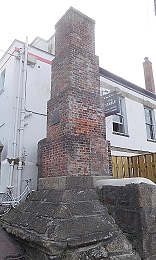
Next to the old customs house (now a pub) on the Town Quay, the old harbour of Falmouth, there is a tall brick structure. On a square base, it is built in four sections, each one slenderer than the one beneath it. The tall object bears a plaque inscribed with an anchor framed by a shield and above it a double-headed eagle. Below these symbols are the words:

“King’s Pipe. Formerly used for the destruction of contraband tobacco.”

According to the website historicengland.org.uk, the King’s Pipe was likely to have been constructed in about 1814, when the customs house was built. The tall chimney stands on a base that contained a furnace that was accessible from the courtyard of the customs house. Overshadowing the town and its harbour, I imagine that many of the townsfolk were far from happy when they saw and smelled the tobacco smoke, which they would have enjoyed creating in their pipes, being emitted from the King’s Pipe.

The double-headed eagle on the plaque affixed to the former chimney interested me. Two major families in Cornwall use this mythical creature in their heraldry: the Godolphins and the Killigrews. It is most likely the latter to which the creature on the plaque refers because in the early 17th century (1613), Sir John Killigrew (1583-1633), helped create the port of Falmouth.

Although we had spent several pleasant days in Falmouth a few years ago, we did not spot the King’s Pipe on that visit. It only goes to show that revisiting places can enhance one’s enjoyment of, and interest in, them.

Remembered in a Cornish car park

THE FORD CONSUL was made in the UK between 1951 and 1962, when I was 10 years old. As a young child, I used to be extremely impressed by this vehicle and was happy when I was occasionally driven in one. Recently, I was in a car park near the Art Deco swimming pool by the sea in Penzance (Cornwall) when I spotted a well preserved example of a Consul, which was still in use. Seeing it, brought back memories of many years ago.

A chiming pub in Cornwall

EGLOSHAYLE IS ACROSS the Camel river, facing the Cornish town of Wadebridge. The Earl of St Vincent pub is hidden away up a hill behind Egloshayle’s St Petroc church. It is housed in a building built in the 17th century as a boarding house for masons. Later, it became a pub. One of its many guests was Admiral Sir John Jervis (1735-1823).

The interior of the pub has timber roof beams and a delightful feeling of times long gone by. It is a great example of many people’s idealised vision of a typical ‘olde worlde English’ country pub. Soon after entering the dimly lit establishment, and your eyes adjust to the low light levels, it becomes evident that the pub is full of clocks, mostly differing in design. Most of them appear to be in working order, but not many of them show the same time. A great number of the clocks chime at least once an hour, but not all at the same time. This being the case, there is usually at least one clock chiming at any given moment. This produces a lovely background symphony of chimes.

I asked one of the pub’s staff why there were so many clocks in the pub. She replied:

“Some people like children. We like clocks”

Later, I asked the landlady about the clocks. She told me that when they took over the pub some years ago, there was no clock in it. She and her husband bought one clock for the pub, and this became the start of their collection. They could not stop buying timepieces. She told me that there are over 200 clocks in the pub and winding them up every day is quite a huge task.

Apart from the fascinating clocks, the pub can be recommended for the delicious, excellently prepared, unpretentious food that can be eaten there.

Eating ice cream in an old harbour

CHARLESTOWN IN CORNWALL should not be confused with the dance named after Charleston in South Carolina, as it is just south of the Cornish town of St Austell. The latter, named after a sixth century Cornish saint, St Austol, was first associated with the tin trade and then with the China clay industry, which burgeoned after the material was discovered in the area by William Cookworthy (1705-1780) in the 18th century.

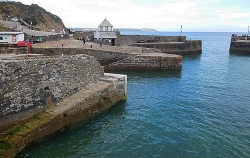
In 1790, only nine families lived in the tiny seashore settlement of West Polmear, a fishing village just south of St Austell. A year later, much was to change in this little place. For, in 1791, Charles Rashleigh, a local landowner, began building a dock at West Polmear, using designs prepared by the engineer John Smeaton (1724-1792), who is regarded by many as ‘the father of civil engineering’. By 1799, a deep-water harbour with dock gates had been constructed. The water level in this dock was maintained by water that travelled in a ‘leat’ (artificial channel) from the Luxulyan Valley, some miles inland. The harbour was fortified against the French with gun batteries.

Named after nearby Mount Charles, the Charlestown harbour was used first for loading boats with copper for export, and then later with China clay, also for exportation. Charlestown prospered during the rapid expansion of the Chana clay industry that lasted until the start of WW1. By 1911, the former fishing village, by then Charlestown, had a population of almost 3200. Between the end of WW1 and the 1990s, Charlestown continued to be a port for exporting clay, but rival ports and the use of ships too large to be accommodated, led to its gradual decline. Now, the lovely, well-preserved 18th century harbour has become a tourist attraction and a home for a few picturesque tall ships. It is also used occasionally as a film set.

We visited Charlestown on a warm, sunny, late June afternoon. After exploring for a while, we homed in on an ice cream stall, a small hut with a pitched roof tiled with slates, located above the northern end of the dock. After queuing for what turned out to be first class ice cream, we sat at a table near the stall to enjoy what we had ordered. It was then that I noticed that some of the tables and chairs were standing on a vast cast-iron plate, which was covered with geometric patterns and some words, which I examined. My suspicion that this plate had once been part of a weighbridge was confirmed when I noticed the words: “20 tons.  Charles Ross Ltd. Makers. Sheffield”. I checked this with the ice cream seller in his stall. He told me that his stall had been the office of the officials who used the weighbridge and pointed out that there was another weighbridge nearby. I found this easily. Its metal plate bore the words: “Avery. Birmingham-England”, Avery being a well-known manufacturer of weighing machines. And the hut that used to be used by the officials now sells a range of snacks.

After eating our ice creams and examining the former weighbridge plates, a trivial thought flashed through my mind: by consuming ice cream at this stall, we were putting on weight at the weighbridge.

A recycled telephone kiosk

RURAL TELEPHONE BOXES (kiosks) are often used (re-purposed) to house AED defibrillators and small book libraries. Occasionally, they still contain coin-operated telephones. We were driving through rural Cornwall between Bodmin and Luxulyan, when we took a wrong turn and drove along a small lane. After making a three-point turn, I spotted an old telephone box partly covered with vegetation. Its original glazed door had been replaced by a wooden one that was quite out of keeping with the box’s elegant design. The present owner of the telephone box has been using this as the entrance to his or her garden. I was pleased to make find this quirky modification of an old telephone kiosk.