From the Dominican Republic to South London via the USA

FIRELEI BÁEZ WAS born in the Dominican Republic in 1981. She studied art in the USA, where she now lives and works. The South London Gallery (‘SLG’) in South London’s Peckham district is hosting her first solo exhibition in the UK. The show continues until the 8th of September 2024. The exhibition is distributed between the main gallery building and a converted fire station, which is a few yards away.

The large exhibition space in the main building is occupied by a wonderful immersive installation. The viewer walks beneath a huge blue canopy with multiple small oval holes suspended from the ceiling. Light filters through the material of the canopy producing the effect of sunlight dappled by leaves of trees, creating the feeling that one is walking in a forest. Recordings of bird sounds enhance this illusion. On the walls of the room there are large, boldly coloured aluminium cut outs, representing silhouettes of Ciguapas – figures from the folklore of the Dominican Republic.  

In the converted former fire station, there are yet more works by Firelei Baez. On the ground floor, there are huge floor-to-ceiling, extremely colourful abstract paintings. The artist’s idea is to immerse the viewer in an excitingly vibrant sea of colours. The first floor has two galleries. In one, there are large, richly coloured silhouettes depicting Ciguapas. In the other, there are many pages from books, which the artist has transformed by overlaying parts of each of them with paint or ink. In doing this, she provides the viewer with alternative versions of what was originally on the page before she added her artwork. Although libraries and book-collectors might well object to extracting pages from books and then painting over them, the effects Firelei produced are both witty and attractive. In addition, they make you think twice about what was originally on the page.

For a north Londoner like me, Peckham seems to be a distant part of the world, but actually it is not to difficult to reach it by public transport. And many of the exhibitions we have viewed at SLG, including the one described above, makes the trip to Peckham well worth making.
Blooms beneath a bridge in the city of Calcutta

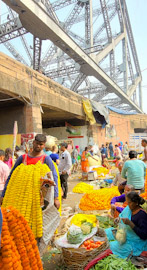
OVERLOOKED BY THE MIGHTY Howrah Bridge and straggling alongside the left bank of the Hooghly River – a stretch of the Ganges – you will find the colourful Mullick Ghat flower market. The best way to enter this busy marketplace is by descending a staircase at the southeast corner of the Howrah Bridge (completed 1943). As you go down the stairs, you will have to step aside to make way for men carrying enormous, heavy loads on their heads. Many of them make use of the stair rails to support themselves while they climb.

Part of the flower market (next to the railway track) is in the open air. The rest of it – the part nearest to the river – is under cover. Narrow, muddy passages run between the numerous stalls selling whole flowers, flower heads, individual flower parts, and petals. Also, flower garlands and other floral decorations are aplenty. A steady stream of people hurry in all directions along these paths. Many of them are carrying heavy head loads. Occasionally, they dump the head loads (containing floral items) at one stall or another. To an outsider, like me, the place seems like a chaotic but highly colourful environment. It is probably not as crazy as it seems, but highly organised.

The flower market was established along this part of the Hooghly during or before the 19th century (https://www.telegraphindia.com/my-kolkata/places/a-visit-to-mullick-ghat-flower-market-one-of-asias-largest-under-the-howrah-bridge-in-kolkata/cid/1892065). The ghat was built in 1855 by Rammohan Mullick in honour of his father Nimai Charan Mullick. It was constructed on the land where the old Noyaner Ghat had stood. The older landing stage had been made by Noyanchand Mullick in 1793.

The Mullick Ghat stands next to the Jagganath Ghat, which was constructed in 1760. Both ghats were important because they were used by pilgrims embarking on ships to transport them to the holy site at Puri in Orissa. Although it is not known for certain why the flower market was established beside these ghats, it is not unlikely that it was connected to the embarkation places for the pilgrims. And flowers play an important role in Hindu rituals.

Even though the market seemed extremely busy to me, it is apparently in decline. This was in no little way connected with the recent covid19 pandemic. If what I saw is a somewhat diminished version of the market, I can barely imagine what it must have been like a few years ago. Providing you are not allergic to pollen or crowds, a visit to the flower market is an exciting and beautiful experience.

A collection of colourful saree textiles in Bangalore

ONE OF THE THINGS that struck me when I first visited India in January 1994 was how everyone was wearing clothing far more colourful than anywhere else I had been before. Wherever I have been in the country, there is a feast of colourful clothing to be seen. Whether the colourful garments are worn purely for aesthetic reasons and/or for ceremonial or group identity reasons, everywhere there is much to please the eye.

I am not alone in noticing the Indian penchant for wearing bright colours. In 1956, the famous style ‘diva’ Diana Vreeland noted in British Vogue magazine: “… pink is the navy blue of India …”. Following from this, an article in India’s “Economic Times” of January 2022, pointed out that “Red is the Indian beige and yellow is the Indian grey…”. In other words, that the exuberant colours worn by Indians contrast dramatically with the much more drab colours currently worn in the West. Actually, as my wife pointed out, long ago in Europe (eg the 18th century and before) clothes – especially those worn by the wealthy and the aristocracy – were far more colourful than now.

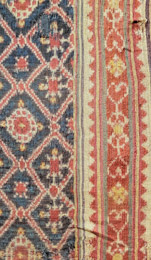
On the 23rd of December 2023, we were fortunate to get admission to an exhibition of sarees on its last day. Intriguingly entitled “Red Lilies, Water Birds”, the show was hosted by The Registry of Sarees in a house on Hayes Road in Bangalore. The Registry (established in 2016) is a trust set up by the Mysore Saree Udyog (founded in 1932). Its purpose is to promote the study, design, and conservation of handspun and handwoven textiles.

The nine rooms of the exhibition contained about 84 examples from the Registry’s much larger collection. Each room concentrated on either a particular region of India, or a specific method of creating the textiles. Every room was filled with sarees, which filled the viewer’s eyes with richly coloured, intricately patterned delights.

Many of the visitors to the exhibition, and the staff looking after, and explaining, the show were wearing clothing that demonstrated what I mentioned at the outset – namely, the preference of many Indians to dress colourfully.

His last mural

THE SERPENTINE NORTH art gallery is housed in what was once a gunpowder store, built in 1805. Next to it, there is an elegantly curvaceous café created by the Iraqi-British architect Zaha Hadid (1950-2016). Until the 3rd of September 2023, there is an interesting exhibit behind the north side of the café. It is an abstract mural of brightly coloured, differently sized rectangles and squares. When I showed a photograph of this to our daughter, she said it reminded her of African printed textiles. Maybe, this should not be surprising suggestions because the mural was painted by a Ghanaian artist, Atta Kwami (1956-2021), who was born in Accra.

The mural, painted on wood, is titled “Dzidzɔ kple amenuveve”, which means ‘Joy and Grace’.

The Serpentine’s website noted:
“Its title is in Ewe, a West African language spoken by Kwami, and its composition characteristically plays with the colour and form improvisations distinctive to Ghanaian architecture and strip-woven textiles found across the African continent, especially kente cloth from the Ewe and Asante people of Ghana.”

Sadly, the mural is the last public work that Atta Kwami created. He died in the UK shortly after he completed it.

Coloured cliffs and the Needles rocks

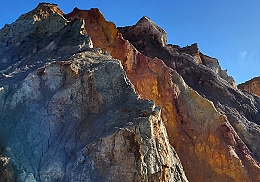
NEAR THE WESTERNMOST point on the Isle of Wight, lies Alum Bay. From its pebble beach, the Needles rock formation with their light house can easily be seen. Turn your back on the Needles and you will see that the bay and its beach have a backdrop of folded cliffs. These are not any old cliffs. They are multi-coloured.

The colouration of the cliffs is caused by the presence of oxidised iron compounds formed under different conditions.

The beach from which the coloured cliffs can be seen can be reached two ways. Either by foot, using a series of staircases, or by travelling on a spectacular set of chairs suspended from cables: a sort of funicular. I recommend descending by foot to enjoy the views at leisure and returning using the chair lift. However, descending on the latter is also said to be an exciting experience.