Antiques in the aisles within a church in Norwich

THE CITY OF NORWICH used to have about 100 churches. Today, there are about 73 churches in use as places of worship. That is approximately one church for every 1900 people. Many of Norwich’s churches are no longer used for worship, but being of historic and architectural value, they are kept standing. One of these redundant churches is St Gregory’s in the heart of the city. It was constructed in the 14th century, and has been designated a Grade 1 Listed Building. Closed in 1971, it is looked after by the Norwich Historic Churches Trust.

On entering St Gregory’s, you are confronted by models of deer with antlers standing in the porch alongside all manner of ‘junk’. Beyond this, there is a glass fronted refrigerator containing cans of carbonated drinks. On entering the body of the church, the visitor is confronted by all manner of used goods (including antiques) arranged picturesquely in the aisles, the chancel, and other parts of the church. When the initial surprising impact of the church is over, one notices features of the original church that still remain: the stone font; the royal coat of arms; stained glass windows; funerary sculptures; the organ; and a fine wall painting of St George and the dragon. Towering above the sea of goods, there is beautiful gothic vaulting.

Since 2011, the church has been used as an antiques centre (actually, it is more like an indoor flea market). The variety of goods on sale is huge. Beneath the organ, where the choir stalls must have been, there is a second-hand book seller. Despite the somewhat Bohemian look about this stall, the books are not moderately priced.

Whether or not one has any interest in purchasing antiques, St Gregory’s is well worth a visit because what has been created within it is much better than many immersive installations created by professional artists.

Three hares or rabbits sharing three ears between them in a church in Buckinghamshire

WE HAVE COME ACROSS this type of curious motif once before in the parish church at Long Melford (Suffolk), and recently (September 2024) in the parish church at Long Crendon (Buckinghamshire). The motif consists of three hares (or rabbits) in a circle and joined by their ears which form a triangle at the centre of the design. Each creature appears to have two ears, but between them, they share only three ears. At Long Melford, this image can be seen in a small piece of mediaeval stained glass in a window on the north side of the church. At Long Crendon, it can be seen on a small 14th century tile close to the high altar.

According to the guidebook we obtained in the church at Long Crendon, the three hare/rabbit motif is only seen in a few places in Britain (including 12 of the Stannary villages in Devon and Cornwall, Long Melford, Lavenham, and Chester Cathedral). Also, it stated that it can be seen:

“… in a few places stretching from China to Europe along the Silk Road.”

Well, this got me very interested, and I did a little research on the Internet. Soon, I came across a website, “Three Hares Project” (www.chrischapmanphotography.co.uk/hares/page7.htm).  This site contains a mine of information including a map showing where the motif has been found along the Silk Route and other places.

The earliest examples that have been found are on the ceilings of  Buddhist caves near Dunhuang in China. They been dated as having been placed there between 581 AD and 907 AD. The three hares have also been found on a late 12th or early 13th century Iranian tray made of brass inlaid with copper. Another example was found painted on the ceiling panel that once used to adorn an 18th century German synagogue. The authors of the website noted:

“The three hares are also found in glass and ceramic wares from the Islamic world.”

So, it appears that the motif that we have seen in churches was not confined to Christian usage.

As to the meaning of the three hares/rabbits motif, the website offered the following:

“… as yet, we have not come across a contemporary written record of its meaning … The hare is strongly represented in world mythology and from ancient times has had divine associations. Its elusiveness and unusual behaviour, particularly at night, have reinforced its reputation as a magical creature. The hare was believed to have mystical links to the female cycle and to the moon which governed it.”

What it meant to Christians, who placed the motif in their churches, was suggested on the website. It said that the ancients believed that the hare was hermaphroditic, and could give birth to its offspring without need for copulation. In relation to this, the learned Thomas Browne (1605-1682) wrote in 1646 in his “Pseudodoxia Epidemica”:

“THE double sex of single Hares, or that every Hare is both male and female, beside the vulgar opinion, was the affirmative of Archelaus, of Plutarch, Philostratus, and many more. Of the same belief have been the Jewish Rabbins: The same is likewise confirmed from the Hebrew word; which, as though there were no single males of that kind, hath only obtained a name of the feminine gender.” (https://penelope.uchicago.edu/pseudodoxia/pseudo317.html).

This belief might have led Christians of old to compare the hare to the Virgin Mary and the birth of her well-known son.

Another less likely possibility is that the three creatures have something to do with representing the Holy Trinity.

Whatever its meaning, I find the motif of three hares sharing three ears almost as fascinating as the eagle with one body and two heads (the double-headed eagle, such as seen, for example, on the flag of Albania and the crest of the Indian State of Karnataka).

ONCE A VILLAGE ON THE MARMARA SEA, NOW A SUBURB OF ISTANBUL

THE FIRST TIME I visited Turkey was in about 1960. My father was participating in a conference organised by the Eczacibaşi Foundation. It was held in the then luxurious Çinar Hotel on the European shore of the Marmara Sea at a place called Yesilköy, which is about 9 miles west of old Istanbul. This April (2024), we visited Yesilköy both for old times sake and because we had read that the place has several interesting sights to be seen. Incidentally, it was in Yesilköy that I had my first piece of chewing gum.

After disembarking from the Marmaray train, which connects settlements on the coast of the Sea of Marmara, we enjoyed the best cheese börek we have eaten since arriving in Turkey. Then, despite constant rain, we walked along Istasyon Caddesi, admiring the many houses with decorative timber cladding that line the avenue.

We made a small detour to look at a Syriac Christian Church, which looked recently built. We could not enter because a service was in progress. Thence, we walked to the rainswept seafront, where we looked around a museum dedicated to the life of Ataturk. It was housed in a mansion once owned by Greeks. The ground floor is dedicated to the first decade of the Turkish Republic, which was founded in October 1923. The first floor has a display of ethnographic exhibits from Turkey. The second floor is a collection of photographs, items, and books relating to the life of Ataturk.

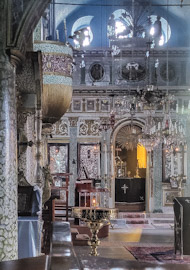
Greek Orthodox church in Yesilköy

Next, we came across a Greek Orthodox church. We could enter its covered porch in which candles were flickering. Through the windows of the porch we could see enough of the church’s interior to realise it is quite beautiful. Unfortunately, the church was locked.

Nearby, we found the huge Latin Catholic Church, which was open. Its interior was nothing special, apart from one religious painting which contained words in the Ottoman Turkish script. The size of the church suggests that there might once have been a large Roman Catholic community in Yesilköy.

Yet another church is a few yards away from the Latin church. It is an Armenian church, enclosed in a compound surrounded by high walls. The entrance was open, and after looking at the church, we joined the congregation (at least 40 people), who invited us to have tea and cakes. A couple of gentlemen began speaking with us in English. They told us that the Çinar Hotel was no longer in business, but it was still standing. They also told us that they are in the textile business. They are waiting for Indian visas because they are planning to visit Bangalore and Tiripur soon because they are looking to buy textile machinery there.

Several people told us that the Çinar Hotel is about a mile from the centre of Yesilköy. As it was cold and raining we decided against looking for it. Despite not revisiting the place I first stayed in Turkey more than 60 years ago, we saw Yesilköy and some of its fascinating sights. It is close to the railway tracks and not on most tourists’ beaten tracks.

Survivors in Suffolk

IN 1975 I WENT to the town of Prizren in Kosovo, which was then part of the former Yugoslavia. I visited an old church in the town. Once, its internal walls had been covered with frescos. However, they had been badly defaced up to a certain height above ground level. Above that height and on the ceiling, they were intact. When the Ottoman soldiers arrived in Prizren, they used their spears to destroy the frescos, but only did so as far as they could reach. Being lazy, they did not use ladders to reach the higher parts of the church. So, the frescos beyond their reach survived.

In England, both the Dissolution of the Catholic religious establishments by Henry VIII, and later the defacement of churches by Oliver Cromwell and his followers, resulted in the destruction of many fine works of religious art. During a recent visit to Suffolk, we saw a few fine artefacts, which like the frescos in Prizren, have survived.

Bardwell

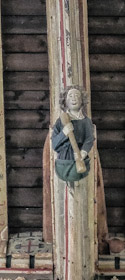
In accordance with Cromwell’s decree, many of the 15th century carved wooden angels that overlooked the nave of the parish church in Bardwell were destroyed. But, a few were left intact. Why was that? Did the workmen lose interest, or were they not paid enough? Who can say? And why was some of the 14th century stained glass left intact? Again, nobody can remember.

Over in the sleepy little town of Eye, the Parish Church contains a wooden rood screen containing beautifully painted panels that should surely have been destroyed by Cromwell’s iconoclastic vandals. Were they covered up with, say, wood panelling before the wreckers arrived, or were they removed and hidden? Luckily for us, these wonderful mediaeval paintings have survived.

Near Eye, there is a tiny church with a thatched roof in the village of Thornham Parva. It contains a rectangular wooden frame containing several mediaeval paintings that were created the 14th century. It was once the retable of an altar. Most likely, it was originally part of an altar in the Dominican Thetford Priory, which was dissolved during the reign of Henry VIII.

It is most probable that when the priory was dissolved, the retable was rescued by a Catholic family who put it in their private chapel. It passed through two other families before it was donated to the church at Thornham Parva in 1927. It is a rare surviving example of 14th century British religious painting. Interestingly, there is another series of painted panels in the Musée Cluny in Paris that resembles the Thornham Parva retable. Comparison of detailed aspects of these two sets of paintings suggests that they were both painted by the same team of artists, and were originally designed for the same location – most probably Thetford Priory.

In the space of three hours, we visited the churches at Bardwell, Eye, and Thornham Parva. All three contain artefacts of great interest and beauty which survived the religious upheavals orchestrated by Henry VIII and later by Cromwell. Once again, touring around in England has opened our eyes to its treasure house of history.

Baby Jesus with bangles

DURING SEVERAL TRIPS within the ex-Portuguese colony of Goa on the west coast of India, we have visited churches and other Christian religious establishments built under Portuguese rule. The Portuguese arrived in India several centuries ago, and finally left their colonies in 1961 when they became incorporated (or annexed) into India. One of the aims of the Portuguese was conversion of their Indian subjects to Christianity. Many of the conquered people became Christian, and many churches and seminaries sprung up in the occupied territories. We have visited quite a few of these.

In most of the churches we have seen in Goa as well as in the recently opened Museum of Christian Art in Old Goa, we have noticed that depictions of angels saints, and Christ himself have facial (and other) features that are typical of Indian physiognomy. This is not too surprising as many artefacts in the churches of Goa were created by Indian artists.

When we visited the Museum of Christian Art in Old Goa, we saw two depictions of Baby Jesus lying on what looked just like typical Indian ‘charpoys’ (traditional Indian beds). The Holy Child in each case is a tiny doll. What fascinated me is that the dolls were wearing the sort of tiny bangles that are often worn by small Indian babies. One of the tiny models of Jesus was also wearing earrings.

Moving away from Christian sculptures and paintings, which have incorporated Indian characteristics, day to day Christian worship in India often incorporates features with origins in Hindu ritual practice. One example is the use of flower garlands (‘malas’), which is just as common in Christian settings as it is in Hindu settings.

Christianity was introduced to India not only by the Portuguese, but by others including St Thomas (apocryphally), and various European invaders. However, despite its foreign origins, India was not only affected by the Christian religion but has also made its mark on it.

Glorious detail in a gothic revival church

I HAD PASSED it often, but never entered it until recently when I attended a concert within it. I am talking about a church on Holland Road in West London not far from Shepherds Bush, St John the Baptist. This Anglican church is an exceptional example of gothic revival style. Designed by James Brooks (1825-1901) with John Standen Adkins (an assistant of Brooks), it was constructed between 1872 and 1910.

Although the façade facing Holland Road is not exceptional, the church’s interior is highly breathtakingly decorative. Unlike mediaeval churches, which took centuries to complete, St John the Baptist was constructed in much less time. Yet, its decorative details, which imitate what is best in many older churches, rival those found within the old ones. The workmanship and fine details in St John’s remind one of the best productions of craftsmen, who flourished many centuries earlier. However, unlike the earlier churches, which inspired the designers of St John’s, the interior of the church on Holland Road looks too good to be true. Completed in a relatively short period, the variety that adds to the charm of gothic churches built in earlier times and more slowly is lacking in St John’s and other fine examples of late Victorian gothic revival buildings. What we see at St John’s is the realisation of the architects’ concept of an ideal ‘mediaeval’ church. What was achieved at St John’s is probably something like the results early creators of (mediaeval) churches hoped to create, but never lived long enough to see fully realised.

The attention to detail in the better gothic revival churches, such as St John’s, is marvellous. The result is an ensemble of decorative features rich in meticulously executed intricate details. While I was listening to the concert in St John’s, my eyes took in the details of the church, and I began thinking it was amazing that the elaborate attention to fiddly ornate minutiae was carried out only a few years before architectural trends turned through 180 degrees from excessively decorative to the greater simplicity of much 20th century architecture.

Two similar churches, one in Kensington and the other in Wiltshire

ENNISMORE GARDENS MEWS IS about 380 yards west of Exhibition Road near South Kensington. It is the site of a church with an Italianate façade, now the Russian Orthodox Cathedral of the Dormition of the Mother of God and All Saints. A tall bell tower stands to the right of the façade as you look at it from the street. Pevsner described the style of the façade as “Lombardic Romanesque”. He noted:

“The Early Christian/Italian-Romanesque style was a speciality of the 1840s…”

Russian Orthodox church in Kensington, London

Although many of the fittings in the church are typical of Russian Orthodox places of worship (e.g., iconostasis and icons), the interior is not typical of edifices built specifically for the Orthodox church. The coloured panels above the arches (supported by iron pillars) lining the nave are not typical of the kinds of images usually associated with the Orthodox Church. They have captions in both English and Latin, but not in Cyrillic. The church was designed as the Anglican Church of All Saints in 1848-1849 by Lewis Vulliamy (1791-1871). The tower was constructed in 1871. Most of the decoration within the building is in the late 19th century Arts and Crafts style.

The Anglican parish, which was based in the former All Saints, merged with another in 1955. Then the church was let to the Russian Orthodox faith and its name changed to its present one. In 1978, the Sourozh Diocese purchased the edifice. The Sourozh is under the control of the Patriarchate of Moscow. The church in Ennismore Gardens Mews has a multi-national Orthodox congregation.  I asked a bearded priest how the cathedral differed from the Russian church in Harvard Road, Chiswick. He replied:

“We are the Orthodox Church based in Moscow, but the other one in Chiswick is the Orthodox Church based outside Russia … it is very complicated.”

Wilton in Wiltshire is almost 80 miles southwest of the Russian church in Ennismore Gardens Mews. Famed for its fine carpet manufacturing, the town has a church, St Mary and St Nicholas, whose façade looks not too different from that of South Kensington’s Russian Orthodox Cathedral. The Wilton church has a similar bell tower, but it placed on the left side of the façade. The church was commissioned by Sidney Herbert, 1st Baron Herbert of Lea (1810-1861), a close ally and supporter of Florence Nightingale of Crimean War fame. Sidney was a son of George Herbert, 11th Earl of Pembroke and his Russian spouse Catherine (née Yekaterina Semyonovna Vorontsova). The church, completed in 1845, was designed by Thomas Henry Wyatt (1807-1880) and his assistant David Brandon (1813-1897).

With many features borrowed from Italian Romanesque architecture, and some from Byzantine designs, the edifice at Wilton, despite being an Anglican parish church, felt to me slightly more like an Orthodox church than the converted ex-Anglican, now Orthodox, church in Ennismore Gardens Mews. However, the interior fittings in the church in Wilton borrow from what can be found in traditional Italian churches rather than in typical eastern Orthodox churches. But, the mosaic covered cupola over the chancel in Wilton’s Anglican church, with its depiction of Christ with two saints resembling what is often found in Byzantine churches, contrasts with the undecorated cupola over the chancel in what has now become the Russian Orthodox Cathedral in Kensington.

Placed side by side, many differences could be discerned between the church in south Kensington and that in Wilton. But it is the similarities between two churches designed by different architects that are remarkable.

Just around the corner … in South Kensington

PEOPLE USUALLY ASSOCIATE South Kensington with its magnificent set of museums. However, there is far more than that in the district, and within a few yards of the museums. Here are a few places of interest near to the Victoria and Albert Museum (the ‘V&A’).

The V&A stands on the northeast corner of Exhibition Road and Cromwell Gardens (a short stretch of the A4) and faces the Ismaili Centre on the southeast corner. This attractive building built for the religious community that is led by the Aga Khan was designed by the Casson Conder Partnership and completed in 1985. According to the website of the Ismailis, https://the.ismaili, the building’s pleasing exterior:

“… has used materials and colours which are compatible with those of the surrounding buildings while at the same time in keeping with the traditional Islamic idiom and its colours of whites, light greys and blues.”

Monument in he Yalta Memorial Garden

An open space, The Yalta Memorial Garden, on the east side of the centre contains a monument to remember “… the countless men, women, and children, from the Soviet Union and other East European states, who were imprisoned and died at the hands of Communist governments after being repatriated at the conclusion of the Second World War…” The memorial consists of a column on the top of which there is a sculpture by Angela Conner (born 1935) depicting 12 faces of men, women, and children. Nearby, a house on the northeast corner of Thurloe Square and facing the V&A, bears a plaque informing that the museum’s first Director Henry Cole (1808-1882) lived there.

The Brompton Oratory, or to give its full name, the Church of the Immaculate Heart of Mary, is a huge Roman Catholic church with a neoclassical façade and a dome. It stands east of the V&A. It was designed by the architect Herbert Gribble (1846-1894), a convert to Roman Catholicism, and constructed between 1880 and 1884. The architectural style is mainly Roman Baroque. This enormous edifice was the largest Roman Catholic church in London until Westminster Cathedral was constructed in the first decade of the 20th century.

Cottage Place runs along the east side of the Oratory towards the Holy Trinity Brompton church north of it. A building that looks like many of the older Underground station entrances on the Place has a façade decorated with blood-red glazed terracotta tiles. Between 1906 and 1934, when it was closed, it was the entrance to Brompton Road station on the Piccadilly Line. It was a stop between the still functioning Knightsbridge and South Kensington stations. It was closed because it was hardly ever used by passengers.  An article in the Guardian newspaper, published in February 2014, related that during WW2, the disused station was used as a command centre for anti-aircraft batteries. It also suggested that the Nazi Rudolf Hess (1894-1987) was interrogated here. Between the station’s closure and about 2014, the building was owned and used by the Ministry of Defence.

The Holy Trinity Brompton Church, a gothic revival structure, was designed by Thomas Leverton Donaldson (1795-1885), and completed in 1829. It was established to accommodate the growing population of this part of Kensington, which until then had to worship in the church of St Mary Abbots in Kensington, almost one mile away. In 1852, a part of the church’s land was sold for building the Oratory upon it. The large grassy space north of Holy Trinity, now a park, was formerly the church’s graveyard.

Although none of the places I have described rival the splendour of the V&A and especially its fantastic collection of artefacts, they are worth exploring if you happen to be in the neighbourhood. A problem in London is that there are so many places of the greatest interests to visitors, which often means they have so little time to explore the lesser-known curiosities that form part of the rich tapestry of London’s past and present.

Annigoni under the flight path to Heathrow

HAYES IN THE London Borough of Hillingdon is not on the itineraries of most tourists, although many of them fly over the area when landing at nearby Heathrow Airport. In addition to the venerable old (late mediaeval) parish church of St Mary, there is a lovely park and another church worth seeing in the area.

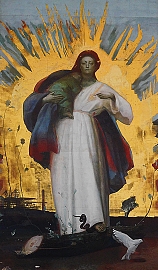
Painting in Hayes by Pietro Annigoni

St Mary’s church stands at the northeast corner of Barra Hall Park, the grounds of Barra Hall. The park was opened to the public in 1923. Largely on level ground, it has lawns, flower beds, and plenty of old trees. There is a bandstand whose roof is supported by metal pillars with curly decorative features. Nearby, there is an open-air theatre whose stage is under four enormous rectangular metal plates, that act as shades. Each of them has been bent into a slight curve. Its auditorium consists of circular concrete steps, which can accommodate an audience of 180.

The Barra Hall, which stands within the park, was originally a manor house, once known as ‘Grove House’. In the late 18th century, it was home to Alderman Harvey Christian Combe (1752-1818), who became Lord Mayor of London in 1799. In 1871, it passed into the hands of Robert Reid, an auctioneer and surveyor. Reid claimed to be descended from the Reids of Barra. He enlarged and modified the building in various ways and renamed it Barra Hall in 1875. In 1924, the house became the Hayes and Harlington town hall. When Hayes became part of the Borough of Hillingdon, the Hall ceased being used as a town hall. In 2005, after renovation, the large house became used as a children’s centre. The building is Victorian in appearance with a mixture of neo-Jacobean and neo-gothic decorative features.

The Hall and its park are less than a mile north of the Lidl supermarket in the Botwell Green area of Hayes. Opposite the supermarket, stands the Roman Catholic church of the Immaculate Heart of Mary. This basilica-style church was designed by Burles, Newton, and Partners and completed in 1961. It has a tall brick bell tower. In front of its vast west window, there is a fine statue of the Virgin by Michael Clark. This window, along with those beneath the tall ceiling above the wide nave, fills the spacious church with light. The nave is flanked by north and south aisles beneath lower ceilings. The walls of these aisles contain attractive stained-glass, both abstract compositions and depictions of biblical scenes. These windows were designed by Goddard and Gibbs. High above the altar, hanging on the east wall of the chancel, there is a lovely painting of the Virgin and Child by Pietro Annigoni (1910-1988). At the east end of the north aisle, there is a painting of St Jude by Daniel O’Connell.

Before the church was built, the local congregation of the parish, which was created in 1912. worshipped in a chapel created in Botwell House, an early 19th century building, which still stands in the grounds of the church. Both this church and the much older one near Barra Hall Park provide welcome, peaceful oases, which allow one to temporarily escape from the bustle and stresses of modern life.

Catching the wind

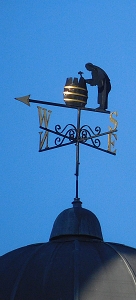
Cambridge, UK

LOOK UP AND if your eyesight is reasonably up to scratch, you might well be lucky enough to see a weathervane on top of a church steeple or some other high point on a building. The ‘vane’ in weathervane is derived from an Old English word, ‘fana’, meaning flag (in German the word ‘Fahn’ means flag). Weathervanes are simple gadgets that indicate the direction of the wind. They usually consist of an arrow attached by a horizontal straight rod to a flat surface that catches the wind. The rod is mounted on a vertical support in such away that it can rotate as the wind catches the flat surface. The horizontal rod with the arrow rotates so that it offers the least resistance to the prevailing wind. Beneath the rotating arrow are often indicators that are labelled with letters denoting the four points of the compass. If, for example, the wind begins to blow from east to west, the horizontal rod will rotate so that the arrow is above the ‘E’ denoting east. Some weathervanes substitute the horizontal rod with a single flat asymmetric object that can catch the wind and rotate. Often the object seen above churches is a cock or other bird, whose beak will indicate the direction of the wind. I suppose that for birds wind direction is quite important.

The weathervane is not a recent invention. It was invented in the 2nd century BC both by the Greeks and the Chinese but separately. Some of the oldest Chinese weathervanes were shaped as birds and later, at least by the end of the 9th century AD, bird shaped vanes became used in Europe. Although avian weathervanes are still very common, a wide variety of other shapes have been used. Sundials, weathervanes, now archaic, only give an approximate indication of time and wind direction respectively. However, unlike sundials, which do not work when the sun is not shining, weathervanes work in all weather conditions and in day and night, although they are somewhat difficult to see at night-time. Despite their relative inaccuracy compared with modern instruments for measurements of  wind, weathervanes are attractive adornments to buildings both old and new.