In most churches, one can light candles when saying prayers.
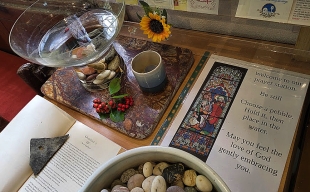
At St Winnow in Cornwall, we noticed something quite different. A bowl filled with water was standing on a table next to a bowl filled with pebbles. Those wishing to make a prayer, are invited to take one of the stones and place it into the water, instead of lighting a candle. We were told by someone working in the church that the stone dropping is a Celtic Christian tradition. I have since read that it might also have been a pagan tradition.
ON THE SIXTH of February 2025, I boarded an auto (autorickshaw, tuk-tuk) in central Bangalore. It contained a selection of Christian religious leaflets and booklets, which passengers were invited to take. Some of them were in English, the rest in Kannada (the main language spoken in Karnataka). The driver had adorned his auto with Christianity related stickers.
As we wove our way through the busy traffic, I wondered if I was travelling in a type of ‘Peace Auto’. The Peace Auto movement in Bangalore was started by Anil Shetty in October 2013 to improve the relationships between auto drivers and their passengers. To quote from Shetty:
THE LETTERS ‘CITU’ stand for the Centre of Indian Trade Unions, which was founded in 1970. Its ‘logo’ includes the hammer and sickle, a symbol first used on some Chilean coins as early as 1894. However, it became widely recognised after 1917 when it was used as a symbol during the Russian Revolution, and long after it was over.
Today, I spotted a small street stand erected in Pondicherry by the CITU. It is located on the corner of Rue du Bazar St Laurent and Beach Road (Goubert Avenue), which runs along the seafront. It has three white hammer and sickles, each on a red background. One of these symbols faces in the opposite direction to the other two.
Now, here is what interested me. Two of the Communist symbols decorate the stone supports of a short table or bench. Running along the length of the bench and slightly above it, there is a row of religious images. Four of them depict Hindu deities, three of them are images of Christianity, and one, showing two mosques and the Holy Koran, is connected with Islam.
I suppose that this might reflect the fact that local members of the CITU are adherents of these three religions. But, I am only guessing.
MATTHEW KRISHANU WAS born in Bradford (UK) in 1980. His parents were Christian missionaries. His father was British, and his mother Indian. Their work took them to Bangladesh, where Matthew and his brother spent some of their childhood years. Matthew’s formal education in art took place at Exeter University, and then at London’s Central St Martin. Today, the 1st of June 2024, we viewed a superb exhibition of his paintings at the Camden Art Centre in Hampstead’s Arkwright Road. The exhibition continues until the 23rd of June 2024.
Many of the paintings on display include depictions of two young boys – the artist and his brother – often in a tropical setting that brings to mind places on the Indian Subcontinent. The paintings vary in size, but all of them are both pleasing to the eye and full of interest. His paintings of trees and other plants are impressionistic. Like many of the other pictures, they were inspired by the artist’s childhood in Bangladesh and later visits to India.
One room with several paintings contains works that must have been inspired by the artist’s memories of being brought up in a missionary family. The paintings in this gallery are depictions of the colonial legacy of Christianity in the Indian Subcontinent. Another indication of the artist’s upbringing in a Christian religious family setting is the appearance of small images of the Last Supper in several of the paintings, including those which are not specifically portrayals of religious environments.
Although, there is no doubt much that can be read into his paintings, Krishanu’s works are both approachable and engaging. I liked them immediately – as soon as I saw them. It is worth a visit to Arkwright Road to see this well laid-out exhibition.
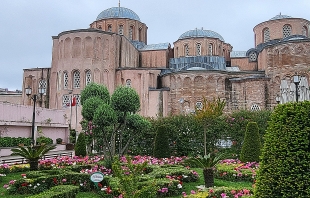
THE MOLLA ZEYREK mosque stands high on one of Istanbul’s seven hills. From its garden, which has a pleasant café, you can enjoy a wide panorama that includes views of the Bosphorus, the Golden Horn and bridges crossing it, the Galata Tower, the great Suleymaniya Mosque, and many other historic buildings around it. Turn your back on the view, and look across the well-kept flower garden, then you will see what looks like a large Byzantine church with three apses and several domes. However, as you stroll around this building, you will soon notice that it has its own minaret. This mosque was a church before 1453 when the Ottomans captured Constantinople/Istanbul.
As is the case with many other places of historic interest in Istanbul, there is an informative notice outside the mosque, written in three languages (Turkish, Arabic, and English). It outlines the history of the mosque. The building, designed by the architect Nikeforos, was built in the 12th century by Eirene (died 1134), the wife of Emperor Ioannis II Komnenos (ruled 1118-1143). Her father was King Laszlo I of Hungary. The edifice which is, in fact three churches joined in one building were the churches of the large Pantokrator Monastery. This institution included a 50-bed hospital, a library, an old-age home, a sanctuary for lepers, a medical school, a pharmacy, and a holy spring. The triple church was exceptional because:
“Except for the Church of the Holy Apostles, no other Byzantine building received as many imperial burials. John II (1118-43) and Eirene (Piroska of Hungary), their son Manuel I (1143–1180), and his wife Bertha of Sulzbach, were buried there, as were the Palaiologan emperors Manuel II and John VIII in the 15th century. In front of Manuel’s black marble sarcophagus was the Stone of Unction (a marble slab on which Christ’s body laid after his crucifixion), which Manuel brought from Ephesus around 1170. The large funerary chapel of the Archangel Michael is described by the typikon as a heroon – the shrine of a hero later used for the imperial mausoleum of Constantine and his imperial successors at the Church of the Holy Apostles.” (www.thebyzantinelegacy.com/pantokrator-monastery)
These monuments can no longer be found in the building.
Soon after Mehmet the Conqueror captured Istanbul, the monastery was converted into a madrassa. It became the first educational establishment created by the Ottomans in Istanbul. The monastery’s monk cells became cells for the madrassa and the triple church, suitably modified with a minaret, a mimbar, a mihrab, and other Islamic features, became a mosque with two classrooms for religious instruction. One of the new establishment’s professors was Molla Mehmed Efendi, nicknamed ‘Zeyrek’ – now, part of the mosque’s name. This learned man not only offered education to those who were already Muslim, but also to those who converted to Islam. In addition, he was instrumental in persuading many local people to convert to his religion.
Apart from the former church complex, now mosque, the other monastery/madrassa buildings have disappeared. This century, what had become an unusable, badly dilapidated structure was restored, and is now back in use as a mosque. The mosque occupies the southernmost of the three chapels. The other two chapels, although attractively painted, were empty spaces. One of these once served as the Byzantine Imperial mortuary chapel.
The Molla Zeyrek Mosque was formerly a Byzantine church. When the Ottomans took Istanbul, rather than destroying the places of worship of their Christian enemies, they recycled or repurposed them – they modified the churches and converted them to become mosques. Probably, the best-known example of this is Istanbul’s enormous Ayasofya-i Kebir Cami-i Şerifi (i.e., the ‘Hagia Sophia Grand Mosque’), constructed in the 6th century. Apart from Ayasofya, which we walked past almost every day during our recent 16-day visit to Istanbul, The Molla Zeyrek mosque was one of the most impressive and largest former Byzantine churches that we saw in the city. However, my favourite of these recycled churches was near where we were staying: the Kucuk Ayasofya Mosque, in whose charming walled garden we enjoyed numerous glasses of tea, met many friendly Turks, and watched the antics of the garden’s large feline population.
I have visited many cities in America, Asian and Europe. Many of them are fascinating, but now I can safely say that amongst these wonderful places, Istanbul has become my favourite because here the past, present, and future blend together with an exciting vibrance.
YOU NEVER KNOW WHAT you might discover when you stop in a small English town or village. And wherever you halt, you are highly likely to find something intriguing. Camelford in Cornwall is no exception to this. We stopped there to buy meat from Steve Heard Quality Butchers, and their meat is so excellent that we have shopped there twice in the last few days. After our second visit to the shop, we strolled around Camelford and soon came across the Methodist Free Church, which is housed in a rather plain grey stone edifice. A small sign near its entrance advertised that there was an exhibition inside its entrance lobby. Luckily, the church was open, and we were able to discover something about Camelford’s missionary in China.
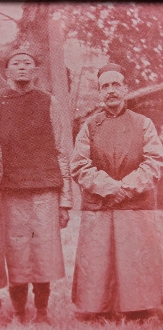
Samuel Pollard (1864-1915), the son of a Bible Christian Church preacher, was born in Camelford. After commencing a career in the British Civil Service, working in the Post Office Savings Bank in London’s Clapham, he was appointed a missionary to China in 1886. His change of career was prompted by his having attended a conference (The Southsea Methodist conference). In 1887, he set off for southwest China, where he became a Christian missionary amongst the Miao people. In 1891, he was posted to a newly opened Bible Christian mission station in Zhaotong. It was there that he began establishing a Christian movement amongst the Big Flowery Miao (aka ‘A-Hmao’) people, who live in the cold, rugged, mountainous areas of southwest China. In Zhaotong, Samuel married Emma Hainge, and they had four sons.
During the last 10 years of his life, Samuel converted 80% of the 400,000 Big Flowery Miao to Christianity. According to a Methodist website (www.myunitedmethodists.org.uk/content/people/ministers/sam-pollard):
“Sam Pollard worked from a missionary base in Zhaotong but travelled extensively around the province of Yunnan sometimes alone but usually with other missionaries or with Christian converts. From 1897 to 1904 Sam’s missionary efforts was focused on anyone who would listen. He and his colleagues held services which were often in the open air in a town centre or village market place. To gain attention he started off either banging a gong or attempting to play a concertina. Then, in order to have more effect, he blew a trumpet but he always maintained that he had little or no musical ability. As his reputation spread there was less need for this noisy introduction and simply standing up in a crowded place or advertising a meeting by word of mouth was enough. Sometimes many hundreds of people would attend and occasionally up to 3000!”
Apart from many adventures whilst living in, and travelling around, China, Pollard, who learned Mandarin at China Inland Mission training school at Ganking, is best known for a linguistic achievement. Along with several colleagues, he developed a script for the language spoken by the Big Flowery Miao. It has become known as ‘Pollard Script’. The Methodist website explained:
“‘Pollard Script’ was developed by Sam and several of his colleagues to help the A-Hmao to read in their own language. This proved a difficult task because many of the words use different tones rather than phonetics. He took inspiration from a script that had been developed by a Methodist Missionary working with North American Indians and also adapted Pitmans shorthand to indicate the level of the voice tones. Sam managed to translate much of the New Testament into this script before he died and there have been some improvements since, but it is still known as ‘Pollard Script’ and is also used by several other ethnic groups such as those that speak Tibeto-Burman languages.”
Samuel died of typhoid whilst trying to help a Chinese child suffering from that illness. Returning to the website already mentioned:
“The A-Hmao, Big Flowery Miaos still venerate Samuel Pollard as their spiritual leader. Their deep respect has survived Communism and the extremes of the Cultural Revolution right through to today. And it all started with Sam’s birth in the Bible Christian Manse in Victoria Road 150 years ago in Camelford in Cornwall!”
A recent President of China (‘reigned’ from 2003 to 2013), Hu Jintao, restored Pollard’s grave (at Weining Yi in Miao Autonomous County). He is said to have asked his officials to be like Pollard and support the poor.
Had it not been for the excellence of the butcher in Camelford, we would not have returned to the town. Because the town centre is quite picturesque, we spent some time looking around, and, as luck would have it, we stumbled across an exhibition about a remarkable man, of whom I had never heard.
DURING SEVERAL TRIPS within the ex-Portuguese colony of Goa on the west coast of India, we have visited churches and other Christian religious establishments built under Portuguese rule. The Portuguese arrived in India several centuries ago, and finally left their colonies in 1961 when they became incorporated (or annexed) into India. One of the aims of the Portuguese was conversion of their Indian subjects to Christianity. Many of the conquered people became Christian, and many churches and seminaries sprung up in the occupied territories. We have visited quite a few of these.
In most of the churches we have seen in Goa as well as in the recently opened Museum of Christian Art in Old Goa, we have noticed that depictions of angels saints, and Christ himself have facial (and other) features that are typical of Indian physiognomy. This is not too surprising as many artefacts in the churches of Goa were created by Indian artists.
When we visited the Museum of Christian Art in Old Goa, we saw two depictions of Baby Jesus lying on what looked just like typical Indian ‘charpoys’ (traditional Indian beds). The Holy Child in each case is a tiny doll. What fascinated me is that the dolls were wearing the sort of tiny bangles that are often worn by small Indian babies. One of the tiny models of Jesus was also wearing earrings.
Moving away from Christian sculptures and paintings, which have incorporated Indian characteristics, day to day Christian worship in India often incorporates features with origins in Hindu ritual practice. One example is the use of flower garlands (‘malas’), which is just as common in Christian settings as it is in Hindu settings.
Christianity was introduced to India not only by the Portuguese, but by others including St Thomas (apocryphally), and various European invaders. However, despite its foreign origins, India was not only affected by the Christian religion but has also made its mark on it.
I HAVE PASSED IT often, and have long been curious about it, but until today I have not bothered to find out about it. I am referring to a small chapel on the corner of Kensington Place and Newcombe Street, which leads to the south side of a space where a weekly farmers’ market is held (on Saturday mornings). Called the Bethesda Baptist Church, its congregation was established in 1866. The building resembles a style commonly used in the late 18th century. According to a history of Kensington Place (www.hillgatevillage.com/the-facts), the chapel was constructed in about 1824. Over the years, it has been used by various Baptist sects. Currently, it is the home to a congregation, who believe in Restricted Communion and Particular Redemption. This sect was founded in 1866.
Bethesda Chapel, Kensington
Currently, I am reading about a clergyman, Conrad Noel (1869-1942), who believed fervently that the church should be both democratic and all-embracing. So, it was with some interest that I stumbled across a chapel in which people believing in ‘Restricted Communion’ gather to worship. The sect is a branch of the Strict and Particular Baptists, who follow the decrees of High-Calvinism. If you are finding this a bit difficult to follow, then you are not alone. Let me take a stab at giving a simple explanation of what the congregation in the Bethesda Chapel believe: a set of beliefs that are new to me. One website that seemed to clarify them well is www.sbhs.org.uk/membership/strictbapt/, from which I have attempted to extract the following information.
‘Strict’ refers to ‘restricted communion’. Unlike many branches of the Christian Church, which permit anyone who believes and loves Jesus Christ to partake in Holy Communion, the Strict and Particular Baptists believe that Communion should only be offered to those “who have been baptised by immersion as believers”. The above-mentioned website explained:
“Strict Baptists see baptism as a rite by which believers testify to their faith in Christ, and associate it with church membership. The Lord’s Supper is for those who have joined the church in this way.”
As for ‘particular’, this lives up to the common meaning of the word. The Strict and Particular Baptists believe that:
“…Christ died to make certain the salvation of a definite number of people whom he has purposed to save, rather than to make possible the salvation of an indefinite number of people who might choose to believe.”
That is, only the ‘select’ few, known as the ‘Elect’, will be saved. The sect does not accept infant baptism, even by immersion, as being sufficient to become part of the Elect. Another website (www.baptists.net/history/2022/07/the-articles-of-faith-of-the-gospel-standard-churches/) explained what is required to become a member of a Strict and Particular Baptist sect such as that which uses the Bethesda Chapel:
“At a regularly constituted church meeting … the candidate (whether already a member of another church or not) shall make a verbal confession of faith, and declare what he or she believes God has done for his or her soul. If accepted by a vote of the majority of members present and voting, signature in the church book to the Articles of Faith and Rules will be required. Thereafter, at the earliest convenient opportunity, the person shall, unless previously baptised by immersion, be so baptised in the Name of the Father, and of the Son, and of the Holy Ghost; and be formally received into church fellowship at the next observance of the Lord’s Supper.”
The Articles of Faith, and there are many of them, are strict. Thus, despite my oversimplification, it would seem that the Strict and Particular sects are, unlike the open-door church espoused by Conrad Noel, extremely exclusive and restrictive.
PS: A little way west of the Bethesda Chapel, there is an institution that is, unlike the chapel, far from exclusive: it is open to all children regardless of faith, providing they live in its catchment area: Fox Primary School. This state school, which was founded in 1842, is housed in modern buildings. I mention it as a postscript because its walls are decorated with several attractive, colourful mosaics.
THAXTED IS A PICTURESQUE small town in Essex, about six and a half miles northeast of Stansted Airport. Apart from its numerous quaint old buildings, the town has three notable landmarks: an old windmill, a 15th century guildhall, and a large parish church, which was built between 1340 and 1510 during the time when Thaxted was an important centre for the manufacturing cutlery. Also, Thaxted is home to an annual music festival, whose existence derives from the discovery of the town by a composer, Gustav Holst (1874-1934), creator of “The Planets” and many other musical compositions, who was on a walking tour in Essex during the winter of 1913.
Gustav Holst in Thaxted
Holst, who was born in Cheltenham, was living in London by 1913 and teaching music at St Pauls School for Girls in Hammersmith, James Allen’s Girls School in Dulwich, and Morley College for adults in Lambeth. At the same time, he was busy composing.
Holst had come to study at The Royal College of Music in London in 1893. Soon after arriving in London, he became acquainted with William Morris (1834-1896) and attended meetings at the latter’s house in Hammersmith, where he would have heard lectures on socialism given by George Bernard Shaw (1856-1950) and others. Holst joined the Hammersmith Socialist Society (‘HSS’), which was led by Morris. Many of the socialists he met including Shaw were vegetarians, as was the composer Wagner, whom Holst greatly admired. As a student and a regular attender of meetings of the HSS, he became a vegetarian and at the same time developed a great interest in Hinduism (www.ivu.org/people/music/holst.html). He began studying Sanskrit at The School of Oriental and African Studies (https://www.bl.uk/20th-century-music/articles/holst-and-india) and several of his compositions bear Indian-sounding titles, such as “Savitri” and another opera called “Sita”, and songs based on the Rig Veda.
According to Nalini Ghuman:
“In contrast to the vague musical orientalism in vogue during the height of the British Empire, Holst’s hymns, with their bona fide Indian texts, subjects, and musical elements, have often seemed decidedly ‘un-Indian’ to the uninformed ear: ‘Sound firm impressions of the East from a sane Western perspective’ declared The Musical Times; ‘They do not suggest a point further East than Leicester-square’ (Daily Telegraph); after all, explained the Manchester Guardian ‘many real Eastern musical ideas are frankly ugly and uninteresting’. Their Indian musical roots have long been denied by the composer’s biographers.” (https://www.bl.uk/20th-century-music/articles/holst-and-india).
However, Ghuman points out in her article that Holst did incorporate elements of Indian music, including emulating Vedic chanting and a South Indian mode, the namanarayani. You would need to be a serious musician with specialist interest in Indian music to be aware of these features whilst listening to Holst’s Indian inspired compositions.
Returning to his political leanings, major biographies of Holst tend not to focus much on his connections with socialism, but an informative article, “Gustav HoIst, William Morris and the Socialist Movement” by Andrew Heywood (Journal of the William Morris Society, vol 11, no. 4: 1996), shows that his involvement was far from inconsiderable. In addition to attending meetings of the HSS, Holst conducted its socialist choir, played the harmonium on the ‘official socialist’ cart, and was involved in the administration of the society. Heywood wrote that:
“In the light of his clear commitment to the socialist movement through 1896 it would seem likely that his involvement with the musical activity of the society did not stem from a lack of political commitment; rather it was an opportunity to serve the movement in a way which utilised his musical talents and interest.”
It was through the HSS that Gustav met his wife Isobel, who not only sang in the socialist choir but also, according to Heywood, was politically active in the society.
So, it was with a background of involvement with socialism that Holst walked into Thaxted in late 1913 and took such a great liking to the place that he rented a 17th century cottage there (actually, in Monk Street, 1 ½ miles from Thaxted) from its owner, the Jewish author Samuel Levy Bensusan (1872-1958). Thus began Holst’s several year’s association with the town. It was not long before he made the acquaintance of Thaxted’s vicar, Conrad le Despenser Roden Noel (1869-1942). After the cottage in Monk Street burnt down, Holst and his family lived in a house, The Manse (formerly known as ‘The Steps’), in the centre of Thaxted. Today, this is marked by a commemorative plaque.
Noel was not a run-of-the-mill country cleric. He was a Christian Socialist and a member of Social Democratic Federation, a founder member of the British Socialist Party, and for some time the Chairman of the Anti-Imperialist League, supporting the struggle for independence both in Ireland and India. Deeply committed to Christian socialism, social justice, and egalitarianism, Noel made sure that what went on in his parish church promoted these ideals. Noel’s biographer, Reg Groves, wrote that Conrad:
“…emphasised always that there was much more to making a new society than the acquisition of political power and the transfer of some property from the rich to the state, from one set of rulers to another. In this as in so many things, he was at one with the wisest of English socialists, William Morris, and much of what Morris said in prose and poetry and in the work of his hand, Noel tried to say in the group life he had developed at Thaxted”.
Noel and Holst shared socialist sympathies and more.
During Holst’s sojourn’s in Thaxted in between his heavy teaching and other musical commitments, he attended services led by Noel. It was after one of these held at Whitsun in 1915, that Holst, having heard the great potential of singers in the church, approached Noel and offered to give the choir the benefit of his professional skills as a trainer of vocalists. Noel, recognizing the splendid opportunity, soon had Holst become his church’s ‘master of music.’
Heywood explains that Holst’s:
“…first job was to train the choir for the church. Its members were drawn from the local population, and they achieved high standards with Holst. One member, Lily Harvey from the local sweet factory, was sent to London for professional training because of her exceptional vocal talents. In addition to his activities with the choir and playing the organ, Holst organised three major music festivals in Thaxted between 1916 and 1918.”
Lily was not the only person sent to London for musical training. The then young curate Jack Putterill, who was politically turbulent and played the organ, became one of Holst’s students at Morley College. Jack, who married Noel’s daughter, succeeded Noel as Vicar in 1942.
The festivals organised by Holst involved not only performers from Thaxted but also some of his students from Morley College and St Pauls as well as other musicians from outside the town. Each festival lasted several days, on each of which there were many hours of music making, both rehearsed concert pieces and much spontaneous music.
Holst not only helped make music in Thaxted but also composed there. The plaque on the The Manse, where he lived, is positioned on the outside of the wall of the room in which he composed. While living at Monk Street, he composed much of what was to become the well-known piece, “The Planets”. The “Jupiter” section of “The Planets” contains a tune or theme that Holst named “Thaxted” (you can listen to this familiar tune here: https://youtu.be/GdTpBSg7_8E). In 1921, “Thaxted” was used as the tune for the patriotic song “I vow to Thee, My Country”, whose words were written by the British diplomat Cecil Spring Rice (1859-1918). Holst also composed pieces specially for Thaxted and its people. These works include a special version of Byrd’s “Mass for Three Voices”, “Three Hymns for Thaxted” (later known as “Three Festival Choruses”), and a setting of the Cornish carol “Tomorrow shall be My Dancing Day” (hear it on https://youtu.be/Cz_0j__FDuc).
Although the last festival in Thaxted with which Holst was intimately involved was in 1918, he never lost touch with music making in the town, even after he moved from it to nearby Little Easton in 1925. Holst’s pupil Jack Putterill, an accomplished musician who was Thaxted’s assistant curate from 1925 to 1937 and its vicar from 1942 until 1973, helped keep the town’s musical life alive and vibrant. In the 1950s and 1960s, concerts with great orchestras such as The London Philharmonic and audiences in excess of 1000 were held in the parish church. In 1974, the hundredth anniversary of Holst’s birth, the first of what was eventually to become an annual music festival was held in Thaxted. By the 1980s, the Thaxted Festival had become a regular and respected part of the British musical calendar (www.thaxtedfestival.co.uk/).
Apart from the Festival and the house with the plaque in Thaxted, most souvenirs of Holst’s time in the town can be found within the cathedral-like parish church, which, incidentally, was once a candidate for becoming Essex’s cathedral (this honour was granted to the parish church in the centre of much larger Chelmsford). The church in Thaxted contains a photograph of Holst with singers and musicians at the Whitsuntide Festival held in 1916. Near this, there is some calligraphy with the words of “Tomorrow shall be My Dancing Day”. The church’s Lincoln organ built in 1821 by Henry Cephas Lincoln (who worked between c1810 and c1855) was played by Gustav Holst and has been recently restored. Not far from the organ is a cloth banner, sewn by Conrad Noel’s wife, which was used in the 1917 Whitsuntide Festival. It bears the words “The aim of music is the glory of God and pleasant recreation”. These words were written by the composer JS Bach (1685-1750) and were chosen for use on the banner by Holst. Near this banner, there is a bust of Holst’s friend and collaborator, Conrad Noel.
Both Holst and his student Putterill fell in love with Thaxted at first sight and were so strongly drawn to it that the town came to occupy important places in their hearts and minds. We first visited Thaxted in the early summer of 2020 soon after covid19 restrictions began to be relaxed sufficiently to permit travelling out of one’s immediate neighbourhood. Like Holst and Putterill, Thaxted made a special impression on us, so much so that we have visited it at least twice since our first encounter with it. Next year, we hope to be able to attend concert(s) at the Thaxted Festival inside a church that we have grown to love.
THE NATURAL HISTORY MUSEUM in London’s South Kensington district was constructed between 1873 and 1881. It was designed by the prolific Victorian architect Alfred Waterhouse (1830-1905). Almost hidden away but close to Oxford Street, there stands another distinctive building designed by Waterhouse. Dome decorative brickwork on the east side of the structure proclaims that it was built as:
“Kings Weigh House Chapel”, and:“These buildings were erected in the year 1891 for the worship and service of God”.
The complex of buildings on Duke Street faces the northeast corner of Brown Hart Gardens. They were designed to include a chapel and a Sunday school as well as other offices. The chapel derives its name from a former dissenters’ chapel that used to stand above the Kings Weigh House in Eastcheap. It was formed in about 1685 (https://en.wikipedia.org/wiki/King%27s_Weigh_House). In 1834, the site of the church was moved to larger premises at Fish Street, near London Bridge. Where it used to stand there is now an entrance to Monument Underground station. In 1882, the Fish Street site was compulsorily purchased bt the Metropolitan Railway. The Duke of Westminster offered the congregation a site on Robert Street (now Weigh House Street) and funds to construct yet another chapel (https://victorianweb.org/art/architecture/waterhouse/3.html). The church accepted his offer and their chapel designed by Waterhouse is what you can see today.
I have only seen the chapel’s decorative exterior with some Romanesque features, which were achieved using brickwork and contrasting whitish masonry, but have not yet entered it. However, I have seen pictures of its interior, which show that it is quite interesting. Apart from the impressive tower on the southwest corner of the church, I was struck by the oval structure that forms the bulk of the building. This houses the main place where the congregation worships. With the long axis of the oval running east to west, the oval ‘nave’ is surrounded above by an oval gallery with several rows of tiered benches (www.british-history.ac.uk/survey-london/vol40/pt2/plate-23). I have not seen many oval churches like this but did see one in Edinburgh (Scotland), the neo-classical style St Andrew’s and St George’s West Church. In this case the long axis of the oval also runs east to west.
The chapel was bombed during a communion service in 1940 in October 1940, when two people were killed and the chancel was damaged. During most of WW2, the chapel was requisitioned as a fire watching centre, presumably because of its high tower, and also as a ‘rest centre’. After the war, the damage was repaired, and the church was rededicated in 1953. By1965, the congregation ceased using Waterhouse’s chapel. It was decided in 1966 to disband the church at the Duke Street site and sell it.
In 1967, the chapel was bought by the Ukrainian Catholics. They have used it as their cathedral in London. Its full name is now ‘The Ukrainian Catholic Cathedral of the Holy Family’ (Українська Католицька Єпархія Пресвятої Родини в Лондоні). The church is open for services, usually either early in the morning and/or in the early evening (www.ucc-gb.com/cathedral). Sadly, we looked at the place mid-morning, but we will visit it again one day when there is a service in progress so that we can view its interior.





 yamey
yamey 