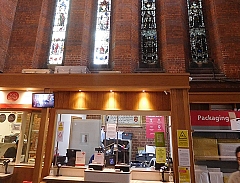
Some tiny doors at the Windsor Castle in London’s Kensington

THREE YEARS AGO, I published a book about west London past and present. In it, I made a brief mention of a pub, the Windsor Castle, which is near to Notting Hill Gate. This is what I wrote in the book:

At the western end of Peel Street, there is another pub, The Windsor Castle. Unlike the Peel Arms, this is a working establishment, now popular with the locals, most of whom are definitely not poorly paid labourers. The hostelry was originally built in about 1826, and then remodelled in 1933. The pub contains much of its original late Georgian building fabric and is a Grade II listed place.”

A tiny door

Although the pub is a mere 5 minutes’ walk away from our home, where I have been living for more than three decades, I only entered it for the first time today, the 24th of August 2025. On entering, we were given a warm welcome by the pub’s manager before we sat at a table in the shade of a tall tree that overlooks the hostelry’s enclosed garden.

Within the pub, the furnishings look quite old. A notice on the wall draws the attention of visitors to some very low doorways in the wooden screens that divide the interior into separate rooms. The notice relates that in the seventeenth, eighteenth, and nineteenth centuries, families ran pubs. The children of the landlord and landlady used to work in the pubs, delivering food and drinks. They would enter and exit the areas where the customers were enjoying food and drinks through the tiny doors such as still can be seen at the Windsor Castle, closing the doors behind them. The pub’s patrons were not allowed to use these little doors. They had to stay in the sections of the pub that were reserved for their social status: the public bar, the private bar, the sherry bar, and so on.

Just as I had never entered the Windsor Castle before, I had never seen these tiny doorways in any of many pubs I have visited.

My book “BEYOND MARYLEBONE AND MAYFAIR: EXPLORING WEST LONDON” is available from Amazon: https://www.amazon.co.uk/BEYOND-MARYLEBONE-MAYFAIR-EXPLORING-LONDON/dp/B0B7CR679W/

Touchy feely: tactile art from Czechoslovakia in London

PAINTINGS, PRINTS, AND drawings cannot be fully appreciated by the partially sighted, and not at all by those who are blind. In contrast, sculptures can be enjoyed by those who have problems seeing if they are permitted to touch them. Sadly, most sculptures by famous artists are not allowed to be touched. Today (7th of June 2023), I visited an exhibition of works by the Czechoslovak artist Maria Bartuszova (1936-1996) at London’s Tate Modern gallery.

Many of Bartuszova’s intriguingly original sculptures, often with highly organic shapes are too fragile to be touched. In 1976, the 1st Sculpture Symposium for blind and partially sighted children was held at the Elementary School for Partially Sighted Children in Levoca (Slovakia). A second such event was held at the school in 1983. Bartuszova created a series of hand-sized sculptures, some of which could be taken apart and then re-assembled by the children attending the workshops. The idea was to get the visually handicapped children to appreciate shapes and textures by handling her sculptures. The exhibition at the Tate Modern shows photographs of the youngsters at these workshops, most of them with happy expressions on their faces.

Some of the artworks that these children were encouraged to touch are displayed in glass cases. However, visitors to the exhibition at the Tate Modern are not permitted to touch them.

Alas, poor little Clopton

THE GLORIOUS GOTHIC CHURCH in Lavenham (Suffolk) attests to the prosperity that the town enjoyed many centuries ago when it was involved in the then extremely lucrative wool trade. In those far-off days, infant mortality was far from uncommon amongst people from all social classes. Related to this, there is something quite unusual on the floor in front of the chancel of Lavenham’s large early 16th century church of St Peter and St Paul.

The strange object in the floor is a funerary brass. These are commonly found in mediaeval churches, but differ from the one in Lavenham. At first sight, the small brass looks a bit like a fish. However, on closer examination, it can be seen to be a depiction of a baby wrapped in swaddling clothes or chrism robes.  At one end, the babies small face is visible. The brass is curious because it is, if not the only, one of the few, surviving examples of a funerary brass depicting an infant, rather than an older person. The brass marks the grave of Clopton, the first-born son of the antiquary and politician Sir Symonds d’Ewes (1602-1650). His son died in 1631 only 10 days after being born, and 4 days after having been baptised.

The prominent position of Clopton’s grave probably relates to the fact that his father had married Anne, the daughter and heiress of Sir William Clopton, and in so doing had become very wealthy. In 1636, he was appointed the High Sheriff of Suffolk. He was also Lord of the Manor in which Lavenham was located. Clopton was not the only of their offspring to die young. In the “The autobiography and correspondence of Sir Simonds D’Ewes, bart., during the reigns of James I. and Charles I”, we read about Clopton’s demise in 1631:

“Our sweet infant was a little ill, Thursday, July the 7th, but we had no suspicion or fear of his approaching end till Saturday, July the 9th, when he was surprised with a violent and little intermitting lask [i.e., looseness] or scouring; with which he having been grievously afflicted and disquieted all the day, he had some intermission about four of the clock in the afternoon, and so lay quietly breathing out his last and innocent breath till near upon six of the clock the same evening, when he rendered up his blessed soul into the hands of his eternal Creator. I had attended him, fasting the greatest part of the day; and when he had given up the ghost, my dearest and myself could not refrain from many tears, sighs, and mournings…”

Two sons followed Clopton’s death – Adrian and Geerardt. Both died early in their lives. Sir Symonds wrote that in 1633, Adrian:

“… was interred, March the 14th, Thursday, in Lavenham chancel, also in the same grave with Clopton D’Ewes, his elder, and Geerardt D’Ewes, his younger brother.”

From this, it seems that the unusual brass not only marks the grave of Clopton, but also the final resting places of Adrian, and Geerardt. And in 1634, we learn:

“Between two and three of the clock in the afternoon of the same day, she [i.e., Symond’s wife] was safely delivered of her fourth son, who was baptized in Ixworth parochial church, on the 1st day of August, and named Clopton. For though we had lost the eldest of the same appellation, yet my dear esteem of my wife and her family made me once more bestow her surname on this son, who was at this time, his three elder brothers being dead, one heir-apparent.”

Alas, the second Clopton never lived long enough to inherit his father’s baronetcy. In about 1650, about 9 years after Anne had died, Symond’s second wife, Elizabeth (née Willoughby) produced a son – Willoughby D’Ewes, who inherited the baronetcy.

Although I have visited St Peter and St Paul in Lavenham several times before, it was only during my most recent visit that I noticed the unusual ‘baby brass’. Many of Lavenham’s charms – notably its abundance of half-timbered houses and its Guildhall (built 1525) – are obvious. In addition, the town is full of fascinating less prominent details, such as Clopton’s brass I have just described.

A chance meeting in north London

During the late 1990s, our then young daughter had a baby-sitter called Bridie. Although Bridie was already well into her eighties when we first met her, she was a remarkably sprightly lady. Born in a rural part of the west of Ireland, she came to England in her late teens. On arrival in England, she and her husband were cared for by the Salvation Army in exchange for taking a pledge never to drink alcohol again. Bridie never reneged on this promise.  To earn a living in London, where she settled, she became a domestic servant. Hearing that I had been brought up in northwest London’s Golders Green, she told me the following story.

War memorial clocktower in Golders Green

Sometime before WW2, Bridie was employed as a maid in a Jewish household in Golders Green. She looked after the family’s children and carried out many household duties. Even though it was not a particularly wealthy family, Bridie recalled that she wore uniforms when on duty. There was one outfit that she wore in daytime and in the evening, she changed into another. As she did with our daughter, Bridie became fond of the family’s two young sons.

Many years later, when Bridie had become a grandmother and our daughter’s baby-sitter, she used to spend her spare time travelling around London by bus (making use of her old age free bus pass).  One day, she was waiting for a bus at the stop closest to Golders Green’s Sainsbury’s (on the site of the Ionic cinema), when a well-dressed late middle-aged man in the queue said to her:

“Goodness! Is it you, Bridie? We have not seen each other for so many years.”

After a moment, Bridie realised that she was being addressed by one of the two boys, whom she had looked after in the house in Golders Green before the War. Just then, a bus arrived, and as her former charge was about to embark, he shouted:

“This is my bus. Are you taking it, Bridie?”

Bridie misheard what he had said, and by the time she realised, the bus had pulled away, leaving her at the bus stop. She told me that if she had known he was taking that bus, she would have joined him. As far as I know, she has never seen him again.

The fantastic herons

ON SUNNY EASTER Sunday (2022), we took a morning walk along the Thames Path from the Black Lion pub (and the excellent Elderpress Café facing it) to Dukes Meadows, upstream from the pub. Dodging the endless stream of mostly courteous joggers and less polite cyclists, we enjoyed splendid views of the River Thames and the many old buildings lining Chiswick Mall. Several of the buildings were covered with flowering wisteria.

The Fantastic Herons

The river was well-populated with waterfowl including swans; geese of various kinds; ducks; a pair of cormorants resting on a buoy; and several herons. The latter were either standing on the sand and mud at the waterside or in the water close to the bank. Eventually, we reached Dukes Meadows, which consists of fields formerly part of the estate of nearby Chiswick House.

Near the Hammersmith end of the Meadows, we saw a metal sculpture, ‘The Fantastic Herons’, on top of a tall pole. Created by the artist Kevin Herlihy (born 1962) along with pupils from Cavendish Primary School and unveiled in 2004, it depicts three herons standing on a nest. Like most of Herlihy’s creations which often depict animal life, it is made from recycled waste materials. Funded by Singapore Airlines, who held a series of art workshops in the school, it is an appropriate sculpture for the area as herons can often be standing by, or in, the Thames flowing past the Meadows.

A village, a school, and Jemima Puddleduck

LONG MELFORD IN Suffolk is a village that I have passed through several times. It was only during our most recent visit in August 2021, when we stopped there to see its church and Melford Hall that I realised that the place has a connection with Highgate School (in north London), which I attended between 1965 and 1970.

Melford Hall sits on land that was once owned by the abbots of St Edmundsbury. As with all monastic property, it passed into the hands of King Henry VIII when he ordered the dissolution of the monasteries in the 16th century. The king with an eye to profit rather than the prophets sold the properties he had confiscated to wealthy buyers (nobles, merchants, and lawyers). Melford Hall and its lands were sold to a local lawyer, William Cordell (1522-1581). His father was a personal assistant (‘steward’) to Sir William Clopton, a lawyer and owner of Kentwell Hall at Long Melford. Young Cordell was sent to study law at Lincolns Inn and was called to the Bar at the early age of 22. An active politician during the reigns of Queens Mary I and Elizabeth I and a founder of the Russia Company, William Cordell acquired great wealth. It was he that bought the estate at Long Melford along with its stately home, Melford Hall. In addition, he married Sir William Clopton’s granddaughter, heiress to estates in Lincolnshire and Yorkshire.

Cordell did not build Melford Hall, but he did modify it in various ways. However, he did build the nearby Hospital of the Holy and Blessed Trinity in 1573. Situated across from the cathedral-like parish church, this was an almshouse for 12 aged men and women. The Great Church of The Holy Trinity stands behind and above the almshouse. It is a superb example of 15th century gothic architecture and is distinguished by having a separate Lady Chapel, which cannot be entered from the church, at its east end. It is one of the only parish churches in the country, which was never part of an abbey, to have such a feature. Within this fine church, Sir William Cordell’s elaborate sculpted tomb can be found in the chancel to the right (south) of the high altar. He died childless.

Amongst other important roles, William Cordell became Recorder of London. He succeeded his acquaintance, another lawyer from Lincolns Inn, Sir Roger Cholmeley (c1485-1565). Sir Roger was the founder of Highgate School during the final months of his life. This is the school I attended many years later.

Thomas Hinde, author of “Highgate School. A History” wrote that after Cholmeley, William Cordell was the school’s greatest early benefactor. Connected with two other educational establishments, St Johns College in Cambridge and Merchants Taylors’ School, Cordell became a Governor of Highgate School in 1576.

When I was at Highgate, it only admitted boys. Some pupils, including me, were day boys, and others were boarders. The boarders lived in one of four houses: School House, The Lodge, Grindal House, and Cordell House. Grindal was named to commemorate Bishop Edmund Grindal (c1519-1583), who helped establish Highgate School and Cordell was named to honour William Cordell. Until We visited Long Melford, I had no idea about the reason for giving Cordell House its name.

Returning to Melford Hall, once the home of William Cordell, it has passed through many generations of the Hyde Parker family, who acquired the hall and its grounds in 1786 from a descendant of both William’s sister and his cousin, Thomas Cordell. In 1890. The Reverend Sir William Hyde Parker (1863-1931) married Ethel Leech (1861-1941) in 1890. Ethel had a cousin, who has become extremely well-known, the children’s author Beatrix Potter (1866-1943). She used to visit the Hyde Parkers at Melford Hall, where she stayed occasionally. She used to draw and sketch many features of the hall and its grounds. We were shown one of the bedrooms in which she used to sleep. Nearby in a glass-fronted display cabinet, you can see a toy duck, wearing the outfit that Beatrix had created for it. This duck was the inspiration for her book “The Tale of Jemima Puddleduck”, which was first published in July 1908.

I had seen photographs of Melford Hall, which made me want to visit it, and I was not disappointed. However, I had not expected to learn that the Hall and the village have connections with both Beatrix Potter and one of the earliest benefactors and governors of the secondary school I attended in Highgate. Our visit to Long Melford certainly broadened our minds, as the popular saying goes. I will leave you with how GK Chesterton, who attended St Paul’s School rather than Highgate, expressed this idea in his “The Shadow of the Shark”:

“They say travel broadens the mind, but you must have the mind.”

A post office in a church

WEST HAMPSTEAD, FORMERLY known as ‘West End’ in the time, before the 20th century, that Hampstead was a small town separated from London. Now, yet another of London’s numerous suburbs, West Hampstead has several churches as well as a synagogue. One of these places of worship, St James Church, is worth entering because it is not what it seems from its external appearance.

The large Parish Church of St James, built mainly with red bricks, was erected in about 1887 (www.lwmfhs.org.uk/parishes/6-middlesex/28-hampstead). It was designed by Sir Arthur William Blomfield (1829-1899), the fourth son of CJ Blomfield, Anglican Bishop of London between 1828 and 1856, who encouraged much new church building during the 19th century. This large church could seat 1000 people (www.british-history.ac.uk/vch/middx/vol9/pp145-152#h3-0007) and has some fine 19th century stained-glass windows.

On entering the church through its electrically operated glass sliding doors, you will be surprised by what you find beneath its fine hammer beam timber ceiling. The west end of the nave is occupied by a post office, the first main-branch of a UK post office ever to be housed within a church. The north aisle of the church contains a children’s ‘soft play’ area, appropriately named ‘Hullabaloo’. The floor of the nave is filled with tables and chairs occupied by people of all ages, some enjoying refreshments from the church’s Sanctuary Café. All these things that you would not normally expect to find inside a church are part of The Sherriff Centre, a community organisation that began operating in 2014 (https://thesherriffcentre.co.uk/). The Centre’s activities also include a stationery store, a free food bank, live music as well as other events, free wi-fi, debt advice, and more.

Jesus is said to have thrown the moneychangers and others involved in commercial activity from the Temple in Jerusalem (“The Holy Bible”, John, Ch 2, v 13-16). However, he might have approved of the commercial activities within St James because profits from the sales outlets in the Centre are used to help finance charitable work. In addition to everything that I have already described about what goes on within St James, there is one more thing to mention. Despite the activities that you might not expect to find inside a church, regular religious Church of England services are held there. It is wonderful that St James, instead of becoming yet one more barely used Victorian church in London, has become a vibrant and beneficial part of a local community, catering to more than only just its by now small congregation.

Wrecked, then recovered

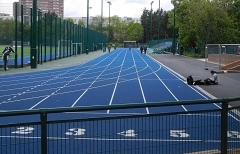
Running track at Paddington Recreation Ground

PADDINGTON RECREATION GROUND, located between West Kilburn and St John’s Wood, was formally established in 1893. It was London’s first public athletic ground. From 1860 to 1893, it was a parish cricket ground. In 1888, a cricket pavilion was constructed. It is now named after Richard Beachcroft who was Secretary of the cricket club in the 1880s. Also in 1888, the grounds were opened to public access and a cycle track was laid out, which remained in existence until 1987 when the position of the cricket pitch was moved. In 1893, the Paddington Recreation Act was passed, authorising:

“…the formal acquisition of lands in the Parish of Paddington to “provide the residents with a public recreational ground.” (https://en.wikipedia.org/wiki/Paddington_Recreation_Ground).

In 2006, the grounds were completely refurbished by Westminster City Council. The centrally located cricket pitch and its Victorian pavilion are now surrounded by a children’s playground; tennis courts; an outdoor gymnasium; a running track; hockey pitches; a bandstand; a bowling green; and various fenced off enclosures containing gardens and an ‘environmental area’. The pleasant park with its café and other facilities covers 27 acres and is well used by locals.

The Paddington Recreation Ground was a place where two world famous sportsmen trained. One was the professional road and track cyclist Sir Bradley Marc Wiggins (born 1980), who won the Tour de France in 2009. He learned to ride a bicycle in the grounds. He attended the St Augustines Church of England School nearby. The other sportsman was a medical student at the nearby St Marys Hospital when he trained on a running track at the Recreation Grounds, and on the 6th of May 1954, he became the first man to run a mile in under 4 minutes. This man was Sir Roger Bannister (1929-2018).

The Recreation Ground has several entrances. One of these is a short path leading from Carlton Vale. It runs past a pub called ‘The Carlton Tavern’, which has a curious recent history. In 1918, a German bomb destroyed a pub that stood on this site. In 1921, this was replaced for the Charrington Brewery by a newer building designed by Frank J Potter (1871-1948), who also designed the observatory in Hampstead. During WW2, the pub was the only building in the street not to have been destroyed during The Blitz. This plucky little pub’s luck ran out in 2015.

In 2015, developers bought the Tavern with a view to demolishing it to create space to build luxury flats. A week before the pub was due to become a protected historical edifice, the developers, no doubt having learned what was in the offing, reduced it to rubble. They hoped that they would get away with being fined an amount, which they could easily recoup when they sold the luxury accommodation they were planning to build. Things did not work out in their favour. Local action groups fought for the pub’s reconstruction and won. The courts ordered the developers to reconstruct the pub brick-by-brick (www.standard.co.uk/news/london/developer-told-to-rebuild-maida-vale-pub-brick-by-brick-after-site-torn-down-without-notice-10211892.html). They did a good job, and today it looks much as it did before it was hurriedly demolished.

Both the pub and the Recreation Ground stand in the shadow of the tall tower of the Anglo-Catholic Church of St Augustin. Known as ‘the cathedral of north London’, the church was designed in the gothic revival style by John Loughborough Pearson (1817-1897), who also designed Truro Cathedral in Cornwall. St Augustin was consecrated in 1880, but the tower and spire were not completed until 1897-98. I have never been inside this building, but I have seen photographs of its interior, which looks superb.

The places described above are almost all that remains of an area which has been subject to much rebuilding since WW2. Visiting these places can make an interesting detour when walking near Little Venice along the Paddington Arm (branch) of The Grand Union Canal. I doubt that I would have visited the Recreation Grounds had I not been alerted to it and encouraged to pay it a visit by two sets of friends, to whom I am grateful.

A local working-class heroine

COLVILLE SQUARE GARDEN in North Kensington is seventy-two yards east of a section of Portobello Road, where stalls with various foods do business most days of the week. The square was laid out in the1870s by the local developer George Frederick John Tippett (1828 – 1899). By the 1950s, the area around Colville had a large proportion of the local ‘black’ community, numbering about 7,000 (https://citylivinglocallife.files.wordpress.com/2017/04/colville-community-history-newsletter-issue-18.pdf), living there.  Conditions in the locality became particularly bad not least because of the activities (www.rbkc.gov.uk/vmpeople/infamous/peterrachman.asp) of the notoriously unscrupulous local Polish-born landlord Peter Rachman (1919-1962). Unfortunately, in addition t0 Rachman’s poor behaviour with his mostly impecunious tenants, the area became seedy and crime ridden. Since those days, things have looked up and the area has become a far more pleasant place to live and visit.

Colville Square Gardens is a typical London square surrounded by residential buildings. Long and thin. it runs parallel to Portobello Road between Colville Terrace and Talbot Road. Much of the garden is used for recreational activity and includes a play area for young children. At the south-eastern corner of the square, there is a decorative iron gate leading to a nursery and pre-school. The gates bear the words:

“In memory of Pat McDonald”, and her dates:

“1940 – 1986”

A small, rather indistinct plaque next to the gate records:

“Pat McDonald. Working-class heroine. Lived and worked in North Kensington from the 1960s until her death in 1986. She was the driving force behind the campaigns for better housing, more play-space, and new nurseries. May her fighting spirit live on.”

There is no mention of who placed this memorial.

Pat’s endeavours to improve the care of children under the age of five began in about 1967 when she:

“… and a mothers group ‘commandeered’ a local vicar and started a playgroup in the vestry of a local church … The booklet to commemorate Pat McDonald’s life tells through reminiscences how this became Powis Playgroup in All Saints Church Hall, which gained a grant for equipment from the Pre-school Playgroups Association.” (www.academia.edu/28663809/Activism_and_organisation_Creating_a_community_nursery_in_1970s_Notting_Hill).

And this is almost all that I have managed to discover about North Kensington’s local heroine. It seems that the poor lady’s life ended tragically. Two websites allude to her tragic, premature end. From one of them (www.theundergroundmap.com/article.html?id=34069), we learn:

“The Colville Nursery Pat McDonald gates are dedicated to the People’s Association community activist play worker, who was murdered by her husband.”

The association was most likely the ‘Notting Hill People’s Association’, which was set up in 1966 to:

“… to widen access topeople with grievances and problems and to resolve them with legal advice – to resolve the individual problems but also to campaign on more general issues.” (www.unionhistory.info/britainatwork/emuweb/objects/common/webmedia.php%3Firn%3D1618+&cd=8&hl=en&ct=clnk&gl=uk).

Once again, whilst walking along a street which I have used hundreds of times, I came across something I had never noticed before. This time it was the quite conspicuous gate in memory of a social reformer and the far less conspicuous memorial plaque close to it. I pride myself on being reasonably observant, but clearly, I have not been nearly as aware of my surroundings as I believed.

What have we come to?

I FIRST MET MY FRIENDS, the brothers, ‘A’ and ‘B’, at the birthday party of another friend ‘C’. This meeting would have been in March 1965. I know this because the celebrations included watching a matinee performance of the film “Goldfinger”, which had been released in the UK a few months before (in September 1964). We saw the film in the now long-since demolished Odeon Cinema in Temple Fortune, which is on the edge of Hampstead Garden Suburb (‘HGS’), where we all lived. Sadly, one of the brothers died a few years ago, but the other two friends are still thriving.

BLOG PUT 3

Mutton Brook

Since the major London ‘lockdown’ ended and we have become more mobile, having acquired a motor car, we have made several visits to HGS to see ‘old haunts’. One of these places is the series of public gardens (Northway Gardens and Littleton Playing Fields) that run along either side of a stream called Mutton Brook (it is a tributary of the River Brent that flows into the Thames at Brentford in Middlesex). The Brook runs parallel to Falloden Way, a stretch of the A1 road. Flanking the road that separates HGS into two sections, there is a shopping area appropriately and unimaginatively called the Market Place. During my childhood, the section of HGS north of Falloden Way was affectionately known as ‘Across the Jordan’ because many Jewish people live(d) there. I suspect that today, there is a fairly equal distribution of Jewish households in both sections of HGS separated by the A1.

My friends, A, B, and C, and I used to visit the gardens alongside Mutton Brook in our spare time. In those days, but not now, the water in Mutton Brook had a rather unpleasant smell (sewage or something rotting). One of the attractions in the gardens was a putting green open to the public. For a small fee it was possible to hire a putting implement (a putter) and a golf ball. The brothers, A and B, were very competitive, and C was less so. The three of them managed to complete the course in a respectably low number of well-aimed shots. By the time I had reached the second hole, the others had putted their balls into all 18 of the holes on the course. What I have never been able to understand is why  when my ball was within inches of a hole, instead of falling into the hole, it spun around the circumference of the mouth of the hole without falling into the target area. Well, I was never skilled at any ball games, but I enjoyed the company of my friends.

Back in the 1960s, I believe that there were no refreshment areas in either Northway Gardens or Littleton Playing Fields. This has changed. There is a charming Café Toulous near one entrance to Northway Gardens and the Café Gaya in Littleton Playing Fields. Today, we sat at a table under trees near the latter and enjoyed drinking coffee in the shade. The ambient temperature was 31 degrees Celsius.  In one direction, we could see the spire of Lutyen’s St Jude on The Hill Church in the heart of HGS and in the other, a nursery school that shares the same building as houses the Gaya.

There were about twenty children’s push chairs (buggies) parked in front of the two-storey nursery. This came as no surprise because the school was in use. What was remarkable was the presence of three hefty looking security men, two in uniform and one in ‘mufti’. Each of these fellows had walkie-talkies and the two in uniform seemed to be wearing protective (bullet-proof?) vests over their jackets. They were keeping a very close watch on the kindergarten and unlocked its front door when ever there was something to be delivered.

After enjoying our drinks, we asked the Eastern-European lady working in the café about the security guards. In not brilliant English with a marked accent, she replied:

“Security”.

Flippantly, I asked:

“Are the kids dangerous?”

Not seeing the joke, she explained:

“Private Jewish school”,

And then added:

“All private Jewish schools have security.”

How sad it is that nowadays, even kindergartens filled with tiny tots are considered to be at risk from attack. This was never the case when my friends and I knocked golf balls around the now non-existent putting green on the bank of Mutton Brook. What have we come to?