GOING NUTS

I was at school throughout most of the 1950s and ’60s. I came into contact with numerous other children. As far as I can recall, not one of my fellow pupils ever admitted having a food allergy. A few had asthma or wore spectacles, but none seemed to suffer from allergies.

When our daughter attended schools at the beginning of this, the 21st century, many of the children with whom she studied had food allergies, notably nut allergies. Some of them even carried adrenaline filled epipens with them to be used should they come into contact with allergens. Our daughter was, luckily, not allergic to anything, but felt left out because she did not have an allergy. It seemed to her that having an allergy or wearing orthodontic appliances were almost ‘fashion statements’

Why are food allergies so common now? Is it a result of obsession with today’s hygiene and fear of germs. We live in the era of the hand sanitizer and obsession with ‘use by’ dates. Today’s children are shielded from allergens from a very tender age and this impedes the development of an effective immune system.

Research done in the USA some years ago compared the incidence of allergies in kids brought up on farms, where dirt and animals are hard to avoid, with that in children brought up ‘hygienically’ in cities. It was found that the city kids had a far higher incidence of allergies than their country cousins.

Our daughter first visited India when she was 7 months old. It was impossible to stop her putting just about anything she found on the ground into her mouth. I like to think that this might be why she differed from many of her peers in that she missed out on having allergies.

So, if you have young children, do not go nuts about shielding them from external factors that might prevent them needing to carry an epipen in the future.

Now, I will play the part of the Devil’s advocate. It is remotely possible that the apparent absence of children with allergies during my school days was because any kids with allergies had died of anaphylactic shock before they were old enough to attend school. I hope not!

My cat

I love cats. I have only ever ‘owned’ one. I named it Crumpet.

I was less than ten years old when Crumpet entered my life. I was lying in bed at home, recovering from a bout of tonsillitis, when my late mother brought Crumpet into my bedroom. She had only just bought the cat at a pet shop to cheer me up.

My mother, who was always nervous about me risking injury, would not allow me to open the tins of cat food that Crumpet enjoyed. She was concerned that I might cut myself on the sharp edges of the open tin lids. So, as my mother did not want to disturb my father, who did much of his academic work at home, she became responsible for feeding Crumpet.

Cats tend to be quite self oriented. They favour the people who feed them. In Crumpet’s case, it was my mother who received much of the cat’s attention. Our cat used to rub herself against my mother’s legs affectionately, especially when my mother was opening the cat food.

Now, here’s the rub. My self sacrifying mother could not bear cats. She put up with Crumpet for my sake.

Crumpet must have realised that my mother was not keen on her because after a few weeks our pussy abandoned our home for another about one hundred yards away from ours.

Since Crumpet deserted us, I have never kept another pet, but my fondness for cats has remained.

Chewing gum


It was in Turkey that I first tried chewing gum. I was ten years old. It was 1962, and we were staying at the Hotel Çınar at Yesiliköy on the Marmara Sea just west of Istanbul. We walked from the hotel into the nearby village, where my parents bought me a small pack of chewing gum. The pieces of gum were coated with a hard, sugary outer layer. I thought that this layer extended right through the piece, and I was surprised to find when I bit into it that it contained a soft gooey substance. I was not impressed.

GUM 1

Source: wikipedia

A year later, the family spent the last three months of 1963 in Chicago, Illinois. It was while we lived in the USA that I became very keen on chewing gum and its close relative bubble gum (specially the Bazooka brand). Between arriving in America and leaving Turkey, I had learned how to enjoy chewing gum. In America, the range of flavours of gum was huge compared with what was available in the UK. I used to chew a piece of gum and when its flavour had weakened, I added another piece, and then another, and so on until there was a huge mass of gum in my mouth. This ever-growing glob of gum would remain in my mouth for several hours.

I attended school while we were in Chicago. In each class room there were desks with swivelling desk-tops for writing on. I soon discovered that the undersides of these desks were covered with soft blobs. After touching these blobs, I discovered that the tips of my fingers acquired different pleasant odours. Naïve as it may sound, I only discovered after returning to England that these ‘perfumed’ squishy mounds were bits of discarded chewing gum.

In the late 1960s and the following decade, we used to visit Greece almost every year. In those days, Greek cities and towns had numerous kiosks selling newspapers, magazines, and … chewing gum. The most commonly found brand of gum was ‘Chiclets’. This trade name, established in 1900 in the USA is derived from the Spanish word chicle, which means ‘chewing gum’. The range of flavours available at these kiosks was much greater than what was available in the UK at the time.

We took many flights during my childhood. In the 1960s and ‘70s, many ‘planes were not as well pressurised as modern aircraft. During take-off and landing, there was a risk of much ear-popping. Sucking sweets or chewing gum was recommended to reduce the unpleasantness of the ear popping.

I was happily chewing gum as was usual on a flight when a thought occurred to me. The endless chewing of gum brought the rumination of cattle to mind. Suddenly, I compared myself to cattle chewing the cud. Although I have no objection to cattle moving their jaws endlessly, I felt that it was inappropriate that I should be doing the same. Since then, I have rarely chewed gum, and when I have done so I have found that my jaw muscles tire easily.


GUM 2

Source: CollectingCandy.com

Archimedes and Eureka!

As a young child I was fascinated by the following story, which may be apocryphal. Archimedes (c287-c212 BC), the great Greek physicist, mathematician, engineer, and general genius, is reputed to have made an important discovery whilst taking a bath. He noticed that the level of water in his bath rose as he immersed himself in it. This led to his famous Principle. When he realised the significance of the change in water level, he is said to have leapt out of his bath yelling “Eureka”, which is the Greek for “I have found it.”

ARCHIMEDES

In 1960, my father had to attend a conference at Kyrenia (Girne in Turkish), which is now in Turkish Northern Cyprus. It was then part of one unified country. We, the rest of my family, accompanied him. On our way, we had to change ‘planes in Athens. I remember walking down the steps that led out of the aircraft from London and feeling my face hit by a wave of burning hot air. I thought for a moment that I was feeling the exhaust from the ‘plane’s engines, but soon realised that the air at the airport had a very high ambient temperature.

On our return from Cyprus, we spent a few days in Athens. Our visit happened shortly after I had learnt about Archimedes and his Principle at school. In Athens, we visited numerous ancient Greek and Roman sites, and this put the idea into my head that somewhere amongst these ancient ruins we should be able to locate the famous bath out of which Archimedes leapt. Rather sportingly, my parents hired a taxi and explained to the driver the nature of our quest. He was happy to spend hours driving us around Athens, stopping regularly to enquire about the location of the bath. It was a fruitless quest. During the hours that we spent with our driver, he told us that he was Jewish. When he realised that we were his co-religionists, albeit completely non-practicing, he took us to see a synagogue, which was unmemorable architecturally.

Sadly, after spending time in the taxi, we were not able to exclaim “Eureka.”

Some months after we returned to London, I discovered that Archimedes had lived in Syracuse (Sicily) rather than Athens. If his bath had ever existed and still happened to be in existence, which was highly unlikely after so many centuries had elapsed since his death, it was there that one needed to search for it, rather than in Athens.


To read about more of Adam Yamey’s childhood travels, CLICK HERE


Summers in Florence

I hope that this piece will not sound ungrateful, dear reader.

ARY 36 HW 60s

When I was a child and in my early teens, my parents, who were art-lovers, took my sister and I to Florence every summer. As a child, I failed to appreciate what a treat these visits were. At the end of the summer when school recommenced, my friend N and I would compare notes about our holidays. N visited Llandudno in North Wales every summer with his parents. He would relate how they had climbed the Great Orme, travelled on a special tramway, and stayed at a marvellous hotel overlooking the sea. What was I able to tell N? Well, nothing that I believed would rival the exciting things that N had experienced. What, for example, was the Uffizi art gallery in Florence when compared with the Great Orme in Llandudno? I mention the Uffizi in particular, because our annual visits to this treasure house of art filled me with despair. I wrote of this place in my book “Charlie Chaplin Waved to Me” (available from Amazon and Bookdepository.com) as follows:

“The aforementioned Uffizi was another of the places that we often visited in the morning. I used to dread having to walk through its seemingly endless series of inter-connected galleries filled with masterpieces. The only thing that sustained me during this ordeal was the promise of an ice-cream afterwards or the promise of the opportunity to buy a paper cone filled with corn to feed the pigeons in the Piazza Signoria outside the gallery.

One of the first pictures that we always used to stop and admire was the Portinari Triptych painted by the Flemish painter Hugo Van der Goes in about 1475. That was during the time when the Florentine merchant Portinari, who commissioned it, was living in Bruges in the building which became the hotel in which we often stayed. My father, who is fascinated by the iconography of Renaissance art, explained to us the meanings of everything in this beautiful picture. My very young sister absorbed this information so well that year after year she could explain to us, and also to other tourists, who gathered around to listen to her, the reasons that particular things were depicted in it. For example, she could relate why there were a certain number of lilies in the vase near the bottom of the central picture; and why there was a barely visible devil’s horn at its top left, just above the horn of a cow grazing in the holy manger. This horn only became apparent after the picture was cleaned in the early 1960s.”

The museums and my late mother’s seemingly endless visits to the dress-maker and countless shoe shops added to my lack of enjoyment of Florence. However, it was not all gloom and doom. The food we ate was lovely and there were some cultural sights which I enjoyed. And, Florence did hold some mysteries, one of which was solved between two successive annual visits. Let me quote from my book again:

“The River Arno flows through Florence. It is traversed by a number of bridges, the most famous of which is the Ponte Vecchio. This is covered, like the mediaeval London Bridge used to be, with buildings and shops. The most interesting feature of this old bridge was the‘secret’ corridor that ran along its buildings just beneath their roofs. This, so my father often told us, linked the Uffizi on one side of the Arno with the Palazzo Pitti on the other side, the Oltrarno. Thispassageway, which must be about almost half a mile in length, allowed Florence’s rulers to move between these important buildingsunobserved by the public. It was closed to the public when we used to visit the city.

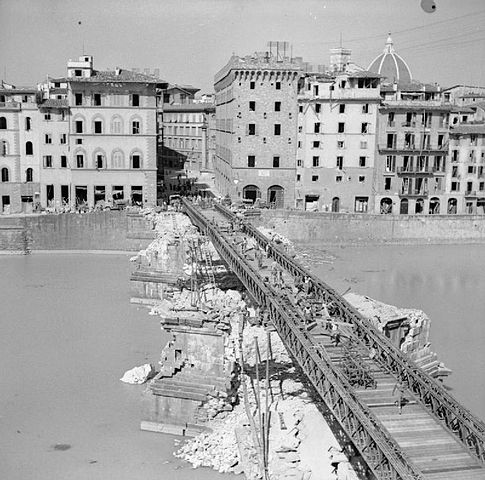
When the Germans retreated at the end of WW2, they demolished all of the bridges across the Arno except the Ponte Vecchio. They decided that as its carriage way was far too narrow to accommodate military vehicles and large troop movements, it could not have been used by the Allied armies chasing them. My father said it was a tragedy that this bridge was saved whereas its neighbour a few yards downstream was demolished. This bridge, the Ponte Santa Trìnita, was a masterpiece designed by the renaissance artist Bartolomeo Ammanati (1511-1592). His Fountain of Neptune is an important and much photographed landmark in the centre of Florence.

When we first visited Florence, the bridge, which was painstakingly reconstructed after the war from the fragments found scattered about under the waters of the Arno, had two statues at each of its ends. Three of these were complete, but one of them was missing its head. This was the only bit of the bridge that had not been recovered. One summer, when we were visiting the city, my father pointed at the bridge and asked us if we noticed anything different about it. We discovered that the missing head had been found, and was back in its rightful place; the bridge was complete again. This must have been in 1962, as the head was only recovered late in 1961.”

Most people reading this blog article, will probably think that I was so lucky to have visited Florence so often, and they would be justified. However, to a young boy as I was, I could not appreciate it properly. Now, many years later, I realise that my exposure to the arts at such a tender age was a great gift bestowed by my parents, even if it meant that I never saw the Great Orme.

The slow table

Food can be scarce

but when it’s abundant

let folk have plenty of choice

ADAM small


I attended Golders Hill School, a primary school in in Golders Green, between 1956 and 1960. It was a high-achieving school for boys and girls with an all female teaching staff. Founded in 1908, just after the Underground was extended from Hampstead to Golders Green, it still works today but in a greatly enlarged ‘campus’.


We used to spend all day at school. Lunch was served at 1 pm. We sat at various long tables. The children sitting on the table which ate its food fastest were  rewarded with a piece of confectionary from a box of ‘Dolly Mixture’.


I was a fussy eater. Having had a difficult few first months of life, my mother was happy to see me eating anything at all. I was not forced to eat anything I did not fancy. Actually, there were few foods that I was prepared to put in mouth. A particular dislike of mine, which remains with me to this day, is green peas. Their taste, or even just thinking about them, makes me feel nauseous. I can recall that my mother was keen that I should get to like these nauseous little green spheres. She would put a few on my plate. To avoid eating them, I employed the following delaying tactict: I would first slowly peel a pe, and then carefully cut into four pieces. My parents soon tired of watching, and eventually attempts to make me consume them were abandoned.


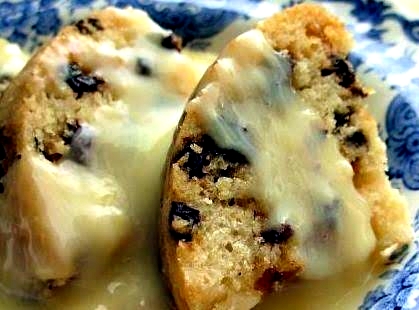
Almost nothing that was served at Golders Hill appealed to me apart from steamed pudding and the oddly named ‘spotted dick’. Main courses often came served with cubed carrot, chopped green beans, and green peas. I would not touch them. No table that I sat on would ever be rewarded with pieces of Dolly Mixture.

spotted

Spotted Dick with custard – source: https://www.justapinch.com

I was shifted to the slow table, where the four slowest eaters in the school sat trying to finish their food during the play time that followed lunch. I remember nothing about the three other members of the slow thable except that they were all girls and one of them was called Rhoda.


Even if I had been kept at the slow table for the rest of the day, there was no way that I would be able to finish what was in front of me. I devised a solution. I put whatever I could not eat into the pockets of my short trousers (‘shorts’), visited the toilet, and then emptied the unwanted food into the toilet pan, and flushed it away. This worked for most foods including slices of canned fruit.


My biggest challenge, and I can only remember it happening once, was gooseberries in hot custard. I felt that putting this in my pockets was not at all a good idea. In desperation, I carried my filled bowl to the closed door of the staff room. I knocked on the door, hoping that whomever answered would take pity on me. A forlorn hope because many of the teachers were quite formidable. I hoped that it would not be the large Miss Fitzgerald, who frightened me greatly. If it was Miss Dredge, I would have felt happier.


I cannot say who it was that opened the door. But, as soon as it opened I dropped the plate with all of its contents ont the feet of the teacher at the door. It still puzzles me why I was neither punished nor told off for my act of carelessness, or was it defiance.


PS: I still dislike peas, but now I love gooseberries.

Sabotaged

My late and much-loved mother was very protective of her two children. She saw dangers everywhere. We were not allowed to go near to electric wall sockets just in case we got an electric shock. Intelligent as she was, I have the feeling that she believed that electricity flowed out of the holes in the socket like water from a tap. 


During my childhood, my aunt and uncle used to smoke Benson and Hedges cigaretess that were supplied in nice small hinged metal boxes, which when empty were very useful for storing small objects. When one day I was given one of these boxes, empty, my mother confiscated it immediately. She was concerned that I might cut my fingers on the sharp edges of the box.

As for matches, much caution was needed here. Despite the fact that her grandfather had owned a factory that manufactured safety matches, even safety matches were deemed unsafe by my mother. Therefore, we were forbidden to handle boxes of  (even safety) matches just in case they should spontaneously ignite in our hands or packets. I am sure her intentions were well meant, but sometimes they went a bit too far. This excerpt from my book “Charlie Chaplin Waved to Me” (he did!) shows how her anxiety sabotaged what promised to be a wonderful hiking trip:

“The four of us (aged 17) embarked on a second youth hostelling trip the following Easter. Once again, we took a train to South Wales, and made our way up to our first hostel, which was located at Capel y Ffin in the Black Mountains near to the English border. We spent the night there, and awoke to discover that snow had begun to fall.


I had been instructed that I had to telephone home every morning to ensure that my mother knew that I was still alive. I rang from the hostel’s public telephone and my mother answered. She had heard on the radio weather forecast that there was snow in Wales, and asked meabout it. When I said that it had begun falling where we were, she ordered that we return to London immediately. Believe me, this was not an order that could be discussed. My mother, anticipating that we would surely be lost like Scott of the Antarctic in an avalanche or in freezing snow drifts, had to have us back as soon as possible. I broke the news to my 3 friends, who were furious. For about an hour they kept offering me reasons that I should give my mother in order to try to change her mind about our premature return. Eventually, they gave up. We all knew that none of these would work. And, because, I imagine, they feared my mother, we set off back to London. I have never been allowed to forget this fiasco. Even Hugh’s mother, now in her eighties, often recalls her amazement when she learnt how my mother had successfully wrecked our trip.“


“Charlie Chaplin Waved to Me” is available by clicking: HERE