A peaceful place of rest in bustling Kolkata

 IN ITS HEYDAY, the Jewish community of Kolkata consisted of as much as 6000 people. That was in the early 1940s. Today, less than about 20 Jewish people reside in the city. Most of Kolkata’s Jewish inhabitants were members of families that had migrated mainly from Iraq, but also from Syria. They were all Sephardic, rather than Ashkenazi, Jews. They began arriving in Kolkata in the very late eighteenth century. Most of Kolkata’s Jewish people have migrated to other countries – not because of anti-Semitism, but for economic reasons (as have many other Indians of all religions).


One can get an idea of the size of Kolkata’s Jewish community of yesteryear by visiting the Jewish Cemetery on Narkeldanga Main Road. It contains at least 2000 gravestones. We visited it on New Year’s Day 2025.
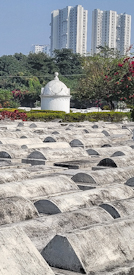
 

The genizah standing amongst the gravestones

The cemetery is beautifully maintained. Flowering bushes,  trellises, and trees punctuate the sea of white gravestones. According to Sephardic tradition, the stones are horizontal, rather than vertical. Most of them consist of a rectangular base surmounted by a hemi-cylinder. Each grave bears the name of the deceased in Hebrew and/or Latin script. It seemed to me that all of the graves are oriented in the same direction: roughly speaking the long axis of each grave runs in an east/west direction (more accurately,  the west end of each gravestone is slightly north of the east). The majority of the gravestones are simple, without ornament. A few of them are ornamented often with a stone carving of an open book.


Several of the stones record the deaths of military service personnel,  who died in action. Notices on these record that the bodies of these people were buried in military cemeteries elsewhere, at Ranchi.


In the centre of the gently undulating burial ground, there stands a circular tower, which is higher than all of the other graves. The tower, looking a bit like an enlarged pillar box (letter box). has a rectangular opening like that found on post boxes. This structure is a genizah.


A genizah is a place for disposing of worn out or no longer required sacred texts. These can include any documents that contain the name of God. These can be anything from holy texts to commercial contracts, legal documents,  and personal letters. If you wish to know more about the contents of a genizah, you could do well to read “In an Antique Land” by Amitabh Ghosh. I have read this autobiographical novel that includes much about a very ancient genizah discovered in Cairo,  and was very excited to see a real genizah in Kolkata.


I am not sure how easy it would have been to visit this fascinating Cemetery – a record of a once thriving community  – had we not known one of Kolkata’s few remaining Jewish inhabitants. Mentioning this person’s name persuaded the security officials to allow us to enter.

Hindoo Stuart and a son of  a great author

THE SOUTH PARK Street Cemetery in Kolkata was opened in 1767 and was used as a burial ground for Europeans (mainly British) until 1830. It contains a large collection of funerary sculpture (mostly mausoleums and obelisks), much of which is in the neoclassical style. This now peaceful oasis in central Kolkata with much greenery is the final resting place of many people who had roles in the British East India Company (including its armies) and their families.  Although the place contains the remains of many interesting people  I will concentrate on two of them, both of whom had military careers.

Tomb of Hindoo Stuart

Charles Stuart (c1758-1828) was born in Ireland (Dublin) and joined the East  India Company when aged 19. He served in one of its armies, reaching the rank of Lieutenant Colonel.  In India, he was attracted to, and fascinated by, Hindu culture and traditions. He adopted many Hindu ways of life including religious practices. For example, when off duty,  he wore Indian clothes and bathed in the Ganges (the Hooghly) daily. In addition,  he wrote many articles, published in the newspapers of Calcutta,  which extolled the Indian ways of living, and encouraged Europeans to wear Indian garb rather than western clothing. He felt that ladies from Europe would feel more comfortable and look better wearing saris in India. His sympathy for the Indian modes of life and admiration of Indians earned him the nickname ‘Hindoo Stuart’, but did not impede his military career.  His funerary monument in the South Park Street Cemetery is in the form of a small Hindu temple, quite different in form from all of the other monuments in the graveyard.


The other military person commemorated at South Park Street  has a very modest, barely legible gravestone. It records the death of the short-lived Walter Landor Dickens (1841-1863).  He was the fourth child and second son of the author of “Oliver Twist” and many other famous novels: Charles Dickens. Walter became an officer cadet in the East India Company armies, arriving in India in 1857, just before the so-called Indian Mutiny began. After the end of this revolutionary activity and the end of the Company’s rule in India and the start of the British government’s control of the country, he became a soldier in the British Army. Illness resulted in his death in a military hospital in Calcutta.


Walter was buried at the Bhowanipore Military Cemetery in Calcutta.  In 1987, some students at Kolkata’s Jadavpur University raised funds and had Walter’s gravestone moved to the South Park Street Cemetery. This was done because it was not being cared for and to honour his father, the famous author.


Having recently become a fan of the novels of Charles Dickens,  I  was pleased to have been able to view Walter’s gravestone.  The lettering on it is legible, but not too easy to read.


During our recent visit to the Cemetery, which we made in December 2024, we saw the two graves mentioned above and many others which we had not noticed on previous visits.  For those interested in the early history of Kolkata during its British occupation, the South Park Street Cemetery should not be missed.

From Myanmar to the garden of Eden in Kolkata.

THERE IS A MAJOR cricket stadium in Kolkata called Eden Gardens. This world renowned sporting venue is adjacent to a far less well-known park: Eden Gardens Park. Established in about 1842, its fame was eclipsed by the opening of the cricket stadium in 1864. The stadium is named after the park.


Lord Auckland, the governor-general of India from 1836-1842, had ordered the construction of this pleasure ground. The garden was named after his sisters, Emily and Fanny Eden.


For a modest entry fee (20 rupees per person) one can enter the park, which contains a bandstand, flower beds, a rather rundown Japanese garden, a lake, a café, and a surprising feature that I will describe shortly. When we visited the park on a Saturday afternoon,  there was a discotheque operating in the bandstand.  The volume of music coming from the bandstand was excessive and unbearable. A local division of the Kolkata Police Special Department were having a party. Despite the racket, we strolled through the park to the attraction, which makes the park quite distinctive: a pagoda from Burma (Myanmar).

 The wooden pagoda, which is in need of a little repairing,  stands almost surrounded by the lake. The British brought it in pieces from Prome in Burma in 1854 at the end of the second Anglo-Burmese War (1852-1853), and reconstructed it in the park in 1856. Burmese workers put it together in the park.


Prome is known as ‘Pyay’ in Burmese. Regarding the period when the pagoda was removed to Calcutta,  Wikipedia related:

“Called Prome by the British … the city became part of British territory after the Second Anglo-Burmese War in 1853. The town was taken by the British in 1825 during the Battle of Prome and again in 1852, on both occasions with hardly any opposition”. In 1862, the city was almost completely destroyed by fire. So, in a way, it was lucky that the wooden pagoda was saved from this conflagration.


The pagoda is an example of Tazoungs (idol house) architecture. It is surrounded by Burmese stone carvings. The pagoda used to contain a Buddha effigy,  but this is no longer to be seen.


Kolkata is full of surprises. The Burmese pagoda is just one of them. I am glad we put up with the background noise in the park because I would have been disappointed not to view this unusual souvenir from Burma.

Praying along a busy street in Kolkata

SEI VUI IS OUR favourite Chinese restaurant in Kolkata. It is located on Black Burn Street that runs through what remains of the city’s old Chinatown. Black Burn Street runs off a busy main thoroughfare: Khirode Vidya Binode Avenue.  On Friday, the 27th of December 2024, we walked to Sei Vui from Dalhousie Square at just after midday. 

 When we arrived at Khirode Vidya Binode Avenue,  we saw something we had never observed before. There were many Muslim men in rows of four or five lining the north side of the road for many hundreds of yards. They were all facing the same direction.  Some of these rows had many more men and extended into side streets including Black Burn Lane. Each man was barefooted and had his own prayer mat. This long line of men were performing Friday prayers. Every now and then they prostrated themselves on their mats, and then stood up again.


Our host and friend at Sei Vui explained that the local mosque is too small to accommodate the large number of Muslim men in the area. So, they pray in the street, facing the mosque.  He said that he thought that what we had seen was a phenomenon unique to Kolkata. He believed that most other Muslims would not consider worshipping out on a busy street. On special occasions, there are so many worshippers that Khirode Vidya Binode Avenue has to be closed to vehicular traffic during the prayers.


It so happens that Khirode Vidya Binode Avenue runs in a mainly east/west direction. Also, the east end of the avenue is very slightly south of its west end. This being the case, by facing westward,  as the worshippers were doing, one is looking approximately towards Mecca, which is west of Kolkata and slightly north of it.


We had an excellent lunch at Sei Vui.  After we had finished, the prayers were over, the worshippers had left, and the avenue was back to normal.


The power of faith and a polluted river

HAPPY NEW YEAR!

ON CHRISTMAS MORNING (2024), we walked leisurely beside the Hooghly River (a stretch of the Ganges) between Prinsep Ghat and Eden Gardens, a distance of about 1.3 miles. With a good paved footpath,  this is a pleasant, picturesque, tree lined place to stroll.


Near Eden Park railway station,  there is a popular bathing ghat (a flight of steps leading into the water). From a  bridge that overlooks this, we watched people bathing in the river. Many of them immersed themselves fully several times. Others washed themselves. We saw people applying shampoo to wash their hair. I noticed a few men wading out into the water, carrying small trays containing flowers for puja. They threw these floral offerings into the fast flowing stream.

 The Ganges, of which the Hooghly is a part, is considered to be a place of great holiness by Hindus. They believe that bathing in this river conveys several benefits including: cleansing the soul; connecting with divine cosmic forces; washing away bad karma from the present or previous births; health giving and healing; and removing negativity. So, if you are a believer, bathing in the Hooghly/Ganges must be a good thing. But, must it?


Signs along the path on which we strolled exhort people not to dump rubbish in the river. But it is clearly obvious that these signs are not obeyed.  It is not only strollers’ rubbish that enters the sacred river. The river is being continuously polluted by sewage, industrial effluent, and decomposing corpses. This has resulted in high levels of toxic chemicals including heavy metals, and frighteningly large amounts  of bacterial and other microbial pathogens.


According to several official bodies, the Hooghly  has been deemed totally unsuitable for bathing. Yet despite this, there is no shortage of people entering the river to bathe, putting  their entire heads underwater, and washing themselves with this water that carries a real risk of causing ill-health. Such is the power of faith that the well-publicized risks of bathing in the river are outweighed by the belief that the water can only benefit the bather.

Oh no, the baby is missing!

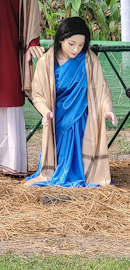
ON CHRISTMAS EVE (2024), we visited the Victorian gothic St Paul’s Cathedral in Kolkata (Calcutta). There was a creche (Nativity scene) in the garden. Unlike other such cribs we have spotted in the city, in which all the human characters look European,   all of the (lifesize) models in the St Paul’s creche depict Indians. The three kings look like Rajput maharajas,  a small boy near the crib is wearing kurta pyjamas, a shepherd carrying a lamb sports a turban, Joseph is wearing a dhoti, and Mary is dressed in a blue sari.

 This beautifully made ensemble illustrating happenings in Bethlehem, where there was no room at the inn, is lacking one person. There was no baby Jesus to be seen. The model of Mary seems to be looking adorably at an empty patch of ground. I wondered whether someone had stolen the model of Jesus. We asked a gardener what had happened to baby Jesus. He replied: “It’s Christmas Eve. Jesus has not been born yet. He’ll come tonight.

The Golders Green Complex in Calcutta  (Kolkata)

DURING THE LONG taxi ride from Kolkata’s airport to the city centre, I noticed an intriguing sign on a building we passed. It read: “Golders Green Complex”. The reason that this interested me was that I was brought up in a northwest London’s suburb called Golders Green.

I have no idea if the proprietors of Kolkata’s Golders Green Complex know of the existence of my childhood haunt in northwest London. The idea that someone might suffer from a malady named the Golders Green complex flashed through my mind. How this would manifest itself, I will leave to your imagination. In my case, the lasting effect of a childhood in Golders Green led me to write a book about the place (https://www.amazon.co.uk/GOLDERS-GREEN-HAMPSTEAD-GARDEN-SUBURB/dp/B0BHG873FB/  )

A bridge across the river in Calcutta

I HAVE BEEN to Calcutta (Kolkata) several times, and each visit I am impressed by the Howrah Bridge. It is a suspension type balanced cantilever bridge that carries pedestrians and road traffic across the Hooghly River, which is part of the mighty Ganges. This massive bridge contains 26,500 tons of steel riveted together – it contains no nuts and bolts. When it was opened for use in 1943, it was the world’s third largest cantilever bridge.

Before the present bridge was constructed, there was another bridge that crossed the Hooghly. Unlike the existing bridge, its roadway was close to the water. It was a pontoon bridge. Its roadway rested on floating pontoons. It had a section that could be opened to allow the passage of large vessels travelling along the Hooghly. The pontoon bridge was completed and ready for use in 1874. It served its purpose until the current bridge was opened in 1943.

The pontoon bridge

Recently, I obtained a book called “Wonderful India”. Inside its front cover, a former owner of the book had handwritten “LW Morris, Royal Air Force, Calcutta-July 1943”. The current bridge was opened in February 1943. The book does not contain a picture of that bridge, Instead, it contains a photograph of its predecessor, the pontoon bridge, with the caption:

“The famous pontoon bridge to Howrah, with the railway terminus in the background.”

I am guessing that had the new bridge been near completion when this book was compiled, it would have included this wonder of bridge engineering. As the book has no date of publication, the inclusion of the pontoon bridge rather than the suspension type cantilevered bridge, I feel that the book must have been compiled long before the new bridge was near completion, That the book includes a photograph of another bridge across the Hooghly: The Willingdon Bridge (also known as ‘Vivekananda Setu’). As this bridge (upstream from the Howrah Bridge) was completed in 1931, it would seem that “Wonderful India” was published sometime between 1931 and early 1943.

Crossing the Howrah Bridge as a pedestrian is a thrilling experience. One shares the footway with many other people. A large proportion of them are carrying loads on their heads, The water is far below one side of the footway, and the wide roadway is on the other. From the footway, one can see a huge flower market and several bathing ghats lining the riverbank. A steady stream of traffic flows across the bridge, including buses painted in many colours; ancient, yellow-painted Ambassador taxi cabs; hand-hauled carts; trucks; and other motor vehicles. And all of this crosses a stretch of the holy Ganges River. Although traversing the present Howrah Bridge is a memorably enjoyable event, which I am happy to repeat whenever I visit the city, crossing the former pontoon bridge must have been at least as exciting.

A nursery for bonsai trees and the death of an automobile

ABOUT FIFTEEN YEARS ago, some friends visiting England from from Calcutta wanted us to meet their friend, Peter Chan, with whom they were staying at his home near Lingfield in Surrey. One weekend, we drove down from London to meet them. What we did not know before we reached the Chan’s home was that Peter runs one of the best – if not the very best – Bonsai nurseries in this country. He showed us around his remarkable collection of Bonsai trees, which he sells, and what we saw made a great impression on us. Winner of 21 Chelsea Flower Show gold medals, Peter named his business Herons Bonsai.

About a year later, we were invited to a golden anniversary luncheon in a pub near Lingfield. Having arrived too early, we decided to revisit Peter’s bonsai nursery and to say hello to the Chans. We parked our Saab car in the nursery’s car park, and returned to it after greeting the Chans and having a quick look at the bonsai plants. I turned the ignition key. The car made a strange noise and smoke wafted out from the engine’s bonnet. I tried again – the car had died. We called the Automobile Association (‘AA’), and after about twenty minutes, an AA rescue man arrived. He quickly diagnosed the problem. I asked him to estimate the cost of repairing it. He said it would cost at least £300.

I had just had the car serviced, and while it was at the Saab garage I asked the sales staff to tell me how much I should expect to get if I part exchanged our car with a newer vehicle. I was told that I would get no more than £400 because of our car’s age. In addition, I was informed that several serious faults would soon need rectifying by the time I came for the next annual service. These repairs would have been costly. Knowing these things, it was easy to decide that our Saab had reached the end of its life – it was not worth repairing. We left the car at the bonsai nursery, having explained to the Chans that I would arrange for it to be collected by scrap dealers within a few days. The AA man drove us to Gatwick Airport, where we hired a car, and managed to arrive at the anniversary lunch by the time that the main course was being served.  Our Saab was taken away two days later.

This June (2024), my wife’s cousins met us for lunch at a pub, which they had chosen and booked. We knew nothing about the place. They drove us from Redhill station to the Wiremill pub near Lingfield. As we neared the place, I began recognising the countryside, notably a modernistic church built in 1958 by the Mormons. We turned off the main road into Wiremill Lane, and to our great surprise we passed Peter Chan’s bonsai nursery.

After a leisurely lunch, we visited Herons Bonsai. Before we arrived, I warned our cousins about the fate of our Saab, but they were not worried about parking at Herons.  After admiring some of the wonderful plants, we met Peter Chan, who vaguely recalled our last visit and the demise of our car. He introduced us to one of his regular customers, an Anglo-Indian, who had been brought up in Calcutta. He was at the nursery, showing it to his cousin who was visiting from Canada. Peter invited them and our party (my wife, her cousin and her husband, and me) to join him for tea in the nursery’s meeting hall that overlooks the Japanese style garden that Peter has created. We drank tea, exchanged gossip, and listened to Peter telling us about some of the fascinating things he has done in his life.

We left Herons without any automobile-related mishaps. Was it pure chance that we had been booked to eat at the Wiremill pub, or did the hidden hand of fate cause my wife’s cousin to choose the pub so near to the bonsai nursery?

An accident in a crowded street in Calcutta

SOME YEARS AGO (in 1997), we attended the first performance at London’s Nehru Centre (in Mayfair) of a work, “Samaveda Opus 2”, by the composer John Taverner (1944-2013). Taverner introduced the piece. During his introduction he repeated the sentence “India wounds me” several times. I have no idea what he meant by this, but the words have stuck in my mind. Until our latest visit to Calcutta (Kolkata), which was in January 2024, India has never wounded us. However, one morning, an unfortunate incident occurred, which I will now describe.

We (my wife Lopa and I) decided that we would revisit the 18th century Armenian church of St Bortola, which is in Bara Bazar in North Calcutta. Before leaving the Tollygunge Club, where we were staying, we found out from a website on the Internet that the church was supposed to be open. After enjoying good coffee at Blue Tokay in Bahrison’s bookshop on Park Street, we hailed a yellow and black Ambassador cab. The driver knew where we wanted to go and drove us through ever increasingly congested streets to Netaji Subhas Road in Bara Bazar. In this crowded street, the traffic was so bad that vehicles could barely move. As we were quite near to St Bortola, we disembarked, having decided to walk the rest of the way. As it happened, the narrow side streets along which we wended our way were so full of people that it would have been almost impossible for a taxi to go along them.

Busy bazaars always fascinate me. The streets in the part of Bara Bazaar near to the church were no exception. As we walked along them, we realised that we were in a district that was home to the shops and stores of merchants who sold chemicals in wholesale quantities. After negotiating the crowds in a couple of lanes, we spotted to spire of St Bortola, towering above the chaotic ensemble of buildings below it. We found the entrance to the compound containing the church. There were several men, including some security personnel, sitting in the porch. They all were very sure that visitors were not allowed to visit the church, nor even to photograph it. We protested that the website had claimed it would be open. We were told that if we wanted to view the church, we would first have to get special permission from the Armenian College (which is close to Park Street).

Having failed to gain access to the Armenian Church, we decided to visit the nearby Roman Catholic cathedral – The Cathedral of the Most Holy Rosary on Brabourne Road, almost opposite the Magen David Synagogue. Brabourne Road is one of the main thoroughfares carrying traffic to and from the Howrah Bridge, which crosses the Hooghly River. To say that this road as extremely busy is an understatement. Lined with stalls, the pavements are almost un-negotiable. So, pedestrians, including us walk along the edges of the roadway. People walk in both directions, often carrying heavy loads – usually on their heads. Added to this, many people seem to be in a great hurry and think nothing of rudely pushing aside fellow pedestrians. Meanwhile, buses, cars, wagons, rickshaws, heavy trucks, bicycles, motorbikes, and a variety of other wheeled vehicles rush past the pedestrians on the street. We experienced all this on a hot mid-morning.

We had to cross Brabourne Road to reach the cathedral. Fortunately, most of the traffic came to a stop briefly at a red traffic signal, and we joined a crowd of people swarming across the road. We began negotiating the crowds in an attempt to reach the cathedral. Then, it happened.

A wagon loaded with filled white sacks approached us. The sacks projected beyond the sides of the wagon. There were so many people walking along the side of the road that it was impossible for us to get out of the way of this heavily laden vehicle. Suddenly, one of the sacks hit Lopa’s shoulder, and she was sent flying. I was horrified. Luckily, she was thrown away from the road and her fall was cushioned by soft goods on the flimsy trestle tables of some pavement vendors. Although very shocked and extremely upset, she escaped major injury. Fortunately, her only injury was a small graze on her hand. She had had a lucky escape.

Much to my surprise, after a few minutes, Lopa decided we should walk the short distance to the cathedral. This we managed without any further unfortunate incidences. The compound – a peaceful garden in front of the west end of the church was open. However, when we reached the church, it was locked up. Someone sitting on the porch informed us that it was only opened once a week – on Sundays, and only for one mass.

By now, we had had our fill of Bara Bazaar. We hailed an Ambassador taxi to take us back to the Tollygunge Club. When Lopa related her unfortunate incident to the driver, he told us that Bara bazar is a bad area filled with ‘badmashs’ (i.e., bad or unprincipled people).

This unfortunate accident in Bara Bazaar was, as far as I can recall, the first time (in 30 years) that India wounded us. Having said that, I am sure it was not a physical injury that led John Taverner to say “India wounds me”.