A nursery for bonsai trees and the death of an automobile

ABOUT FIFTEEN YEARS ago, some friends visiting England from from Calcutta wanted us to meet their friend, Peter Chan, with whom they were staying at his home near Lingfield in Surrey. One weekend, we drove down from London to meet them. What we did not know before we reached the Chan’s home was that Peter runs one of the best – if not the very best – Bonsai nurseries in this country. He showed us around his remarkable collection of Bonsai trees, which he sells, and what we saw made a great impression on us. Winner of 21 Chelsea Flower Show gold medals, Peter named his business Herons Bonsai.

About a year later, we were invited to a golden anniversary luncheon in a pub near Lingfield. Having arrived too early, we decided to revisit Peter’s bonsai nursery and to say hello to the Chans. We parked our Saab car in the nursery’s car park, and returned to it after greeting the Chans and having a quick look at the bonsai plants. I turned the ignition key. The car made a strange noise and smoke wafted out from the engine’s bonnet. I tried again – the car had died. We called the Automobile Association (‘AA’), and after about twenty minutes, an AA rescue man arrived. He quickly diagnosed the problem. I asked him to estimate the cost of repairing it. He said it would cost at least £300.

I had just had the car serviced, and while it was at the Saab garage I asked the sales staff to tell me how much I should expect to get if I part exchanged our car with a newer vehicle. I was told that I would get no more than £400 because of our car’s age. In addition, I was informed that several serious faults would soon need rectifying by the time I came for the next annual service. These repairs would have been costly. Knowing these things, it was easy to decide that our Saab had reached the end of its life – it was not worth repairing. We left the car at the bonsai nursery, having explained to the Chans that I would arrange for it to be collected by scrap dealers within a few days. The AA man drove us to Gatwick Airport, where we hired a car, and managed to arrive at the anniversary lunch by the time that the main course was being served.  Our Saab was taken away two days later.

This June (2024), my wife’s cousins met us for lunch at a pub, which they had chosen and booked. We knew nothing about the place. They drove us from Redhill station to the Wiremill pub near Lingfield. As we neared the place, I began recognising the countryside, notably a modernistic church built in 1958 by the Mormons. We turned off the main road into Wiremill Lane, and to our great surprise we passed Peter Chan’s bonsai nursery.

After a leisurely lunch, we visited Herons Bonsai. Before we arrived, I warned our cousins about the fate of our Saab, but they were not worried about parking at Herons.  After admiring some of the wonderful plants, we met Peter Chan, who vaguely recalled our last visit and the demise of our car. He introduced us to one of his regular customers, an Anglo-Indian, who had been brought up in Calcutta. He was at the nursery, showing it to his cousin who was visiting from Canada. Peter invited them and our party (my wife, her cousin and her husband, and me) to join him for tea in the nursery’s meeting hall that overlooks the Japanese style garden that Peter has created. We drank tea, exchanged gossip, and listened to Peter telling us about some of the fascinating things he has done in his life.

We left Herons without any automobile-related mishaps. Was it pure chance that we had been booked to eat at the Wiremill pub, or did the hidden hand of fate cause my wife’s cousin to choose the pub so near to the bonsai nursery?

An accident in a crowded street in Calcutta

SOME YEARS AGO (in 1997), we attended the first performance at London’s Nehru Centre (in Mayfair) of a work, “Samaveda Opus 2”, by the composer John Taverner (1944-2013). Taverner introduced the piece. During his introduction he repeated the sentence “India wounds me” several times. I have no idea what he meant by this, but the words have stuck in my mind. Until our latest visit to Calcutta (Kolkata), which was in January 2024, India has never wounded us. However, one morning, an unfortunate incident occurred, which I will now describe.

We (my wife Lopa and I) decided that we would revisit the 18th century Armenian church of St Bortola, which is in Bara Bazar in North Calcutta. Before leaving the Tollygunge Club, where we were staying, we found out from a website on the Internet that the church was supposed to be open. After enjoying good coffee at Blue Tokay in Bahrison’s bookshop on Park Street, we hailed a yellow and black Ambassador cab. The driver knew where we wanted to go and drove us through ever increasingly congested streets to Netaji Subhas Road in Bara Bazar. In this crowded street, the traffic was so bad that vehicles could barely move. As we were quite near to St Bortola, we disembarked, having decided to walk the rest of the way. As it happened, the narrow side streets along which we wended our way were so full of people that it would have been almost impossible for a taxi to go along them.

Busy bazaars always fascinate me. The streets in the part of Bara Bazaar near to the church were no exception. As we walked along them, we realised that we were in a district that was home to the shops and stores of merchants who sold chemicals in wholesale quantities. After negotiating the crowds in a couple of lanes, we spotted to spire of St Bortola, towering above the chaotic ensemble of buildings below it. We found the entrance to the compound containing the church. There were several men, including some security personnel, sitting in the porch. They all were very sure that visitors were not allowed to visit the church, nor even to photograph it. We protested that the website had claimed it would be open. We were told that if we wanted to view the church, we would first have to get special permission from the Armenian College (which is close to Park Street).

Having failed to gain access to the Armenian Church, we decided to visit the nearby Roman Catholic cathedral – The Cathedral of the Most Holy Rosary on Brabourne Road, almost opposite the Magen David Synagogue. Brabourne Road is one of the main thoroughfares carrying traffic to and from the Howrah Bridge, which crosses the Hooghly River. To say that this road as extremely busy is an understatement. Lined with stalls, the pavements are almost un-negotiable. So, pedestrians, including us walk along the edges of the roadway. People walk in both directions, often carrying heavy loads – usually on their heads. Added to this, many people seem to be in a great hurry and think nothing of rudely pushing aside fellow pedestrians. Meanwhile, buses, cars, wagons, rickshaws, heavy trucks, bicycles, motorbikes, and a variety of other wheeled vehicles rush past the pedestrians on the street. We experienced all this on a hot mid-morning.

We had to cross Brabourne Road to reach the cathedral. Fortunately, most of the traffic came to a stop briefly at a red traffic signal, and we joined a crowd of people swarming across the road. We began negotiating the crowds in an attempt to reach the cathedral. Then, it happened.

A wagon loaded with filled white sacks approached us. The sacks projected beyond the sides of the wagon. There were so many people walking along the side of the road that it was impossible for us to get out of the way of this heavily laden vehicle. Suddenly, one of the sacks hit Lopa’s shoulder, and she was sent flying. I was horrified. Luckily, she was thrown away from the road and her fall was cushioned by soft goods on the flimsy trestle tables of some pavement vendors. Although very shocked and extremely upset, she escaped major injury. Fortunately, her only injury was a small graze on her hand. She had had a lucky escape.

Much to my surprise, after a few minutes, Lopa decided we should walk the short distance to the cathedral. This we managed without any further unfortunate incidences. The compound – a peaceful garden in front of the west end of the church was open. However, when we reached the church, it was locked up. Someone sitting on the porch informed us that it was only opened once a week – on Sundays, and only for one mass.

By now, we had had our fill of Bara Bazaar. We hailed an Ambassador taxi to take us back to the Tollygunge Club. When Lopa related her unfortunate incident to the driver, he told us that Bara bazar is a bad area filled with ‘badmashs’ (i.e., bad or unprincipled people).

This unfortunate accident in Bara Bazaar was, as far as I can recall, the first time (in 30 years) that India wounded us. Having said that, I am sure it was not a physical injury that led John Taverner to say “India wounds me”.

Exclusion of Indians even after India became independent

WE HAVE STAYED in the guest accommodation at Calcutta’s Tollygunge Club several times. On our most recent visit, I spent a few minutes looking at the boards on which the names of the Club’s past Presidents are listed.

Between the year in which the Club was founded – 1895 – and 1968 – twenty-one years after Indian Independence- all of the Presidents had British surnames.
In 1969, the post was held by Brigadier RB Chopra. His surname is Indian. He was succeeded in 1970 by HA Whittle – someone with a British surname. Mr SP Achary, who was the next President (in 1971) had an Indian surname.

Mr Achary was followed by CJN Will CBE in 1973. Thereafter, most, but not all, of the Presidents had Indian sounding surnames. An exception was the President in 1979, who was AWG Macintyre, CBE. He was a senior executive in the Dunlop tyre company.

Seeing all of these Presidents with British surnames holding their positions so long after India became independent got me wondering. Already I knew that even after independence, some private clubs and other institutions in India restricted admission to Europeans and refused entry to all but a very few Indians. I became curious to know when the Tollygunge Club began welcoming Indians as members. The answer is that the colour bar was lifted in 1961. Indians were then admitted as “Associate Members”. They had no voting rights. The first non-white Associate Member was the then Japanese consul. In 1967, the first batch of 30 Associate Members (I.e., Indians) were made Permanent Members. The first Indian President, Brig. Chopra was amongst this batch.

Various factors must have swayed the Club towards admitting Indians. One of these might have been the slowly declining British presence in Calcutta. Another was more serious. Cutting a long story short, in the late 1950s, the West Bengal government, acting to some extent on guidelines from Central government, began to question the future of the elite clubs of India.

The government of West Bengal drew up a plan to construct a housing estate on the extensive grounds of the Tollygunge Club golf course. The clubhouse would have then been converted to some kind of communal amenity. These plans caused great concern to Calcutta’s British community. This plan was aborted. I have heard one explanation of why this happened, but it would be best if I do not reveal it.

Declining Club revenues and increased taxation must have also led to the Club enlarging its membership by accepting Indians as full members. During the very early 1970s, my father-in-law, a senior executive in a large company, was offered membership by the Tollygunge Club. He turned down the offer because he was reluctant to join a club that had refused membership to Indians for so many years after India became independent.

It is fortunate that the Tollygunge Club with its lovely grounds has survived because, although still quite exclusive, it is a wonderful place to relax and make new friends.

Almost paperless at the airport in Calcutta

OUR TAXI PULLED up outside the departure section of Calcutta’s huge airport terminal on the 20th of January 2024. We were dismayed to see the extremely long lines of people waiting with trolleys laden with assorted baggage. They were all waiting to pass through the police security check points to enter the terminal.

We soon realised that even if we were to have been at the head of one of these queues, we would not have been able to pass through the checkpoint without having first registered with DijiYatra.

If you have not flown from an Indian airport recently, you will be as puzzled as we were. DijiYatra is an electronic system depending on AI facial recognition to allow passengers to pass the various checkpoints on their way to the ‘plane without having to keep on showing paper documents at each point.

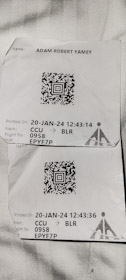
An app exists for DijiYatra, but we did not have this on our telephones. Looking perplexed, an airport official working for our airline, Indigo, led us to some electronic terminals. A man standing by it entered our PNR code, and took pictures of our faces. Following thus we were each handed small flimsy squares of paper bearing our names, flight details and a QR code. We were directed to a policeman standing nearby.

The policeman scanned our DijiYatra paper slips and checked our passports against the faces now recorded in the system. After this, we were sent to one of the checkpoints next to the entrance to the terminal. There was only one person in front of us. After having our small paper slips and our faces scanned, gates opened and we could proceed to the baggage drop-off counters.

At another checkpoint at the entrance to the security checking area, we scanned our DijiYatra slips once again. When the system matched the slip to a scan of our faces, we proceeded into the security control area.

The idea behind DijiYatra is to reduce the use of paper checking and to replace it by facial recognition systems. All well and good, but in our experience the system did rely on keeping two easy-to-lose tiny bits of paper. I guess that had we downloaded the app, the paper slips would not have been required.

What puzzled me were the long queues. Everyone in them had registered for DijiYatra.

Words of advice to an early shopper in India

TODAY, MY SHOULDER bag broke suddenly whilst on my way to Calcutta’s New Market – one of my favourite shopping districts. Humayun Place, which leads from Chowringhee to one side of New Market, is lined with pavement vendors. We stopped at one selling bags, and asked to see one that I hoped might be a suitable replacement for the bag whose strap had just broken.

Inside New Market in Calcutta

The bag was ‘ok’ but not ideal. We asked the price, and were quoted 950 rupees (about £9.50). We told the seller that seemed too much for such a bag. We told him that we had paid about 500 for the old bag less than a year ago. Hearing that, he said we could have it for 500, and as he spoke those words, he put it into a plastic carrier bag.

I was still not sure that this was the ideal replacement, and we began to walk away. The seller then offered us the bag for 400, saying that if we bought it would be his ‘bohni’ for the day. Hearing that and feeling that the bag was worth 400, we purchased it.

In India (and Pakistan), the custom of bohni is commonly observed. The bohni is the vendor’s first sale of the day (or at the start of some other defined period of time). Many shopkeepers believe that the bohni establishes the success of his or her business during the rest of the day.

So, one of the risks faced by those who shop soon after the stores or stalls open is they will be made to feel that they ought to buy something in order not to jeopardise the vendor’s success during the rest of the day. For, being the first to enter a shop or halt at a stall without purchasing a bohni is a bad omen for sellers.

Although I am sure most vendors who tell you that by making a purchase you are doing the bohni for the day are bona fide, there must be a few who try to achieve a sale by saying it is the bohni when it is not.

Horses and a golf course in Calcutta

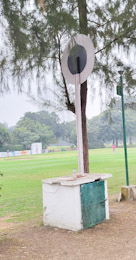
HAVE STAYED AT the Tollygunge Club several times, but it was not until yesterday (18th of January 2024) that my friend Prihvi Chaudhury made me aware of an interesting historical object. Near the club’s Shamiana refreshment area and partly hidden by the foliage of a tree, it is a circular metal plate mounted on a tall metal pole. Prithvi told me that it is all that remains of the former Tollygunge Club horse racing track. It was the finishing post.

The Tollygunge Club was founded by a Calcutta banker, Sir William Cruikshank. He established the club on land bought from the descendants of Tipu Sultan. The Club was originally founded for British colonialists to enjoy equestrian activities within easy reach of the city. The racecourse was laid out in connection with this.

In addition to the racetrack, much of the extensive grounds of the Club were develope into an 18 hole golf course. This is beautifully landscaped and provides many challenges to the golfers who play there.

The race course was ‘dismantled’ many years ago. However, the Club’s association with horses continues today. On the Club grounds there is an airy, well-maintained stable block, which is currently home to at least 36 horses. We visited the stables today and fed some of the animals with carrots provided by members of the friendly stable staff.

The horses are exercised twice a day either in a special paddock or on some of the footpaths that thread their way through the club’s grounds. Club members can join horse-riding lessons and can hire steeds for taking rides (not gallops) around the Club’s terrain. When taking a ride, the horse and rider are accompanied by a stable hand.

Had Prithvi not pointed out the historic finishing post, I doubt that we would have become aware of the stables for a long time, if at all.

Golden dogs on a golf course in southern Calcutta

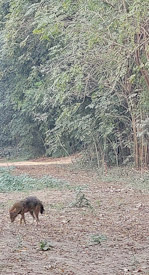
THE TOLLYGUNGE CLUB in southern Calcutta has a beautiful golf course. Between the greens, bunkers, and other golfing features, there is a large variety of trees, many water features, and a profusion of bushes and flowers. It is a joy to stroll through the grounds, taking care not to get in the way of the golfers and their caddies. As you wander through the terrain, you can spot a variety of birds, the occasional dog, and a few pussy cats. However, the greatest treat is to come across the Golden jackals (Canis aureus) that live on the golf course land.

These jackals, usually only seen in the wild, seem quite at home on the golf course. During the day, they lope around or squat, watching the golfers and walkers like myself. Although not tame, they allow humans to approach quite closely before they wander away, but not hurriedly. At night, their howling can be heard if the Club is not holding a noisy social function.

A study by AK Sanyal et Al. (Rec. Zool. Surv. India III, 2010) revealed that when it was published there were 40 to 45 jackals living on the Club grounds. They tend to live some distance away from the Club house and its neighbouring buildings. This is probably because of the tame dogs that hang around close to the Club’s semi-outdoor eating areas. The study discovered that the jackals feed on a wide variety of creatures including insects, birds eggs, rodents, larger animals, and fruits. They are also partial to food produced by humans.

The above-mentioned study revealed that there have been rare attacks on humans, but only by rabid jackals. These incidents have happened in the wild, rather than in the Club’s grounds. And the most common way that the jackals can catch rabies is by being bitten by dogs.

The Tollygunge Club land is about one square kilometre and is home to about 7 families of jackals. In the wild, this number of families would occupy an area of up to three square kilometres. This suggests that the living conditions for jackals in the Club grounds is far better than in the wild.

Every time I have walked on the golf course land, I have seen some of the jackals. When I first saw them, I was wary of them, but now I realise that they have no inclination to interact with me or fellow members of my species. Even though I have seen them plenty of times, I am thrilled whenever I spot one of the Club’s Golden jackals.

Hergé, Hitler, and a lifelong friend

A FEW DAYS AGO, I posted a photograph on Facebook. It shows some books displayed on a pavement bookstall in Calcutta’s Park Street. Two of Hergé’s Tintin books were placed next to a copy of Hitler’s “Mein Kampf” (translated into English). The book by Adolf H was placed next to another book – “The Intelligent Investor” by Benjamin Graham. Neither the title nor its author meant anything to me.

Seeing books by Hergé is not uncommon in India. Nor is it unusual to find copies of Hitler’s book on sale, as I have described in my book “The Hitler Lock and Other Tales of India”.

Soon after I posted the above-mentioned photograph on Facebook, my friend Andrew Sofer, whom I have known since he was born, commented on the photo as follows:
“Grandpa Ben would not be happy about his neighbor.”
I was staggered to read this. The author of “The Intelligent Investor” was Andrew’s grandfather. His book, which was displayed next to Hitler’s was first published in 1949, and still sells well.

Andrew’s father, Cyril, was born in South Africa and was one of my father’s best friends. Cyril was a Don at Queen’s College in Cambridge when he died at a young age. Our family used to visit Cyril and his family at their home in Cambridge regularly during my childhood and early teenage years. Benjamin Graham was the father of Andrew’s mother. I was unaware of Andrew’s connection with Benjamin Graham when I took the photograph of Hergé’s books juxtaposed with “Mein Kampf”.

What puzzles me is whether the close placement of the books by the three authors was random (ie accidental) ,or consciously arranged. Both Hitler and Hergé had fascist tendencies, but not Benjamin Graham. I wonder what was going through the bookseller’s mind when he arranged the books on that stall.

You will not find my book on that bookstall but you can purchase it here: https://www.amazon.co.uk/HITLER-LOCK-OTHER-TALES-INDIA/dp/B0CFM5JNX5/.

Enjoying forbidden food in Calcutta after waiting many years

JHAL MURI IS a Bengali ‘street food’. Mixture of puffed rice, mustard oil, and other things including: chilli, coconut, channa, peanuts, lemon juice, coriander, onion, tomato, sev, chutneys, … and more! You choose your mix.

Making jhal muri

Usually made in the street, it may pose a risk to weak stomachs. My wife’s mother, a medical doctor, forbade her daughter from eating this when it was sold by street vendors. It was sold just outside Loreto House School, where my wife was a pupil. She felt hard done by when she saw her schoolfriends eating this ‘forbidden’ snack.

Today, having yearned for it for many years, she sampled jhal muri at the Tollygunge Club. Sadly, it did not meet her great expectations.