
My first visit to Kolkata (Calcutta) was very nearly my last

IN AUGUST 2011, my wife was invited to attend a Loreto House School reunion in Calcutta (Kolkata). As I had never been to the city before, I accompanied her. While my wife took part in the daily activities with some of her former schoolmates, I explored, and fell in love with, the great city on the Hooghly River – one of the channels through which the Ganga (Ganges) makes its way to the sea.

Throughout our five-day visit to the city, the monsoon rains fell heavily and incessantly. I walked around Calcutta in sandals without socks – often wading through filthy water that submerged my feet and lapped around my ankles. Fortunately, my feet did not become infected by whatever might have been lurking in the water. However, the monsoon did not affect my enjoyment of the vibrant, but delightfully decaying. city – one could almost say it is India’s own distinctive version of Havana in Cuba.

One day, I visited Jorasanko, the palatial residence of the Tagore family, whose members included not only the Nobel Prize winner, the polymath Rabindranath Tagore (1861-1941), but also artists such as Abanindranath and Gaganendranath (both Tagore). After seeing around the fascinating rooms of Jorasanko, which I enjoyed so much that I visit it whenever I am in the city, I sploshed through the flooded streets towards the Hooghly River. On my way, I walked along a busy street lined with shops and filled with crowds of people. A steady stream of rickshaws pulled by thin, sinewy men – each of the vehicles laden with two or three passengers – made its way through the busy throng. The huge wheels of these vehicles keep the passengers high above the water flooding the streets, but the pullers’ feet were permanently submerged.

I noticed that some shops – often those of clothing and textile merchants – men were distributing hot food – rice and dal – to occasional passers-by. I stopped at one of the stores, and asked about the food distribution.  It was explained to me that during Ramadan, it was a virtuous thing to feed the poor. This kindness impressed me, especially as those who were serving it were fasting.
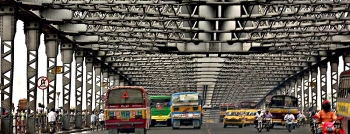
Howrah Bridge

Eventually, after boldly crossing a wide road clogged with slow moving heavy traffic, I stepped onto the Howrah Bridge, a gigantic steel bridge – a Meccano lover’s dream come true. It traverses the Hooghly – a section of the great Ganges River system. It was constructed between 1935 and early 1943. At first, the bridge crosses over a large market that is strung along the riverbank. Then, after a few yards, it is over the water. I walked along the downstream facing pedestrian walkway, dodging many porters carrying heavy and bulky loads on their heads. I took numerous photographs until I was two thirds of the way across the river. There, I met a policeman with an ancient-looking rifle – its leather strap slung over his shoulder. Politely, he informed me that photography was forbidden on the bridge. By then, I had sufficient images stored in the memory of my digital camera.

Once over the river, I headed through the streaming rain and thick crowds to a boat station close to the Howrah railway terminus. My plan was to travel on a river bus downstream to a landing stage not far from Park Street.  I bought a ticket which was printed on such very poor-quality paper that it had to be kept dry to stop it dissolving or falling to pieces.  I asked someone on the floating platform at the water’s edge if the boat that was approaching was heading for my planned destination. I received what I believed was an affirmative reply, and then boarded a relatively empty boat with plenty of free seats. We set off.

To my surprise, the boat headed upstream rather than downstream. Soon, we passed beneath the Howrah Bridge. We sailed a long way upstream away from the city centre. The banks of the river were lined with unattractive industrial buildings, and these were punctuated by occasional bathing ghats. We were heading away from the pleasant old part of the city in which Park Street is located.

I disembarked at the boat’s first stop. Had it not been raining so heavily I would have stepped out of the boat station to explore the area around it. Instead, I bought another flimsy ticket to return to Howrah. This time, I asked several people to tell me at which of the two floating embarkation pontoons I should board the downstream boat. I waited close to the water while a large crowd of fellow passengers gathered behind me. I wanted to be sure of embarking first.

The boat approached where we were all standing. I could see from afar that it was ‘packed to the gills’ with people. When the boat was about 18 inches away from the pontoon, I felt a great push from behind me and I was catapulted across the water towards the approaching vessel. Luckily, I was able to grab something on the boat, and this saved me from falling into the water and being crushed between the boat and the pontoon. Had I not been able to do this, I feel sure my life would have ended prematurely.

 The boat was stuffed with people – I am sure that sardines are less tightly packed in tins. I wanted to try to take a photograph to capture an image of this crowd, but I could not because so great was the pressure exerted by those around me that I was unable to raise my hands from beside my body. Thus wedged, I looked around and noticed there were only a few lifesaving flotation items. If our boat had sunk, I imagine that only a few of us on board would have survived.

It was a great relief to disembark at Howrah. I was drenched, somewhat shaken, and hungry. I decided to take a taxi to Flurys in Park Street. It is a European style tearoom/restaurant that served what I was yearning at that moment – toasted club sandwiches. I boarded a dented yellow Ambassador taxi in a car park near the railway station.  We inched our way forward into a mass of other similarly damaged taxis. The crowded taxis were so close to each other that it felt as if they might become welded together. It took almost an hour for my driver to skilfully manoeuvre his vehicle a couple of hundred yards from where I boarded it on to the beginning of the bridge.

At last, we arrived at Park Street, where, slightly drier because of sitting for ages in the taxi, I settled down at a table in Flurys. I ordered my sandwich and savoured the peaceful atmosphere in the tearoom*.

Despite my near escape from severe injury (or worse) on the banks of the Hooghly, my enthusiasm for Calcutta remained undiminished.

*Note: when I last visited Flurys in January 2025, it had lost most of its charm; it has become a place for tourists and Instagrammers.

This is a chapter in my book “The Hitler Lock & Other Tales of India”, which is available from Amazon

Bankers living on the banks of the Hooghly River in West Bengal

BANKERS ON THE BANKS OF THE HOOGHLY RIVER

JAINISM IS AN ANCIENT Indian religion still practised today. The Jains, members of this religion, believe, amongst many other things, in non-violence towards all members of the animal kingdom, from microbes to elephants. For this reason they are vegetarian and will not eat anything that grows beneath the surface of the soil for fear of killing creatures that might be attached to them. Thus, Jains will avoid eating, for example, onions, carrots, and potatoes.

Recently, I read that Jains do not go in for farming because by tilling the soil there is a risk that creatures living in it might be harmed. For reasons that include this, the Jains tend to be a business and banking community.

In the eighteenth century, some Jain families migrated from arid Rajasthan to fertile Bengal and settled around Murshidabad. It is said that these people helped persuade the rulers of Bengal to move their capital from Dhaka to what is now Murshidabad. Some of these Jains, known as the Sherherwalis, became bankers to the Nawab, and consequently became extremely wealthy.

One of these Sherherwali bankers, Rai Bahadur Budh Sing Dudhoria, constructed a huge mansion, now known as ‘Bari Kothi’, close to the river Hooghly in what is now the small city of Azimganj (near Murshidabad). The huge edifice, which was restored a few years ago, is built around seven courtyards. It is lavishly decorated in a style that would have been familiar to the family when it was enjoying its heyday. Today, it is used as a luxurious ‘heritage’ hotel, which is famed for its Jain food.

When the banker, who lived at Bari Kothi, told the Nawab that he wanted to move away from Murshidabad because he lacked the company of fellow Jains, the ruler allotted land on both sides of the river to the Jain community, and told the banker to invite other Jains to make their homes there. 97 families arrived.

The combined wealth of the 30 or so Sherherwali families who settled in the Azimganj area was so great that it exceeded that of the entire English aristocracy. This was sometime before 1757, when the Nawab Siraj-ud-Daulah was defeated by the British at the Battle of Palashi (Plassey). After that, Bengal’s capital shifted to Kolkata, as did most of the Sherherwalis.

Bari Kothi was badly damaged during the Naxalite disturbances in the 1970s. It was beautifully restored under the supervision of the architect Dr Samar Chandra. We visited the place today (15 January 2025) and were shown around the maze of corridors, rooms, and courtyards. Our guide showed us parts of the building that are still undergoing careful restoration. What has already been restored and is used by hotel guests is superbly done. For those seeking a glorious ‘heritage’ experience, a few days at Bari Kothi will not be disappointing. However, for those hoping for a fried egg at breakfast time, this is most certainly not available.

An evening prayer offering by the water of the River Ganges

THE WORD AARTI is from the Sanskrit language. It means ‘something that removes darkness’. In many pujas (Hindu ceremonies), an aarti is performed: it involves presenting a flame to appease the deity or deities. 


One evening, we were walking along the bank of the Hooghly (a part of the holy Ganges river that flows through Kolkata) just after sunset. We came across rows of plastic chairs facing the river at Babughat (one of the stepped landings used by people bathing in the river). Between them and the water there was a row of altars. We asked someone the reason for the chairs. We were informed that they were set up so that people could watch the daily Ganga Aarti, which was due to happen at 530 pm. Our daughter,  who had witnessed a Ganga Aarti at Varanasi, persuaded us to wait and watch the forthcoming aarti.


We sat down and joined the other spectators. While we waited, several hawkers walked along the rows of chairs, selling snacks of various kinds, both packaged and prepared to order (for example, jhal muri – puffed rice with flavourings). One hawker carried a tray on which a small lamp (a diya) was flickering. For a small cash offering, he blessed the ‘customer’ and placed some prasad (blessed food) into his or her right hand. Meanwhile, rotating spotlights and piped music added to the festive atmosphere. Gradually,  all the seats were occupied,  and many people were standing nearby on the sides of the ghat.


At 5.30 pm, priests dressed in shiny gold robes with wide sashes over their left shoulders began assembling, one in front of each of the altars. The latter were illuminated with hoops carrying brightly lit electric light bulbs. Then,  the ceremony began.


A pandit, dressed in white, speaking into a handheld microphone chanted prayers in Sanskrit. As he was doing this, the gold clad priests performed several visually exciting activities. These included moving containers emitting clouds of smoke. They swung them and moved them in circles, each man in synchrony with the others. After this, they did much the same thing with candelabras each carrying many small flaming oil lamps (diyas). These were then replaced by larger flaming lamps, each of which had handles shaped like cobras ready to attack.  After the balletic flame movements, the flaming lamps were carried down to the water’s edge. I could not see whether they were immersed in the river.


In addition to the movements with the flaming lamps, large conch shells were washed through with water, some of which was sprinkled on the crowd. The conches were also blown to produce a sound indistinguishable from the horns on the locomotives of the trains running every few minutes on the suburban railway track that was a few feet behind where the ceremony was being performed. 


I am very pleased we waited to watch the Ganga Aarti. Apart from being more spectacular than many theatrical performances I have seen, it was very moving. It is yet another example of how much more vibrant and fervent religious ceremonies are in India than they are in most parts of Europe.

The power of faith and a polluted river

HAPPY NEW YEAR!

ON CHRISTMAS MORNING (2024), we walked leisurely beside the Hooghly River (a stretch of the Ganges) between Prinsep Ghat and Eden Gardens, a distance of about 1.3 miles. With a good paved footpath,  this is a pleasant, picturesque, tree lined place to stroll.


Near Eden Park railway station,  there is a popular bathing ghat (a flight of steps leading into the water). From a  bridge that overlooks this, we watched people bathing in the river. Many of them immersed themselves fully several times. Others washed themselves. We saw people applying shampoo to wash their hair. I noticed a few men wading out into the water, carrying small trays containing flowers for puja. They threw these floral offerings into the fast flowing stream.

 The Ganges, of which the Hooghly is a part, is considered to be a place of great holiness by Hindus. They believe that bathing in this river conveys several benefits including: cleansing the soul; connecting with divine cosmic forces; washing away bad karma from the present or previous births; health giving and healing; and removing negativity. So, if you are a believer, bathing in the Hooghly/Ganges must be a good thing. But, must it?


Signs along the path on which we strolled exhort people not to dump rubbish in the river. But it is clearly obvious that these signs are not obeyed.  It is not only strollers’ rubbish that enters the sacred river. The river is being continuously polluted by sewage, industrial effluent, and decomposing corpses. This has resulted in high levels of toxic chemicals including heavy metals, and frighteningly large amounts  of bacterial and other microbial pathogens.


According to several official bodies, the Hooghly  has been deemed totally unsuitable for bathing. Yet despite this, there is no shortage of people entering the river to bathe, putting  their entire heads underwater, and washing themselves with this water that carries a real risk of causing ill-health. Such is the power of faith that the well-publicized risks of bathing in the river are outweighed by the belief that the water can only benefit the bather.

A bridge across the river in Calcutta

I HAVE BEEN to Calcutta (Kolkata) several times, and each visit I am impressed by the Howrah Bridge. It is a suspension type balanced cantilever bridge that carries pedestrians and road traffic across the Hooghly River, which is part of the mighty Ganges. This massive bridge contains 26,500 tons of steel riveted together – it contains no nuts and bolts. When it was opened for use in 1943, it was the world’s third largest cantilever bridge.

Before the present bridge was constructed, there was another bridge that crossed the Hooghly. Unlike the existing bridge, its roadway was close to the water. It was a pontoon bridge. Its roadway rested on floating pontoons. It had a section that could be opened to allow the passage of large vessels travelling along the Hooghly. The pontoon bridge was completed and ready for use in 1874. It served its purpose until the current bridge was opened in 1943.

The pontoon bridge

Recently, I obtained a book called “Wonderful India”. Inside its front cover, a former owner of the book had handwritten “LW Morris, Royal Air Force, Calcutta-July 1943”. The current bridge was opened in February 1943. The book does not contain a picture of that bridge, Instead, it contains a photograph of its predecessor, the pontoon bridge, with the caption:

“The famous pontoon bridge to Howrah, with the railway terminus in the background.”

I am guessing that had the new bridge been near completion when this book was compiled, it would have included this wonder of bridge engineering. As the book has no date of publication, the inclusion of the pontoon bridge rather than the suspension type cantilevered bridge, I feel that the book must have been compiled long before the new bridge was near completion, That the book includes a photograph of another bridge across the Hooghly: The Willingdon Bridge (also known as ‘Vivekananda Setu’). As this bridge (upstream from the Howrah Bridge) was completed in 1931, it would seem that “Wonderful India” was published sometime between 1931 and early 1943.

Crossing the Howrah Bridge as a pedestrian is a thrilling experience. One shares the footway with many other people. A large proportion of them are carrying loads on their heads, The water is far below one side of the footway, and the wide roadway is on the other. From the footway, one can see a huge flower market and several bathing ghats lining the riverbank. A steady stream of traffic flows across the bridge, including buses painted in many colours; ancient, yellow-painted Ambassador taxi cabs; hand-hauled carts; trucks; and other motor vehicles. And all of this crosses a stretch of the holy Ganges River. Although traversing the present Howrah Bridge is a memorably enjoyable event, which I am happy to repeat whenever I visit the city, crossing the former pontoon bridge must have been at least as exciting.