ST NICHOLAS COLE Abbey is a church a few yards southeast of London’s St Paul’s Cathedral. Like the cathedral, St Nick’s (as it is affectionately known) was designed by Sir Christopher Wren and built between 1672 and 1678. The earlier church on this site had been destroyed during the Great Fire of London in 1666. It was the first of the 51 churches lost in the Fire to have been rebuilt. In 1941, it was severely damaged during a German air raid. It remained a shell until it was repaired and reconsecrated in 1962. Sadly, the windows designed by the pre-Raphaelite artist Edward Burne-Jones were destroyed in the air raid. They have been replaced by three attractive windows, which reminded me of the work of Chagall, designed by Keith New (1925-2012).
When we entered the church today (28 April 2025), we found that the floor of its spacious interior was occupied by tables and chairs and along its south side, there was a counter where hot and cold drinks as well as snacks were being served. Most of the tables and chairs were occupied. Some people were enjoying refreshments, others were working with their laptop computers, and yet others were chatting quietly. There are also tables and chairs on the terrace outside the south side of the church. Although the church serves as a café on weekdays, during weekends and on some other days, services are held.
The café has been in existence for about 10 years. Although we have passed the church innumerable times, it was only today that we first ventured inside it. So near to St Pauls and all the eateries catering to tourists visiting it, this church-cum-café seems to be well off the tourists’ beaten track, but well-known to local office workers.
EVERY TIME I VISIT Hampstead, I feel pleasant twinges of nostalgia not only because I was brought up in the area but also because of my associations with the place after childhood. One place, which still exists, and has done so since it first opened in 1963, is Louis Patisserie on Heath Street. Originally, its shop sign bore the words “Louis Hungarian Patisserie” because it had been established by a Hungarian called Louis Permayer.
Sometime in 1970 or maybe the following year, I took a young lady, who is now my wife, to Hampstead on our ‘first date’. We had a genteel afternoon rendezvous at Louis. My wife remembers that she had coffee, and that it had been served with a separate bowl containing freshly whipped cream. Back in those days and for many years afterwards, Louis, with its wood-panelled walls, seemed to me to have a ‘touch of class’ as well as being evocative of Central Europe. The cakes and other baked items they used to sell were all good quality versions of what you might expect to find in a ‘Konditorei’ in Vienna or a ‘Cukrászda’ in Budapest.
Today (the 26th of February 2024), it was windy and extremely cold when we got off the bus in Hampstead. For old time’s sake, we entered Louis to warm up with hot beverages. Louis has long since changed hands, but the wood-panelling and several other original features still remain. However neither the hot beverages nor the patisserie items were of the same high quality as they used to be long ago. There are now other places in Hampstead where both the coffee and the food are superior to what is available at Louis, but none of these places bring back happy memories.
High on the end wall of the sitting area within Louis, there is a large, framed painting of a pond with buildings along one side of it. These are reflected in the water. In the foreground, three figures are depicted fishing with rods. The picture is painted with muted colours, or, possibly, the colours have faded since it was completed. Despite having visited Louis on numerous occasions, I had never looked at the painting properly until today. At the lower left corner of the painting, there is the artist’s name and a date:
“… Towner was born at Eastbourne and studied at Eastbourne and Brighton schools of art and at the Royal College of Art under William Rothenstein 1923-1927. He moved to Hampstead in 1927 where he lived until his death and produced many paintings of the area and residents. D.C. Towner showed at the RA, Burgh House, NEAC etc.”
William Rothenstein (1872-1945), mentioned above, lived in Hampstead between 1902 and 1912, but by the time he taught Towner he was living elsewhere. It is unlikely that Towner lived in Hampstead because of Rothenstein. It was more likely that he chose the area because it was already favoured by many other artists.
Although DC Towner is not one of the greatest of the artists who lived and worked in Hampstead, his family name has related to the arts in another way – possibly better known than for his paintings. When his father, Alderman John Chisholm Towner of Eastbourne, died in 1920, he left 22 paintings and £6000 for the establishment of a public art gallery. Rehoused in a new gallery opened in 2009, the Towner Gallery still exists in Eastbourne. We visited it in its beautifully designed new home in 2019.
As the picture in Louis was painted in 1972, we would not have seen it on our ‘first date’. I do not know when it was purchased or acquired by the owner of the café. Who knows, but maybe the artist used to enjoy ‘Kaffee und Kuchen’ in the place where I took my future wife out one afternoon long ago.
PS: If you wish to see another of Towner’s paintings in Hampstead, you should visit the Lady Chapel of St John’s Parish Church in Church Row. In it, you can see Towner’s depiction of Church Row, where he lived, and his self-portrait – he used a mirror image of his own face for the Christ in this painting. The picture in the church was created to commemorate the artist’s mother, Grace Towner (1862-1949), who lived in Church Row and was buried nearby in St John’s cemetery.
MUCH HAS CHANGED IN Golders Green since I was a small child in the 1950s. However, a few things have remained more or less the same. My earliest memories of Golders Green Underground station and its neighbouring open-air bus terminus date back to about 1960, when I began travelling by bus to school in Swiss Cottage.
The Underground station used to have two entrances. One, which faces the bus yard, is still in use. The other, which was approached by a long, covered walkway from beneath the bridge crossing Finchley Road, was closed to the public many years ago, but the passageway still exists. It was this entrance that my family used when using the train to travel into central London. There was also a covered staircase situated between these two entrances – this, now disused, was opened during rush hours. It led to the small parking area where the H2 bus, which serves Hampstead Garden Suburb, begins its journey. During my childhood, there was no public transport in the Suburb. Every day, I used to make the 10-minute walk to Golders Green station, passing the crematorium and the Jewish cemetery on my way.
Overlooking the eastern edge of the bus yard, is what was once the Hippodrome Theatre. When I was a lad, this was a flourishing theatre showing plays and pantomimes. Later, it was taken over by the BBC. After they left it, various religious organisations have used it for their meetings. Built in 1913, six years after the Underground was extended from Hampstead to Golders Green, this building’s exterior looks much as it did when I first remember seeing it.
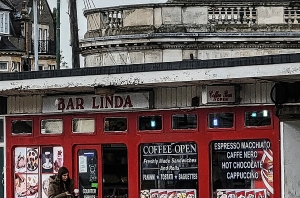
The western edge of the bus yard has always been lined with a row of single storey sheds. Most of these have been used as shops and offices for London Transport. One of them houses a small café called Bar Linda. This was not in existence when I first used to visit the station, but I believe that it opened in the 1960s. Although this friendly little place has been serving customers for many decades, the first time I ventured inside it was in about 2017 when I was about to walk around Golders Green to take photographs for a blog article I was planning to write. I have re-visited it several times since then.
Although Golders Green might not be as aesthetically pleasing as its neighbours, Hampstead and Hampstead Garden Suburb, it is an area full of interest. Much has happened there since 1907 when it began growing from a rural hamlet into a leafy suburb. You can discover much more about Golders Green – its past, my memories of it, and its vibrant present – by reading my book “GOLDERS GREEN & HAMPSTEAD GARDEN SUBURB: VISIONS OF ARCADIA”, which is available (paperback and/or Kindle, from Amazon websites, such as:
MANY READERS – ESPECIALLY those with some knowledge of physics – will have heard of the German Werner Heisenberg (1901-1976), who is well known for his famous Uncertainty Principle that relates to quantum physics. Because of my uncertainty about what exactly this principle expresses, I will let you look it up on Google or elsewhere.
One thing I was not uncertain about was seeing a café called Heisenberg in Chiswick’s Turnham Green area. As it was nearly 11 am, I was certain that I needed a cup of coffee, and what better place to have it than a place named after a person who ‘discovered’ uncertainty. The café is small but quirkily decorated and the coffee it served was very good. We drank from disposable cups, which bear the motto:
“Perfection cannot be measured as explained by the Heisenberg theory. However, this is the closest you’ll get to the perfect cup of coffee.”
Although I am uncertain whether the second part of this is true, I am certain that when I am next in the area, I will try another cup of Heisenberg’s coffee.
THE RIVER BRENT is a major tributary of London’s River Thames. It has two main sources: one, which feeds into Dollis Brook, is west of Barnet; the other, which feeds into Mutton Brook, is near East Finchley. As a child, Mutton Brook figured amongst the places where I used to play with my friends. It flows through Hampstead Garden Suburb (‘HGS’) where I lived during the first three decades of my life. In those far-off days, I had no idea that the then rather malodorous, winding Mutton Brook flowed into the Thames. Mutton and Dollis Brooks merge to become the Brent near Golders Green. The Brent flows through northwest and then west London to reach its junction with the Thames at Brenford, an interesting place, rich in history, described in my book “Beyond Marylebone and Mayfair: Exploring West London”.
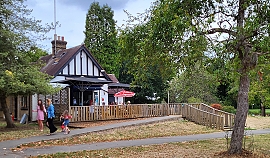
The cafe in Pitshanger Park
On its way to the Thames, the Brent skirts another garden suburb, Brentham Garden Suburb (‘BGS’), which, like HGS, was an attempt to create a leafy residential Utopia. They were built at roughly the same time. The northern edge of BGS borders Pitshanger Park, through which the Brent winds its way towards the Thames. The name of the park derives from the Putelshanger or Pitshanger family, who occupied the area in the 13th century. The manor occupied the area between Hanger Hill and the Brent. Until 1908, when it was demolished, the manor house (and its antecedents), known as ‘Pitshanger farmhouse’, occupied a plot on the present Meadvale Road, which runs along the northern edge of BGS. This building was completely different to Pizhanger Manor near Ealing Broadway, which was built by John Soane (and is described in my book).
Pitshanger Park is laid out on what used to be part of the grounds of Pitshanger farmhouse. BGS was built on another part of that same estate. The park is adjacent to Ealing Golf Course. Both were already in existence by 1912. The Brent also runs through the golf course. While we were visiting the park, we watched two men leaning over the bank of the river, rather ineffectually attempting to recover a ball from the weeds growing beside the water.
The park consists mainly of spacious grassy meadows that are bordered to the north by dense bushes and trees lining the bank of the Brent. Amenities offered in the park include, tennis courts, outdoor exercising equipment, and an attractive children’s play area. Housed in a small building with fake half-timbering, there is a small café with a terrace on which there are tables and chairs. The ‘caf’ offers hot and cold drinks and a few snacks. Its staff are pleasant, and the washrooms were clean.
While Pitshanger Park cannot be classed as one of London’s more exceptional open spaces, it is a wonderful amenity for residents in the area, just as was (and still is), the public gardens in HGS through which Mutton Brook flows.
“BREAKFAST LIKE A KING; lunch like a prince; dinner like a pauper”. This popular saying emphasizes the importance of breakfast amongst the meals partaken during the 24 hours of a day. We spent three nights in Widnes (Cheshire) in July (2022), and wanted to enjoy a decent breakfast. A search of Google revealed that the best-rated place for breakfast was Shelly’s Café located close to Harrison Street, a small road leading off the larger Hale Road.
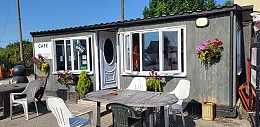
Shelleys café
There is a sign (for Shellys) with an arrow at the corner of Harrison Street and an unnamed short road with a badly damaged surface. This side road, which is lined on one side by dust-covered parked vehicles, some with flat tyres, leads to a pair of large metal gates, which were closed when we arrived. A key-pad next to the gates allows one to ring Shelley’s. When answered, the gates open slowly. We drove through them into a secure industrial area. This contains several buildings, some of which are warehouses and others factories (including several ice-cream manufacturers). In between the buildings, there are numerous parked cars, vans, and caravans. Most of them are old models covered with a thick layer of dust. We learned that some of them have been standing unused for a year or longer.
Shellys Café is housed in a single-storey wooden shack, adorned with pots of flowers, next to the electrically operated entrance gates. It has large windows and there were chairs and tables outside. The interior is simply decorated with a few wall plaques relating to the joys of riding motorcycles. Two large blackboards list what is on offer. One corner of the building is occupied by a spacious kitchen where Shelley and her husband prepare customers’ orders. On each of the three mornings we ate at Shellys, we sat beneath a photograph of Marilyn Monroe. The café had other framed photographs of film stars.
Everything we ordered was delicious. The fried items (including eggs, bacon, black pudding, mushrooms, sausages, hash browns, and tomatoes) were tasty and totally free of grease. What is on offer at Shellys is basic and unpretentious, but well-prepared. Given that this place is rated the best for breakfast in the Widnes area, it is remarkably good value. Were it nearer our home in London, I am sure that we would drive out to eat there, despite the industrial nature of its location.
ST MARTINS IN THE FIELDS church is a prominent landmark located on the east side of London’s Trafalgar Square. This 18th century church, which first opened in 1724 and was designed by James Gibbs (1682-1754), hosts many concerts, mostly of classical music.
There is a large crypt beneath the church. Its vaulted brickwork ceilings are supported by sturdy masonry pillars. There are many gravestones flush with the floor. The floor is covered with tables and chairs, which are used by the many customers of the café which uses the crypt as its home. It is a pleasant place to while away the time of day.
The café serves food and drink. The coffee served there is slightly below average in quality and is priced a just little bit higher than average for London. Regardless of price or quality, the crypt provides a pleasant ambience to meet friends or simply to relax peacefully.
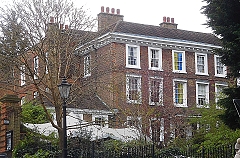
Burgh House stands high above the southwest end of Well Walk in north London’s historic village of Hampstead.Here is a little bit about it, an extract from my new book about Hampstead:
“… Burgh House is entered from a steep side street called New End Square. The house, built in 1704, is close to the Hampstead Well Spa (see below). According to Bohm and Norrie, the House is named after its 10th owner, The Reverend Allatson Burgh (1769-1856), who was the vicar of St Lawrence Jewry in the City of London. Burgh, who was keener on music than looking after his parishioners, neglected both them and his house. Thomas Barratt wrote:
“Mr. Burgh was a rector in the city, and the composer of a work on church music, published by Longmans. Burgh House is depicted on five pieces of the Wedgwood service, made in 1774, for Catherine II., Empress of Russia.”
Between 1858 and 1884, Burgh House became the headquarters of the Royal East Middlesex Militia. After having been put to a variety of uses, the house became used as a cultural centre in 1979. It now contains a small art gallery, a café, a shop, and a Hampstead Museum. The Reverend Burgh would have been pleased to know that today his former home also hosts many fine concerts of classical music.
From the bottom of the garden of Burgh House, the ‘Wells Tavern’ pub can be seen dominating the view along the gently inclined Well Walk. Known as ‘The Green Man’ until 1850, when it was rebuilt and renamed the ‘Wells Tavern’, a pub has stood on his spot since at least 1762. The pub’s name reflects one of the reasons that Hampstead became popular in the 17th century. Apart from enjoying clean air, people were attracted to the mineral water springs issuing chalybeate (iron-rich) water that were beginning to be exploited in Hampstead at that time…”
My book is called
“BENEATH A WIDE SKY: HAMPSTEAD AND ITS ENVIRONS”
YOU CAN BUY the paperback or ebook (Kindle) from Amazon:
IT IS NOT OFTEN that I feel the need to write about answering the call of nature but after a recent visit to Hampstead’s South End Green, I must satisfy the urge.
There is a yard at South End Green, where buses serving the route number 24 wait before setting off to Victoria station. Long ago, this yard used to have tram tracks as it was the terminus of a tram line. A lovely small café, Matchbox by name, stands beside the yard. Its owner, Mirko, a friendly Slovenian, serves excellent hot beverages and a range of mouth-watering snacks, both sweet and savoury. The nearest public toilets are across the yard, almost opposite to Matchbox.
The toilets are below ground level and accessed by staircases with cast-iron structures above them. It was only on our most recent visit to South End Green, in December 2021, that I had reason to descend into the ‘gents’, and I am pleased that I did, not only for reasons related to my physiology but also to satisfy my curiosity.
The ‘gents’ is magnificent, with its white glazed brick walls decorated with bands of light green bricks, its long narrow, black and white chequered floor, its polished dark wood cubicles, and its row of white urinals all topped with grey (marbled with white streaks) granite separators. Although there is electric lighting, a skylight admits some natural light.
The underground toilet facilities, both the men’s and the ladies’, were constructed in 1897 for the benefit of passengers using the tramway. Stephen Emms, writing in the “Kentish Towner” in October 2013, noted that the gent’s underground facility at South End Green was a pick-up place used by homosexuals. He noted:
“But most memorably South End Green is the only public toilet still in use known to have been visited by iconic 1960s playwright Joe Orton. Apparently it was his “favourite pick-up point” too””
You might be relieved to learn that my recent brief visit was completely uneventful.







 yamey
yamey 