He lived and painted in and around London’s Hampstead district

TWO HALF-BROTHERS from India were both artists, and spent time creating artworks in and around Hampstead. Lancelot Ribeiro (1933 – 2010) was one of them, and the other was his older and more famous brother Francis Newton Souza (1924-2002). Today (23rd of June 2024), we dashed up to Hampstead’s Burgh House to see an exhibition of works by Souza created when he lived in Hampstead and Belsize Park. This small, but superb exhibition closes today.

Born in Portuguese Goa, Souza studied art at the prestigious JJ School of Art in Bombay. A participant in the Quit India Movement, he was expelled from that school in 1945 when he pulled down a Union Jack flag at a school celebration. Souza migrated to the UK in 1949. By 1955, he was already making a success in London’s contemporary art world.

In London, Souza first lived in Paddington, then North Kensington, and by the mid-1950s, he had moved to Hampstead. By 1961, he had made enough money to buy a large house – number 9 Belsize Park. He remained there until he moved to the USA in 1968.

The exhibition handout (produced by London’s Grosvenor Gallery) described Souza as an Expressionist artist who:

“… conveyed the fear and anguish of the generation.”

One of the great fears was that of nuclear weapons. Souza became an anti-nuclear activist, taking part, for example, in the Aldermaston Marches. Three of the paintings at the exhibition, “The Mad Prophet of New York”, “The Apocalypse”, and “Oedipus Rex”, reflected Souza’s reaction to nuclear weaponry, and were painted during his time in the Hampstead area.

At least two of the paintings we viewed reflected Souza’s life in northwest London. One of them depicts a church in Chalk Farm (near Belsize Park), and the other, a parody of Picasso’s 1907 “Demoiselles d’Avignon”, has the title “Young Ladies of Belsize Park”.

The paintings were hung in the well-lit Peggy Jay Gallery in Burgh House, and were accompanied by informative panels. It is a shame that this excellent exhibition was only open for a few days (19th to 23rd of June 2024). I am glad that we made the effort to see it.

An artist from Vienna who lived in Hampstead (north London)

HAMPSTEAD HAS BEEN home to many artists – both painters and sculptors. Some of these are well-known, such as John Constable, George Romney, Stanley Spencer, Henry Moore, and Barbara Hepworth – to name but a few. Others are less widely known. Amongst the lesser-known is the late Marie-Louise von Motesiczky (1906-1996), some of whose paintings are on display in a special exhibition in Hampstead’s Burgh House until the 15th of December 2024. In addition to the works in the temporary exhibition, Burgh House’s permanent collection includes a few of her paintings.

Marie-Louise was born in Vienna (see: www.motesiczky.org/biography/). Her mother’s family were well-connected with Vienna’s flourishing intellectual circles in the early 20th century. Her grandmother, Anna Von Lieben, was one of Freud’s first psychoanalytical patients. At the age of 13, Marie-Louise left school, and began studying art in Vienna, The Hague, Frankfurt, Paris, and Berlin. In 1927, she joined the master classes held by the artist Max Beckmann (1884-1950) in Frankfurt-am-Main. This painter became an important influence in her life and work.

After the Anschluss (the Nazi annexation of Austria) in March 1938, Marie-Louise and her mother, Henriette, left Vienna. They went to Holland, where, in 1939, Marie-Louise had her first solo exhibition. Soon after this, she and her mother left for England, and settled in Amersham. There, she met the Bulgarian writer Elias Canetti (1905-1994) and his wife. Canetti was to become an extremely close friend of Marie-Louise. At Burgh House, we saw her portrait of him on display.

When WW2 was over, Marie-Louise and her mother moved into a flat in West Hampstead, which they rented until 1960. Then, they purchased a large house in Hampstead, number 6 Chesterford Gardens (a short road linking Frognal and Redington Road). While living there, she painted many portraits of her ageing mother. Some of these were on display at Burgh House.

Marie-Louise is now highly acclaimed as a 20th century artist in the country where she was born. Although the paintings I saw today at Burgh House are often imaginative and pleasant enough, I began to understand why she has not become as well-known as some of the many other artists who lived in Hampstead. However, everyone has different tastes in art. So, a good way to judge this artist’s work would be to pay a visit to Hampstead’s lovely early 18th century Burgh House.

From Bombay to Belsize Park

SEVERAL OF OUR FRIENDS born in India came to study accountancy in the UK during the late 1960s and early ‘70s. In those days, studying accountancy had two benefits apart from giving our friends the opportunity to have careers in commerce and finance. First, coming to the UK was an opportunity to live abroad, and, more importantly, because they had to study whilst employed by an accountancy firm, they got income to cover their living expenses. All of them have had successful careers in business and/or banking. Some years earlier (in 1950), Lancelot Ribeiro (1933-2010), born in Bombay, came to the UK to study accountancy. However, he did not complete the course. Instead, he began studying art at London’s St Martins School of Art between 1951 and 1953. At that time, he lived in London’s Chalk Farm with his half-brother, the artist Francis Newton Souza (1924-2002), who was born in Goa. In August 1954, Lancelot was conscripted into the RAF. He was released from this in January 1955. Then, he returned to Bombay.

In Bombay, Lancelot was employed by the Life Insurance Corporation. He remained in this company for four years, by which time his poetry and painting were becoming recognised by Bombay’s artistic community, notably by the poet Nissim Ezekiel, the critic and poet Rajagopal Parthasarathy, the critic Rudolf von Leyden (German born, but lived most of his life in Bombay), and the Tata industrial group (who commissioned some of his works). By 1959, he had decided to make painting his profession. By the early 1960s, he was exhibiting in both group shows and solo exhibitions and was gaining wider, and influential recognition. Lancelot and his wife returned to London at the end of 1962/early 1963.

After living in various parts of London, the Ribeiro’s settled in the Belsize Park area of Hampstead – at Belsize Park Gardens – for a few years. By now, Lancelot’s works, and those of other Indian artists living in England, were being exhibited both in the UK and India. Life in London was not easy even in the late 1970s for people with ‘brown’ skins as Lancelot found out the hard way. Several times, he was attacked in the streets near Swiss Cottage, and once badly injured when attacked outside Hampstead Police Station. In addition, some of his pictures were vandalised when on display at the Swiss Cottage Library in 1986-87. However, none of this subdued his irrepressible creativeness.

Some of his prolific and highly inventive artworks were exhibited in Hampstead’s Burgh House when it held an “Indian Month” in 1980. Although he did not enjoy as much fame as his better-known half-brother, Ribeiro’s work is well worth seeing. An opportunity to do so is currently available at Burgh House until the 17th of December 2023. The well-displayed exhibition, “Lancelot Ribeiro: Finding Joy in a Landscape” can be seen free of charge. The Burgh House website describes it as follows:

“A journey through the changing landscapes of Hampstead-based expressionist poet and painter Lancelot Ribeiro, from his roots in pre-Independence 1930s India to life in mid-20th century Britain.

Ribeiro experimented with form and materials, moving from conventional depictions of the Lake District to otherworldly townscapes and sharp, bright abstracts inspired by geology. Each work encourages us to look anew, reconsider the form and substance of our environment, and how we might depict and share those landscapes with others.”

I can strongly recommend that you pay a visit to this show to see the works of an artist, who should be more widely known.

Finally, I wonder what would have become of our few dear friends had they abandoned accountancy prematurely. One of them, in his retirement from many years in banking, has become written a highly acclaimed novel. Another, who retired from a career in an international corporation, is now highly developing his skills as a cook. A third, who dropped out of accountancy, has become a successful translator.

A penguin in the museum

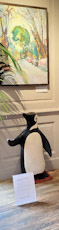
HAMPSTEAD’S BURGH HOUSE was constructed in 1704 and retains many of its original architectural features. Several of its rooms house a fascinating museum with exhibits relating to the history of Hampstead. I have visited the museum many times, but it was only today (the 9th of March 2023) that I noticed a model penguin on display. This used to stand inside High Hill Bookshop, which was located on Hampstead High Street. Founded by Ian Norrie in 1956, it remained in business until 1988.

During my childhood, in the 1950s and 1960s, I used to visit Hampstead almost every Saturday morning with my parents and my sister. We used to park the family car near to Jack Straws Castle, which is close to Whitestone Pond – one of the highest spots in London. Then, we would walk down Heath Street and along the High Street until we reached High Hill Bookshop. My parents were keen to encourage my sister and I to read. Therefore, every time we visited the bookshop, we had to choose one book each, which they purchased for us. I cannot recall all of the books I chose, many of them Puffin paperbacks, but I do remember that during these visits I gradually built up my collection of the adventures of Tintin by Hergé.

According to an article (https://jessicanorrie.wordpress.com/2017/08/04/the-best-independent-bookshop-in-london/) by Norrie’s daughter, Jessica Norrie, there was a party for Penguin Books held in the shop in 1960. The model penguin, which I saw in Burgh House today, was in attendance at that party back in 1960. I was eight in 1960, but I am afraid that I cannot remember seeing the penguin. It must have been in the shop during some of my visits, but then my interest in choosing a book was greater than looking for model penguins.

The penguin in the museum is black and white. On the white section of the bird’s belly, there are words, including “October 12th, 1960. High Hill Bookshop Silver Jubilee Party” and, also, some signatures. One of the signatures is that of Allen Lane, founder of Penguin Books. He died 10 years after the party. Another signature is that of the novelist Olivia Manning, There are several other signatures, but I found them too difficult to decipher.

Seeing the penguin at Burgh House brought back happy memories of my childhood and, at the same time, made me sad because High Hill Bookshop was irreplaceable. Waterstone’s, which followed in its wake, although well-stocked, lacks the charm of Ian Norrie’s wonderful creation.

You can read more about Hampstead past and present in my recently published book “Beneath a Wide Sky: Hampstead and its Environs”, which is available from Amazon: https://www.amazon.co.uk/BENEATH-WIDE-SKY-HAMPSTEAD-ENVIRONS/dp/B09R2WRK92/

Painting in the Mall

BETWEEN HAMPSTEAD AND Belsize Park, there is a narrow footpath running north from Tasker Road. One side of it is lined with a terrace of low buildings known as Mall Studios. Built in 1872 by Thomas Battersby, they were designed as artists’ studios. Each of them contained small waiting rooms; costume rooms; and a lobby. Each studio had three skylights and large north facing windows to capture the kind of light favoured by many artists. Following the advice of the artist Walter Sickert, who had lived there, the artist John Cecil Stephenson (1889-1965) settled into number 6, Mall Studios in March 1919.  It was to remain his home until he died. In 1927, Barbara Hepworth became his neighbour in number 7, and at around that time, the influential art critic and writer Herbert Read moved into number 3. Nearby, Parkhill Road became home (for various lengths of time) to other artists including Henry Moore, Ben Nicholson, Naum Gabo, Piet Mondrian, Hans Erni, and other artists who have since become famous.

By John Cecil Stephenson

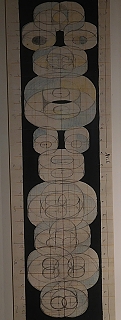
Whether it was the proximity of his artistic neighbours, who were pioneers of 20th century modernist art, or something else in his artistic evolution, Stephenson departed from his previous ‘straightforward’ portraiture and landscape painting and created works characteristic of what is now known as the ‘Modernist’ style. Although some of his works created after the late 1920s are to some extent figurative, most of his output was mainly abstract and constructivist. During WW1, Stephenson left London’s Slade School of Art temporarily to work in munition factories in Bishop Auckland (County Durham), the town where he was born. His experiences of working with industrial machinery and observing the efficiency and speed of the mechanised production processes is reflected in some of the paintings he produced later.

Stephenson, son of a grocer, was less well known than his neighbours. He produced art that bears favourable comparison to the works produced by them. Until the 18th of September 2022, there is a wonderful small exhibition of his works in a gallery within Hampstead’s charming Burgh House. The catalogue, edited by Sacha Llewellyn, Paul Liss, and George Richards, not only contains a fine collection of photographs of the exhibits but also provides a superb introduction – better than others I have seen – to the story of the pioneering role of Hampstead in the evolution of modern art in England. Burgh House, which contains several rooms comprising a museum of the history of Hampstead, also hosts excellent exhibitions such as the current survey of Stephenson’s works. Its well illuminated Peggy Jay Gallery provides a space for contemporary artists, many of them local, to display their works. Beneath the two storeys of cultural experiences, the basement of Burgh House is home to a pleasant café where anything from a cup of coffee to a wholesome meal can be obtained. And amongst the interesting range of books in the small bookshop, you can find copies of my book “Beneath a Wide Sky: Hampstead and its Environs” on sale (if they have run out, tell them to ask me for more, and then get your copy from Amazon).

Rudyard Kipling, Hampstead, and Cambridgeshire

WIMPOLE HALL IN Cambridgeshire is according to the architectural historian Nikolaus Pevsner:

“Without doubt the most spectacular country mansion in Cambridgeshire…”

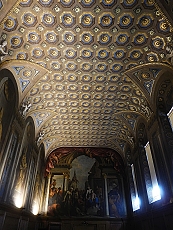
Chapel at Wimpole Hall, Cambridgeshire

Much of the mainly red brick building dates from the 17th century, although more was built in the 1740s. It contains many splendid rooms including a large library; a chapel decorated in 1724 by the painter James Thornhill (c1675-1734), who decorated the Painted Hall in Greenwich; and a large ‘salon’ created by Sir John Soane. These are a few of the wonders that can be viewed within the house, now maintained by the National Trust. The grounds of Wimpole are also superb and include a magnificent walled garden and a ‘Gothick’ folly.

Despite the visual attractions of Wimpole Hall, I was fascinated by its last owners: George and Elsie Bambridge. George Louis St Clair Bambridge (1892-1943) was a British diplomat and a soldier. In October 1924, he married Elsie Kipling (1896-1976), the second daughter of the famous writer Rudyard Kipling (1865-1936).

After living in several places outside the UK, George and Elsie came to London. Between 1933 and 1937, they lived in Hampstead. Their home in that lovely district of north London was the elegant Burgh House, which was built in 1704. In an epilogue to a biography of her father by Charles Carrington, Elsie wrote of Burgh House:

“In 1933 we returned to England, and our life in the delightful old house which we rented in Hampstead was a source of happiness to him to the end of his life.”

The person to which she was referring (i.e,, “him”) was her father, Rudyard Kipling.  

On the 12th of January 1936, Rudyard and his wife (Carrie) visited George Bambridge, who was in bed at Burgh House, suffering from bronchitis. It was to be Rudyard’s last outing because on the following day he was admitted to Middlesex Hospital where he underwent hazardous surgery for a haemorrhage. He died in hospital on the 18th of January.

The Bambridges moved from Hampstead to Cambridgeshire in 1937. They rented Wimpole Hall between 1937 and 1942, when they purchased to property. George died in 1943, and his widow, Elsie, continued living in Wimpole Hall until her death. When they moved in, the place was empty of contents. They bought pictures and furniture, much of which can be seen today. After her husband’s death, Elsie used the substantial royalties from her father’s books to refurbish the house. On her death, she bequeathed the house and its vast estate to the National Trust. It is well worth visiting if you are anywhere near Royston or Cambridge and it is no more than one hour’s drive from central London.

A house where music has been played for many centuries

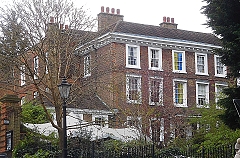
Burgh House, Hampstead, London

Burgh House stands high above the southwest end of Well Walk in north London’s historic village of Hampstead. Here is a little bit about it, an extract from my new book about Hampstead:

“… Burgh House is entered from a steep side street called New End Square. The house, built in 1704, is close to the Hampstead Well Spa (see below). According to Bohm and Norrie, the House is named after its 10th owner, The Reverend Allatson Burgh (1769-1856), who was the vicar of St Lawrence Jewry in the City of London. Burgh, who was keener on music than looking after his parishioners, neglected both them and his house. Thomas Barratt wrote:

“Mr. Burgh was a rector in the city, and the composer of a work on church music, published by Longmans. Burgh House is depicted on five pieces of the Wedgwood service, made in 1774, for Catherine II., Empress of Russia.”

Between 1858 and 1884, Burgh House became the headquarters of the Royal East Middlesex Militia. After having been put to a variety of uses, the house became used as a cultural centre in 1979. It now contains a small art gallery, a café, a shop, and a Hampstead Museum. The Reverend Burgh would have been pleased to know that today his former home also hosts many fine concerts of classical music.

From the bottom of the garden of Burgh House, the ‘Wells Tavern’ pub can be seen dominating the view along the gently inclined Well Walk. Known as ‘The Green Man’ until 1850, when it was rebuilt and renamed the ‘Wells Tavern’, a pub has stood on his spot since at least 1762. The pub’s name reflects one of the reasons that Hampstead became popular in the 17th century.  Apart from enjoying clean air, people were attracted to the mineral water springs issuing chalybeate (iron-rich) water that were beginning to be exploited in Hampstead at that time…”

My book is called

“BENEATH A WIDE SKY: HAMPSTEAD AND ITS ENVIRONS”

YOU CAN BUY the paperback or ebook (Kindle) from Amazon:

https://www.amazon.co.uk/dp/B09R2WRK92

A Sunday afternoon in Hampstead and a bit of marketing

FROM CAMDEN TOWN, home of the busy Camden Lock and other popular markets, the 24-bus route more or less follows course of the now buried River Fleet, and ends at Hampstead’s South End Green. We disembarked at the Lawn Road bus stop on Fleet Road and walked the short distance to the Lawn Road Flats, also known as The Isokon. This building, inspired by the avant-garde housing projects in pre-WW2 Germany pioneered by the Bauhaus and similar institutions, was completed in 1934. A relatively bomb-proof structure, it was home to many people involved with cultural activities, including the author Agatha Christie (1890-1976), who wrote several of her novels whilst living there. The modernist block of flats still houses tenants. On Saturdays and Sundays, a small museum illustrating the history of this amazing edifice is open to the public. It contains photographs, information panels, and historical furniture items, all connected with the Isokon and its illustrious tenants. There is also a small, but well-stocked bookshop. It was here that I left several copies of my new book about Hampstead to be available for sale to visitors.

Bust of Agatha Christie at the Isokon Gallery in Hampstead

From the Isokon, we walked past South End Green and up Willow Road, which ascends ever more steeply as it approaches its northern end just near to Flask Walk and our next port of call, Burgh House. The house was constructed at the beginning of the 18th century. Here, we viewed the latest temporary exhibition, “John Cecil Stephenson: A Modernist in Hampstead”, which started at the beginning of April 2022. I will write more about this in a separate piece. Burgh House is home to a museum of the history of Hampstead and to a pleasant and popular café, which serves drinks and both hot and cold foods. The house also contains a small bookshop, well-stocked with a variety of books about Hampstead and artists associated with the place. I left several copies of my book about Hampstead to be sold there.

After spending a relaxing time in the Burgh House café, we wandered along Flask Walk, passing Keith Fawkes antiquarian bookshop, where copies of my book are on sale. Then, we walked onwards along the High Street and Perrins Court, where my father and I used to eat lunches at the Villa Bianca Italian restaurant. Reaching Heath Street, we passed the The Village Newsagent, which stocks my book (can you spot the theme emerging here?), and then entered Church Row. Halfway along it stands St John’s Parish Church.

The neo-classical church was completed in 1747. Twenty-three years before this, the “St Johns Passion” by Johann Sebastian Bach (1685-1750) was first performed in the Church of St Nicholas in Leipzig. At 5pm on Sunday the 3rd of April (2022), we listened to a good performance of this wonderful piece of religious music in the Church of St John in Church Row. With a small choir, a competent orchestra, and excellent soloists, the acoustics were excellent. Very thoughtfully, foam rubber cushions are provided for improving the comfort of the seating in the wooden pews. I was pleased to note that the current (April) issue of the parish newsletter includes a note about my new book.

After watching a colourful sunset, we took a bus to Paddington, where we enjoyed a tasty meal at the Malaysian Tuk Din restaurant not far from the station.

My book “Beneath a Wide Sky: Hampstead and its Environs” is available in Hampstead at the following locations:

THE CAMDEN ART CENTRE (Arkwright Road)

KEITH FAWKES (Flask Walk)

ISOKON GALLERY (Lawn Road)

THE VILLAGE NEWSAGENT (Heath Street)

BURGH HOUSE (New End Square, near Flask Walk)

The book (and Kindle) is also available from Amazon (https://www.amazon.co.uk/dp/B09R2WRK92)