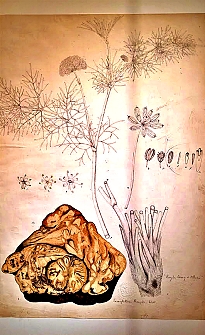
ALMOST AS SOON as English people began visiting India, and later colonising it, they took an interest in the flora of the Indian Subcontinent. Their interest was both scientific and commercial: looking for plants that could be exploited to make a profit. Many of the early English explorers of India’s flora worked in an era before photography was invented, or in the early days before colour photography became possible. Instead of making photographs of botanical specimens, detailed drawings and paintings of plants were created. Until I visited an exhibition at Kew Gardens, which runs until 12 April 2026, I believed that all the intricately detailed botanical images had been created by English and other European people.
The exhibition, “The Singh Twins: Botanical Tales and Seeds of Empire”, is divided into two related but quite different sections. One section contains colourful, contemporary artworks by the Singh Twins. The other, subtitled “Flora Indica: Recovering the lost histories of Indian botanical art” contains 52 botanical illustrations by Indian artists commissioned by British botanists between 1790 and 1850. Each one of them is rich in detail, delicately drawn and/or painted, and a delight to behold. Not much is known about the Indian artists apart from their names, and where they were based. The artists were both Hindus and Muslims, and their pictures combine traditional Indian draughtsmanship with the kind of scientific realism required by the English botanists who commissioned them. Compared to other Indians employed by British botanists, they were well paid, receiving up to £500 per month in today’s money.
Most of the Indian artists, whose works were on display were based in Bengal: most in Berhampur, others in Calcutta and Darjeeling. Other artists were in Burma, Saharampur, and Nepal. All of them were male. Over 7500 drawings of flora in South Asia were commissioned by the East India Company, and were created entirely by Indian artists. Some of these images reached Kew in 1879 from the Company’s India Museum, established in London in 1801 and closed for good in 1879.
The exhibition is well-displayed with informative labels. It is in the Shirley Sherwood Gallery of Botanical Art. This contemporarily designed edifice is close to the much older Marianne North Gallery, which houses a huge collection of botanical images created by Marianne North (1830-1890). Although her paintings are superb, those by the Indian artists in the exhibition have a certain delicacy that is lacking in many of North’s often quite bold depictions of flora.
The “Flora Indica” exhibition is showing alongside the Singh Twins’ artworks, which are imaginative, witty, and provide a satirical view of the consequences of European colonisation, particularly of India and Africa. Rich in floral details, the images complement those created much earlier by the Indian botanical artists.
ONE OF THE characteristics of a living organism is the ability to reproduce itself. Pollination of plants is an important stage in maintaining the survival of a species.
Yesterday (the 15th of May 2024), we saw a curious tree at Kew Gardens. It looked as if it had both green and white leaves. It is a Handkerchief tree (Davidia involucrata). The white appendages are not leaves but bracts. They form for about a fortnight each year, and serve to increase the chances of the tree’s flowers being pollinated.
I ALWAYS ENJOY visiting Bushy Park, which is near to London’s famous Hampton Court Palace. Parts of the park are unenclosed, where plenty of deer roam at liberty. Other parts – the Pheasantry and Waterhouse plantations – are enclosed by fencing to keep the deer excluded.
The plantations contain a rich variety of plants and trees, all of which are a joy to see. There are two types of plants that never fail to fascinate me. One of these is the swamp cypress trees (Taxodium distichum). What makes them interesting is their aerial roots (known as ‘Cypress Knees’), which look like small woody stalagmites or tapering tree trunks. You can see rows of these stumpy aerial roots lining the stream near to the Pheasantry Café. According to a web article (www.graftingardeners.co.uk/trees-of-bushy-park/), these trees were:
“Once native to Britain, there have been ancient remains of this tree species found in Bournemouth. However, the swamp cypress was reintroduced to Britain by John Tradescant the Younger in 1640 … When the ground is particularly waterlogged, the swamp cypress tree grows pneumatophores. These are like knobbly woody stumps that grow out of the ground and serve as a sort of snorkel.”
Skunk Cabbage flowers
The other plant that stands out in my mind is known as Skunk Cabbage. With yellow flowers that slightly resemble Arum lilies, the Skunk Cabbage (Lysichiton americanus) is believed to emit an odour similar to that of skunks when it blooms. The smell is attractive to pollinators. The plant, although interesting to look at is a potential pest, as I found out on a website that deals with invasive species (www.invasivespecies.scot/american-skunk-cabbage):
“The large leaves and dense stands of the plant lead to it out-competing smaller plants due to its shading effect and can cause extensive damage locally to native flora including vascular plants and mosses. It can grow in shade or full-light and in a range of different soil conditions and thrives in disturbed environments. Given the popularity of this plant in gardens and its continued introduction into the wild, the problems are likely to increase. Although initial invasions will expand slowly, once this plant takes hold it can spread rapidly and become a serious problem.”
We saw the Skunk Cabbage in various stages from bud to full bloom when we visited Bushy today (the 24th of March 2024), but could not get close enough to the flowers to smell the odour from which they have got their name. I had noticed these plants before, but until today I did not know what they are.
Seeing curious plants such as the Swamp Cypresses and the Skunk Cabbage, which, incidentally, is edible if its root is roasted and dried, adds to the pleasure that is gained from seeing Bushy’s less strange plants such as daffodils, camellias, rhododendrons, and so on. Visiting the park and its gardens is well worthwhile, but get there early in the morning to ensure finding a place in the car parks.
We visited Funchal in Madeira in early June 2022. Although we were recommended to visit some of the numerous botanical gardens in and around the city, it was hardly necessary. I do not think that I have ever visited a place filled with such a profusion of flowers as is the case for Funchal. The whole city seems to be one great garden.
During our visit, we were in time to see a vast number of blue flowered agapanthus plants. Although they are commonly known as ‘lily of the Nile’ or ‘African lily, they are not of the lily family. They are members of the Asparagales order of plants, a part of the Asparagus genus. Had I not seen so many of these flowers in Funchal, I might never have bothered to find out anything about them. As the saying goes, travel broadens the mind.
REMNANTS OF LONDON’S ROMAN wall can be seen from various points in the Barbican Estate, whose construction began in 1965. The not entirely unattractive residential brutalist concrete jungle, known as The Barbican is sited next to the northern edge of what was formerly Roman Londinium. According to a history of the area (www.cityoflondon.gov.uk/services/barbican-estate/barbican-estate-history):
“The name of the Barbican comes from the Low Latin word ‘Barbecana’ which referred to a fortified outpost or gateway: an outer defence of a city or castle or any tower situated over a gate or bridge which was used for defence purposes. The “Barbecana” was probably situated somewhere between the northern side of the Church of St. Giles Cripplegate and the YMCA hostel on Fann Street.”
By the 1850s, the district of Cripplegate, where the Barbican is located, was very crowded with dwellings and business premises. Much of the area now occupied by the Barbican had been destroyed by bombing during WW2. The Estate was built to replace what the Luftwaffe had destroyed.
Apart from several water features, there is one oasis of greenery on the otherwise extremely urban site. This is the Barbican Conservatory. Opened in 1982, it is located above the Barbican’s main theatre and can be entered through an entrance close to that of the Barbican’s Art Gallery. Despite it having been in existence for so many years and having known about it for several decades, it was only yesterday (6th of April 2022) that I first ventured inside it. We had just viewed the current exhibition in the Gallery, “Postwar Modern: New Art in Britain 1945-1965”, an impressive display of rather unexciting artworks. Entering the Conservatory was literally “a breath of fresh air” after viewing the exhibits that had been arranged to illustrate the depressing emotional aftermath of WW2 as depicted by artists in Britain.
I was surprised to learn that the Barbican Conservatory is:
“… the second largest in London (after Kew Gardens) and home to over 1,500 species of plants, but is one of the city’s lesser-known green spaces.” (www.atlasobscura.com)
Apart from the plants, many of them exotic, which are arranged on various levels and can be viewed from both a lower floor and an elevated walkway, there are three ponds. One contains koi carp and the other, raised above ground level, is home to two terrapins, which were found in ponds on Hampstead Heath. The Conservatory is divided into two main sections. The larger is the tropical section, where visitors are permitted to wander about. The other, which was locked up yesterday, is the arid section, containing cacti and succulents.
Despite being in the midst of a manmade, visually intriguing, but harsh urban environment, the Conservatory with its tall trees, bushes, flowers, and other vegetation, feels like another world – a primaeval paradise from which the modern world can be glimpsed in the background.
The artist uses delicate models of the natural world to illustrate that life simultaneously has its dark and light aspects. This innovative exhibition has to be seen to be believed. It makes for an intriguing accompaniment to the lovely botanical gardens.
PRIMROSE HILL IN NORTH LONDON is a delightful place to take exercise. From its summit at 210 feet above sea-level, it is possible to enjoy a superb panorama of London if the weather permits. At its summit, a low concrete construction is inscribed with the words the poet William Blake (1757-1827) told the lawyer, diarist, and a founder of University College London, Henry Crabb Robinson (1775-1867):
“I have conversed with the spiritual Sun. I saw him on Primrose Hill”
In one of his poems, Blake wrote:
“The fields from Islington to Marybone,
To Primrose Hill and Saint John’s Wood,
Were builded over with pillars of gold,
And there Jerusalem’s pillars stood.”
On a recent visit to Primrose Hill in January 2021, when the temperature was at the freezing point of water and London was covered by low cloud, we had no sight of the sun, spiritual or otherwise. Nevertheless, we had an enjoyable stroll that evoked many memories. One of these was when I studied at University College London. If I felt energetic, I used to walk the five or so miles to college from my home in Hampstead Garden Suburb. Part of my route was up and over Primrose Hill.
The gardens on the south side of Elsworthy Road back on to the northern base of the hill. It was on this road that my parents, newly married in 1948, lived briefly in a flat that they rented from the economist Ronald Coase (1910-2013). My mother told me that amongst the furniture in the flat there was a record player with a gigantic horn as its speaker. 46 years later, my father and my stepmother bought a house on the road. He lived there until he died last year.
Elsworthy Terrace, a cul-de-sac, leads from Elsworthy Road to Primrose Hill. The botanist and first female botanist to be elected a Fellow of the Royal Society, Agnes (née Robertson) Arber (1879-1960), lived at number 9 between 1890 and 1909, when she married the paleobotanist Edward Alexander Newell Arber (1870–1918). The Terrace leads to one of the many footpaths that form a crisscrossing network all over the grassy hill that has well-spaced trees of varying shapes and sizes. Plenty of these were covered with frost. Many of the paths meet at the treeless summit of the hill where, if you are lucky with the weather, you can enjoy a good view.
Primrose Hill, first opened to the public in 1842, was part of land appropriated for hunting by King Henry VIII. The earliest mention of its name was in the 15th century. In October 1678, the body of the anti-Catholic magistrate Sir Edmund Berry Godfrey (1621-1678) was found on Primrose Hill, marked with signs of strangulation and other bruises. The identity of his killer(s) remains a mystery. The hill was also the site of duels including one in about 1813 when the Italian patriot Ugo Foscolo (1778-1827) faced Mr Graham, the editor of the “Literary Museum”. The dispute that led to this was about his ‘Three Graces’:
“The Three Graces were his maidservants; two of them turned out to be prostitutes, and one of them ran off with his former translator. This led to a duel, whether in Regent’s Park or Primrose Hill is not clear; fortunately no blood was shed.” (www.regentsparklit.org.uk/authors_e_i.htm#Foscolo)
The southern edge of the hill is bounded by the Regents Canal, designed by John Nash (1752-1835), first used in about1816. We walked eastwards along the towpath from the elegant bridge number 10 to the point where the canal makes a right angle and heads under the Water Meeting road bridge and towards Camden Lock. This stretch of the canal has the London Zoo on both of its banks. On the north side of the canal, we passed the aviary designed by Lord Snowdon in 1964. One of Snowdon’s collaborators was Frank Newby, who was a colleague of my uncle Sven Rindl, a structural engineer at the Felix Samuely company. On the opposite bank we passed the Giraffe House and the wild hunting dog’s enclosure, where we spotted several of these beasts prowling about. Moored at the corner where the canal changes direction, you cannot miss seeing an old-fashioned boat that looks as if it has sailed from China. This houses the ‘Feng Shang Princess’ floating Chinese restaurant, which was already built by the 1980s.
The Victorian gothic St Marks Church is flanked on two sides by the canal and on another by a short street, St Marks Square. The church, which is not particularly attractive, was consecrated in 1853, damaged during WW2, and rebuilt by 1957. The northern edge of the church’s ground is on the southern side of Regents Park Road.
Heading west away from the church, we reach number 52 Regents Park Road. It was here that four of my good friends including the author and art historian Michael Jacobs (1952-2014) lived as ‘house-sitters’ for its then owner Rudi ‘G’ during the 1970s. The road flanks the north-eastern edge of Primrose Hill before curving eastwards and becoming an upmarket shopping street.
Since 1979, a Greek restaurant called Lemonia has been flourishing in Regents Park Road. Originally, this was housed in premises on the east side of Regents Park Road. Then, it moved to larger premises across the road in 1992. For a while, its original premises, remained part of the restaurant but renamed ‘Limonaki’. This has disappeared. The lady, who has become my wife, lived for a few months during the spring of 1983 in an avant-garde dwelling in Eglon Mews, close to the shops in Regents Park Road. It was then that she ‘discovered’ Lemonia, which became one of our favourite restaurants for several years. We held a few birthday parties there. Much later, when my father came to Elsworthy Road, he and my Greek stepmother became keen users of this friendly eatery. Nearby, is the independent Primrose Hill Books shop, a handy source of reading matter for the many local inhabitants with intellectual leanings, real or imagined.
These long-established businesses are in the midst of a good range of shops, offering a wide variety of goods. as well as cafés and restaurants and a pub. I can heartily recommend taking some physical exercise on Primrose Hill before acquiring something to stretch your mind at the bookshop (sadly not open at the moment), and taking refreshment in a pleasant, faintly Bohemian but distinctly bourgeois environment.
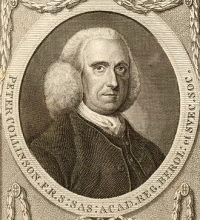
AN AGED BRICK WALL, clearly once the boundary of the grounds of a grand house, runs along part of The Ridgeway in London’s Mill Hill. It bears a plaque commemorating the fact that this was once the site of Ridgeway House, the home of Peter Collinson (1694-1768), author, naturalist, and botanist. This was not a name with which I was familiar, yet he played an important part in the scientific life of 18th century London and further afield.
Peter Collinson, born a Quaker, the son of the owner of a textile business, was unable to attend university in Britain because in his time members of that branch of Christianity were not admitted. He inherited his father’s business and taught himself to such an extent and to such a high level that in 1728 he became a member of the prestigious Royal Society (www.londongardenstrust.org/features/millhill.htm provides a good biography of Collinson). His greatest interest was plants and gardening, and he was responsible for importing many plants such as magnolias, kalmias, rhododendrons, azaleas and cedars of Lebanon, which were then relatively new to the UK, into the country. He imported these plants in great quantities so that these could be planted all over the country and thereby enriched and transformed the landscape. His legacy may be seen in many of the landscaped gardens of the country’s great houses.
When Collinson’s father-in-law died in 1748, he inherited Ridgeway House in Mill Hill, which was built in about 1525, and moved there from Peckham. Apparently:
“The house had no particular architectural merit; it was described as “double-fronted” with French windows” that open onto the garden.”
Not only did he move his family from Peckham but also all the plants he had been growing there. At Mill Hill he created a wonderful garden, about which he wrote:
“Very few gardens if any excel mine at Mill Hill for the rare exotics which are my delight.”
Collinson became a good friend to a frequent visitor to England, the American Benjamin Franklin (1705/6-1790), who became a vegetarian in his teens, but is better-known for other achievements. Many of these were in the field of scientific research. The two men corresponded regularly (https://founders.archives.gov/search/Correspondent%3A%22Collinson%2C%20Peter%22%20Correspondent%3A%22Franklin%2C%20Benjamin%22). Much of the contents of their letters that sailed across the Atlantic concerned the exciting discoveries that Franklin was making in fields such as electricity. In the letter dated 28th of March 1747, Franklin thanked Collinson for his:
“… kind present of an electric tube, with directions for using it, has put several of us on making electrical experiments, in which we have observed some particular phaenomena that we look upon to be new. I shall, therefore communicate them to you in my next, though possibly they may not be new to you, as among the numbers daily employed in those experiments on your side the water, ’tis probable some one or other has hit on the same observations.”
Other matters were also discussed. For example, in a letter dated 9th of May 1753, Franklin wrote to Collinson:
“I have often observed with wonder, that Temper of the poor English Manufacturers and day Labourers which you mention, and acknowledge it to be pretty general. When any of them happen to come here, where Labour is much better paid than in England, their Industry seems to diminish in equal proportion. But it is not so with the German Labourers; They retain the habitual Industry and Frugality they bring with them, and now receiving higher Wages an accumulation arises that makes them all rich.”
Much of Collinson’s correspondence with Franklin was to keep the latter up to date with scientific developments in Europe, especially those relating to new German experimentation with electricity. And much of Franklin’s correspondence with Collinson reported the results of his experiments with electricity in America, which Collinson conveyed to The Royal Society. It was these letters that were the basis of a book published by the Royal society in 1751, “Experiments and Observations on Electricity”, which is one of the most important scientific publications to emerge from 18th century America.
I cannot discover for sure whether Franklin ever visited Collinson in Mill Hill. However, Collinson did host the Swedish naturalist Daniel Solander (1733-1782), assistant to the great Swedish botanist Carl Linnaeus (1707-1778), at Ridgeway House. Linnaeus had earlier visited Collinson in Peckham. The Victorian guidebook writer James Thorne suggests that Linnaeus himself also visited Collinson at Ridgeway House.
Solander travelled to England in 1760 to promote the system of classification of biological organisms devised by Linnaeus. In 1753, Linnaeus named a genus of flowering plants, ‘Collinsonia’, to honour Collinson. It was Collinson, who got Solander the job of classifying the natural history specimens in Sir Hans Sloane’s collection, which formed the basis of the recently established (1753) British Museum, which opened to the public in 1759. It was the combined efforts of Collinson and Solander that persuaded the British to accept the Linnean system of classification. In 1768, Solander was one of the participants on Captain Cook’s first voyage to the Pacific Ocean, and thus became the first Swede to circumnavigate the Earth.
Collinson died in 1768. From 1801, his property at mill Hill was owned by the botanist Richard Anthony Salisbury (1761-1829), a founder member and the founder Secretary of the Royal Horticultural Society. In 1807, he sold it to the group who founded the Protestant Dissenters Grammar School. the forerunner of Mill Hill School. Apart from six trees in the school’s grounds, much of Collinson’s collection of plants has disappeared. Ridgeway House, which housed the school at first, was demolished in 1826 when the present grand school buildings were constructed. Collinson would have been pleased to know that Mill Hill School was:
“… first educational establishment to provide a first class education for the sons of dissenters, those whose religious or philosophical outlook did not conform to that of the state and who, like Collinson, a Quaker, were barred from the attending the established seats of learning.” (www.mhps.org.uk/collinson/botanical-contribution.asp#millhill).
When I saw the old wall running beside the Ridgeway in Mill Hill and what was written on the plaque affixed to it, little did I realise that such an important man in the scientific community of the 18th century had lived on the other side of it.





 yamey
yamey 