How do you know whether a book is worth reading from beginning to end?
Some people read the first few, say 10 to 20 pages, and then decide to continue or discontinue reading. Others I know read the first few and last few pages, and then choose whether it is worth reading in its entirety. Someone I knew, who was an avid and intelligent reader, told me that if she was finding a book difficult to ‘get into’, she would open the book, and read a few pages somewhere in the middle of the volume, before making a decision. My wife does all three: beginning, end, and a few pages in the middle. What ever method you use to assess the readability of a book is up to you.
In my case, if my attention is grabbed and I have reached the hundredth page, I will read to the end. If not, then I will most probably abandon the book, and move on to another.
PS Most people give up reading Ulysses by James Joyce before they reach page 30
FOUR MAJOR ROADS meet at Bombay’s Hutatma Chowk. In the middle of this extensive piazza, there is one of the city’s much-loved landmarks: the Flora Fountain. This fountain was constructed in 1864 and is surmounted by a statue depicting the Roman goddess Flora. Originally intended for the Victoria Gardens, it was placed in its present position instead. It stands where the Church Gate, one of the gates of Bombay’s Fort, which was demolished in 1860, was located.
Within a few feet of Flora, there are several places where books can be purchased. For new books and the latest releases, head for Kitab Khana, which is about 73 yards southeast of Flora. This is a well-stocked, pleasantly arranged bookshop with its own (rather pricey) café. Books are sold at their marked prices less ten percent. It is a fine bookshop but not a patch on The Bookworm and Blossom Book House in Bangalore. Both of these Bangalorian booksellers offer a far more extensive stock (both new and second-hand) than Kitab Khana.
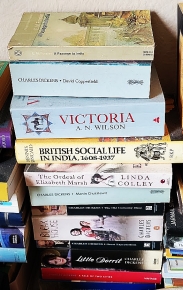
Just over 70 yards north of Flora Fountain, there is a corner where Dadabhai Naoroji Road meets Mahatma Gandhi Road. Several pavement booksellers display their vast stocks of books around this corner. Each seller has a bewildering number of books, mostly arranged as tall columns from which removing a book can be quite difficult to achieve without causing all the books to topple over. Some of the books are new, some are pirated editions of recent books, and the rest are used books. I do not know how they do it, but the booksellers have a good knowledge of what they have in their stock, and where to find a particular title if they have it.
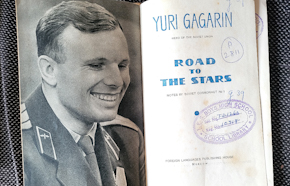
Whenever we visit Bombay, we spend time at the pavement booksellers. Over the years, I have managed to find several rare, out of print books here. Prices are reasonable and the vendors are prepared to discuss the price (i.e., ‘haggle’). At the end of 2025 and the start of 2026, we were in Bombay, and as usual, haunted the pavement booksellers. Whereas on previous visits, I have found what I was looking for as well as some interesting surprises, on our most recent trip, most of the well-stocked stalls were devoid of the kind of books I was hoping to find. Only one of the several stores had a good selection of out-of-print books. It was here that I acquired a copy of “Road to the Stars” by the Soviet astronaut Yuri Gagarin: the first man in space. Although newer softcover versions of this book are available, I bought a slightly battered copy of the original hardback edition published in the USSR in 1960 by The Foreign Languages Publishing House (Moscow). I paid considerably less than I would have for one of the newer (often facsimile) editions.
My other find, which I obtained in late 2025, is extremely rare. It is not listed on the very comprehensive bookfinder.com website. The book in question is “The Bohras” by Asghar Ali Engineer. Several of his other books are listed for sale on the website but not this one. Although I have yet to read the book, I can tell you that the Bohras are members of a denomination within the Ismaili sect of Shia Islam. The bookseller told me that the book is rare and refused to drop his (not unreasonable) starting price. While buying the book, neither the seller nor I knew how truly difficult it is to find a copy of this volume.
Whereas Flora Fountain is a sight that tourists feel they must see, the bookshops around it are, for me, the greater attraction when in Hutatma Chowk.
MANY THOUSANDS OF authors aspire to ‘make their name’ by publishing their writing. Most of these people hope to follow in the footsteps of, say JK Rowling, and to achieve fame and become a bestselling author. This hope is exploited ruthlessly on social media, especially, so I have noticed, on Facebook and X (formerly ‘Twitter’).
Every day, I notice a steady stream of advertisements promising to convert your piece of writing into a bestseller. Some ads offer to convert your manuscript into a book that looks as if it has been produced by a recognised commercial publishing house. Other, provide editing and mentoring services. Yet more of them, promise to promote your book on social media. Some will guide you as to how to make your book more prominent on Internet search engines. And others will review your book any number of times. There are even websites that will write the text of your book using AI. All these services naturally attract fees, and these can in some cases be quite hefty. If despite using these miraculous sounding services, your book neither sells well nor achieves great acclaim, you might be considerably out of pocket.
The problem is that very few of the myriad books written have either any outstanding literary merits or appealing features. The services offered in the ads offer profits and huge readerships on the horizon. But will they materialize, or will they remain mirages that fade away after you have parted with your money? I have never used any of the services that I have seen advertised. I wonder whether they would be honest enough to say that despite their best efforts, the submitted work is likely to be a failure, or do they not care.
THE ARTIST ANDREW Salgado was born in Canada in 1982. He graduated at Chelsea College of Art with a Masters Degree in Fine Arts. He lives and works between London (England) and New Brunswick (Canada). Until 28 June 2025, there is a wonderful exhibition of his imaginative, colourful paintings at Beers gallery in Little Britain, close to the Barbican and Smithfield Market.
The exhibition has the artist’s chosen title “Self-portrait as a Stack of Books”. Several of the paintings on display and one sculpture portray books. Salgado is an avid reader, and he says he has been influenced by some of the authors he has read. Whether they contain books or not, his creations are intriguing and hint at confused imagery of dreams. As to the artist’s intentions in the collection of works at Beers, the gallery’s hand-out noted:
“Asking Salgado about the intentions, symbolism, or directive in this collection of paintings – because it’s obviously ripe with his (now) trademark imagery – he becomes deferential, ambiguous, and almost evasive about everything from idea to technique, to presentation, and even the compelling title piece: a rare venture into sculpture which seems – whether through its books or its chair, or its uncanny, discombobulated human parts – to reference the paintings and even the act of painting itself. But also books. Words. Memory. Fallability. That head at the apex is glass. It’s his.”
It is right that the artist is evasive. He leaves the enjoyment of interpretations of his works to the viewer, and that is admirably democratic.
If you have not come across Beers gallery already, it is always worth visiting their exhibitions. The works they display are often joyfully colourful and never dull.
I HAVE VISITED BANGALORE regularly over the past 31 years. Each time, I have been impressed by the city’s numerous well-stocked bookshops. Many of them are now located along the short Church Street, which runs parallel to a stretch of the much longer MG Road. At the last count, I found 9 bookshops along Church Street, which is less than half a mile in length.
Bookworm
One of these shops that impresses me most is called Bookworm. Its location has changed several times since I first found it in 1994. Now, it is housed in a former mansion set back from Church Street and reached by a tree shaded pathway. It contains many rooms, each of which has walls lined with bookshelves filled with books from floor to ceiling. Much of the floorspace in these rooms is covered by piles of books. The books range from the latest releases to out of print and secondhand volumes. Recently, a small room has been added to display rare antiquarian editions. Despite this, there are many old and interesting books within the other rooms.
Bookworm is an ideal place for browsing if you have plenty of time on your hands. If you are pressed for time or know what you are looking for, the helpful staff will either know where to find what you are seeking, or will search for you.
When you have selected what you wish to purchase, some of the newer titles are subject to a discount at the cash desk. The older books and secondhand editions are priced very reasonably.
Although there are other superbly stocked bookstores in Church Street, notably Blossom Book House, Bookworm is my favourite. It is truly a magnet for bookworms.
WHENEVER CLASSIC BOOKS were recommended to me during my childhood, I never bothered to read them because I hated to be told what to read by people who had no idea what interested me. Therefore, until a couple of months ago I had not read anything by highly acclaimed British authors such as the Brontes, Thomas Hardy, Jane Austen, Scott, Trollope, Thackeray, and Dickens. I have read and enjoyed English translations of French authors including Balzac, Flaubert, and de Maupassant.
This summer (2024), we paid a visit to the delightful coastal town of Broadstairs in Kent. This place is rich in souvenirs of the author Charles Dickens (1812-1870). It was in this town that he worked on several of his novels. After our brief visit to Broadstairs, I was suddenly filled with the desire to begin reading something by Dickens to see what I have been missing for so many years, and to discover whether I ought to have followed the many recommendations I was given (during my youth) to read his work. I began with “Nicholas Nickleby” because some of it had been written in Broadstairs. After reading and enjoying this 600-page novel, I moved on to “Martin Chuzzlewit” (762 pages), which I have just finished. That I have already begun reading “Oliver Twist”, another novel by Dickens, shows that I have begun to like Dickens’s writing.
I do not find that reading Dickens is easy-going. Often, he says what could be said in a few words in many sentences, thus spinning out the story. Another problem is keeping track of the vast numbers of characters in the stories. It felt to me that every few pages, a new character is introduced. Some of them appear for a few pages and then disappear for a long time, only to reappear much later. So, when they do reappear, it is sometimes difficult to remember anything about them. As for the plots, they are complex, but fascinating. Despite the lack of conciseness, the huge number of characters, and the length of the novels, Dickens knew how to keep the reader engaged from start to finish. He had to do this because at first his stories were published as monthly episodes in magazines. If he had not kept his readers engaged one month, then they might not have bought the next episode a month later. Even though the plot acquires more and more sometimes seemingly unconnected strands, I felt instinctively that eventually they would coalesce. How Dickens kept track of what he was writing and did not ‘lose the plot’ amazes me. And how well he holds the reader’s attention is also a marvel.
Dickens’s mastery of detail amazes me. It is fascinating to read how parts of London, which I know well, were when Dickens was writing about them. His minute descriptions of aspects of daily life in early Victorian England are of great interest. His ability to portray villainous people is something else I have enjoyed. The villains and crooks are, for me, the most enjoyable of the characters in the two novels I have already read. Page after page, I realised that in the end they would receive their comeuppance, but how this happens eventually is a wonderful surprise that is revealed in the final pages of the books. Would I recommend reading Dickens? Well, I have been enjoying what I have read so far. To those who read quickly, I would strongly suggest trying Dickens. But for those who read slowly, I am not so sure. My reading habits have changed over the years. Had I attempted Dickens when I was younger, I doubt I would have read an entire novel. Now, in my retirement, I find that I am reading faster. Although Dickens should not be read too fast because of the incredibly large amount of detail he includes, I find that I can now cope with his writing and enjoy it. I am glad that I ignored the many who tried to persuade me to read Dickens when I was a child. I am pleased that at long last I have discovered how much fun it is to read his novels. I shall certainly be carrying something by Dickens to read during my next long-haul aeroplane journey.
IN 1965 I HAD to apply for admission to secondary school. As part of the preparation for this, the headmaster of my preparatory school (The Hall in London’s Swiss Cottage) interviewed each of the pupils who were ready to apply for admission. I was one of them. With some trepidation, I met him in his office. One of the questions he asked was: “What do you read?”. I answered: “Thrillers”. Then he asked me which thriller writers I liked. I answered: “Ian Fleming. I enjoy the James Bond stories.” Mr Cooper, the headmaster, seemed upset by my response. After a moment, he asked: “Don’t you read Margery Allingham?” I had never heard of her, and when I told him this, I felt that he thought I was a ‘lost cause’. Now, 59 years later, I have not yet read any books by her, but thanks to Mr Cooper, I have known about her for a long time.
In the last few years, I have published 3 books about Albania and the Albanians:
ALBANIA ON MY MIND
This book describes Albania as I saw it when I made a trip there in 1984. Then, the country was being ruled by the isolationist, Stalinist dictator Enver Hoxha. The country was even more isolated from the rest of the world than is the case with North Korea today.
REDISCOVERING ALBANIA
This is a description of a visit I made to Albania in 2016. The book describes Albania as we found it then, and compares it with what I saw in 1984. It also contains descriptions of Albania made by other travellers at various times in the last 300 years.
FROM ALBANIA TO SICILY
This is one of the few books in English to describe the past and present of the Albanian-speaking people who migrated to Sicily in the 15th century to escape from the Ottoman armies that were invading the Balkans. It provides an in-depth study of the lives of this interesting group of people.
These three books are available as paperbacks and as Kindles from Amazon



 yamey
yamey 