A DISH OF RICE AND MEAT IN HYDERABAD AND ELSEWHERE

HYDERABAD IS FAMOUS for its biryanis. One restaurant that is well-known and highly rated is Shadab, which is not far from the Char Minar in the centre of the old city. We have visited it on previous visits to Hyderabad and thought highly of its biryanis. Today, in late January 2025, we ate a mutton biryani. It was certainly very good, but not nearly as excellent as one we ate in Surat last year and another we ate at Berhampore (West Bengal) a few days ago. However, the best biryani I have eaten to date was a Moplah style biryani served at Paragon in Calicut (Kerala). Blending Arabic and Keralan flavours, this biryani, which we ate more than 20 years ago, was memorably fragrant and tasty: a symphony of flavours.

Almost nothing remains, but this palace and its owner have not been forgotten

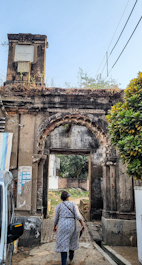
ALL THAT REMAINS OF A MAHARAJAH’S PALACE … IS ONLY A FEW ARCHES.

Not marked on Google maps, but mentioned in a guidebook to Murshidabad (in West Bengal), this remnant of a palace is extremely difficult to find. Our toh-toh (electric autorickshaw) driver asked many locals for directions. To my surprise, all knew about the small remains of a former palace, once a home of Maharaja Nanda Kumar (1705-1775), a tax collector for the British East India Company [see: https://en.m.wikipedia.org/wiki/Maharaja_Nandakumar ], who fell foul of the Company’s law. The guidebook did not mention this or the fact that he, a friend of Warren Hastings, was hanged by the Company for alleged fraud.

Mrs Warren Hastings and a diamond dealer in Bengal

AS EARLY AS THE SEVENTEENTH century, the French,  Dutch,  and English set up factories (trading stations) at Cossimbazar, which is beside the Hooghly River in the north part of West Bengal.  It existed before what is now Murshidabad became capital of Bengal. Today, what was once an important trading centre, where European merchants acquired goods to bring from India to Europe, is now no more than a rustic village.


Cossimbazar is home to a small cemetery, the Old English Cemetery, which contains the graves of  about 30 Brits who died between 1730 and  about 1800.  Within this small graveyard, which is maintained by the Archaeological Survey of India,  there is one above the burial place of Mary Hastings and her young daughter Elizabeth. The gravestone has been restored and is legible.


Mary, who died in 1759  (as did her daughter), was the first wife of Warren Hastings (1732-1818). He was a senior British East India Company administrator: the first governor of the Presidency of Fort William (Bengal), the head of the Supreme Council of Bengal, and so the first governor-general of Bengal in 1772–1785. He lived in Cossimbazar for a short time.


While reading about the Old English Cemetery,  I discovered that it contains the grave of a successful Jewish merchant from London: Lyon Prager  (died at Cossimbazar). Born in 1746, he died suddenly in May 1793. In brief, as an article (www.telegraphindia.com/culture/diamonds-and-dust-the-backstory-of-a-forgotten-grave-in-murshidabad/cid/1889965) revealed:

“Prager had come to Calcutta in 1786 on behalf of a London firm of Israel Levin Salomons, an Ashkenazi Jew. Diamonds were just one of the things Salomons traded in his India business; pearls and drugs were others.”

Stones cut in Benares by experts from Gujarat  were sent down the Ganges to merchants and traders at Cossimbazar and other places further down the Hooghly. Most probably when Lyon Prager took ill at Cossimbazar  he was there for undertaking business dealings.


Unlike Mary Hastings’s gravestone, the writing on Prager’s is now illegible. I have seen a photograph of his monument that is surmounted by an obelisk,  which was taken when the grave was still identifiable.  Without knowing that it was Prager’s grave, I  photographed it when we visited the cemetery in January 2025.


When I was researching my book about Jewish migration to South Africa, I learned that the Dutch East India Company did not permit Jewish people to travel to their trading stations in the Cape of Good Hope and elsewhere unless they had converted to Christianity. The presence in India of a Jewish trader, such as Lyon Prager   suggests that in the eighteenth century, Jews were not barred from joining trading expeditions by the British East India Company.

Bankers living on the banks of the Hooghly River in West Bengal

BANKERS ON THE BANKS OF THE HOOGHLY RIVER

JAINISM IS AN ANCIENT Indian religion still practised today. The Jains, members of this religion, believe, amongst many other things, in non-violence towards all members of the animal kingdom, from microbes to elephants. For this reason they are vegetarian and will not eat anything that grows beneath the surface of the soil for fear of killing creatures that might be attached to them. Thus, Jains will avoid eating, for example, onions, carrots, and potatoes.

Recently, I read that Jains do not go in for farming because by tilling the soil there is a risk that creatures living in it might be harmed. For reasons that include this, the Jains tend to be a business and banking community.

In the eighteenth century, some Jain families migrated from arid Rajasthan to fertile Bengal and settled around Murshidabad. It is said that these people helped persuade the rulers of Bengal to move their capital from Dhaka to what is now Murshidabad. Some of these Jains, known as the Sherherwalis, became bankers to the Nawab, and consequently became extremely wealthy.

One of these Sherherwali bankers, Rai Bahadur Budh Sing Dudhoria, constructed a huge mansion, now known as ‘Bari Kothi’, close to the river Hooghly in what is now the small city of Azimganj (near Murshidabad). The huge edifice, which was restored a few years ago, is built around seven courtyards. It is lavishly decorated in a style that would have been familiar to the family when it was enjoying its heyday. Today, it is used as a luxurious ‘heritage’ hotel, which is famed for its Jain food.

When the banker, who lived at Bari Kothi, told the Nawab that he wanted to move away from Murshidabad because he lacked the company of fellow Jains, the ruler allotted land on both sides of the river to the Jain community, and told the banker to invite other Jains to make their homes there. 97 families arrived.

The combined wealth of the 30 or so Sherherwali families who settled in the Azimganj area was so great that it exceeded that of the entire English aristocracy. This was sometime before 1757, when the Nawab Siraj-ud-Daulah was defeated by the British at the Battle of Palashi (Plassey). After that, Bengal’s capital shifted to Kolkata, as did most of the Sherherwalis.

Bari Kothi was badly damaged during the Naxalite disturbances in the 1970s. It was beautifully restored under the supervision of the architect Dr Samar Chandra. We visited the place today (15 January 2025) and were shown around the maze of corridors, rooms, and courtyards. Our guide showed us parts of the building that are still undergoing careful restoration. What has already been restored and is used by hotel guests is superbly done. For those seeking a glorious ‘heritage’ experience, a few days at Bari Kothi will not be disappointing. However, for those hoping for a fried egg at breakfast time, this is most certainly not available.

Baked earth and building Islamic places of worship

THE COUNTRYSIDE AROUND Murshidabad is dotted with brick factories. Their tall, often smoking, chimneys are surrounded by vast expanses of new bricks, usually stacked neatly. The clay that can be found in the area is particularly good for brick making.  So, it is unsurprising that many local buildings make substantial use of brickwork.


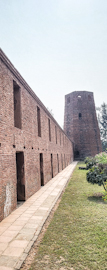
One of the towers of the Katra mosque

Near Murshidabad,  there are two famous mosques constructed not with stone or concrete, but with bricks. One of these, the Katra mosque, was constructed entirely with bricks between 1723 and 1724. This huge edifice was built not only as a mosque but also as a caravanserai. It is one of the largest caravanserais in the Indian Subcontinent.  The rooms of the caravanserai are arranged in a square that surrounds the mosque rather like cloisters in a monastery. These small rooms also served as workplaces and bedrooms for students studying the Koran and other Islamic texts. Thus, the Katra was a complex consisting of a mosque, a caravanserai, and a madrasa. At each of its four corners,  there were tall brick towers. Only two of these remain.   The tomb of Nawab Murshid Quli Khan(1660-1727) is located under the staircase leading to the main entrance of the building. Protected by the Archaeological Survey of India, the remains of the Katra complex are well conserved. This is not the case for another brick mosque nearby: the Fauti Masjid.


The Fauti was constructed in 1740 by Nawab Safaraz Khan (c1700 – 1740). However,  it was never completed. It is a large mosque, 137 feet long and 38 feet wide. If you manage to chamber within it, which I did with great difficulty despite helping hands, the remains of its five huge incomplete domes can be seen.


The Fauti is a protected building, but in a bad condition. It is possibly perilously unstable. However, because of the vegetation around it and within it, it is a picturesque ruin of the sort that eighteenth and nineteenth century European Romantic artists enjoyed portraying.


In addition to these mosques, which were built using baked clay (I.e., bricks), we have also seen some Hindu temples near Murshidabad that include terracotta in their construction.  But more about these at a later date.

A white horse, which only works for a few days each year, grazes in Bengal

This white horse, grazing outside the Nizamat Imambara, which faces the Hazarduari Palace in Murshidabad, is only required to work during the few days of the Shia Muslim festival of Muharram.

The Imambara is a Shia congregation hall, which was constructed in 1847. Only open during Muharram, it contains a shrine that houses soil brought from Mecca.

Defeated by the British who were helped by a traitor

THE MOTIJHEEL PARK in Murshidabad is a popular amusement park with a boating lake, a roller coaster, a restaurant, a miniature railway that carries passengers, and, surprisingly, a small museum.

Siraj-ud-Daulah

The museum is dedicated to Siraj-ud-Daulah (1733-1757), who was the last independent Nawab of Bengal before the territory was conquered by the British East India Company’s army. There is also a statue of Siraj-ud-Daulah in the park.

His forces were defeated at the Battle of Palashi (Plassey) in 1757 by armies led by Robert Clive. Siraj-ud-Daulah lost the battle not least because Clive bribed Mir Jafar, who was Siraj-ud-Daulah’s Commander-in-Chief, to defect to the British. The defeat at Palashi was an important factor in allowing the British to conquer Bengal.

The dimly lit museum at Motijheel Park contains a series of information panels that give the viewer a simplified history of Siraj-ud-Daulah and the Battle of Palashi. Apart from these, there are a few other exhibits of no great significance.

An artist who depicts nature only naturally

AJIT KUMAR DAS was born in 1957, son of a laundry man (washer man). From an early age, he became fascinated with the wonderful  colours of the textiles that his father washed. He became involved with traditional fabric printing and design. Today, Das is recognised as one of India’s foremost natural dye painters.


Das paints on cloth using natural dyes, rather than artificially created colours. He uses dyes derived ed from sources such as, for example,  pomegranate rind, turmeric, fermented iron solution, indigo, and madder. He applies them using bamboo brushes and handmade quills. The colours are fixed using alum as mordant. With decades of experience and experimentation,  he is able to use the natural dyes to produce interesting colourful effects.


At his exhibition held in a  magnificent gallery in the Kolkata Centre for Creativity, we were able to view more than 20 of his paintings. All of them feature closely observed natural objects, such as foliage, birds, and fish, all arranged in patterns on the textiles. Some of these compositions are naturalistic. In others, Das has arranged the details from nature to produce lovely patterns.


We were fortunate to have been at the inauguration of the exhibition, during which the soft-spoken Das discussed his works with a panel of invited guests. From what I could gather, the panellists were more interested in the current state of natural dye crafts than the artist’s works on display. I am pleased that we made the journey from central Kolkata to the outlying district of Anandapur to see the exhibition and to learn a little about the use of natural dyes in traditional methods of textile making.

A truly exciting and creative experience in a suburb of Kolkata

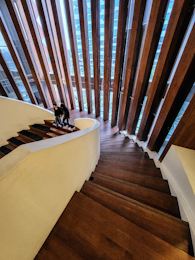
THE KOLKATA CENTRE for Creativity (‘KCC’) was established by the businessman Radhe Shyam Agarwal,  executive chairman of the Emami Group. He commissioned architect Pinakin Patel to build the arts centre that stands in Kolkata’s Anandapur district. Inaugurated in late 2018, it has 70,000 square feet of floor space for art, artists, and art lovers. This includes an auditorium, gallery spaces, an elegant café, shops, a dance studio, and a library.

 The building is a superb example of contemporary architectural design, both externally and internally. Inside, it is spacious and well-lit. The building, which serves its various purposes well, is in itself a work of art: a functional sculpture, one might say. We attended the inauguration of an exhibition, which was held in the auditorium,  which forms part of the gallery space. I will describe the exhibition in another piece, but suffice it to say,  the KCC, although distant from central Kolkata,  is worth visiting.

An artist who works and lives in Kolkata

WHEN VIEWING ARTWORK or listening to music, my reaction  to, and enjoyment of it is governed by my initial visceral feelings that it evokes. If these feelings are satisfactory, my interest and enjoyment of the art increases, and I might begin to delve more deeply into understanding what the creator is trying to convey with his or her work.


My initial reaction to the oil paintings and ink drawings by Kolkata based artist Debajyoti Roy were very positive. Each of his works on display appealed to me. Many of the images are in black ink on white paper. A couple of larger paintings were more colourful, created with oil colours and inks.


 Some of the works in ink reminded me a little of Chinese or Japanese calligraphy. The works are both abstract and at the same time somewhat figurative. Yet, as I studied them, they gave me the feeling that they are abstractions of reality, often of biological phenomena.  As Roy explained in the exhibition catalogue:

“When someone engages with a piece of art, it is inevitable to interpret its visual aspects. Still, the essence lies in deeper inquiries that provoke interpretation of the perception and reality.”

I felt that this was certainly the case with what I saw of his creations.


Debajyoti Roy has created a set of images that are intriguing both visually and intellectually. It is a shame that his exhibition at the Jogen Choudhury Centre for Arts in south Kolkata is ending soon (on 11 January 2025). If you happen to be in Kolkata before it ends, it is well worth viewing.