Death on the tracks

This is a true story told to me by the man who took the upper berth on a train in India’s Uttar Pradesh state.

Our friend, who related this story, was boarding a sleeper car. He had reserved the lower berth in a compartment, but when he reached it, he found it occupied by a man who had not made a reservation. The man aggressively refused to budge from our friend’s berth. Our friend called the conductor. After a considerable and unpleasant argument, the miscreant relinquished the berth, which our friend then occupied.

Shortly after this, an old man, who had been given a reservation in the upper berth, entered the compartment. He was unable to climb into the upper berth. Out of kindness, our friend took the old man’s upper berth and gave him the lower one.

Next morning, our friend woke up. He climbed down from his upper bunk and was horrified to discover that the old man had been stabbed to death during the night. No doubt, the man who had been evicted by the conductor had exacted his revenge.

Two names, one country

The Albanians now refer to their country as “Shqipëria”. Almost everyone else calls the same country “Albania” or some variant of this.

Here is an interesting article that discusses this difference: http://www.tiranatimes.com/?p=133209

Incidentally, the national symbol of Albania is a two headed eagle. This is appropriate for a country known by two names!

Giving and receiving

I love receiving gifts. I love giving gifts especially if the recipient expresses joy, rather than gratitude.

This photograph taken in the Khanderao Market in Vadodara (India) expresses the joy of giving, which, as in the case of this flower merchant, can be greater than the joy of receiving.

Mashed potatoes

Some restaurants in India serve both veg (vegetarian) and non-veg (meat, fish, eggs) food. Recently, my wife and I were sitting near to a young lady in a very good Italian restaurant in Vadodara in Gujarat.

Our young neighbour is a vegetarian. She ordered a veg pasta and asked the waiter if she could have a portion of mashed potatoes. I know that pasta and mashed potatoes are an unusual combination, but that is what she wanted.

The waiter told her that she could not order mashed potatoes with a veg pasta. Puréed potatoes, which are pure veg, could only be served with a non-veg dish.

We overheard the waiter telling this to our neighbour. My wife, who always tries to be helpful, interrupted the waiter and told him to bring a small dish of mashed potatoes with the pasta. Eventually, and somewhat reluctantly, the waiter did as asked. Our neighbour was so happy to receive the mash with her pasta that she got up and gave my wife an affectionate hug.

I am not a vegetarian.

Although I have met numerous pure vegetarians during the 25 years I have been visiting India, I still find it hard to believe that there are so many people, who have never tasted meat, eggs, or fish.

Tastes change

Once, long before ‘political correctness’ became fashionable, when my wife was an undergraduate student, she asked two Nigerian students whether they preferred their tea “black or white “. They looked at her indignantly before answering aggresively: “with milk“.

When I was a child, I drank tea without milk. That was the way my parents preferred it. That is what I became accustomed to. If I sipped even a little tea with milk, I felt nauseous. Tea with milk, as served in England, is made by adding brewed tea to milk or vice versa depending on your preference.

My prejudice against tea with milk persisted until I began visiting India in 1994. At first, I was suspicious of the “white” tea on offer, but soon began to enjoy it. I think that this is because it is made differently from that which is served in the UK.

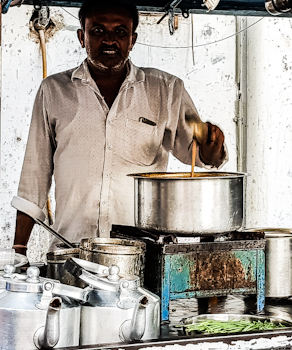
In India, tea leaves are boiled vigorously with milk. Often additives such as sugar, crushed ginger, cardamom, mint, and lemon grass are added to the hot bubbling mixture. After a while, the boiled milky tea is passed through a strainer, often cloth, and served in cups. The resulting drink is a harmonious blend of the flavour of tea and the additives. In my opinion, it tastes quite different from, and much better than what is served in England.

I have visited India many, many times since 1994. Apart from developing a great fondness for the country and its people, my tastes in food have changed for the better as a result of my exposure to life in India.

Slurp, don’t suck

Currently, many people want to “save the planet”. This is a worthy desire.

One way to help save our planet is to ditch plastics, which are not biodegradable, and replace them with paper that can be degraded biologically. Thus, plastic bags are giving way to paper and cloth bags. Supermarkets in the UK are now charging customers, who have not brought along their own reusable bags, a fee to buy a new plastic bag in which to carry home the goods which the supermarket companies have packed in non-biodegradable plastic!

Now, enter your café and order a drink with a straw. Trendy cafés, which are trying to be eco-friendly, supply biodegradable drinking straws Instead of the old fashioned plastic ones. This offers no problems if you suck your drink rapidly. If you prefer to linger over your drink, the paper straw absorbs fluid and becomes soggy. You might well need to use more than one paper straw to finish your drink. This will result in creating more rubbish than using a single plastic straw.

One solution to the straw problem, which I favour, is not to use one, but to put your lips to the glass or bottle that contains your drink: slurp, don’t suck!

Finally, to escape from the humble drinking straw, let us raise our heads to the solar panels with which we adorn our roofs in order to reduce our consumption of the rapidly reducing sources of natural fuels. A learned friend once told me that in order to manufacture these panels, more fossil fuel energy is expended than will ever be saved by the panels!

Save the planet by all means, but make sure that these means will actually save the planet, rather than simply salve our consciences.

GOING NUTS

I was at school throughout most of the 1950s and ’60s. I came into contact with numerous other children. As far as I can recall, not one of my fellow pupils ever admitted having a food allergy. A few had asthma or wore spectacles, but none seemed to suffer from allergies.

When our daughter attended schools at the beginning of this, the 21st century, many of the children with whom she studied had food allergies, notably nut allergies. Some of them even carried adrenaline filled epipens with them to be used should they come into contact with allergens. Our daughter was, luckily, not allergic to anything, but felt left out because she did not have an allergy. It seemed to her that having an allergy or wearing orthodontic appliances were almost ‘fashion statements’

Why are food allergies so common now? Is it a result of obsession with today’s hygiene and fear of germs. We live in the era of the hand sanitizer and obsession with ‘use by’ dates. Today’s children are shielded from allergens from a very tender age and this impedes the development of an effective immune system.

Research done in the USA some years ago compared the incidence of allergies in kids brought up on farms, where dirt and animals are hard to avoid, with that in children brought up ‘hygienically’ in cities. It was found that the city kids had a far higher incidence of allergies than their country cousins.

Our daughter first visited India when she was 7 months old. It was impossible to stop her putting just about anything she found on the ground into her mouth. I like to think that this might be why she differed from many of her peers in that she missed out on having allergies.

So, if you have young children, do not go nuts about shielding them from external factors that might prevent them needing to carry an epipen in the future.

Now, I will play the part of the Devil’s advocate. It is remotely possible that the apparent absence of children with allergies during my school days was because any kids with allergies had died of anaphylactic shock before they were old enough to attend school. I hope not!

NATION OF SHOP KEEPERS

It is popularly believed that Napoleon Bonaparte described the British as a nation of shopkeepers but in reality he might not have said so. More likely, the early economist Adam Smith, author of The Wealth of Nations, might have coined this phrase. He wrote: “… the sole purpose of raising up a people of customers may at first sight appear a project fit only for a nation of shopkeepers…”

Well, Great Britain still contains many shop keepers, but most of them are hopeless. Few shop keepers or their assistants, who are employed to make sales, put much effort into encouraging customers to buy. In general, they are an unhelpful bunch. Often when one asks for something, one is told by a typical British shop keeper: “If we’ve got it, it will be out on the shelves”, and then the customer is left to hunt for it somewhere in the shop.

Occasionally, you can find a helpful salesperson. Once, I was in London’s Oxford Street looking for a winter coat with certain features. I described in detail what I was seeking to a salesman. He replied cheerfully: “I know exactly what you need, Sir. I know just the job. You need a Danimac.” He paused before continuing: ” there’s only one problem: Danimacs are not made anymore.” And, that was it.

Had I been looking for that coat in India, the salesman would not have stopped at that point. Instead, he would have shown me a range of other types of coat in the hope that I might see the benefits of modifying my requirements and buying something else.

Unlike their British counterparts, Indian shop keepers and their sales people take a professional pride in both satisfying the customer and making sales.

Take clothes shopping for example. You enter a shop without much idea which shirt or skirt you want and are bewildered by the variety on display. You will be welcomed by a sales person, who will begin by showing you a garment that may not be to your taste. Then, you will be shown a series of other items. The salesperson will gradually show you merchandise that really appeals to you because he or she has been watching your reactions to what is being shown to you, and from these, your taste in clothes can be accurately ascertained. When you have selected whatever you were looking for as well as much that you never knew you wanted, alterations that might be needed to ensure a good fit will be carried rapidly out at no extra charge.

Some Indian shopkeepers are brilliant salesmen, especially the Kashmiris who run handicraft shops. You might enter one of these shops without any intention of making a purchase, but so expert are the sales people that I doubt that you will leave empty handed!

I could go on and on about the excellence of sales people in India, but I will not. However, before signing off, let me tell you about a simple vegetable seller in Bandra (Maharashtra). Formerly, he used to lay out a cloth blanket by the roadside. At about 1 pm, a truck would stop next to his cloth and various vegetables would be delivered. From day to day, the vendor had no idea which vegetables would arrive, but whatever arrived was, and still is, of a very high quality. His customers, mostly regulars, would turn up and buy what they needed.

After some years, the veg seller acquired a mobile phone. He collected the phone numbers of his customers. Now, every day the veg seller takes pictures of whatever he has received for sale, and then sends the pictures, the prices of his goods, and a description of them, to his customers via WhatsApp. His customers reply with their orders, which they come and collect from him. Thus, from humble beginnings a street vendor has brought his age old business into the 21st century.

Had Napoleon Bonaparte reached India, he would have had good reason to say, as I do, that Indians are truly a nation of first class shopkeepers.