Sad to leave, glad to return

AT THE END of a four day stay in Venice, a city, which I have loved ever since my early childhood days, I felt sad at the prospect of departure for home. Wandering about the city brought back happy memories of visits there with my parents as well as giving me the chance to experience familiar sights and to make new discoveries. Although Venice is a little overrun with tourists, its history as a gateway to points further east remains fascinating and evocative. So, the anticipation of leaving filled me with sadness.

We left Venice on a waterbus, which arrived punctually and was not overcrowded. After a lovely 70 minute voyage, which included stops at the Lido, the Fondamente Nove, and a couple of stops on the island of Murano (famous for its glass production), we arrived at Marco Polo Airport. And that is where our journey became wearying.
First, we had to queue to reach the baggage depositing facility for our airline Easyjet. Next, we discovered that our departure would be delayed by about 30 minutes. Then, we sat in a crowded waiting area without knowing from which gate we would be boarding our ‘plane. It was important to know this because there are two sets of passport control points, each leading to a separate set of gates. Once the gate was announced, another queue. This time, we had to wait (not too long) to have stamps placed in our non-EU passports. On arrival at the departure gate, we were told that boarding was beginning. What this meant was that everybody had to stand up, to show our boarding passes, and then to stand in a long sloping corridor for at least 10 minutes before we were invited on-board. The 1 hour 55 minute flight to London’s Gatwick Airport was pleasant, although delayed.

At Gatwick, we disembarked at a point distant from the immigration hall. The latter was reached after a good 15 minute walk. The passport control area was chock-full of people, some of them inebriated. Unlike in the EU, where EU and non-EU passport holders are separated, at Gatwick (and Heathrow), both kinds of passport holders and those from several other countries (e.g., Australia, NZ, and Japan) queue together to use the automated passport checking machines. The process, which might save spending on labour costs, is not user-friendly. Many passengers had difficulty using the machines and had to be helped by other passengers and a few members of airport staff. Fortunately, because it had taken so long to get through the immigration control, our suitcase had arrived in the baggage collection hall.

After one more short, but fast-moving queue, we reclaimed our car keys, and soon began the 1 hour drive home. Although I was so sad leaving Venice, after the many hours spent at airports and the numerous lines in which we waited, I was glad to be home. Years ago, when I was a child, leaving wherever we had spent our holiday was always sad, but even worse was returning to everyday routines of school and life in the staid Hampstead Garden Suburb, where we lived.

The place where the artist Tiepolo was born in Venice

GIOVANNI BATTISTA TIEPOLO (1696-1770) is one of my favourite artists. I have been familiar with his works ever since my childhood, when we visited Venice annually from the late 1950s or early 1960s onwards. My parents took me from church to church to see the great master’s paintings, which I prefer to the somewhat more photograph-like paintings of Canaletto.

We used to stay in a pensione on the Fondamente Zattere, a waterfront facing across a wide canal to the Giudecca island. The Gesuati church was a few yards from where we resided in Venice. It contains ceiling panels and a wall painting, all created by Tiepolo. Often, we passed the church and almost always entered it to gaze up at Tiepolo’s ceiling. I cannot remember it, but my sibling recalls that almost every morning, early, my father used to stand quietly and alone in the church for a few minutes.

I became so keen on Tiepolo that I broke my train journey between Ostend and Vienna to spend a night in Würzburg in order to see Tiepolo’s paintings in the city’s Residenz (a palace).

This September (2022), I was walking along a narrow passageway (Calle S Domenico) when I spotted a commemorative plaque above an archway leading into a long narrow courtyard surrounded by tall residential buildings. The plaque recorded that in the courtyard there was the house in which Tiepolo was born on March 1696. Exactly in part the courtyard, the Corte S Domenico, the artist was born, I could not determine. However, I had never seen this place before and was thrilled to have stumbled across the place where one of my favourite artists was born.

Parasol in the palace: art and architecture

WHEN I SET off for Venice a couple of days ago, I doubted whether I would enjoy the Biennale as much as my wife and our daughter. How wrong I was. I have been enjoying exploring the artworks housed in a number of different places around the city. Some of the shows are in pavilions specially designed for Biennale exhibitions. Others are in places adapted, mostly temporarily, for use during the art festival. For example, the Nepalese and Armenian shows are in what look like disused shop premises. Others are in far grander edifices.

Today, we visited an exhibition housed in the courtyards and rooms of a huge palace, which is home to a music conservatoire (located close to Campo S Stefano). The exhibits (sculptures, paintings, and videos) were created by members of a group of artists within the fold of the Parasol Unit art foundation. The artists in the show are: Darren Almond, Oliver Beer, Rana Begum with Hyetal, Julian Charrière, David Claerbout, Bharti Kher, Arghavan Khosravi, Teresa Margolles, Si On, Martin Puryear, and Rayyane Tabet.

The show in the conservatoire is wonderful. The building itself is a fantastic architectural sculpture with a myriad of neo-classical decorative sculptural details. The works of art, which are in total contrast to the architecture, harmonise interestingly with the environments in which they have been placed. Photographs cannot do justice to this exhibition; it has to be experienced in person.

Although this show will be amongst my favourite exhibitions in the 2022 Venice Biennale, it is not alone in being magnificent. I am glad that we have come to Venice for this artistic bonanza.

Two empty pavilions at the Venice Biennale

THE BIENNALE IN Venice was first held in 1895. The original international bi-annual art exhibition was contained in public gardens at the Eastern end of the city of Venice in the Castello district.

Initially, there was a Central Pavilion, opened in 1894. Later, various participating countries built national pavilions, the first being Belgium in 1907. The latest is the Australian pavilion, built only a few years ago.

The national pavilions reflect both the politics and architectural styles prevailing at the time they were built. Therefore, they are at least as interesting as the artworks that take up temporary residence within them at each exhibition.

I will discuss two of the pavilions in this short essay, and hope to write about some of the others at a later date.

The Russian pavilion bears the date 1914 and several double-headed eagles. It was constructed before the 1917 Revolution, and has some traditional Russian architectural features.

Next to the Belgian pavilion, stands the Spanish one. First constructed in 1933, its facade was replaced by a modern brick one in 1952.

Both the Spanish and the Russian pavilions appear to be empty, but for quite different reasons. For the 2022 Biennale, the artist Ignasi Aballi (born 1958 in Barcelona) has left the pavilion empty but shifted its internal walls in an attempt to correct a discrepancy between its original architectural plan and what ended up being constructed. The result is an empty pavilion with a strange internal layout. It was at first disconcerting to discover a pavilion empty of artworks, but soon it became pleasurable to see the strange vistas and connections between neighbouring rooms.

The Russian pavilion, unlike the Spanish, is closed. But it is also devoid of exhibits. Russia was not invited to the Biennale this year. The reason for this was Mr Putin’s unwise decision to invade his neibour, Ukraine.

Music in the piazza

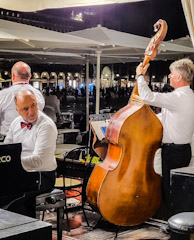
MUSIC IS A PART of what I associate with St Marks Square in Venice (Italy). Whether it be the occasional outdoor orchestral concerts that used to be held in on summer evenings in the 1960s, when we made annual family visits to the watery city, or the small bands that play on stages next to some of the square’s costly cafés. One of these ‘cafs’ is Florian’s, where a 6 Euro charge is added to your bill for the music.

Florian with its beautiful neo-baroque rooms that are entered beneath the arcade surrounding the Square was founded in 1720 as ‘Alla Venezia Trionfante’ but soon became known by its present name.

We looked at the menu at Florian, but although it is an extremely romantic place, there is a substantial price to pay to be an active part of it!

To Venice by crossing the water

THE LAST TIME I flew into Venice’s Marco Polo airport was in the late 1960s with my parents. In those days, the airport was tiny in comparison with what it is now. Back then, there were two ways of reaching the city of Venice from Marco Polo: by bus to Piazzale Roma, or far more expensively, in a private water taxi, in effect a speed boat. Despite my mother’s tendency to become seasick easily, we always took the speedy water taxi from the airport to our pensione on the Fondamente Zattere. In those now distant times, the airport arrival hall was much closer to the shore of the lagoon than it is today.

Water bus

Times have changed. The airport has grown and is far from the waterfront. Although there are still plenty of speedy water taxis carrying passengers, there is now a regular, moderately priced water bus service, which links Marco Polo to many points in Venice. We used this service.

As we crossed the lagoon, many water taxis sped past us. We passed Murano and the cemetery island of St Michele. Then, as we approached the Fondamente Nuova on Venice proper, I spotted the curious domed Bell Tower of the church of Madonna dell’Orto. I looked at it and felt a lump in my throat as I remembered the numerous times I visited that church with my parents to see the frescos within it. It was one of my favourite Venetian excursions, being taken to see that edifice.

After getting off at the wrong stop (mea culpa) and boarding another vessel, we reached our destination near the Gardens where much of the Venice Biennale happens. There is no doubt that arriving in Venice by traversing the water in a boat is far more dramatic and pleasant than arriving across the bridge by train or bus.

A rustic ‘utopia’ in London’s suburbia

MY CHILDHOOD HOME was in the heart of north London’s Hampstead Garden Suburb (‘HGS’). For those of you who are unfamiliar with garden suburbs, here is a definition (from Collins online dictionary) that might begin to help:

“…a suburb of a large established town or city, planned along the lines of a garden city”

And a garden city is (from Collins) is:

“…a planned town of limited size with broad streets and spacious layout, containing trees and open spaces and surrounded by a rural belt”

In Brentham garden suburv

The garden suburb differs from the garden city in two main ways. (1) The former is part of a city, whereas the latter is separated from other cities by countryside (e.g., Welwyn Garden City). (2) The garden city is exclusively or mainly residential, but the garden city can include all that other cities contain.

The first houses in HGS, which was founded by Dame Henrietta Barnett, were completed in 1907. Our house in HGS bore the date 1908.

Brentham Garden Suburb (‘BGS’) was founded earlier than HGS: in 1901. One of its founders was Ebenezer Howard, the who founded The Garden City Movement in 1899. BGS is located close to the River Brent, where it flows through the Borough of Ealing. Its architecture was influenced by the Arts and Crafts Movement, which was inspired by the philosophy of the social reformer and designer William Morris.

On a recent visit to BGS, the first for me, I was impressed by the similarity of many of its houses to those which I had grown up amongst in the HGS. The similarities are not surprising when you learn that from 1907 onwards for a few years, BGS’s planning was under the supervision of Raymond Unwin, the architect who planned the layout of HGS. Most of the buildings built after 1907 in BGS were designed by Frederic Cavendish Pearson and George Lister Sutcliffe, who were both in sympathy with Unwin’s ideas.

Most of the houses in BGS were built before the 1920s. This was not the case in the larger HGS, where building on a substantial scale continued into the 1930s. So, whereas Art Deco buildings and some other modern designs can be spotted in the HGS, this is not the case in the more architecturally homogenous BGS. A visit to BGS is worthwhile, especially if you are familiar with other garden suburbs and garden cities.

From Piccadilly to New Delhi

APPLE TREE YARD is a cul-de-sac near London’s Piccadilly. It runs east from Duke of York Street and parallel to Jermyn Street. On its south corner where the Yard meets Duke of York Street, there is an interesting monument consisting of three slightly separated carved basalt slabs with letters inscribed in them. The letters make up the following words, all in capital letters:

“SIR EDWIN LUTYENS ARCHITECT

DESIGNER OF NEW DELHI

LAID OUT HIS PLANS HERE IN APPLE TREE YARD”

Although I have never been to Delhi, I am familiar with the work of Edwin Lutyens (1869-1944). I was brought up in north London’s Hampstead Garden Suburb not far from its Central Square, which is surrounded by buildings that Lutyens designed before embarking on his projects in New Delhi. Although the above-mentioned basalt blocks were completed in 2015, I had not been past Apple Tree Yard  until yesterday (13th September 2022). Next to the inscribed blocks there is an attractive figurative bas-relief carving, also in basalt, mounted on a wall.

The carvings were made by Stephen Cox and he describes them in detail on a web page (www.lutyenstrust.org.uk/portfolio-item/apple-tree-yard-sculpture-honours-spirit-lutyens/). Here is a brief summary of what he wrote. The bas-relief sculpture is called “Relief; Figure emerging”. It was inspired by sculptures in Hindu cave temples, especially those around a town near Chennai (Madras): Mahabalipuram. The basalt that can be seen in Apple Tree Yard was quarried near the south Indian temple town of Kanchipuram. Cox, who has a studio in Mahabalipuram, was assisted by local carvers, when he created the bas-relief.  In summary, the monumental slabs and the nearby sculpture have their roots in India, which is highly appropriate as they commemorate an architect, who worked in India.

I must admit that amongst all the foreign architects, who have made significant buildings in India, Lutyens is not my favourite. Those, whose works I have seen in India and liked, include William Emerson (1843-1924), Frederick W Stevens (1847-1900), Le Corbusier (1887-1965), and Louis Kahn (1901-1974).

Lutyens, who was a former Viceroy of India’s son-in-law, drew up the plans for New Delhi in an office at number 7 Apple Tree Yard. Hence, the location of the monumental stones. Number 7 was for a long time the home of the Royal Fine Art Commission, but it exists no longer. It is now covered by a new building. However, his work in both India and the Hampstead Garden Suburb can still be admired by those who like Lutyens’s work. I feel that Cox’s memorial to him is much more elegant than much that I have seen of his buildings.

Art appealing to eye and brain: two exhibitions near Piccadilly

THADDEUS ROPAC GALLERY, in a most elegant building on central London’s Dover Street is four minutes’ walk from Waddington Custot Gallery on Cork Street. We visited both today (the 13th of September 2022). At Thaddeus Ropac, we saw an exhibition, “City of Silence” by Wolfgang Laib (born in Germany in 1950), and at Waddington Custot, we saw “In the Studio”, a collection of works by March Avery (born 1932 in New York City).

Works in beeswax by Wolfgang Laib

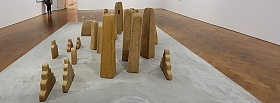
Laib’s works, the best of which is a collection of objects made in beeswax that resemble towers and ziggurats, were not particularly visually appealing at first sight. Neither were his numerous minimalistic works on paper or even a set of identical model boats made in brass. It was only after reading some of the explanatory material provided by the gallery that these artworks began to become interesting. They did not become more appealing to the eye, but they began to make some kind of sense to me. For example, the beeswax towers and other objects alongside them are supposed to evoke thoughts of dwellings in the Middle East and the Towers of Silence where Zoroastrians leave corpses to be devoured by vultures. To some extent, these objects achieve the artist’s mental vision of the structures, which inspired them. However, without the explanations, Laib’s exhibition would have ‘left me cold’.

Immediately on entering Waddington Custot, Avery’s colourful, mostly figurative paintings appealed to my eyes and provided feelings of visceral satisfaction. Although it is highly likely that the paintings are manifestations of the artist’s thoughts and ideas, the viewer can get enjoyment from the artworks without knowing anything about what was going through Avery’s mind while she was creating them.   

We left Avery’s exhibition both visually and intellectually satisfied. In contrast, we felt that Laib’s works on their own without explanation were far less fulfilling than Avery’s.