An artist and a gallery in a British seaside resort

THE GREAT BRITISH artist Joseph Mallord William Turner (1775 – 1851) was accurately described by the writer John Ruskin as “… the father of Modern art …” in 1843. Turner first visited Margate when he was aged 11. After about 1820, he often stayed in the town because he thought the skies over the area were the most beautiful he had seen in Europe. Between 1827 and 1847, he stayed in the town in a guesthouse owned by Mr and Mrs Booth. When Mr Booth died in 1833, Turner became a close companion of the widowed Sophia Booth, who died in 1878. He also adopted the name ‘Booth’.

The house owned by Sophia Booth, where Turner resided, is no more. Where the guesthouse once stood is now occupied by the Turner Contemporary Gallery (‘TCG’). The gallery was designed by David Chipperfield (born 1953), and opened in April 2011. Just as Turner’s paintings were considered avant-garde and even provocative when they first appeared, the TCG is a highly adventurous contrast to the rest of the old town that neighbours it. Some buildings look better inside than outside. The TCG is a good example of this. The gallery spaces are spacious and well-lit both by natural and artificial light. They were a perfect place to view the highly colourful creations of the Brazilian born artist Beatriz Milhazes (born 1960), which are on show at the TCG until the 10th of September 2023.

I believe that the presence of the TCG has elevated Margate’s status from being a simple, unexceptional seaside resort to a place that attracts a much wider range of visitors than it did in the past. As happened in London’s Islington in the 1960s, a rather mundane place has become somewhere that people now feel they ‘must visit’. Although the usual British seaside attractions can still be found in Margate, the town is now also catering for the ‘up market’ clientele. And that cannot be a bad thing because when I lived in Kent (1982-1992), apart from Whitstable (and maybe Broadstairs), most of the seaside places in north and east Kent were in decline and rather melancholy.

The opening of the TCG has done for Margate what the art Triennale has done for another previously dreary Kent town – Folkestone. Even if Turner might have been shocked to see what now stands where he spent many happy hours with Sophia Booth, I feel sure that he would have been happy to know that it has revitalised a town which he loved.

Remembering victims of war in Sandwich, Kent

Some of the WW1 names and the Falklands victim below

IN THE HEART of Sandwich in Kent, near to the deconsecrated Church of St Peter, there is a war memorial that was erected to commemorate those from the town who died in the ‘War to End All Wars’ – the First World War (1914 – 1918). Roughly 100 names are recorded on the lists of people who died during WW1. However, they are not the only people listed on this monument because ‘The War to End All Wars’ did not live up to its name.’

The memorial lists about 15 people who were killed in WW2 (1939-1945). In addition, three of Sandwich’s population perished in the Korean War (1951), and more recently, one of the townsfolk was killed in the Falklands Conflict (1982).

I sincerely hope that no more names need to be added to this war memorial as a result of the conflict in Ukraine, or any future wars.

Safe and sound under the ground

DURING WW1, THERE were German Air raids over the town of Ramsgate in Kent. Many were killed by relatively few bombs.

In the late 1930s, the forward thinking Mayor of Ramsgate and his Chief Engineer designed a series of tunnels deep below the town to be used as air raid shelters. Over three miles of tunnels were dug into the chalk far below the town. The digging was carried out by miners from the (now closed) coal mines of East Kent.

Bunks in the tunnel shelter

Except for a short section about 25 feet below the ground, which was reinforced with thick concrete, the rest of the tunnel system, which was on average 75 feet below the surface, was self supporting. The tunnels could accommodate up to 60000 people, but because many of Ramsgate’s population were either evacuated or serving inthe armed forces, the town’s population was about 15000 during WW2.

The tunnels were fitted out with electric lighting; bunk beds; benches; first aid stations; and chemical toilets. People were allowed to spend the night there or when air raids were in progress. Given that Ramsgate was the last place that German bombers flew over when returning to mainland Europe, they tended to drop any remaining bombs on the town. In addition, the Germans had heavy long-range guns at Cap Gris Nez just across the English Channel from Ramsgate, and shells capable of destroying buildings fired from these could arrive in the town without prior warning.

In short, the tunnel system saved innumerable lives. Today, excellent guided tours allow visitors to explore it. Today, the 24th of July 2023, we joined one of these tours. Everything was beautifully and interestingly explained. Although not as well furnished and comfortable as the huge nuclear bunker built at Gjirokaster in Albania in the 1960s, what was constructed in quite a hurry at Ramsgate is remarkable.

Having just seen the not too brilliant film “Oppenheimer”, I could not help wondering how many people might have been saved had Hiroshima and Nagasaki been supplied with deep shelters like that at Ramsgate.

Loads of lavender in rural Kent

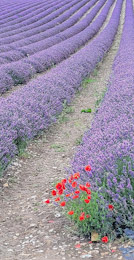
ON OUR WAY to visiting new friends in Kent, at their recommendation, we stopped en-routr at Castle Farm near Shoreham. We were delighted to discover that this agricultural enterprise specialises in cattle and growing lavender. It is the largest lavender farm in the UK.

I had no idea until we visited the farm that lavender was grown on such a large scale in England. I have visited lavender farms in Provence and seen many glorious photographs of lavender fields in that and other regions of France. However, it came as a complete surprise to discover similar fields in South East England. I am grateful to Asha and Matthew for introducing us to this place.

A Northerner’s photographic images of the American south

THE PHOTOGRAPHER BALDWIN Lee, a Chinese American, was born in Brooklyn (New York) in 1951. He studied photography at MIT and then at Yale. In 1982, he was appointed Professor of Photography at the University of Tennessee, where he established the university’s photography course. As a New Yorker born and bred, he was amazed at the contrast between living conditions in the southern states and where he had come from. He began making tours of the south, photographing members of various African Americans at home, at work, and at play. Over the years he took more than 10000 photos. All of them are in the black and white format. Apart from being fascinating glimpses of the everyday lives of low income ‘black’ Southerners, they are beautifully composed, superbly detailed images – well worth seeing, as we did recently at the David Hill Gallery in London’s Ladbroke Grove.

At his gallery, David Hill discussed Lee’s work with us. What particularly interested me was that Lee used (still uses) an old-fashioned field camera with a lens made before WW1. He chose this old lens because unlike modern lenses its glass has no coating. Also, and this is something I learned long ago, many of these older lenses were hand ground, rather than machine made. This resulted in the lens having a far better resolution than many of the best quality lenses that were available in the 1980s. The type of camera that Lee used to make his splendid photographs was not dissimilar to the kind of camera that early photographers such as Julia Margaret Cameron (1815-1879) used to create images. The lens on the simple camera that Lee used projects an image onto a ground glass screen at the back of the camera. In Victorian times, a prepared glass photographic plate used to be attached to the rear of the camera to capture the image. Lee, working more that 100 years later, captured his images on sheets of 5×4 inch high quality, fast negative monochrome film. Using these, Lee was able to create high resolution photographic images, and his subjects did not have to hold their poses for nearly as long as was the case when Cameron was creating her photographs. Because Lee’s subjects did not have to maintain their poses for more than a few seconds, his images are far clearer than Cameron’s whose subjects often had to try to remain still for many minutes. This meant that in addition to the deliberate artistic manipulations that Cameron made in her dark room, the inevitable slight movements that her subjects made added to the interestingly other-worldly images she created.

The advantage of using an old-fashioned camera and lens, such as Lee employed, was that it was a high-quality pin-hole camera. Unlike modern cameras, these present hardly anything that might alter the light entering the camera and affect the images.  I found it fascinating that apart from taking advantage of the improvements in film quality this superb photographer prefers to use a camera that would have been familiar to Julia Margaret Cameron rather than a modern one that made the light entering it take a complicated path from the outside world to the film surface.

You can read more about Cameron in my book, which is available here:

A boundary stone in a Dalston railway station

WE VISIT KINGSLAND Road in London’s Dalston district frequently for several reasons: to eat Turkish food, to watch films at the Rio Cinema, and to enjoy plays at the Arcola Theatre. Using the Overground is quite a convenient way for us to reach the area. We use trains to and from Dalston Kingsland station. The station, close to the colourful Ridley Road market, was opened in 1850 as part of The North London Railway. Today, it is a busy station on the Overground Network.

Today (20th of July 2023), whilst walking along the westbound platform, I noticed something for the first time. It was a small white object a bit like a milestone standing a few feet east of the bridge that carries Boleyn Road over the western part of the station. It bears the date 1863. And below that there are the letters:

“St M. 1”

And at the bottom of the object is the following:

“JOSEPH SURR JUNr

WILLIAM HARVEY

CHARLES SAWBRIDGE”

They are all described as “Church wardens.”

I suspect that the stone is or was a parish boundary marker. On a map surveyed in 1870, there is a line marked “Parliamentary Boundary”, rather than ‘Parish Boundary’, running through the very spot where the marker stone stands today. The “St M” might refer to the local parish Church of St Marks. Although I cannot yet be certain, it is possible that the parish and parliamentary boundaries were in the same place where the stone stands today.  Oddly, various searches of the Internet produced hardly any information about the stone except that one person, writing on Twitter, wondered if it had been moved to its present position from another place. This is unlikely because I have discovered that a boundary marker in exactly the same position as that which I saw today is marked on a detailed map surveyed in 1893-94.

The date “1863” is curious because the present Church of St Marks in Dalston was only constructed between 1864 and 1866. Maybe, there was an earlier parish church, or possibly the parish was only established in 1863. Who knows?

It is interesting that one small item, the boundary stone at Dalston Kingsland, can give rise to so many mysteries.

A visit to Cosmic House in Kensington

ALTHOUGH IT IS NEAR where we live, I had never heard of the Cosmic House at 19 Lansdowne Walk near Holland Park. Recently, our daughter went to a special event there and was so impressed by the place that she very kindly gave me admission tickets for my Father’s Day gift.

Cosmic House, initially called ‘Thematic House’, was designed by the American born writer, theorist, and architect Charles Jencks (1939-2019). It is a heavily modified building first erected in the early 1840s. Jencks purchased it in 1978 and had completed most of its many dramatic alterations by 1983. It is a song of praise to Post Modernism. Because Jencks was fascinated by cosmology, the house’s various rooms and other spaces have been designed with cosmological ideas in mind. For me, the most exciting element of this house is the spiral staircase from which all the rooms on various levels can be accessed. Each room contains a riot of decorative motifs. Jencks let his imagination run wild. Some of the rooms, such as the library and the jacuzzi area (inspired by a dome designed by Borromini), are extremely effective. Some of the other rooms, are, as Jencks can be heard admitting in a film we were shown, a bit ‘over the top’.

The shapes of the rooms and the various spaces in Cosmic House show that Jencks was a great architect. However, I felt that they were somewhat disguised by the flamboyant interior décor, which was designed mainly by Jencks. With natural light accessing the building in many ingenious ways and the profusion of objets d’art in many of the rooms, we were reminded a bit of the ‘atmosphere’ of the Sir John Soane Museum in London’s Lincolns Inn Fields.

As a Father’s Day gift, a visit to Cosmic House was certainly original. It is a place worth visiting, possibly on the same day as a visit to another highly original edifice nearby – Leighton House.

A sign with missing vowels in Shepherds Bush

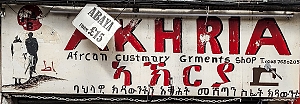
IN SHEPHERDS BUSH Market, I noticed a shop sign written in Arabic, Ethiopian and Latin scripts. The Latin script read as follows:

“Afrcan custmory grments shop”.

Was this bad spelling of English words or maybe something else? It might have been the latter as I will try to explain using two examples.

When I was a dental surgeon, I worked for a while with a wonderful assistant from Uganda. Her English was very good, but when she saw me eating potato crisps at lunch time, she used to ask me whether I was enjoying my “crisips”.  The other example concerned a couple of Italian friends who had been living together since they were both 18 years old. Just after their 40th birthdays, they married suddenly. When we asked them why, the lady said in English:

“For physical regions.”

We were surprised. It turned out that what she was trying to say in her Italian accented English was that they had married for FISCAL reasons.

Both my Ugandan assistant and our Italian friend had inserted vowels between two consecutive consonants where they did not exist in the properly pronounced versions of ‘crisps’ and ‘fiscal’. Remembering this, I wonder whether whomever had written the shop sign in Shepherd Bush Market had thought it unnecessary to put in various vowels where they should have been because they believed that readers of their sign would automatically add vowel sounds between some pairs of consonants. This kind of reader would probably read the misspelt signs as follows:

“African customary garments shop”

If this is not the case, then the signwriter needs to improve his or her spelling of English words.