FOR PERSONAL REASONS King Henry VIII dissolved all the monasteries and similar establishments in England during the 16th century. Many of their buildings were destroyed or left to disintegrate. Their lands were sold or given to new owners. Some of them incorporated the remains of the monastic structures that they had acquired into new buildings. A good example of this can be seen in Devon’s Torquay. It is the remains of Torre Abbey.
The abbey was founded by members of the Premonstratensian Order in 1196. By the time of the Dissolution in 1536, Torre Abbey was the wealthiest of the houses of the Order in Britain. In 1539, the monastery was given over to one of King Henry VIII’s commissioners. After that, the first leaseholder of the former abbey and its lands was the lawyer Sir Hugh Pollard (?1498-?1576). What was left of the monastic buildings was incorporated into a large house built for Thomas Ridgeway. After several others had owned the property, it came into the hands of the Cary family in 1662. In 1740, the residential building was remodelled in the Georgian style, which is what can be seen today. This family retained ownership of the abbey remains, the house, and its lands, until 1930, when a member of the family sold them to Torquay Borough Council. Since then, the house has been used for municipal administrative purposes and during WW2, it was occupied by the RAF.
Near to the main house, there is a large, intact tithe barn. This was constructed in about 1300. In the summer of 1588, the Spanish sent a large fleet, the Armada, to invade England with the intention of restoring the Roman Catholic religion in what had become a Protestant country. The Spanish failed miserably, and many of them became prisoners of war. Francis Drake (c1540-1596) forced one of the Spanish vessels to surrender and as a result captured 397 Spanish prisoners. They were held in the tithe barn for 23 days before they were transferred to Exeter. As a result of this, the barn is now known as The Spanish Barn. during WW2, the RAF used it as a gymnasium. Now, the barn is hired out for weddings and other special occasions.
The remains of the abbey, the barn, and the house built within the abbey ruins, overlook a park, a small golf course, and a few yards away, the waves in Tor Bay. The abbey grounds are a short walk from the commercialised harbour area in the centre of Torquay, and provide a pleasant contrast to the latter.
ISAAC BASHEVIS SINGER, the author, should not be confused with Isaac Merritt Singer (1811-1875), the American born inventor of a successful version of the sewing machine. By 1862, he had fathered 18 children with several different women. In 1862, Isaac and his second wife, Isabella Eugénie (née Boyer), shifted from the USA to Europe because of his scandalous reputation in the States. They lived in Paris until the outbreak of the Franco-Prussian War in 1870. Then, they moved to England with their six children. For reasons connected with its mild climate, the family moved to the Torbay area in early 1872. By then, he had already purchased the Fernham Estate in Paignton, next to Torquay.
Oldway Mansion, (Paignton) Torquay
Singer and his family squeezed into Little Oldway, a villa on the estate, which had been built in about 1850. Next, he commissioned the architect George Soudon Bridgman (1839-1925) to help him design his ‘dream house’, the basis for the present grandiose Oldway Mansion, and the neighbouring circular building, the Rotunda. The latter was designed for stabling and as an exercise pavilion. The house was completed by the end of 1875.
What we see today is not what Isaac would have seen when the edifice was completed. Between 1904 and 1907, Paris Singer (1867-1932), one of Isaac and Isabella’s sons, who had bought the mansion from the Singer Trustees in 1893, made major changes to its appearance. He engaged two French men, the garden designer Achille Duchêne (1866 — 1947) and his father Henri, to design his new home, the present Oldway Mansion. His aim was to create an edifice inspired by the Palace of Versailles. The reconstructed (remodelled) mansion is a magnificent imitation of a French palace in the style of that which can be seen at Versailles. It incorporates decorative features copied from notable buildings in France. Its interior, which I was unable to see, is grandiose and includes fine paintings and a reproduction of the Hall of Mirrors.
In 1917, after having had an affair with the dancer Isadora Duncan (1877-1927) in 1917, Paris moved to the USA for tax reasons. After having been used for various purposes, Paignton Urban District Council bought the property from the Singer family. Currently, the building is mostly disused apart from a small, but pleasant café. Its formal gardens are well-maintained, but the mansion and the Rotunda are in need of maintenance. Oldway Mansion looks rather like an abandoned Russian aristocrat’s palace many years after the Revolution.
BRADFORD-ON-AVON is a charming old-fashioned town in Wiltshire. It straddles the River Avon, which flows through Bath and Bristol. Its Town Bridge is not only old (construction includes some 14th century structure) but also it has a small building on it. This was originally a chapel but became used as a lock-up in the 17th century. Also of interest is the Roman Catholic church of St Thomas More, which is unusual in that it is housed on the first floor of what had once been the Town Hall (built 1854).
Despite the many old and attractive buildings in the town, what interested me most was the old post office. It stands in the picturesque Shambles, which used to be the part of the town dedicated to slaughtering animals and butchering. Compared to many of its neighbours, it is a relatively modern building; it was built in 1899 (www.bradfordonavonmuseum.co.uk/post). It was designed by William Henry Stanley. Then, in 1935 it was enlarged. By the time the new extension was complete, King Edward VIII had ascended to the Throne. What makes it most interesting and unusual is that it bears the monogram of King Edward VIII and the date 1936.
King Edward VIII, who succeeded King George V, reigned from the 20th of January 1936 until he abdicated on the 11th of December 1936. As is well-known, he gave up the throne to marry the American divorcée Mrs Wallis Simpson. What is less well-known is that few, only of a handful of, new post offices were opened in Edward’s brief reign (http://britishpostofficearchitects.weebly.com/bradford-on-avon.html), and Bradford-on-Avon’s extended branch was one of them.
I first spotted the Edward VIII monogram when we visited the town about 20 years ago. Then the post office in the Shambles was still in use. About 5 years ago, this special post office closed. It now operates from within a Co-Op supermarket in the town. However, the old office is now a protected building. The monogram remains but the building is now home to various shops.
THE WALLS OF Bath Abbey are lined with memorials to the dead, many of whom are buried within the church. A remarkably large percentage of the funerary memorials commemorate the lives of people who worked in Britain’s colonies. There are monuments to people who lived and worked in the Caribbean, North America, and Asia, especially for the East India Company, which ‘ran’ and exploited India until 1858.
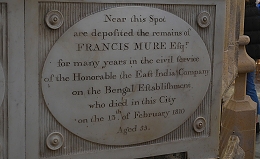
For example, Francis Mure Esq worked for many years in the civil service of “the Honourable the East India Company on the Bengal Establishment”. He died in Bath in 1810 aged 53. Henry Lynch Esq MD “of the island of Barbadoes” died in Bath in 1823, aged 49. Also from this place in the Caribbean was Benjamin Alleyne Cox Esq who died in Bath in 1802 aged 74. In 1812, 78-year-old Rawson Hart Boddam also died in Bath, after having served as the Governor of Bombay in 1784. Robert Brooke Esq, who had served in the Bengal Civil Service died in 1843 aged 72 is also interred in Bath Abbey. Peter Read Cazalet, “of the Honourable East India Madras Civil Service”, who died in 1859, aged 37, is yet another old ‘India hand’, who is buried in Bath. Also in the abbey are the remains of Major General Sir Henry White KCB, part of whose inscription reads chillingly like some of the news bulletins in the current Ukraine crisis: “The judicious Position taken by his Division in the Attack on Agra Which accelerated its fall And the Reduction of The Strong Hill Fort at Gwalior By Siege Are Proofs of Zeal and Military Skill…” He died in 1822.
What puzzled me was why did so many of these men from the colonies ended their lives in Bath. Was it because they were sick and had come to the place to take the curative spa waters, which failed to cure them? Or had they retired to Bath? Or, as someone suggested, Bath is close to Bristol, which was in many ways involved with colonial affairs.
The answers to these questions must remain uncertain at present. However, I wondered why the wealthy American Senator William Bingham died in Bath in 1804, aged 49. He was involved with the Barings Brothers bank in London, which might have been a reason for him being in England at the time of his death. He left for England in 1801, when his wife was taken ill. What he was doing in Bath remains unclear.
Amongst the many fascinating memorials in the Abbey are several commemorating people who died abroad. Some of these people had been in India when their lives ended. An interesting example of this, which illustrates the hazards of warfare and the difficulties in subduing people, who have no wish to be colonized, is the monument to 1st Lieutenant George Dobson Willoughby, of the Bengal Artillery and the Commisary of Ordnance at Delhi, who died in 1857. His inscription includes the following details: “As a brave and zealous soldier he stood firm in the defence of the post intrusted to him, and when resistance failed blew up the Delhi Magazine on 11: May 1857 to prevent it falling into the hands of the mutineers and rebels. Burnt and wounded he subsequently fell a prey to the insurgents …”
Maybe, this is a lesson from which the dutiful Russian soldiers in Ukraine should take heed.
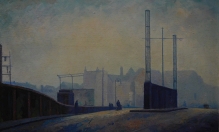
RECENTLY, WE DROVE to Southend-on-Sea in Essex to see an exhibition, “Brothers in Art”, at the town’s superb Beecroft Art Gallery. There, we enjoyed visiting a temporary exhibition of the paintings of two artists, about whom we knew nothing: the brothers Walter (1908-1997) and Harold (1911-1971) Steggles. They were members of the East London Group of artists, East End workers who created and exhibited together between 1928 and 1936. Influenced by the artists John Albert Cooper (1894-43) and Walter Sickert (1860-1942), the group produced pictures that often-depicted everyday scenes and mundane sites in a joyful way.
The Steggles were born in Ilford (east London), sons of the manager of a high-class footwear store in London’s Strand. They were not born into a family that had any history of artistic talents. At an early age, the brothers began visiting art exhibitions, including, in 1925, one at the Bethnal Green Men’s Institute Art Club at the Bethnal Green Museum. This led them to join the art classes there. Walter was 17 and Harold was 14. Unhappy with the classes at Bethnal Green, they joined the art classes conducted by John Cooper at the Bromley & Bow Institute. He encouraged the brothers to paint scenes near the institute. Soon they became members of the East London Group.
In 1928, the Group held an exhibition at the Whitechapel Art Gallery. The brothers exhibited several of their paintings at this prestigious public art venue. Many influential members of the art scene attended the show, one of them being the then director of the Tate Gallery. Several of the brothers’ paintings at the exhibition were acquired by the Tate.
The East End Group also held regular exhibitions at the Lefevre Gallery in London’s West End. The gallery, which existed from 1926 until 2002, represented leading artists including, to mention only a few, Seurat, Matisse, Degas, Picasso, Dali and Kandinski. The two brothers:
“… found themselves part of a cosmopolitan artistic milieu that included Ben Nicholson, Charles Ginner, Philip Wilson Steer, George Braque and Raoul Dufy … Before long they found themselves sought after by other galleries and Harold became a protégé of the flamboyant aesthete Eddie Marsh who lived near his office in Gray’s Inn as well as accepting a prestigious commission from Villiers David to paint the gentlemen’s clubs of St James.” (https://spitalfieldslife.com/2017/07/26/harold-walter-steggles-artists/).
Harold recalled that the first picture he sold was bought by the highly influential art dealer Sir Joseph Duveen (1869-1939) and was hung at the Tate Gallery in 1929. In 1936, Walter had one of his paintings exhibited in the Venice Biennale.
Walter and Harold sold their paintings and became prosperous enough to buy a car. This allowed them to make forays into East Anglia where they painted things they saw. Some of these East Anglian scenes were on display at the exhibition in Southend alongside their paintings of sights in London; many of these places have disappeared since WW2. Both Walter and Harold were commissioned by the Shell petrol company to create posters. These display places in England, beautifully depicted. Several of these were also on display.
Even though the brothers were successful as artists, they had to continue working in non-artistic jobs to gain a sufficient income. When Walter retired, he was able to concentrate fully on painting.
With the death of John Cooper in 1943, the East End Group declined and the works it had created faded from the artistic world’s limelight. What the group created was not as excitingly innovative as the art produced by the now better-known artists, some of which I mentioned above. However, the work of the Group and, in particular, of the Steggle brothers is of high quality and very pleasing aesthetically. It was well worth trekking out to Southend to see their paintings.
SPIRAL RAMPS LEAD up to the Ha’penny Bridge, which allows pedestrians to cross the Paddington Arm of the Grand Union Canal, where it runs between Delamere Terrace on one bank and Blomfield Road on the opposite one. A few yards west of the bridge and south of the waterway, there is a Victorian gothic church with a tall tower decorated with layers of red brickwork separated by layers of white masonry and topped with a white spire. It is St Mary Magdalene’s church.
The church was designed by George Edmund Street (1824-1881) and completed in 1878. It was built in what was then an area with poor quality housing, where several hard-up families lived crowded together under one roof. The parish in which it is located began life as an offshoot of All Saints in Margaret Street (near Oxford Circus). Like All Saints, St Mary Magdalene’s was established as an Anglo-Catholic church. Its website, grandjunction.org.uk, revealed that Anglo-Catholicism:
“… emphasises the Catholic heritage and identity of the Church of England. In the mid-nineteenth century Anglo-Catholicism was very controversial and provoked riots. Anglo-Catholic churches were often built in very poor areas, and their clergy believed that their services, full of light, colour, music and ritual, were likely to appeal to the poor.”
Like All Saints Margaret Street, the interior of St Mary Magdalene’s is a masterpiece of Victorian gothic extravaganza, a riot of colour. The nave has a magnificent painted ceiling which includes faces of various saints. This was painted by Daniel Bell, a Victorian artist. Sculptures of saints carved by Thomas Earp (1823-1893) look down on the nave. The floor of the vast nave is decoratively tiled. Street did not believe in fixed pews such as are found in many other Victorian churches and were rented out to parishioners to raise money. He believed in ‘free seating’, especially in a church like St Mary Magdelene’s that was built to serve the poor. The apse is unusual in that it is polygonal, reminiscent of apses that the widely travelled Street had seen in French and Flemish churches.
An unusual feature of this out of the ordinary church is that although the nave is flanked by a south and a north aisle, the latter is barely wide enough to accommodate one person, whereas the south one is almost as wide as the nave. The reason for the narrow north aisle was related to building regulations in force when the church was being constructed.
If it is open, and it was when I visited the church, it is worth entering the undercroft. This area beneath the church is flanked on its south side by a chapel that was undergoing restoration in February 2022. This is the chapel of the Holy Sepulchre created to commemorate the church’s founder and first vicar Fr Richard Temple West (1827-1893). Containing much decorative artwork and resembling a mediaeval chantry chapel, it was created by the architect Ninian Comper (1864-1960).
Outside the church, there is a WW1 memorial, added by Martin Travers in 1929. It is a gold-coloured crucifixion with a stone base on which are inscribed the Latin words “Infinitum est”, which is neither classical nor biblical; it means ‘It is not finished’, which are ominous words on a war memorial and are most portentous on a memorial to the first of (so far) two world wars.
Added on to the west end of the church, there is a modern extension, which houses a pleasant refreshment outlet called the Grand Junction Café. This is a good place to rest for a while after the excitement of seeing inside the spectacular church.
THE SHORT-LIVED POET, John Keats (1795-1821) resided briefly in Hampstead in what is now called Keats House. In my new book, “Beneath a Wide Sky: Hampstead and its Environs” *, Keats:
“… took a great liking to Hampstead and settled there in 1817. He lived in Wentworth House, which was later renamed ‘Keats House’. The house in Keats Grove was built in about 1815 and divided in two separate dwellings. One half was occupied by Charles Armitage Brown (1787-1842), a poet and friend of Leigh Hunt and the other half by Charles Wentworth Dilke (1789–1864), a literary associate of Hunt and a visitor to his home in the Vale of Health. Keats became Brown’s lodger. This was after Keats had visited his neighbour Dilke, with whom he became acquainted following an introduction by the poet and playwright John Hamilton Reynolds (1784-1852), who was part of Leigh Hunt’s circle of friends.”
Keats remained in Hampstead until 1820, when, ailing, he left for Italy to try to improve his health. Leigh Hunt (1784-1859), who lived in Hampstead’s Vale of Health, noted in his autobiography that Keats died in Rome and was buried in the English Protestant cemetery near the monument to Gaius Cestius. Amongst his graveside mourners was the poet Percy Bysshe Shelley (1792-1822), who also had spent time in Hampstead.
Had Keats not travelled to Italy, he would have probably died in Hampstead. If that had been the case, it would have been likely that he would have been buried in the graveyard of St John’s, Hampstead’s parish church on Church Row, where the artist John Constable rests in peace.
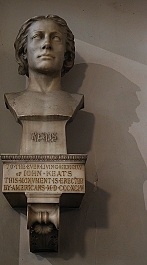
Bust of Keats in St Johns, Hampstead
Within the church there is a memorial to Keats, a bust, dated 1894, within 100 years of the poet’s birth. A gift from admirers of Keats in the USA, it was the first memorial to Keats in England. The story of the bust is related on the church’s website (https://hampsteadparishchurch.org.uk/data/keats_bust.php) as follows:
“Anne Whitney, a Boston sculptor (1821-1915) carved her original bust of Keats in 1873. The marble bust was inscribed Keats and not signed. It was exhibited the same year at Doll and Richards, Boston. It was owned by the artist until 1915 when it was bequeathed to Fred Holland Day. Day exhibited it at Boston Public Library in the loan exhibition of his Keats memorabilia in 1921 to mark the centenary of the poet’s death. The Keats bust was given by Fred Holland Day to Keats House and Museum shortly before he died, and its arrival was acknowledged by Fred Edgcumbe the curator of Keats House and Museum on 2 November 1933, the day of Day’s death. The marble replica of the bust inscribed KEATS AW (monogram) 1883 was carved by Anne Whitney in 1883. It was exhibited by F. Eastman Chase, Boston, and presented by Americans, as the first memorial to Keats on English soil, to Hampstead Parish Church on 16 July 1894. The bust remained in position until March 1992 when it was stolen. It was seen by Judith Bingham, the composer, when it was about to be auctioned at Finchley in May 1992. It failed to reach its reserve, Judith Bingham recognised its identity and it was returned to the Parish Church.”
The Keats bust is near the Lady Chapel, in which I saw a remarkable painting by Donald Chisholm Towner (1903-1985), who lived in Hampstead, in Church Row from 1937 until his death. The church’s guidebook revealed:
“The Altar Piece in the chapel was painted by Donald Towner of Church Row, in memory of his mother. True to the medieval tradition Towner used a local resident as the model for Mary, his nephew for John and his own mirror image for Christ.”
What is remarkable is that the three figures are depicted standing in Church Row. St John’s church can be seen in the background.
Apart from the bust and the painting, the church is well worth visiting to see its lovely architecture and to enjoy its peaceful atmosphere.
AUBREY WALK IS a short street in Kensington. About 260 yards in length, it leads west from Campden Hill Road. Originally, it was the approach road to Aubrey House. Until 1893, when it was given its present name, the short stretch of road was named ‘Notting Hill Grove’ (https://www.british-history.ac.uk/survey-london/vol37/pp87-100#h3-0006).
St George, Aubrey Walk
Aubrey House, at first known as ‘Notting Hill House’, was completed by the end of the 17th century. It is at the western end of the street and was attached to some springs with medicinal properties: the Kensington Wells. In the mid-18th century, the house was enlarged by its then owner, Sir Edward Lloyd. The house and its extensive grounds passed through the hands of many different owners. Between 1767 and 1788, it was the home of the diarist and political observer Lady Mary Coke (1727-1811), the daughter of the second Duke of Argyll. By the mid-19th century, it acquired its present name, Aubrey House, to commemorate Aubrey de Vere, who owned the manor of Kensington at the time of the Domesday Book.
In 1863, the house became the property of a politician and Member of Parliament Peter Alfred Taylor (1819-1891). He was a radical, a supporter of the northern states in the American Civil War, and an anti-vaccinationist. A website, british-history.ac.uk, noted:
“Peter Alfred Taylor was M.P. for Leicester from 1862 until 1884 and was a noted champion of radical causes. His wife Clementia was also famous as a philanthropist and champion of women’s rights. They were closely involved in the movement for Italian liberation and Mazzini was a frequent visitor to Aubrey House. In 1873. Taylor sold the house to William Cleverley Alexander, an art collector and patron of Whistler.”
The Taylors opened the Aubrey Institute in the grounds of the house. This was to improve the education of poor youngsters. WC Alexander (1840-1916), who bought the property, employed the artist James Abbott McNeill Whistler (1834-1903) to decorate the walls of the reception rooms of the house. Sadly, today, all that the public can see of the house, which is now a private residential complex, are glimpses over the outer wall of the roof and the upper storey windows.
Aubrey House used to be neighboured by the now demolished Wycombe Lodge and its large garden. In its place, there is a set of recently built houses arranged around a rectangular open space. This is called Wycombe Square.
Walking east from the wall of Aubrey House, we pass several places of interest including Wycombe Square. On the south side of Aubrey Walk is the club house of Campden Hill Lawn Tennis Club. This was founded in 1884, only seven years after the first championship competition at Wimbledon. Its twelve courts, six outdoor and the others indoors, are not visible from Aubrey Walk. Almost opposite the club, numbers 38-40, a 20th century art deco style building, contains the former home of the singer Dusty Springfield (1939-1999), who resided there from 1968 to 1972.
At the eastern end of Aubrey Walk there is the distinctive Victorian gothic church of St George (Campden Hill). In the middle of the 19th century, the area between Kensington Church Street and Campden Hill Road, the area containing Uxbridge Street, Hillgate Street and Place, and other small lanes, was a slum. It was where labourers in the nearby gravel pits and brickfields lived, often with several families in one tall, narrow house. Many of the folk living in this locality were destitute, which is difficult to imagine when you look at the place today. It was decided to build a church nearby to cater for the poor people living in this deprived area. This became St George’s on Aubrey Walk. The first church was an iron building, a large hut, which had been used by soldiers as a chapel on the Crimean War battlefields.
In 1862, the Vicar of St Mary Abbots, the parish church of Kensington arranged to break up his huge parish into smaller units, one of which became the ecclesiastical district of St George. John Bennett, a local builder, financed the construction of a church to replace the iron structure. The first stone of the present church, which can accommodate 1500 people, was laid in 1864. Its architect was Enoch Keeling (1837-1886). The building he designed is a rare example of ‘continental gothic’, also known as ‘Eclectic Gothic’. This style makes use of brick and stonework of various colours, both externally and internally. Its exterior gives an Italianesque impression. This is especially the case when you look at the prominent bell tower at the southeast corner of the church.
St George’s was actively involved in providing education, and social work (including a soup kitchen on Edge Street) to its congregation who lived in the nearby slums. It also played a major role in the Temperance Society, which served Kensington, Notting Hill, and Shepherds Bush. Before WW1, services at St George’s were well-attended, and a wide range of music was played. Writing in a booklet about the church, its authors, Tom Stacey and Ivo Morshead, noted:
“Elaborate settings for the choir were juxtaposed with favourites from ‘Hymns Ancient and Modern’ … The repertoire consisted of works by Stanford, Goss, Barnby, and Handel … St George’s was hardly classy at this time but it sang the same music as its more fashionable contemporary churches … Perhaps the music was above the heads of some of the congregation; yet St George’s remained a full church until the outbreak of the 1914 War.”
By the 1890s, the people that attended services at St George’s were becoming more similar to those living in other parts of Kensington because slowly but surely housing conditions were being improved and what had been a ‘down and out’ part of Kensington was ‘coming up in the world’. Many of the former slum dwellings just east of St George’s are still standing, but instead of being the residences of the poor, they are the much sought-after homes of the wealthy.
In nearby Kensington Place, east of the church, stands the parish hall, St George’s Hall. In 1901, the Victorian building was, according to a plaque affixed above its main entrance:
“… acquired and altered to commemorate the glorious reign of Her Majesty Queen Victoria born at Kensington Palace May 24: 1819”
It is now used for residential purposes.
Aubrey Walk, although short in length, has several interesting sights. In the 19th century, it linked two social extremes. At the western end was the fabulous Aubrey House and at the eastern end, the poor of Kensington flocked to attend services in St George’s Church.
ST JOHN’S IS the parish church for the C of E parish of Hampstead. The present building, designed by Henry Flitcroft and John Sanderson, was dedicated in 1747. It stands on Church Row, which is lined with elegant 18th century houses and links Heath Street with Frognal.
Church Row, Hampstead, London
The church is at the northern edge of a graveyard well populated with funerary monuments, including the grave of the artist John Constable (1776-1837). This grave is in the old part of the church’s cemetery, which was hardly used after 1878, when it was officially closed. A larger, newer graveyard is on a sloping plot across Church Row and north of St John’s. This is the burial place for a host of well-known people as well as the family of Hampstead’s Pearly Kings and Queens.
When I used to visit Hampstead in the 1960s and early 1970s, I used to ‘haunt’ a most wonderful second-hand bookshop on Perrins Lane, which leads east from Heath Street. It was owned by an old gentleman, whose name, Francis Norman, I only learnt many years after he died. Recently, I met a member of Mr Norman’s family. He told me that Mr Norman died in 1983 and is buried in the cemetery at St Johns, describing the location as: “by a wall near Harrison and the children’s playground”.
I was not sure to whom he was referring when he mentioned “Harrison”. At the church, we asked a lady about Mr Norman’s grave. Hearing that he had died in 1983, she suggested that we looked in the newer part of the cemetery. This has a wall that borders a children’s playground. When I looked around carefully, I found neither any monument to Harrison nor Norman’s gravestone.
On returning to the church and explaining our unsuccessful quest, the lady sent me to see another church official, who was working in an office attached to the church. This lady knew exactly where Mr Norman was buried. She took me into the older part of the cemetery and showed me the gravestones of Francis and his wife Sonia, which lie next to each other. They are next to a small wall and close to a large monument to the clockmaker John Harrison (1693-1776). He was the inventor of a marine chronometer, which solved the problem of how to ascertain longitude whilst at sea. His story can be read in “Longitude” by Davina Sobell. Norman’s grave is not far from that of John Constable.
Francis and Sonia Norman are amongst the few people buried in the old cemetery after it was closed in 1878. My helpful informant at the church did not know why they had been interred there instead of in the newer part.
Francis Norman was a kindly, wise, and friendly fellow, who did not mind me and several of my friends spending hours in his shop, often spending very little on his extremely reasonably priced books. I have fond memories of the time that we spent in his presence, which are described in my book “Beneath a Wide Sky: Hampstead and its Environs” (https://www.amazon.co.uk/dp/B09R2WRK92). So, it was with great pleasure that I met one of his family and was able to pay my respects at his grave.







 yamey
yamey 