
Which way will it blow?
The wind of war brings fear and rage
Let peace reign soon

Which way will it blow?
The wind of war brings fear and rage
Let peace reign soon
ENGLISH PARISH CHURCHES are full of surprises. The church of St Mary the Virgin in the Essex village of Hatfield Broad Oak (once known as ‘Hatfield Regis’) is no exception. Its nave is a surviving remnant of a Benedictine priory founded in 1135 by Alberic De Vere (c1085-1141) The highlight of this church is a recumbent stone effigy of Alberic’s grandson, Robert de Vere, 3rd Earl of Oxford (c1155-1221), who was born in Hatfield Broad Oak. He was one of the barons who forced King John into signing the Magna Carta at Runnymede in 1215. The effigy was placed in the church either by his son or his grandson. It lies on the floor of the chancel in front of the nave and close to the high altar. Whereas in many churches, there is an unobstructed view of the altar (or a rood screen) from the western end of a church, Robert’s effigy sticks out like a sore thumb when you are looking along the length of the nave

The effigy, which is in remarkably good condition given its age, depicts Robert lying with his legs crossed. His right hand clutches a sword and there is a shield attached to his left arm. His left foot rests on something that is not easily identifiable as it has been damaged. What is most remarkable about this funerary sculpture is that Robert is almost entirely clad in chain mail. Part of his face peers through a circular gap in the armoured head dress. The carver of this monument took great pains to show the chain mail in fine detail. For me, this is what makes the effigy quite wonderful.
Fascinating as is the effigy, Robert’s family interested me because of its connection with Kensington in London. Robert’s great grandfather Alberic (or Aubrey) De Vere (1040-1112) was a tenant-in-chief of William the Conqueror. The Domesday Book records that he was a great landowner with properties in nine counties. One of these was the manor of Kensington in the County of Middlesex. His name is remembered today in the Royal Borough of Kensington and Chelsea by the street name Aubrey Walk, which leads to Aubrey House, currently a private residence.
The day before we visited Hatfield Broad Oak, we were in Coggeshall (Essex), where I spotted a memorial to a protestant martyr, Thomas Hawkes (see: https://adam-yamey-writes.com/2022/06/26/burnt-rather-than-baptised/), who had worked for the De Vere family. Had Hatfield Broad Oak not been such a pretty village, I doubt that we would have stopped there. That would have been a pity because then we would have missed seeing the chain mail clad effigy and its interesting connection with a part of west London, with which I am quite familiar.
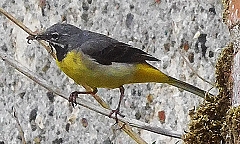
Stay still and silent
Watch carefully and say nought
Else it will take wing
WHILE ELTON JOHN was performing in front of thousands in London’s Hyde Park in late June 2022, a small ensemble was performing works by the baroque composers Pergolesi and Purcell in the large medieval gothic church in Thaxted (Essex). The superbly performed concert in Thaxted starring the Armonico Consort ended well after 9 pm. This was not a problem for the many well-healed members of the audience in the church, who lived locally and were able to feed themselves in their own homes.
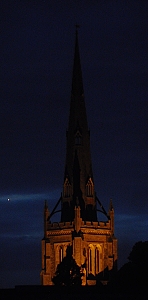
We could have eaten before the concert, which commenced at 7 pm, but were not hungry before that early hour. The pubs in Thaxted informed us that their kitchens stopped taking orders for food before 845 or 9 pm.
At a pub called the Star, someone hearing us asking about food after 9 pm, recommended we should head for Farouk’s. The bar attendant and several bystander’s agreed with our informant. The bar attendant kindly said that we could bring food from Farouk and she would save a table for us at which we could sit and eat after the concert.
Farouk is the owner of a caravan parked in a yard behind a petrol filling station in Thaxted. He and his colleagues, all from Turkey, prepare and sell Turkish food in the caravan. And, his eatery closes not at 845 or 9 pm, but at 11 pm.
After hearing superb renderings of Pergolesi’s “Stabat Mater” and Purcell’s “Dido and Aeneas” (semi-staged), we headed for Farouk’s caravan and the Star pub.
While waiting for our food to be prepared at about 9.40 pm, Farouk explained he had come from Gaziantep. He said that in his part of Turkey, which is quite close to Cyprus, Turkish is spoken with an accent that is very similar to that spoken by Cypriot Turks. During the ten minutes it took to prepare our food, Farouk took many food orders over the phone, which goes to show that in Thaxted there is a healthy demand for food after 9 pm.
We enjoyed our food at the table reserved for us at the Star. This welcoming pub is popular with locals. I suspect that its lively clientele was a different segment of Thaxted’s population from that which attended the concert in the church.
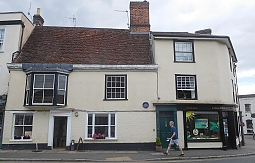
COGGESHALL IN ESSEX is an attractive place to visit. The small town contains over 300 buildings of historical interest, all of which have given protected status. Amongst these is Paycockes House, which I will describe another day. One of the many other old buildings in the centre of the town is a large house, once the home of Thomas Hawkes.
Hawkes was a retainer of John de Vere (1516-1562), the 16th Earl of Oxford, who became a supporter of the Roman Catholic Queen Mary, who became the monarch in 1553 (following the deaths of the Protestant King Edward VI and the unfortunate Lady Jane Grey). Mary decreed that England should return to Roman Catholicism and the Earl of Oxford concurred with this.
Thomas Hawkes, a fervent Protestant, decided to leave his ‘employer’, who had become sympathetic to Mary’s religious cause. He returned to his home (known as ‘Constantynes’) in the centre of Coggeshall. Unwilling to partake in any Roman Catholic practices and a vocal opposer of that branch of Christianity, Hawkes soon became regarded as heretic by the Catholic authorities.
Under great suspicion by those then in power, Hawkes did something that got him into really bad trouble: he refused to have his newly born son baptised into the Catholic faith. He was arrested and taken to Newgate Prison in London. From there, he was taken to the palace of Bishop Edmund Bonner (c1500-1569) several times, and asked to recant. Having refused each time, on the 9th of February 1555, Bonner condemned him to be burnt at the stake. After Bonner had given him one last chance to recant, he is believed to have said:
“No, my lord, that I will not; for if I had a hundred bodies, I would suffer them all to be torn in pieces, rather than I will abjure or recant.” (https://coggeshallmuseum.org/thomas-hawkes/)
After some months, Hawkes was taken to Coggeshall, where on the 10th of June 1555 he was burnt at the stake.
Hawke’s house still stands and is marked with a commemorative plaque. It was built in the mid-15th century, but has been much modified since then.
DURING THE ELEVEN days we spent in Funchal, the capital of Madeira, the city was visited by two enormous cruise ships. Resembling huge blocks of flats (apartments, my North American friends!) floating on water, they arrived in the port at night, remained a whole day, and then departed the next evening.
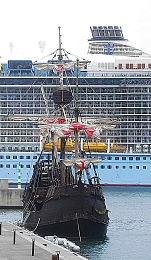
When these vessels disgorge their cargos of tourists, the centre of Funchal becomes crowded; the queue t the cable-car grows longer; and the frequency at which toboggans slide down from the Monte increases.
The port at Funchal is designed to accommodate these ‘humungous’ people carriers, so their arrival does not have the same damaging effect (on buildings and the shoreline) as is created by them in Venice (Italy). Cruising in vessels of this size appeals to many but not to me.
I HAVE BEEN working on the manuscript for a new book, which I plan to publish. I will not reveal what I am writing about … at least, not yet!
As I have been doing for the last few years, I write my text on Microsoft Word, and then re-read it several times, revising and correcting errors of fact, spelling, and grammar. At this stage, I am not too fussed about formatting because this has to be done using other software.
To upload a manuscript to publishers like lulu.com and Amazon KDP, it is best – if not essential – to prepare the final manuscript as a formatted .pdf file. The characteristics of the file need to match what will eventually appear on the printed page. Currently, I am using Serif’s Affinity Publisher software, which is a bit fiddly at first, but it does not take long to get used to it (there are many useful tutorial videos on-line) Using a preformatted template appropriate to the size of book to be produced, I flow my Word text into the Affinity software.
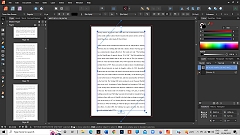
Once it is in the software, each page shows what will eventually appear on each page of the finished book. Using Affinity, I can add illustrations, add page numbers (which change if additional pages are added), an index, and more. I can also edit my text further and shift the formatting of the pages and the spaces between paragraphs to suit me. This stage of the book production is time-consuming but important.
When, eventually, I am happy with what I have produced, I can export the entire book as a .pdf file. This can then be uploaded to the printer’s website, be it lulu.com, Amazon, or another.
Although the writing can be difficult at times, the final formatting of the book to produce a suitable .pdf, which will ensure that everything is in the right place in the printed book is quite demanding but worthwhile at the ‘end of the day’.
We visited Funchal in Madeira in early June 2022. Although we were recommended to visit some of the numerous botanical gardens in and around the city, it was hardly necessary. I do not think that I have ever visited a place filled with such a profusion of flowers as is the case for Funchal. The whole city seems to be one great garden.

During our visit, we were in time to see a vast number of blue flowered agapanthus plants. Although they are commonly known as ‘lily of the Nile’ or ‘African lily, they are not of the lily family. They are members of the Asparagales order of plants, a part of the Asparagus genus. Had I not seen so many of these flowers in Funchal, I might never have bothered to find out anything about them. As the saying goes, travel broadens the mind.
STARING OUT TO sea at Calheta on the Portuguese island of Madeira is a bronze bust of a man wearing 18th century clothing and a bow tie. The sculpture depicts Sebastián Francisco de Miranda y Rodríguez de Espinoza (1750-1816). Born in Caracas in what is now Venezuela, Miranda became a military leader and a revolutionary fighting for his country’s liberation from Spanish rule. Regarded by many as the forerunner of Simon Bolivar (1783-1830), the great liberator of several Spanish South American colonies and born in Caracas, Miranda ended his life in a Spanish prison in Cadiz.

The plaque below the bust in Calheta records (translated from the Portuguese on a website: https://statues.vanderkrogt.net/object.php?record=ptma108):
“The Sons of the municipality of Calheta in the lands of Venezuela at the bicentenary of the Independence in honour of its precursor ‘Generalisimo, Sebastian Francisco de Miranda’ ‘The most universal Venezuelan’”
I interpret this as meaning that the bust was erected by descendants of people from Calheta, who had emigrated to Venezuela.
The bust was created by the Venezuelan sculptor Julio César Briceño Andrade, who was born in Caracas in 1950. It was unveiled in Calheta by Lucas Rincón Romero, the Venezuelan Ambassador to Portugal, on the 5th July 2011.
Miranda was the son of a man, who had migrated to Venezuela from the Spanish Canary Islands. His mother was born in Venezuela. Although, he crossed the Atlantic several times, I do not know whether Miranda ever set foot on the island of Madeira.
Like those from Calheta, who migrated to Venezuela, many others have migrated from Madeira to various parts of the world over the years. I have been told that many of the Portuguese speakers in South Africa had their roots in Madeira. Having seen the bust in Calheta, clearly Venezuela was another destination.
Now, with difficulties that Venezuela has been facing, some its citizens with Madeiran heritage are returning to the island as can be seen in an article published on-line (www.euractiv.com/section/global-europe/news/madeira-an-island-of-refuge-for-venezuelans-of-portuguese-origin/):
“No one knows the exact figure but the authorities in Madeira consider that about 6,000 Venezuelans of Portuguese descent have taken refuge on their island, where they found themselves in an extremely precarious situation. “They arrive with nothing, many are sick, these are people lacking a great deal,” said the President of the Portuguese archipelago, Miguel Albuquerque. These people are second or third generation Portuguese, descendants of those who left Madeira decades ago in search of a better life in Venezuela. They are now making the opposite journey.”
Reading this made me think about South Africa, to which many Europeans, including my parents’ families, travelled in search of a better life. After the ending of apartheid, many of their descendants have left the country because they had become concerned about their futures in a land where Europeans no longer hold the upper hand.
WHILE AWAITING TAKE-OFF from Lisbon’s main airport, our aeroplane was ‘parked’ beside the largest aircraft I have ever seen. Operated by Maximus Air Cargo company, its nose was pointing upwards towards the sky. It was being loaded with freight through an enormous aperture at its front end. The aeroplane was so large that it dwarfed the numerous workers around it and the forklift trucks being used to load its cargo. Even the Airbus 320 craft standing nearby seemed tiny in comparison. As we had to wait for what seemed like ages before we taxied to the runway for take-off, I had plenty of time to stare at it and to take photographs through the window next to my seat. My curiosity increased when I observed that the ‘plane had its make written on the raised section of its nose: Antonov 124-100.

The Antonov aircraft were built mainly during the years that the Soviet Union was in existence. The company that built these freight carrying ‘planes is named after the aircraft designer Oleg Konstantinovich Antonov (1906-1984). Born in the Moscow region, he was the son of a civil engineer. From 1923 onwards, he was deeply involved in aircraft engineering and design. By 1938, he was the leading designer in the aircraft plant headed up by AS Yakovlev (www.antonov.com/en/biography). And in May 1946, he headed up his own aircraft design plant, based in Novosibirsk. By 1948, ‘planes designed by Antonov and his team were being manufactured in Kiev (Kyiv in what is now Ukraine). In 1952, Antonov and his design bureau moved to Kiev. Antonov’s team began designing the AN 124 heavy transport aircraft in the early 1970s. The AN 124’s maiden flight was in 1982, but the vehicle only became known to the world at large when it was exhibited at the Paris Air Show in 1985. The AN 124s were produced at two factories: one in Ulyanovsk (now in Russia) and the other at Kiev (now in Ukraine). One special feature of the AN 24’s design is that its landing gear with 24 wheels is designed both for landing on rough terrain and to enable the ‘plane to kneel down so that its front entrance can be lowered to make loading and unloading easier. About 55 of the AN 124 craft were built between 1982 and 2004. According the uk.flightaware.com website, the AN 124 (registration UR-ZYD), which we saw on the 17th of June 2022 had flown from Leipzig to Lisbon that day and was about to fly on to Cairo (Egypt). It flew to Kigali (Rwanda) from Cairo on the 18th of June. Another website ( www.planespotters.net/airframe/antonov-an-124-ur-zyd-maximus-air-cargo/ejn4jx) revealed that UR-ZYD was built just over 18 years ago, in about 2013/14, making it one of the last to be built.
Maximus Air Cargo, which operates the AN 124, which I saw, is an Abu Dhabi based company, which specialises in transporting larger than usual objects. The company owns one Antonov 124-100, about which its website (www.maximus-air.com/fleet/antonov-124-100) noted:
“The heaviest of the heavyweight cargo lifters. It has a unique self-contained multiple winch and overhead crane system capable of self loading / unloading 120 tonne from front or rear. Can carry 21x Toyota Land Cruisers or 4 x Mi 17 MTV Helicopters without breaking a sweat.”
The aircraft’s maximum range is 6710 nautical miles (‘nm’), but when it is carrying its maximal pay load (120,000 Kg), this reduces to 2420 nm.
I had heard of the Antonov aircraft before, but the example I saw in Lisbon is the first I have seen ‘in the flesh’. I found that seeing this giant was very exciting.
 yamey
yamey 