A numerical oddity in Cornwall

TRERICE HOUSE IN Cornwall was built mainly between 1570 and 1573. It is one of the loveliest National Trust (‘NT’) properties in the county and one of my top ten. In one of the upper rooms there is an ornate bas-relief above the fireplace. The top of this bears the following:

“ANNO: DOMINI: M : CCCCC : LXX3”

It is clearly a date in mostly Roman numerals, (i.e., 1573). However, this date has several odd features.

‘CCCCC’ is 500, but usually abbreviated to ‘D’ in Roman numerals. There is a surplus of colons (‘:’) and instead of ending in a Roman numeral, there is the Arabic numeral ‘3’.  Or is it the symbol for a serpent, rather than a ‘3’? It is a curiously shaped 3: it is widest at the top and tapers towards its lower end.

The NT volunteer offering information in the room with this curious date suggested three possible explanations for this peculiar form of the date above the fireplace. One is that the creator of this date miscalculated the amount of space, and instead of ending the date in ‘: III’, used the Arabic ‘3’ to fit in the last part of the date. Had he used ‘D’ instead of the unusual ‘CCCCC’, there would have been plenty of space to fit in the entire date using only Roman numerals. Another explanation offered is that the ‘3’ is really a stylised serpent, a symbol of wisdom often associated with Queen Elizabeth I, during whose reign the house was built.
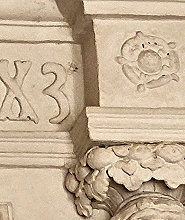
3 or a serpent?

The last explanation was provided by a builder, who had visited Trerice some weeks before us. He suggested that the ‘3’ was added to indicate that the building works were supposed to have been completed in 1570, but had finished 3 years later than expected; the builders were running behind schedule.

Whatever the explanation of the curiously written date, and you might have another theory, Trerice is well worth a visit.
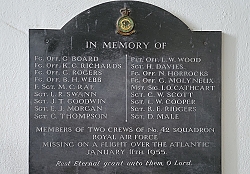
Missing on a flight over the Atlantic

ST COULOMB MAJOR is a small town in north central Cornwall. It has a beautiful gothic parish church, St Columba, which dates to the 13th to 15th centuries. Inside, on the north wall of the church, there is a memorial plaque that caught my eye and roused my curiosity. It lists 18 people, members of the Royal Air Force (‘RAF’) along with their ranks. The plaque was place in memory of:

“Members of two crews of No. 42 Squadron Royal Air Force missing on a flight over the Atlantic. January 11th 1955.”

I was both horrified and intrigued by this.

Both ‘planes that were lost were Shackletons. At 10.14 am, Shackleton WG531 took off from RAF St Eval to commence a routine 15-hour patrol over a part of the Atlantic. At 10.20, Shackleton WL743 took off from the same airfield to join WG 531 on patrol in the same area. At 20.00, the two planes were 85 miles apart. At 20.58, a ground-based radio operator tried to make contact with WL 743, but was unable to do so. This was not cause for alarm because contact was often difficult when planes were at normal operating altitude.

After both aircraft failed to return at the expected time, a search and rescue operation was launched. An extensive search failed to discover either of the aircraft or any bodies of the crew members. In July 1966, one of the engines of WL 743 was caught up in a trawler’s net. Despite a thorough board of inquiry, no plausible explanation of the planes’ disappearances was provided.

St Coulomb Major is 4 miles southeast of RAF St Eval (as the crow flies). There is a church, St Mawgan, between these two places, but that in St Columb Major is larger. Maybe, that is why the memorial to the airmen is where it is. Apart from the RAF plaque, the church contains many other items of interest including its font (c. 1300), which has several faces carved on it.

Red and Blue in Truro Cathedral

THERE IS A COPY of an icon, originally painted in Constantinople, in Truro Cathedral. This well-executed replica stands near the west end of the chancel. It depicts the Holy Child, Jesus, being held by the Virgin Mary. It exemplifies what we were told several years ago whilst being shown around a collection of icons in the Sicilian town of Piana degli Albanese, whose population is descended from Albanians who fled from the Ottomans in the late 15th century. These folk speak not only Italian but also a dialect of Albanian, known as Arberesh.

The icon in Truro shows the Virgin Mary dressed in dark blue and Jesus dressed in red. Our guide in Piana had shown us that in all the icons, the same thing can be seen. Conventionally, in Byzantine icons, Jesus is almost always dressed in red and the Virgin Mary in blue. The copy of the icon on display in Truro Cathedral is no exception to this tradition.

A poorly placed direction signpost

I FIRST BECAME AWARE of fingerposts when I was in Ootacamund (‘Ooty’) in South India in 1994. One of the places in the spread out town is called Fingerpost because there is a fingerpost in the centre of the so named district.


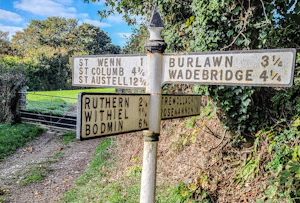
Where we are staying in Cornwall this October (2022) there is a finger post at a T-junction where one road meets another slightly larger one. The fingerpost at this junction ought to have three arms, one pointing along the road that ends here, and two for the larger road. However, the sign has four arms. One of them, pointing to Trewollack and Rosenannon appears to point where there is no road but the entrance to a farmer’s field without even a footpath crossing it.


This sign puzzled us for several days. Then, we spotted a small side road located about 100 yards downhill from the sign and the T-junction. This road leads to Trewollack and Rosenannon, but has no sign indicating this near where the lane begins. The four armed fingerpost is supposed to direct travellers along this road but is nowhere near enough to it to be helpful.

A station, a friend, a cousin

BEFORE I LEARNED TO drive, I began visiting a friend who lives in the heart of the Cornish countryside, a few miles away from Bodmin. I used to travel by train from London’s Paddington to Bodmin Parkway station, which is a short distance away from the town of Bodmin. My friend, Peter, used to collect me from this small station and drive me to his family’s smallholding deep in the countryside. After passing my driving test in 1982, I began driving to Cornwall. Today, the 10th of October 2022, we dropped off our daughter at Bodmin Parkway station to catch a train to London. This was my first visit to the small station since the early 1980s. It brought back memories of my early visits to see Peter and his family.

Bodmin Parkway station

I met Peter through mutual friends. We clicked. In the years following our first meeting, we saw each other regularly, considering how the great the distance is between our homes. On one visit to Peter’s home, I spotted a photograph of his mother, and remarked that her appearance reminded me of my mother. We thought nothing of this at the time.

In the late 1990s, I began researching the history of my parents’ families. An enquiry to a relative, who lived in Zimbabwe led me to contacting another relative, who worked for New Zealand’s diplomatic service. He got in touch with me and was able to supply information that was missing on one of the family trees connected to my mother’s family. I looked at what he had sent me, and my eyes nearly popped out of my head. For, amongst the people listed in that branch of the family tree were Peter and his children. It turns out that Peter is both my fourth and fifth cousin. The reason for this double relationship is that my mother’s parents were second cousins once removed; they shared a common ancestor. So, it turns out that not only is Peter a good friend but also a cousin. It is interesting that although Peter and I were already good friends, knowing that we are related has enhanced our relationship. Standing on the platform at Bodmin Parkway, waiting for our daughter’s train to arrive, brought back memories of my first encounters with Cornwall, a good friend and his mother’s photograph, and my discovery that he is part of my family.

Cattle in Cornwall and Denmark

THE EARLY MORNING sun was shining over the hills surrounding our holiday cottage near Wadebridge in Cornwall, and we decided to take a stroll along the narrow country lanes nearby. The air was crystal clear, and we could see far-off grassy fields dotted with grazing sheep. Wind turbines with slowly turning blades punctuated the northern horizon. After crossing a small, fast-flowing stream, we ascended a steep hill. Every now and then, gaps in the walls bordering the roadway afforded us with splendid views. We reached the entrance to a field, I was reminded of a holiday I enjoyed in 1962 when I was ten years old.

Cows in Cornwall

Early in 1962, I underwent surgery to have my inflamed appendix removed. A few weeks after this, we set off for Denmark in our family Fiat 1100. It was just before Easter and the weather was cold. After traversing West Germany, we crossed into Denmark and headed for our destination, a farm near Toftlund in Jutland. The farm was owned by Lis, one of our former au-pair girls, and her husband. One thing I remember about Toftlund was something pointed out to me by Lis’s father. He showed me that each house had two different numbers: one was on a red background, and the other on blue. I cannot remember which was which, but one numbering system was that of the Danish authorities, and the other was that of the Germans, who had formerly occupied this part of Denmark.

The most memorable and enjoyable aspect of our weeklong stay on the farm was being able to mingle with the farm animals. The cattle and pigs were housed in sheds because it was too cold for them to graze outside. All day my sister and I enjoyed watching and stroking the animals. I think that the time we spent on the farm was so much fun because it was far more ‘child friendly’ than most of our other family holidays, which were centred around my parents’ fascination with artworks in Italian churches and museums.

Some of the cattle had horns. There is nothing unusual about that. However, my mother, who worried about most things and saw potential danger everywhere, was extremely concerned about these horns. What made her anxious was the possibility that one of the creatures might gore me and thereby cause my appendicectomy scar to burst open. Luckily, I survived to tell this story.

Returning to our walk in Cornwall, you will recall that we had reached an entrance to a field that sparked off my memories of Denmark more than 60 years ago. The gate to the field was the entrance to a small pen, The pen contained several cows waiting to be moved somewhere, or maybe to be milked. Seeing them staring at me staring at them reminded me of my wonderful holiday near Toftlund.

For the deserving poor of Padstow

THE CONVOLUTED COAST of Cornwall is dotted with picturesque little ports. One of these is Padstow, which has become well-known because it contains restaurants and other food-related establishments connected with the TV celebrity chef Rick Stein. It is also famous for its centuries’ old annual Oss celebrations held on May Day.

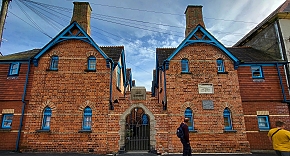
While walking around the streets of the tiny town of Padstow, I came across a disused cinema, which bears a commemorative plaque. Opened in 1924 as the Cinedrome, this became the Capitol cinema. It closed in 1996. However, another relic of the past is still in use around the corner in Middle Street. I am referring to the Padstow Almshouses. This is a small two-winged complex of brick-built houses with some Victorian gothic features.

The main entrance to the complex is surmounted by a granite block carved with the following: “1875 Almshouses”. A plaque located on one of the two facades of the complex informs the viewer that these almshouses were financed by subscriptions raised by friends of John Tredwin to remember him. John Tredwin, who was born in 1818 in Padstow, died at St Columb in Cornwall in 1870. Tredwin, who was a timber merchant and shipbuilder, was involved in the construction of various public works in Padstow. He was also enrolled in the 1st Cornwall Artillery Volunteer Corps, and by 1861 he had become a Captain.  The 1851 Census revealed that by then he and his family were living in St Columb.

John Tredwin was mentioned in a book, “The Cornish Overseas. A history of Cornwall’s ‘Great Emigration’” by Philip Payton:

“The ‘John & Mary’, owned by the Padstow shipbuilder John Tredwin, was engaged in the classic export of immigrants and import of timber that made the Atlantic trade so lucrative in North Cornwall …”

Since the days of the likes of John Tredwin, Padstow has become a relatively insignificant port. Instead, it has become a popular destination for tourists. Although it is undoubtedly an attractive little place, it is outrivalled in charm by other Cornish ports such as Polperro, St Ives, Mousehole, Port St Isaacs, Fowey, and Falmouth. Padstow deserves a visit, but not a long one.

Game of cones in Cornwall

SOME BUSINESSES HAVE chosen names that amuse me. There are plenty of fish and chip shops called ‘The Codfather’. In the small Essex town of Coggeshall, there is a fish and chips shop named ‘Coddes Hall’. And Royal Tunbridge Wells (in Kent) has one of these outlets, which serves fried fish and chips, with the name ‘Happy Friar’. If they have not already been used, I will suggest the following as appropriate names for seafood outlets: ‘Upon my Sole’, ‘The only Plaice’, ‘The Prawn Broker’, and ‘Get on your Skate’.

There is a hair salon in west London’s Ealing district called ‘Pure Barberism’. And when we are in London, one of our favourite coffee shops in Kensington calls itself ‘Perky Blenders’.

You may be excused for asking where this collection of gimmicky names is this leading to? Well, I was inspired to write this short piece after eating some ice cream in the charming Cornish seaport called Fowey (pronounced ‘foy’). The ice creams were sold at a shop called ‘Game of Cones’. I enjoyed the ice cream much more than the only two episodes of the TV show that inspired the ice cream parlour’s name.

Little of this church remains today

WILTON IN WILTSHIRE was capital of Wessex between the 9th and 11th centuries (AD). Today, it is famous for its carpet manufacturing and the wonderful Wilton House, which has been home to the Earls of Pembroke since 1544, when King Henry VIII gave it to them after the Dissolution of the Monasteries. The House, which contains a fabulous collection of paintings by the great masters, was built on the site of Wilton Abbey (established in 871 AD).

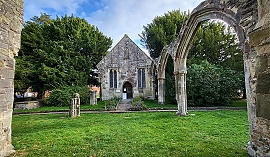
St Mary’s church in the centre of Wilton was originally the first Anglo-Saxon church in the town. It was first built in the 9th century, and then rebuilt in the 12th century. The newer church was further modified in the 15th century. However, by the 18th century it was becoming dilapidated. In 1751, the surving part of the church became used as a mortuary chapel for the Earls of Pembroke. This situation remained unchanged until 1848, when the construction of the large Italianate church of St Mary and St Nicholas was completed in nearby West Street. Then, the old St Mary’s was demolished except for the chancel and the first bay of the nave (than next to the chancel). This survivor is rarely used for services and is now cared for by the Churches Conservation Trust, which looks after historic churches of interest that have become redundant. Outside the preserved part of St Mary’s there are a few gothic arches, remains of the previously much larger church.

We have visited Wilton several times, to see both Wilton House and the Italianate church, as well as to partake of refreshments in the town’s cafés, but it was only today (7th of October 2022) that I first noticed the remains of St Mary’s. This only goes to show that revisiting a place often can be rewarding.

Brief profile of an author: a bit of self publicity!

Adam Yamey is the author of several books, including: “Albania on my Mind”; “Scrabble with Slivovitz;” (Once upon a time in Yugoslavia); “From Albania to Sicily”; “Exodus to Africa”; “Rediscovering Albania”; “Aliwal”; “Bangalore Revealed”; “Indian Freedom Fighters in London (1905-1910)”; “Imprisoned in India”; “Beneath a Wide Sky: Hampstead and its Environs”; “Beyond Marylebone and Mayfair: Exploring West London”.

His latest book is:

“Golders Green & Hampstead Garden Suburb: Visions of Arcadia”

Buy a copy here: https://www.amazon.co.uk/gp/product/B0BHG873FB/

Born in 1952 in London, he attended Highgate School, and then University College London. After a doctorate in mammalian physiology, he became an undergraduate once more and qualified as a dental surgeon. After 35 years in general dental practice in Kent and London, he retired in September 2017.

Adam married a lady from India in 1994, and, since then, has been visiting her native land frequently. India has become his second home. He is a keen traveller. The periods between his journeys are usefully and enjoyably employed with: family, cooking, writing, photography, blogging, cinema, theatre, and exploring the many delights that London has to offer.