EVER SINCE I was able to count, I have visualised numerals as colour.
In my mind:
1 is black
2 is light blue
3 is green
4 is reddish
5 is brown
6 is yellow
7 is dark blue
8 is light green
9 is dark green
10 is black,
and beyond that, I can no longer visualise numerals as coloured. Mention, for example 3, and in my mind’s eye, I see a green figure 3.
In addition to their colouration, I can see in my mind a pattern between 1 and 12 .
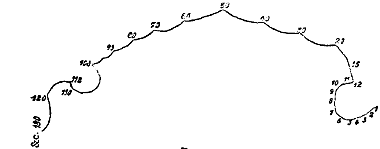
For many years, I believed that I was alone in imagining numbers as being coloured. However, this changed when I became a student at University College London, and began browsing the shelves of its many splendid libraries. I came across books by Francis Galton (1822-1911) in which he described exactly what goes through my mind when I think about the numerals.
In the scientific journal Nature (Jan 15, 1880), Galton published a paper “Visualised Numbers”, in which he described in detail the phenomenon that I had hitherto believed was unique to me. According to his research about one man in thirty, and one woman in fifteen can visualise numerals. He wrote:
“Persons who are imaginative almost invariably think of numerals in visual imagerv. If the idea of six occurs to them, the word “six,” does not sound in their mental ear, but the figure 6 in a written or printed form rises before their mental eye. The clearness of the images of numerals, and the number of them that can be mentally viewed at the same time, differs greatly in different persons.”
As for the numerals appearing in colour, he described the following example:
“One of the sisters sees … the figures themselves are coloured, (1) black, (2) white, (3) yellow, (4) red, (5) greenish yellow, (6) blue, (7) black, (8) red, (9) grey. (0) gold. The other sister has a fainter, but still a decided tendency to see figures in a mental diagram. It is without colour but has variations of shade.”
Of the spatial patterning that people including me experience when visualising numerals, Galton said the following:
“Nearly all of my correspondents speak with confidence of their forms having been in existence as far back as they recollect. One states that he knows he possessed it at the age of four; another, that he learnt his multiplication table by the aid of the elaborate mental diagram he still uses. Not one in ten is able to suggest any clue as to their origin. They cannot be due to anything written or printed, because they do not simulate what is found in ordinary writings or books.”
What I began by describing at the start of this essay and that which Galton described in his article are examples of what is known as ‘synaesthesia’ (in USA: ;’synesthesia’). A reliable-looking article in Wikipedia defined this as:
“… a perceptual phenomenon in which stimulation of one sensory or cognitive pathway leads to involuntary experiences in other sensory or cognitive pathways.”
It added:
“In one of the most common forms of synesthesia, individual letters of the alphabet and numbers (collectively referred to as “graphemes”) are “shaded” or “tinged” with a color. While different individuals usually do not report the same colors for all letters and numbers, studies with large numbers of synesthetes find some commonalities across letters (e.g., A is likely to be red).”
On number forms or patterns, the article revealed:
“A number form is a mental map of numbers that automatically and involuntarily appears whenever someone who experiences number-forms synesthesia thinks of numbers. These numbers might appear in different locations and the mapping changes and varies between individuals. Number forms were first documented and named in 1881 by Francis Galton …”
From what I have read, and that which I have quoted, I am not, as I first imagined, alone in experiencing numbers as patterns and colours.
Finally, relating to the above, I found the following on the Tate Gallery website (https://www.tate.org.uk/art/art-terms/s/synaesthesia) :
“People with synaesthesia tend to be drawn towards the creative arts and some artists have explored the concept in their works, like the Russian abstract artist Wassily Kandinsky, who had an interest in visualising music in his paintings. In the film ‘Sensorium Tests’ which explores mirror-touch synaesthesia, the contemporary artist Daria Martin challenges the idea that the act of looking is a passive experience.”
And in case this is of any relevance, I have been quite creative during my life. As a teenager, I drew and painted, and then later I spent several years engraving and etching, and more recently, I began writing.