Baby Jesus with bangles

DURING SEVERAL TRIPS within the ex-Portuguese colony of Goa on the west coast of India, we have visited churches and other Christian religious establishments built under Portuguese rule. The Portuguese arrived in India several centuries ago, and finally left their colonies in 1961 when they became incorporated (or annexed) into India. One of the aims of the Portuguese was conversion of their Indian subjects to Christianity. Many of the conquered people became Christian, and many churches and seminaries sprung up in the occupied territories. We have visited quite a few of these.

In most of the churches we have seen in Goa as well as in the recently opened Museum of Christian Art in Old Goa, we have noticed that depictions of angels saints, and Christ himself have facial (and other) features that are typical of Indian physiognomy. This is not too surprising as many artefacts in the churches of Goa were created by Indian artists.

When we visited the Museum of Christian Art in Old Goa, we saw two depictions of Baby Jesus lying on what looked just like typical Indian ‘charpoys’ (traditional Indian beds). The Holy Child in each case is a tiny doll. What fascinated me is that the dolls were wearing the sort of tiny bangles that are often worn by small Indian babies. One of the tiny models of Jesus was also wearing earrings.

Moving away from Christian sculptures and paintings, which have incorporated Indian characteristics, day to day Christian worship in India often incorporates features with origins in Hindu ritual practice. One example is the use of flower garlands (‘malas’), which is just as common in Christian settings as it is in Hindu settings.

Christianity was introduced to India not only by the Portuguese, but by others including St Thomas (apocryphally), and various European invaders. However, despite its foreign origins, India was not only affected by the Christian religion but has also made its mark on it.

A grand hotel in Goa

OUR FIRST VISIT to Goa was in about 2007. We stayed at a state run hotel in Colva, a seaside place in South Goa. It was August and the middle of the monsoon season. Much of the time, there was rain and frequently the beach was inaccessible because if the furious waves and wind dashing against it.

One day, we were driven to Panjim North of Colva, and stopped for lunch in the city’s tall Mandovi Hotel. The food served in its grandiose dining room was good. However, what impressed me most was that the hotel, which was built as a luxury establishment when the Portuguese ruled Goa, was a perfectly preserved and well maintained example of an old-fashioned inter-war European grand hotel.

Because the hotel at Colva was, to put it mildly, very badly managed, we left it sooner than we had planned and spent a few days in the Mandovi. As far as I can recall, the hotel was both comfortable and well managed.

In 2018, we paid another visit to Panjim, and had a meal in its restaurant, which looked the same as it did in 2007. Sadly, the quality of the cooking and service had deteriorated.

The Mandovi Hotel was constructed on a plot that had belonged to a Noronha family. The seven storied building was ready to receive its first guests in December 1952, on the day that the Cardinal of Lisbon arrived in Goa. The hotel was where important Portuguese persons stayed. It was the best hotel in all of the territories ruled by Portugal. Stepping inside it was like taking a time trip back to the 1950s, if not before.

Behind the hotel, away from the riverfront, there is a domed Chapel attached to the hotel. This was built by the Noronhas family in 1827, and has been used ever since.

December 2022 found us back in Panjim. We walked over to the Mandovi Hotel and were horrified to find that its main entrance was padlocked closed and the place looked lifeless. A bystander told us that the hotel closed about 4 years ago because the two families who own it are fighting over it in a court of law.

I hope that the Mandovi Hotel will reopen and that it’s remarkable late Art Deco and Indo-Portuguese decorative features will be preserved. Even if it’s interior is modernised, which would be a pity, I hope that the terracotta coloured bas-reliefs on the hotel’s external wall will be saved.

A padlock with an unfortunate name

ABOUT 26 YEARS AGO, we had lunch in a state run hotel near the archaeological site at Hampi in Karnataka. On the way to a toilet, I had to pass some of the hotel’s bedrooms. Each was closed with a padlock. I do not know why I bothered to look at a lock carefully, but I am glad that I did. The lock was manufactured by the Hitler lock company. I could not believe my eyes, and I took a closeup photograph of it.

Since seeing that lock, I have visited India about 50 Times. On every visit, I have spent some time wandering around markets and bazaars in many Indian towns and cities. At every market I have kept an eye open for Hitler locks, but never found even one of them. When I have asked lock sellers if they stock them, the majority of them look blankly at me.

Today, the 9th of December 2023, we enjoyed a journey on a crowded local bus in Goa. We travelled from Panjim to the town of Mapusa to experience its large market. After wandering around for a few minutes, I noticed a small stall selling locks.

As I have always done at other markets I stopped to examine what locks were on sale. To my great surprise, the vendor had some Hitler padlocks. They were available in three sizes. I bought the middle sized version.

The locks are manufactured by Hitler Lock Enterprises,which is located in Aligarh in Uttar Pradesh State. I can only guess that the name Hitler was chosen because someone must have regarded him as being at least as strong as the locks they produce. Why they chose Hitler, rather than strong personalities such as Hanuman or Hercules, puzzles me.

After making my purchase and some others (mainly clothes), we ate superb seafood in the St Francis Xavier restaurant in the centre of the market. On our way back to the bus station (bus stand), we passed another lock seller. I noticed that he also had Hitler locks for sale.

Hitler is a brand name that would not sell well in most parts of the Western World. Judging by the fact that so far I have only found these locks in Mapusa, maybe it is not a trade name that goes down particularly well in India. However, Adolf’s book “Mein Kampf” is available in most Indian bookshops. Although its author was fixated on Aryans, he did not have a soft spot for Indians, as you will discover in the book “Hitler and India”, recently written by Vaibhav Purandare.

Some eagles in Old Goa

THE MUSEUM OF Christian Art has been recently been upgraded and is now a truly excellent display of Christian religious artefacts. It is housed in part of the convent of Santa Monica on Holy Hill in Old Goa. The convent Church was built in the early 17th century.

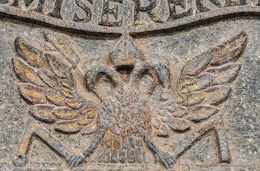
On arrival at the outside (south side) of the church, I spotted a bas-relief carved in stone above the main entrance to the church. It depicts an example of a heraldic creature that has long fascinated me: a double-headed eagle.

Inside the church, we met Natasha, who is the curator of the museum. I asked her if she knew about the reason for the double-headed eagle on the church. She informed us that the convent had been an Augustinian establishment, and that the double-headed eagle is a symbol used by that Order. That was news to me. She also directed me to another depiction of this creature on a carved tablet set into the church’s north wall.

When I returned to our lodging in Panjim, I consulted the internet, and learned about the connection between the Augustinian Order and the bird with two heads. It appears that although the main emblem of the Augustinians was a heart pierced with two arrow, the Hapsburgs allowed this Order to use their emblem, the double-headed eagle.

It will be recalled that there was a significant linkage of the Habsburgs and Spain. And Spain ruled Portugal between about 1580 and 1640. The Convent of Santa Monica was constructed between 1606 and 1627, and that was during the time that Portugal, which colonised Goa, was united with Spain. During that period, the united countries were ruled by Habsburg kings.

Although the museum, which I will describe later, was well worth the visit, discovering yet another example of the use of the double-headed eagle was a great thrill for me.

Cheese is nice … a true story

A POST ON FACEBOOK reminded me of something that happened about 27 years ago in a country east of France.

We were staying with a German lady, who used to become easily stressed. One day I was sitting in her living room whilst she was preparing a meal in the kitchen nearby. Something must have been going wrong because I heard her shouting “cheese is nice” in an angry voice. She repeated these words over and over again.

I like cheese, but could not understand why she was expressing a liking for cheese so angrily. And then the penny dropped. It dawned on me that she was not talking about cheese, but about Jesus Christ. In her perfect but Germanically pronounced English she was saying what sounded like “cheese is nice” but in reality she was cursing by saying “Cheesus Christ”

The posting on Facebook showed Joseph and Mary looking at Ababa doll in an opened Amazon delivery package. The caption to the picture was “Bloody hell, Alexa, I ordered baby cheeses”.

A refreshing breeze in Goa

I SHOULD NOT BE TELLING you about a wonderful place in the heart of Panjim in Goa, but I will.

The Clube Vasco da Gama is situated on the first floor of a building beside Panjim’s lovely Municipal Garden. Founded in 1909, it occupied other buildings before it moved to its present site. With a pleasant decor, which evokes times long past, the Clube serves a wide range of drinks and superbly prepared Goan food. Today, we enjoyed baby squids stuffed with minced vegetable and chopped up squid, served in a tasty sauce. We also ate croquettes filled with a mildly spiced prawn purée. In addition, we consumed fried fish served in a very spicy sauce. Everything tasted wonderful, and as we will be in Panjim for several days, we will work our way through the menu.

We first came across the Clube in April 2018, when the weather was almost unbearable: extremely hot and humid. Quite by chance we came across the Clube and decided to enter it. We discovered that it has two small balconies, each overlooking the Gardens. Each of them has a small table with three chairs. All day long, there is a lovely, cooling breeze blowing across these two tables, making them the coolest places to sit in central Panjim (without resorting to finding places with air-conditioning).

It is because there are only two of these wonderfully positioned tables, it is with some trepidation that I am telling you about them. I do not want to turn up at the Clube to find them occupied by those who have just read this!

If it ain’t broke …

THE KAMAT GROUP has been operating hotels and restaurants for about forty years, if not longer. One of the branches is opposite the Jumma Masjid in the busy Commercial Street district of Bangalore (Bengaluru) in South India. I have visited this eatery many times during the 28 years that I have been making visits to Bangalore.

We usually drop in, or rather ascend the steps to, the seating area of Kamat’s to have a cup of coffee after doing errands in the crowded lanes that form the bustling area through which Commercial Street runs.

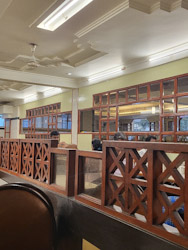
The interior of Kamat never changes. It has probably looked as it does today ever since it opened sometime before my fist visit to Bangalore. Its walls are simply decorated with mirrors and polished woodwork. A wooden barrier runs along the midline of the rectangular seating area, which comprises basic tables and chairs.

Despite not having the latest, trendy internal decor, Kamat in Commercial Street attracts many customers. The owners have done nothing noticeable to modernise the place; to make it compete with the many much more glitzy places in the city. Clearly, they understand the maxim ‘if it ain’t broke don’t fix it’

To beef or not to beef: a mistaken belief

AN INDIAN FRIEND came to the UK to work in the early 1960s. Shortly afterwards, his wife joined him. Back in those days before they became prosperous, one of their occasional treats was to eat in a Wimpy Bar.

My friend and his wife used to order hamburgers, which she enjoyed. Being a devout Hindu, she wanted to avoid eating beef. For years, she believed that the hamburgers were made from ham rather than any other meat. As she enjoyed these burgers so much, her husband decided not to reveal to her that the hamburgers were not made with ham, but with the meat her religion had taught her to avoid. Later, when she discovered that her hamburgers were made with beef, she did forgive her husband for, rather mischievously, concealing that information from her.

This true story, which I was told many years ago, came back to me when I saw a meat store in the grounds of the Bangalore Club (in Bangalore, India). Entertainingly called Meister Wurst, this place sells various prepared meats such as sausages, hams, and salamis. All are made to resemble products made in Germany, but they are manufactured in Bangalore.

There is a large coloured photograph in the front of the store. This image depicts a mouth-watering looking beefburger with the usual accompaniments, all contained between the two halves of a burger bun topped with sesame seeds. Above the photograph are two words, which would have pleased my beef avoiding, hamburger loving friend:
“Ham Burger”.

PS The name ‘hamburger’ has nothing to do with its ingredients. It comes from the name of the German city of Hamburg, where the dish might or might not have been ‘invented’.

Becoming more aware during the covid pandemic

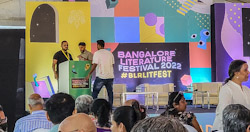
THERE MUST HAVE been some mistake. The organisers of the 2022 Bangalore Literary Festival omitted to invite me to speak about my writing at the festival, which is held in early December.

However, one of the invited speakers was the renowned travel writer Pico Iyer. He said many things that chimed with my way(s) of thinking. One of these was how little we know about our immediate surroundings. During the pandemic lockdown, his movements were restricted to the places in his near neighbourhood (in California). Everyday, he used to walk to the end of his street and gradually realised that until the lockdown commenced he had been unaware if the great beauty of his immediate surroundings, which he had never noticed before.

Likewise, for a few months during the first London lockdown, we did not stray more than about 1 ½ miles from our home. Every day, we took a stroll along streets, which we thought we knew well, and also along nearby streets we had never entered or even knew existed. Everyday, we spotted things we had never noticed before, despite having passed them often over a period of several decades. It seemed that when our horizons became closer and our world contracted, the acuities of our vision and perception expanded. We discovered that our temporarily contracted world revealed details and facets that were hidden from us, or went unnoticed, when our movement was unrestricted. It was these details that inspired me to investigate them and then write about them in what has become my book about West London.

As I listened to Pico Iyer’s excellent lecture, I realised that what we had noticed during the lockdown in relation to heightened awareness of our immediate surroundings in London was what he had experienced several thousand miles away in California.

Modern transport and communication technology has in many ways caused the world to seem as if it has shrunk. Pico Iyer mentioned this, but said that despite this we appear to know less about the world than we think. The enforced confinement to what we believed to be a familiar environment has demonstrated that we really know far less about it than we had hitherto always assumed.

Beverages beneath the banyans

ONCE A CITY FILLED with lovely gardens and other verdant open spaces, Bangalore (Bengaluru) is growing alarmingly rapidly. So, public spaces that have been as yet saved from being built on are valuable amenities. One of these areas of greenery is the so-called Tivoli Garden, which is in the grounds of Airlines Hotel in the heart of the city.

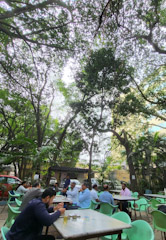
Known popularly as ‘Airlines’, the Tivoli Garden, a name by which it is hardly known, has tables and chairs set out in an open space, a clearing, surrounded by trees, several of them being elderly banyans.

Opened in 1969, the open air café and eatery is still supervised by a man who helped set it up two weeks before it opened all those years ago. Despite its rather untrendy appearance, Airlines is popular with Bangaloreans of all ages. Quite a few of them are students, but many are office workers. Very good South Indian filter coffee is served at Airlines. A wide range of South Indian vegetarian dishes is also served.

The coffee, other drinks, and food are prepared in the kitchen of the hotel. Waiters in white uniforms carry drinks and food across the car park from the kitchen, which is located at the far end of a dingy dining hall, to the garden seating area. Some customers prefer to have their orders served to them whilst sitting in their parked cars.

For my wife and me, Airlines has several attractions. One is the coffee. Another is the pleasant ambience under the trees. And yet another is nostalgia. My wife used to visit Airlines with her family in her late teens. And together with our daughter, my wife and I have been regular visitors to Airlines since when we married in 1994.

For several years, Airlines has been under threat of closure by the people who own the land. Over a decade ago, these people reclaimed half of the area occupied by the café. They built an ugly grey wall (rather like a Berlin Wall) to separate what is left of Airlines from what has now been built on. The supervisor, whom we have known for ages, assured us that as far as he knows the remaining part of the establishment will remain safe from redevelopment.

It would be tragic if Airlines were to disappear, not only because we love it but also it would be yet another example of how what was once a lovely garden city is becoming more and more of an urban jungle