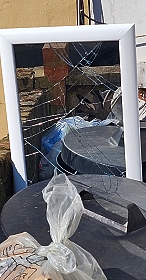
The glass is broken
The mirror image is distort’d
But life goes on

The glass is broken
The mirror image is distort’d
But life goes on

YESTERDAY EVENING, WE took a stroll in Kensington Gardens when the temperature was beginning to drop. The sun was low in the sky. This caused some parts of trees to be shadowed by neighbouring trees so that lovely patterns of light appeared on them. One any particular tree, part of its foliage was brightly coloured because the rays of the sun could reach it, and other parts appeared dark green because the sun could not reach them. All this is obvious when you see it described in words, but wonderful when you see it in life.
PS: It is light effects such as these that make it difficult for artists to paint trees
OFTEN WHEN ONE IS SEARCHING for something, something, which you were not looking for, comes to light. A day or so ago, one of my old passports was discovered. It is an old-fashioned, blue-covered book with barely a trace of the wording and crest that used to be on the cover. I used to carry my passport in a trouser pocket, which rubbed against it and gradually denuded the cover. The ten-year document expired on the 19th of March 1990. This was a couple of months before I made my last trip to what was still known as ‘Yugoslavia’. Soon after that, civil wars erupted, and the country became divided into smaller independent units.

The passport gives my height but not my eye colour, which used to be recorded in earlier passports. It contains eight Hungarian visa stamps (one is illustrated above), all issued in London except for one which was affixed in Belgrade. There is also a Bulgarian visa stamp, which was issued in March 1983. In addition to these visa stamps, for which I was charged roughly $10 each, there are many border stamps – entry and exit. Most of these are for Hungary and Yugoslavia, which I visited frequently throughout the 1980s. In those days, Brits did not need a visa to enter Yugoslavia.
One of the border stamps is of special interest. It was issued when I entered Yugoslavia at Bozaj on the 5th of June 1984. Bozaj, now in the Republic of Montenegro, was a Yugoslav border post on the shore of Lake Shkodra. The stamp was placed in my passport a few minutes after leaving the Albanian border post, also beside the lake, at Han-i-Hotit. It was here that an Albanian entry stamp was put in my passport two weeks earlier when I visited the country, which was then even far more mysterious than North Korea is to us today. In 1984, the Stalinist regime headed by Enver Hoxha was still in place. The two weeks spent in Albania were both fascinating and unusual to say the least. I have described that holiday in my book “Albania on My Mind.”
In addition to the visas and stamps issued by socialist countries, there is one Greek entry and one exit stamp, both issued at Athens airport in August 1981. It seems that I was in Greece from the 11th to the 17th. Another stamp issued on the 13th by the Piraeus branch of the National Bank of Greece takes up most of one page and has something to do with money and traveller’s cheques, but my Greek is not up to translating it.
The accidental finding of this old passport brings back many happy memories of travelling in parts of Europe that have now changed beyond recognition – for better or for worse.
IT ALMOST GOES WITHOUT saying that wherever you are in central London, you are never more than a few footsteps away from a spot that has played a role in significant historical events. Most of these historical spots have been recorded, and therefore are not unknown to at least a few people. However, when walking around London, I often come across a memorial which I had not noticed before despite having passed it several times. Such is the case with number 51 New Cavendish Street – a brick building in Marylebone, which we have walked past several times recently.
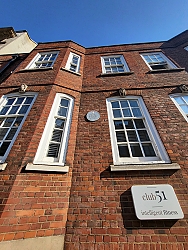
Number 51 bears a commemorative plaque which has the following information:
“This building housed the headquarters of the Polish navy during 1939-1945”.
Underneath this, but in much smaller letters, are sixteen Polish names. From an informative website (https://wartimelondon.wordpress.com/2018/12/12/new-cavendish-street-and-the-free-polish-navy/), I learned that these are the names of Polish naval vessels -ships and submarines.
Poland became an independent country at the end of WW1. By 1920, then with only 90 miles of coastline, Poland began to construct a navy. This was based in Gdynia, near to the ‘free port’ of Gdansk (Danzig), which was not under Polish control. In 1939, with little chance of withstanding attack by the Germans, Polish naval vessels began leaving the Baltic, and heading for British waters. In late 1939, Polish Naval Headquarters were established at 51 New Cavendish Street. Although the Poles had administrative control over their vessels, operational control was dictated by British military requirements. Between 1939 and 1945, the number of men working in the exiled Polish Navy increased from 1000 to 4000.
After the end of WW2, in September 1946, the Polish Naval Detachment in the UK was disbanded. One of its warships was handed back to the new Communist government of Poland. Only a few of the naval personnel felt able to return to their native land now that it was under Communist rule.
Well, I knew a little about the exiled Polish Air Force and have visited Audley End House, where Polish Special Operations Executive personnel trained before being dropped behind the lines in German-occupied Poland. I have even eaten dinner at a Polish Airman’s Club in South Kensington, but this place’s restaurant might well have closed since then. However, until my most recent visit to New Cavendish, I did not know anything about Poland’s navy and its role in WW2.
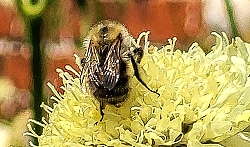
This pollinator
Labouring most diligently
Just let it bee
THE FOLLWING FIVE ROADS meet at West London’s busy Hogarth Roundabout: The Great West Road, Church Street, Burlington Lane, Hogarth Lane, and Dorchester Grove. Excepting Church Street, they are all major thoroughfares, which carry a great deal of traffic. The roundabout is named after the artist William Hogarth (1697-1764), whose former home, Hogarth’s House – now a museum, is close by.

The museum at Hogarth’s House contains a large collection of prints created by Hogarth. All of them illustrate 18th century life in Britain in exceptional detail. The artist did not portray scenes straightforwardly. He portrayed the people and what they were doing in a satirical – sometimes comical – way. So, that what we see today is not only how things looked in Hogarth’s time but also what he felt about them.
Amongst the prints on display, there is one created in 1997 by the cartoonist Martin Rowson (born 1959). It depicts the chaos, dirt, and traffic at Hogarth Roundabout as Hogarth might have done had he been alive to see it. This entertaining print, which was made to commemorate Hogarth’s 300th birth anniversary, includes details copied from Hogarth’s prints. It is a fascinating addition to the collection of the small museum.
EVERY YEAR SINCE 2000, the Serpentine Gallery in London’s Kensington Gardens has commissioned the construction of a temporary pavilion in its garden. These pavilions have two things in common. One is that they contain a café and the other is that it must be designed by a noteworthy architect who has never had one of his or her creations constructed in England. Almost all the pavilions constructed to date have been examples of adventurous and exciting architecture. This year’s architect is Lina Ghotmeh, who was born in Lebanon and now works in her studio in Paris.
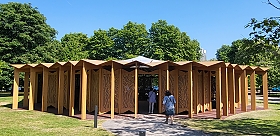
Given the French name “À table”, the circular timber pavilion was conceived as a place for people to sit together and chat, just as they would around a dinner table. Given this aim of the architect, it succeeds. To enhance her aim, the specially designed tables and chairs are arranged in a circle. As my wife said, it is the homeliest of all the pavilions built to date. Unlike some of the earlier pavilions, one does not feel that one is entering an unfamiliar, or even alien, environment. Despite its welcoming nature and very human scale, the pavilion’s design is far from mundane. Although it is far from being amongst the most visually spectacular of the temporary buildings, it is pleasing to the eye. I will certainly visit it again before it is dismantled on the 29th of October 2023.
BETWEEN 1983 AND 1994, I owned a house in Gillingham, Kent. It was not an exceptional building, but it had a long back garden – 180 feet in length and about 22 feet wide. Much of the garden was covered with a lawn bordered by plant beds. When I first moved in, I attended the garden keenly even though I had little idea about gardening. As soon as I unearthed weeds, they re-appeared. It was most disheartening. I discovered that planting shrubs was the best way to hide the weeds, about which I soon stopped worrying.
As for the lawn, I acquired a mowing machine, and for some months, or maybe years, I trimmed the grass regularly. Then, I found that whenever I cut the lawn, my nose would start streaming and I would have fits of sneezing. I realised that I had a grass allergy. So, I decided to cease mowing the lawn. I let the grass grow higher and higher. When it reached its greatest height, people sitting in the garden would be hidden by it. At the end of the year, the grass collapsed and more or less disappeared – only to begin growing again the following spring. I let nature take its course, and ceased worrying about it until a deputation consisting of my immediate neighbours came to my house to complain about my unruly lawn and garden. One of them, an elderly lady, was convinced that all the weeds and insects in her garden had come from mine.
One summer evening, I came home after dark and as it was a pleasant evening, I stood in my back garden looking up at the stars. As I did so, I was aware of a slight smell of burning. The following day, one of my neighbours saw me in the street as I was setting off for work. He told me that the neighbour on the other side of the garden had set fire to mine, hoping that the flames would kill the weeds. Luckily, he had spotted the conflagration, and extinguished it before it did too much damage.
Following the neighbours’ complaints, I conceived an idea about how to deal with my lawn. I decided that I would let it grow without interference, but I would mow a narrow sinuous path along its length. The idea was that I could then explain to the neighbours that the wild grass was part of my garden design. Meanwhile, my shrubs increased in size steadily and the weeds flourished. In the warmer months of the year, whenever I strolled in my garden, clouds of butterflies used to billow from the luxuriant vegetation.
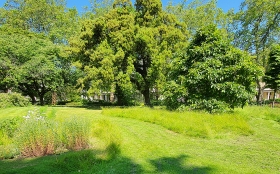
Today, in June 2023, whilst walking in Kensington Gardens, I noticed that much of the grass was growing wild – not being mowed. Here and there, the gardeners had trimmed small areas of grass with a lawnmower, much as I used to do back in Gillingham in the 1980s.
To be honest, I let my garden grow wild because I could not be bothered to spend hours of my life making it look neat and tidy. Today, what I was doing – letting the plants ‘do their own thing’ – is known as ‘wilding’. Maybe, unwittingly I was a pioneer of wilding.
PAINTINGS, PRINTS, AND drawings cannot be fully appreciated by the partially sighted, and not at all by those who are blind. In contrast, sculptures can be enjoyed by those who have problems seeing if they are permitted to touch them. Sadly, most sculptures by famous artists are not allowed to be touched. Today (7th of June 2023), I visited an exhibition of works by the Czechoslovak artist Maria Bartuszova (1936-1996) at London’s Tate Modern gallery.

Many of Bartuszova’s intriguingly original sculptures, often with highly organic shapes are too fragile to be touched. In 1976, the 1st Sculpture Symposium for blind and partially sighted children was held at the Elementary School for Partially Sighted Children in Levoca (Slovakia). A second such event was held at the school in 1983. Bartuszova created a series of hand-sized sculptures, some of which could be taken apart and then re-assembled by the children attending the workshops. The idea was to get the visually handicapped children to appreciate shapes and textures by handling her sculptures. The exhibition at the Tate Modern shows photographs of the youngsters at these workshops, most of them with happy expressions on their faces.
Some of the artworks that these children were encouraged to touch are displayed in glass cases. However, visitors to the exhibition at the Tate Modern are not permitted to touch them.
THE ARTIST JOHN Constable (1776-1837) lived at various addresses in London’s Hampstead. There, he created many sketches and paintings. He was extremely interested in depicting clouds – difficult subjects for an artist to portray convincingly, but Constable was able to do it well. Hampstead, high above most of the rest of London, provided a good spot for an artist interested in creating pictures of meteorological phenomena. High above the built-up parts of the city with no obstructions in his field of vision, Constable was able to set up his easel under a vast sky.

Recently (5th of June 2023), we visited the pre-auction viewing rooms at Sotheby’s in New Bond Street. In one of the galleries, paintings by ‘Old Masters’ were on display. One of them, which caught my eye, was by Constable, and labelled “Study for Hampstead Heath with a rainbow”. Valued at between £300,000 and £400,000, this picture includes a pond in the foreground; two people on the edge of the pond; some trees; a windmill with some small buildings near it; and a flock of birds flying above a small hill. This rustic scene is lovely, but what really catches the viewer’s attention is the sky. Constable has painted billowing clouds, which almost completely hide the clear sky behind them. Some of the clouds are white and others are ominously grey. Almost as accurate as a photograph, this cloudscape does more than slavishly reproduce what the artist saw – it manages to evoke what he must have felt seeing these clouds. And given the fleeting, ever-changing appearances of clouds, the artist must have worked swiftly to capture the celestial scene he saw.
Although I know that Hampstead once had a windmill near Whitestone Pond (now remembered by a lane called Windmill Hill), judging by its surroundings, the pond in the picture was not Whitestone. It might have been one that local enthusiasts he reconstructed recently – located beside Branch Hill. There is a painting in the Tate Gallery’s collections called “Branch Hill Pond, Hampstead Heath, with a Boy Sitting on a Bank”, which has a similar appearance to that which I saw in Sotheby’s, except that there is no windmill. Constable made many paintings and sketches that included the Branch Hill Pond, but apart from the picture I saw in Sotheby’s, which is a study rather than a finished work, they do not include a windmill.
A few months ago, I published a book about Hampstead and some of its interesting neighbours (including Highgate, West Hampstead, and Primrose Hill). Some people have wondered about the title I chose. It was because of Constable’s fascination with sky and clouds and his years of residence in Hampstead that I chose to give my book about the area the title “Beneath a Wide Sky: Hampstead and its Environs”.
My book is available from Amazon as a paperback or an e-book:https://www.amazon.co.uk/BENEATH-WIDE-SKY-HAMPSTEAD-ENVIRONS/dp/B09R2WRK92/
 yamey
yamey 