Still standing but for how much longer?

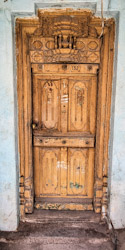
COMMERCIAL STREET IN Bangalore (Bengaluru) is one of the main arteries of a busy shopping district – a bazaar area – in the centre of the city. It is close to an area occupied by military establishments, descendants of a former British military base, to which Sir Winston Churchill (no friend of India) was attached briefly when he was a young man. Another main road, Kamaraj Road, in the area used to be known as Cavalry Road. And another reminder of the area’s military proximity is Infantry Road that runs into the Commercial Street area.

There is a network of narrow lanes that run through the bazaar district. These are lined with shops of varying sizes, tradesmen, artisans, cafés, and other businesses. Numerous motorcyclists and autorickshaws thread their way through the crowds of pedestrians thronging the streets. I suspect that only a small number of these people notice or are interested in the architecture of the buildings lining these lanes. I am one of that small minority.

Many of the buildings in the bazaar are either modern or post 1947. There are still some earlier edifices still standing. Some are gradually falling to pieces and others are in good condition.

Recently, I was taking pictures of some of the older buildings and their traditional decorative features when a man came up to me and said:
“Very old. Historic buildings. Old, very old.”
How old they are, I do not know, but it is likely that they were already standing when India became independent in 1947. I did not ask the man, who commented on the buildings’ age, exactly when they were built. One of my reasons for not doing so was a consequence of an instance in Junagadh (a city in Gujarat) some years ago. We were looking at an interesting mausoleum in the centre of Junagadh, wondering about its age, when we asked a bystander when it was built. He answered:
“I don’t know. I wasn’t born then.”

The few intact attractive, old buildings in the Commercial Street bazaar area are lovely to behold. Given how many of them have already been replaced, I wonder how much longer those remaining will survive.

An unusual letter box in Bangalore

A FRIEND IN BANGALORE, Mr Aggarwal, alerted me to the existence of an historic pillar box (letter box) in the city’s Bowring Institute. This private club has been located in its current position on St Marks Road since 1888, when it’s elegant clubhouse was constructed.

In front of the main entrance to the clubhouse, there is a hexagonal pillar box, which is still in use. This six-sided box is topped with six sloping triangular panels which meet at the highest point of the letter box.

The box bears a crest or emblem on the side where the slot for posting letters is located. This consists of a lion and a unicorn facing each other. Their forecast rest on a circle contains a cross. The circle is surmounted by a crown with two crosses. There is also a small crown with a cros on the lion’s head.

Below the crest, there is a diamond shaped lozenge containing the letters R, N, C, I (or possibly O). What these letters signified (or whether this was the manufacturer’s name) has not yet been revealed by an Internet search.

It had been suggested to me that the pillar box was a British East India Company (‘EIC’) letter box. This is unlikely to be the case because, from what I have managed to ascertain, the EIC crests included two lions facing each other, but no unicorns. Furthermore, by 1888 India was governed by the British Government rather than the EIC (which was in charge of governing India prior to 1857).

The letter box is believed to be contemporary with the construction of the Bowring clubhouse. In 1888, Queen Victoria was the Empress of India. The post box is therefore likely to have some connection with the British Indian postal service. I have yet to discover whether I am right about this. A quick search of the Internet did not reveal any examples of historic pillar boxes bearing the crest on the box at the Bowring Institute. If anyone knows more about this particular crest, please do inform me.

HAPPY CHRISTMAS

A Modulor in Bangalore

THE BOWRING INSTITUTE is a private members’ social club in central Bangalore (Bengaluru). It was established in 1868, and has been standing on its present site since 1888. The club has recently undergone a tasteful restoration and improvement. The old 19th century buildings can be seen in their full glory, looking as if they have only just been constructed.

One external wall of a club building has been adorned with a huge panel decorated with two Modulors. The Modulor is a symbol created by the great pioneer of 20th century architecture, Le Corbusier. It looks like a man with one arm raised and was designed by Le Corbusier to be “ a visual bridge between two scales: the metric and the imperial…” It was also connected with his philosophy that the proportions of structures should be related to those of the human body.

Le Corbusier had several connections with India. For example, he was intimately involved in the design of the city of Chandigarh and created a few wonderful buildings in Ahmedabad.

That said, I have yet to discover why the Modulor was placed twice on a panel at the Bowring Institute so long after its creator’s death. I would like to think that it is a fitting reminder of the considerable influence that Le Corbusier has had on 20th century Indian architects, including Balkrishna Doshi, whose studio and offices are in Ahmedabad.

If it ain’t broke …

THE KAMAT GROUP has been operating hotels and restaurants for about forty years, if not longer. One of the branches is opposite the Jumma Masjid in the busy Commercial Street district of Bangalore (Bengaluru) in South India. I have visited this eatery many times during the 28 years that I have been making visits to Bangalore.

We usually drop in, or rather ascend the steps to, the seating area of Kamat’s to have a cup of coffee after doing errands in the crowded lanes that form the bustling area through which Commercial Street runs.

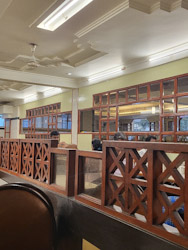
The interior of Kamat never changes. It has probably looked as it does today ever since it opened sometime before my fist visit to Bangalore. Its walls are simply decorated with mirrors and polished woodwork. A wooden barrier runs along the midline of the rectangular seating area, which comprises basic tables and chairs.

Despite not having the latest, trendy internal decor, Kamat in Commercial Street attracts many customers. The owners have done nothing noticeable to modernise the place; to make it compete with the many much more glitzy places in the city. Clearly, they understand the maxim ‘if it ain’t broke don’t fix it’

Beverages beneath the banyans

ONCE A CITY FILLED with lovely gardens and other verdant open spaces, Bangalore (Bengaluru) is growing alarmingly rapidly. So, public spaces that have been as yet saved from being built on are valuable amenities. One of these areas of greenery is the so-called Tivoli Garden, which is in the grounds of Airlines Hotel in the heart of the city.

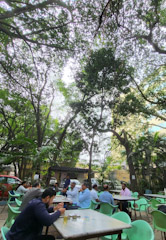
Known popularly as ‘Airlines’, the Tivoli Garden, a name by which it is hardly known, has tables and chairs set out in an open space, a clearing, surrounded by trees, several of them being elderly banyans.

Opened in 1969, the open air café and eatery is still supervised by a man who helped set it up two weeks before it opened all those years ago. Despite its rather untrendy appearance, Airlines is popular with Bangaloreans of all ages. Quite a few of them are students, but many are office workers. Very good South Indian filter coffee is served at Airlines. A wide range of South Indian vegetarian dishes is also served.

The coffee, other drinks, and food are prepared in the kitchen of the hotel. Waiters in white uniforms carry drinks and food across the car park from the kitchen, which is located at the far end of a dingy dining hall, to the garden seating area. Some customers prefer to have their orders served to them whilst sitting in their parked cars.

For my wife and me, Airlines has several attractions. One is the coffee. Another is the pleasant ambience under the trees. And yet another is nostalgia. My wife used to visit Airlines with her family in her late teens. And together with our daughter, my wife and I have been regular visitors to Airlines since when we married in 1994.

For several years, Airlines has been under threat of closure by the people who own the land. Over a decade ago, these people reclaimed half of the area occupied by the café. They built an ugly grey wall (rather like a Berlin Wall) to separate what is left of Airlines from what has now been built on. The supervisor, whom we have known for ages, assured us that as far as he knows the remaining part of the establishment will remain safe from redevelopment.

It would be tragic if Airlines were to disappear, not only because we love it but also it would be yet another example of how what was once a lovely garden city is becoming more and more of an urban jungle

Welcomed to India with coffee

BECAUSE OF THE COVID19 pandemic, we had not stepped onto Indian soil for two years and nine months. This was unusual for us because after we married in early 1984, we have been visiting India on average twice a year. For family related reasons, we have almost always landed in Bangalore.

When a new international airport was opened near Devanahalli village (at the northern edge of Bangalore) a few years ago, a line of eateries and cafés opened alongside the main landside of the terminal building. Being outside the terminal, which can only be entered by holders of air tickets, these outlets can be used by passengers and those who are not travelling by air.

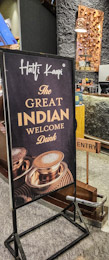
One of these stalls is a grand affair partly decorated with copper sheeting. It is called Hatti Kaapi. The ‘kaapi’ in the name refers to the way local Bangaloreans pronounce ‘coffee’. This particular coffee stand provides excellent quality South Indian filter coffee. It is so wonderful that whenever we visit the airport, either arriving (from the UK or from places elsewhere in India) or departing, we always make time to drink a coffee served by this superb stall.

So, after what was for us an abnormally long absence from India and what has been a disastrous period for everyone, it was wonderful to discover that it was ‘business as usual’ at Hatti Kaapi. And since our last trip 2 ¾ years ago, a new sign has appeared at Hatti Kaapi. It reads:
“HATTI KAAPI The great Indian welcome drink.”


Seeing that sign after 2 ¾ years made us feel much more welcome than its designers could have ever imagined.

Coiffure at the Club

I HAVE NEVER LEFT a barber’s shop without leaving a tip. This is a habit that was instilled in me by my mother during my childhood. Whether the cut was good or bad, I have always left my hairdresser with a gratuity.

In January 1994, I first visited the Bangalore Club in southern India. A few days before my wedding to a member, my in-laws decided that my hair needed a trim. Back in those days, the Club barber shop was located in a hut behind the Men’s Bar, which until a few years ago did not allow the entry of women and girls. Now renamed, this former bastion of maleness permits all drinkers regardless of their genders.

My haircut was at the very least satisfactory and cost all of 20 Indian Rupees, which was debited to my wife’s club account. In those days one pound Sterling was, if I recall correctly, about 40 Rupees. So, my haircut was remarkably good value compared with what I would have paid for it in London.

At the end of my session with the barber, I fumbled in my pocket to find some money for the tip. All I  could find was a 50 Rupees note, which I handed to the man who had looked after my coiffure.

When I related my experience to my wife-to-be, she was horrified that I had tipped more than twice the fee. I suspect that the barber was delighted.

This time last year

WE MARRIED TWICE. That is to say that Lopa and I had a civil marriage in a registry office in October 1993 in London’s Chelsea Town Hall and then a religious marriage in mid-January 1994 in my in-law’s garden in Koramangala, a district south of central Bangalore. Both ceremonies were memorable and meaningful but the one in Bangalore was more colourful, and far lengthier than that in London.

Between November 2019 and the end of February 2020, we were in India. Just before leaving for India in November 2019, we celebrated our English anniversary with our daughter at a French restaurant in London, the Poule au Pot, where one can enjoy typical classic French cuisine in a dimly lit but pleasant environment.

Mid-January 2020 found us near the port of Mandvi in Kutch, formerly an independent princely state, a largely arid, desert region, now part of the Indian State of Gujarat. We were staying with Lopa’s cousin and his wife in their lovely remote and spacious 150-year old farm house, which has been in his family for several generations. Informed of our anniversary, they decided to treat us to dinner at a nearby resort close to the sea. After the meal, we walked to the car under a star-filled clear sky and returned home. There, we sat on the veranda and enjoyed a dessert that Lopa’s cousin’s wife, an accomplished cook, had made specially for us.

A year later, a few days ago, we celebrated our ‘Indian’ anniversary in London. Interestingly, the temperature in wintry London was higher than it was when we were in Kutch (at night), but there was far less sunshine. This year, in the midst of strict ‘lockdown’ conditions necessitated by the covid19 pandemic, we celebrated alone, and not at a restaurant. We had a celebratory cup of coffee outdoors and enjoyed a good home-cooked meal prefaced by gin and tonics. Had we been in India as we often are in January, but not in Gujarat, which is teetotal, we would most probably also have celebrated with ‘g and t’ but sitting outside under the stars on a warm evening in southern India.

Little did we know when we were enjoying ourselves in Kutch last January, that a year later, the idea of visiting India, let alone leaving London, would be out of the question. Well, as my late father used to say, rather annoyingly when misfortune struck:

“Such is life”, or “These things happen.”

Spectacles and Mahatma Gandhi

MANY PEOPLE REGRET having to wear spectacles. I am not a part of that crowd.

When I went to school and university, my eyesight was so good that I did not need to consider wearing glasses. However, many of my fellow pupils were not born with such satisfactory vision and were forced to wear spectacles. I felt that those who wore glasses looked far more intelligent than those who did not. I do not know when and from whom I got that rather ridiculous idea. My parents did not wear glasses until they were about 45 years old, by which time I was in my early teenage. Yet, I knew they were both intelligent long before they discovered that they were having to hold their newspapers and books ever increasingly further from their eyes before they finally resorted to wearing spectacles.

I qualified as a dentist in 1982 without needing to wear glasses apart from safety goggles whilst drilling teeth at the dental school. About three years later, I decided it would be a good idea to protect my eyes whilst treating my patients. Instead of goggles such as handymen (and handywomen) use, I decided to ask an optician to make me a pair of ‘specs’ with tough plain lenses. I was extremely pleased with my spectacles. Wearing them, I looked in the mirror and immediately felt more intelligent, however ridiculous this might sound.

As I approached my mid-forties, the plain lenses needed to be replaced with prescription lenses as my eyesight was no longer what it had been. After a year or so, I began noticing two things. First, at night I was seeing three red traffic lights where there was only one. Secondly, when sitting far away from the stage in a theatre, I could hear what was being said or sung but the performers on the stage were barely distinguishable from one another. Watching a play was a bit like watching from afar insects moving about. Enter my new pair of long-distance ‘specs’ and these problems were resolved. But now I had two carry around two pairs of glasses: one for reading and the other for seeing afar. The solution was to try bifocals, which I have grown to like.

My first pair of spectacles was made by an optician’s firm in Kent, near where I worked. Since then, I have had several pairs made extremely competently in Bangalore, India. Most of my Indian ‘specs’ have been made by a company called Lawrence and Mayo (‘L&M’), which has several branches in the city. We favour the branch that used to be on Mahatma Gandhi (‘MG’) Road, but has, since the construction of Bangalore’s metro train system, been located nearby in Barton Tower, which overlooks MG Road. This branch has supplied eye care for several generations of my wife’s family and at least one of the staff has known members of at least four generations.

L & M was founded in Calcutta in 1877 by two Jewish families, the Lawrence’s and the Mayo’s. According to Girish Bhagat (www.scribd.com/document/352875229/1-Case-Study-on-Lawrence-Mayo-2016-Only-Case-Study-Material), the two families:

“…set up optical businesses in two cities simultaneously: London and Kolkata. Later they went on extending their businesses all over the world … After Kolkata, they went ahead in setting up their branches over large cities of India. It soon gained the reputation as being known as authorised opticians to kings and viceroys alike …”

Apart from London and India, the company had branches in Cairo, Spain, Portugal, Colombo, Rangoon, and Singapore.

The families who established L&M were originally named ‘Lazrus’ and ‘Myers’. According to Vivek Mendonca, whose family took over the firm (www.brandyouyear.com/2020/06/dr-vivek-g-mendonsa-group-director-marketing-lawrence-and-mayo.html):

“They were Opticians, Watchmakers and Craftsmen of fine custom made Jewellery, which they used to embellish on customised spectacles for Royal Families, Prince and Princesses based on colour stones based on their coat of arms.”

Of the Lazrus family I found the following information (www.jewishgen.org/jcr-uk/Community/exe/history/lazarus.htm):

“Frank Lazarus (s. of Mathilda Lyon and Lippa Lazarus of Plymouth), who married into a family who were among the founders of the Jewish community of Hartford Conn., USA, and who later returned to England. He was in the optical business and apparently had a business called Lawrence and Mayo, with a branch in India, and which is now one of the biggest and the oldest optical firms in India.”

Of the Myers, I have not yet managed to discover anything about them.

However, I have found that amongst their many customers, the Indian branches have served some well-known people including Mahatma Gandhi, Pandit Nehru, Rabindranath Tagore, and J.R.D. Tata.  As if that were not enough, they have supplied eyewear to:

“…queens, viceroys, barons and other people of high repute chose Lawrence & Mayo as their personal optician. During the Wimbledon Finals of 1923, Queen Mary was spotted styling the Amulet inspired glare protectors from Lawrence & Mayo.” (https://youandeyemag.com/optician/lawrence-mayo/)

Although the quality of the work they have done for me is more than satisfactory, learning about some of their former customers is additionally gratifying.

Today, the 5th of January 2021, about two years since I last obtained a new pair of specs from L&M in Bangalore’s Barton Tower, I picked up a new pair from a local optician, owned by an Indian optometrist in London. I am about to give them a ‘test drive’ and hope that they will be as satisfactory as those made by Gandhi’s erstwhile optician. They are certainly better looking than the glasses that appear in many portrayals of the Mahatma.