AN ICON IS a person or symbol worthy of veneration. These days ‘iconic’ has come to mean “widely known and acknowledged especially for distinctive excellence”. Thus, for example, the Taj Mahal and the Gateway of India are now described as being iconic.
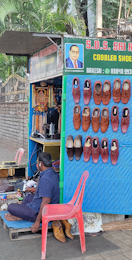
Today, we visited a pavement shoe-repairer (‘cobbler’ or ‘mochi’) in Bangalore. All over India, one can find these useful street side artisans. Often, they work from small open fronted huts, which contain their tools and materials as well as footwear that is either waiting to be repaired or already fixed. One could say that the mochis are iconic features of the streets of India.
Apart from being iconic, many mochis adorn their huts with icons. These icons always include at least one picture of BR Ambedkar (1891-1956). He not only drafted the Constitution of India but also fought for the political rights and social freedom of the Dalits (once known as the ‘untouchables’).
Traditionally and still today, mochis are almost always from Dalit communities. This is why mochis have images (icons) of Ambedkar on their huts. The mochi we visited today on St Marks Road had not only some images of Ambedkar but also one of a Mr Haris, the local member of the Karnataka legislative assembly. And this is not all. Within his hut, the mochi had an image of Shrinatji, who is the God Krishna represented as a young child. This was garlanded with flowers as was one of the pictures of Ambedkar hanging beside it.
The iconic mochi polished my well-worn leather sandals while I sat beside his hut covered in icons
MR HUSSAIN WAS a charming old gentleman full of ‘joie de vivre’, even when infirmity confined him to his bed. A retired businessman, we knew him as ‘Mahomet Uncle’. He was a Kutchi Memon (a Muslim whose ancestors had migrated from Kutch – now a part of Gujarat – to Karnataka). He was immensely popular. His many friends and relatives used to visit him to enjoy his company and to share their news. Once, near the end of his life, we went to his house to wish him ‘Eid Mubarak’ at the end of Ramazan. While we were in his bedroom, where he used to ‘hold court’, a seemingly endless stream of people passed through his front door to celebrate the occasion with him. His death was a great loss not only to his family but also to a vast number of people in Bangalore, who knew and loved him.
We were introduced to Mahomet Uncle by one of his sons who was studying in London at the same time as my then future wife, Lopa, and I were undertaking post-graduate courses. Mahomet Uncle lived in a house on Aly Asker Road Cross, a quiet lane close to the busy Cunningham Road. The Cross road is an offshoot of the larger Aly Asker Road. We have often travelled along this thoroughfare, not only to visit Mahomet Uncle but also other friends who live close by. In addition, when returning from the excellent Shezan Restaurant (on Cunningham Road) to the Bangalore Club, where we often stay, the best route is along Aly Asker Road.
For many years, I have wondered about Aly Asker and why a road should have been given his name. The answer was provided only recently, at the end of January 2024 just before we flew from Bangalore back to London. My friend Subhash Agarwal, with whom I often enjoy an afternoon cup of tea on the lawn in front of the main building of the Bangalore Club, knowing of my interest in the history of Bangalore, kindly presented me with a book, which has the title “Agha Aly Asker”. Published in 2019, it was written by Syeda Mirza, the wife of Aly Asker’s great grandson. The book is well-researched and a pleasant, compelling read. Apart from detailing his life, the author gives many insights into the traditional Persian ways of life.
Aly Asker, a Persian, was born in Shiraz (Persia) in 1808. In 1824, along with his two brothers, he set off for India to sell horses to the British military. They travelled with 200 horses by sea to Mangalore, and then travelled overland to Bangalore. The brothers left him and the horses in Bangalore, where he began selling them to the army of the East India Company. The business was successful, and he imported more batches of horses to sell. Ali Asker became a successful businessman and was befriended by Sir Mark Cubbon (1775-1861), who was the Chief Commissioner of Mysore between 1834 and 1861. Amongst Cubbon’s many achievements were the introduction of Kannada and Marathi as the official state languages, instead of the formerly used Urdu, Hindi, and Persian.
Cubbon was very fond of horses, and is said to have had up to 60 in his stables. His equestrian interests helped develop his friendship with Aly Asker. As a result, Cubbon asked Aly Asker, who had already built himself a fine bungalow, to build 100 bungalows to accommodate the growing military establishment that was developing in Bangalore. Cubbon offered the land free of charge, but Aly Asker told him that he was happy to pay for it, which he did. The residences were constructed on land near today’s Palace Road, Sankey Road, Cunningham Road, and Richmond Road. Many of these houses no longer exist – Bangalorean property developers seem to value heritage far less than profit. One notable example that still stands is the Balabrooie State Guest House. Aly Asker also owned the land on which the luxurious Windsor Manor Hotel now stands.
Aly Asker’s interest in horses extended beyond trading, He was keen on horse-racing, and is said to have been important in putting Bangalore on the horse-racing map of India. His biographer, Syeda Mirza, includes an appendix in which the many victories of Aly Asker’s horses are listed. He was a frequent visitor to the racetrack in Bombay, and then later in Bangalore.
It was their interest in horses that drew together Aly Asker and another noteworthy person in Mysore State – Mummadi Krishnaraja Wodeyar III (1794-1868), the 22nd Maharajah of Mysore. It was through Aly Asker’s help that the British were encouraged to allow the Maharajah’s adopted son Chamarajendra Wadiyar X (1863 – 1894) to become his successor on the throne. Initially, the British, who effectively ruled the state, were reluctant to recognise him as the successor, and it was partly due to the gifts that Aly Asker chose for Queen Victoria that changed their mind in his favour.
Aly Asker died in Bangalore in 1891. He is buried in a cemetery near to the city’s Hosur Road. This is a Persian Cemetery that stands on land granted to Aly Asker and his heirs in 1865. His simple grave is beside that of his wife, and is shown in in a photograph in Mrs Mirza’s book. She noted that he established Bangalore’s first Shia Muslim community. It was when he married Sheher Bano that the first Muharram rituals were first observed in the city. In his will, Aly Asker left money to build the Masjid-e-Askari. It was built in 1909, and still remains as the city’s oldest Shia mosque.
So, having read Syeda Mirza’s book, I now know why there are roads in Bangalore named after Aly Asker. In addition to detailing his life in, and contributions to, the development of Bangalore, Mrs Mirza also described the exciting journey that Aly Asker made between his native land and India. Oddly, Aly Asker does not appear in the index of the authoritative history of Bangalore. “Bangalore Through The Centuries” by M Fazlul Hasan (publ. 1970). In a later (2014) comprehensive history of the city, Maya Jayapal makes one mention of Aly Asker Road, but gives no description of Aly Asker’s contribution to the story of Bangalore. It is therefore valuable that Syeda Mirza took the trouble to write about Aly Askar. As her book bears no ISBN number, and I could not find it either on Amazon or the much wider ranging bookfinder.com, it might well have been privately published, and is now probably quite a rare volume. I am very grateful to Subhash Agarwal for gifting me this informative book – a window on a hitherto poorly described aspect of Bangalore’s history.
MY LATEST BOOK, “The Hitler Lock & Other Tales of India”, is mainly aboutmy very varied and fascinating experiences of travelling in India and only a little bit about Adolf Hitler. Here is a brief excerpt from the book:
Some say that when he was a young boy at school, India’s Prime Minister Narendra Modi helped in his family’s tea stall. Although he never became a chaiwallah, I have met one tea maker who became actively involved in politics. He was the owner of Chai Day Teahouse in Bangalore’s Johnson Market. I visited his establishment a couple of times in 2016, but when I looked for it four years later, it had disappeared.
Chai Day was more of a café than a tea stall. It had tables and chairs within its premises. What struck me immediately was that the walls of the seating area were covered with slogans, such as “Don’t promise when you are happy. Don’t reply when you are angry. Don’t decide when you are sad.”, and “We are not use less. We are used less”, and “Thanking you your faith for Syed Arif Bukhari.” The latter refers to the name of the owner, and the fact that he used to, and may still, put himself forward for election to positions, including MLA, in the Government of Karnataka. He told us that he is an independent and that his symbol is an electronic calculator. Just in case that is meaningless to you, I should explain that all political parties in India identify themselves with symbols as well as their names. For example, the Congress Party symbol is a raised right hand, and that of the BJP is a flowering lotus. This is done so that voters who have difficulty reading can find the party for which they want to vote. After chatting amiably with the charming Mr Bukhari, he said:
“If one chaiwallah can become a Prime Minister, maybe I can do the same.”
He might have been joking, but who can tell what the future will bring.
We are fond of drinking tiny cups of sweet, milky, often spiced, tea at the numerous tea stalls that can be found all over India. During a visit to the Gujarati city of Baroda (Vadodara), we spoke to two tea makers one morning. One of them was a charming lady, who told us about the working life she led. She operates her stall from 630 am until 730 pm daily. She boils her tea with milk and spices on a gas ring, as do most other chaiwallahs. Each of her gas cylinders contain enough fuel (domestic LPG, which contains butane or propane or a mixture of them) to keep her stall going for 15 days.
The other chaiwallah we spoke with was Gopal. He has a tea stall near the entrance to one of the former pols (see below) of Vadodara. He works from 10 am to 6 pm. His stall was very busy when we visited it that morning. It faces a peepal tree with numerous Hindu offerings around the base of its trunk. One of the daily offerings to the gods is the first cup of tea that Gopal makes each morning. Like many other chaiwallahs we have visited in Gujarat, Gopal adds fresh herbs and spices to his tea. That morning, he had large sprigs of mint leaves and bunches of lemon grass and ginger. He pounds the latter in a pestle and mortar. He told us that pounding the ginger releases more flavour than grating it, which is what many other tea makers do. I asked Gopal whether I could take photographs of him and his stall. He allowed me to do so. As we were leaving him, he told his customers proudly (in Gujarati):
“Our Prime Minister must go to the UK and USA to have his picture taken. See, people from the UK have come all the way from London to Vadodara to photograph me.”
[Note: A pol is an ancient form of gated community, built for protection, found in the historic centres of Varodara and (more prevalently) in Ahmedabad].
You can buy a copy of the book either as a paperback or as a Kindle e-book from Amazon:
THINGS DID NOT BEGIN well for me when I arrived at Bangalore Airport’s recently opened Terminal 2 prior to boarding an Emirates airline flight to Dubai, where we were to catch another flight to London. We arrived at the airport in good time – before the check-in desks were open. After finding somewhere to sit, I walked to the Chaayos refreshment stall and asked for two cups of south Indian filter coffee. The server must have misheard me and only charged me for one. When this arrived instead of the two, I was expecting, I paid for another cup. While it was being made, I carried the first to my wife. I returned to the stall and picked up the second cup. It was filled to the brim, very hot, and the cup was poorly insulated. Just before I reached where we were sitting, my hand moved slightly, and the boiling hot coffee fell on my palm. This was extremely painful. I dropped the cup and the rest of its contents. I rushed to the washrooms, and after finding a tap that worked, I rinsed my palm in cold water. Meanwhile, my wife managed to get me some ice to put on the scalded part of my hand.
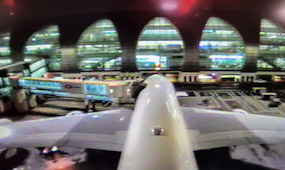
Dubai Airport
After dropping off our baggage and collecting boarding passes (printed on extremely thin paper), we headed for the security check. This involves divesting oneself of anything that contains metal before walking through a metal-detecting arch and then being frisked by a security official. Because the trousers I was wearing were too big, I had to keep one hand on them to stop them falling down. Meanwhile, I was somewhat shocked, and my hand was still smarting after the scalding.
After the frisking, I went over to the conveyor belt that carried our hand baggage and other items slowly through an x-ray machine. After rescuing both my wife’s and my own cabin baggage, telephones, wallets, coats, neck cushion, and my trouser belt, I secured my trousers with the latter. It was then that I realised that my boarding pass was nowhere to be seen. I was horrified – in so many decades of flying, I had never lost a boarding pass.
We reported the loss to the security supervisor – a female officer. She rang for an official from Emirates airline. While waiting for him to arrive, she said to my wife in Hindustani: “He should not worry. They won’t leave him behind.” After an agonising wait – actually, it was no longer than about 15 minutes – the official arrived. By then, I was feeling both anxious and extremely upset. The Emirates man explained that I would be issued a new boarding pass at the boarding gate. Not entirely happy with that, we left the security area, and headed for the departure lounges. On the way, we came across an empty baggage trolley, and began loading it with our carry-on bags and coats. As we were doing that, something fell to the ground – it was my missing boarding pass. In an instant my mood of melancholy and apprehension switched to one of immense happiness and relief. I rushed back to the security supervisor to tell her the good news. As the Emirates man was still around, I told him and shook his hand.
The flight to Dubai was pleasant. There was nothing to complain about. At Dubai, we had to pass through another security check. This time, I decided not to remove my belt before passing through the metal detector. Instead, I untucked my shirt and covered my belt with it. Despite there being a large metal buckle on the belt, the detector did not detect it. Nobody stopped me. Meanwhile, passengers’ hand baggage was passing through an x-ray machine so quickly that I doubt there was time to examine the series of x-ray images in any detail – if at all. After enjoying exorbitantly expensive hot drinks, which I did not manage to spill, we entered a departure lounge dedicated to our flight to London. Before entering the lounge’s seating area, an official examined each passenger’s passport and boarding pass. Most passengers, including my wife and I, had to head for a line of trestle tables. By each of them there was a male or female security official. A few passengers were sent straight into the seating area, bypassing the tables.
The officials standing at the tables first searched the contents of bags – rather cursorily. Then, using an electronic wand, they frisked the passenger. After that, each passenger was asked to present their hands, palms facing upwards. An explosives detector sponge was rubbed on each palm, on the clothing, within the footwear (which had to be removed), on the mobile ‘phones, and other carry-on items. After placing the (re-usable) sponges in a machine, we were allowed to sit down and await the flight. My wife told me that the security lady who examined her was both rude and rough.
This process took quite a while. I sat watching it and gradually, I and my wife became aware of something curious. About a third of the passengers on our flight were women wearing hijabs (Muslim head coverings). This was not surprising in an airport in a Gulf State. What was astonishing was that not one of them had to be searched at the tables. They were allowed to board the flight without having been checked as thoroughly as the other passengers had been. Given that very recently, soldiers wearing hijab were able to enter a hospital in Gaza and attack it with firearms, was it wise to assume that because they were wearing hijab, the passengers on our flight to London were beyond suspicion, whereas all the other passengers – both male and female – needed to be regarded as potential terrorists?
The flight to London could not be faulted. And in case you are wondering, by the time we landed at Heathrow, my scalded palm was neither painful nor inflamed.
PROPERTY ALONG LAVELLE Road in Bangalore (Bengaluru) is currently the most expensive real estate in the city. The thoroughfare was named in memory of the Irish soldier Michael Fitzgerald Lavelle (1831-1895), who discovered gold, and then established goldmines, at Kolar ), which is about 44 miles east of the centre of Bangalore (see, for example: http://www.advertiser.ie/mayo/article/130402/micky-lavelle-the-gold-king-of-kolar ).
One of the entrances to the Bangalore Club, where I often stay when in the city, is on Lavelle Road. Many a time have I walked from the Club along Lavelle Road towards the delightful Airlines Hotel open-air café. On the way, I pass a four-storey building with a narrow façade facing Lavelle Road. This side of the building has four small balconies. Today, it is an office block, but quite a few years ago, it was the home of Bangalore’s Max Mueller Bhavan (a German cultural centre – a branch of the Goethe Institut). This organisation first established its presence in Bangalore in 1960. It provides lessons in German language and culture, and also puts on events relating to German cultural life.
The building on Lavelle Road has a flat roof. When it housed the German cultural centre, there was a straw canopy covering the roof. Beneath the canopy, there were tables and chairs and a kitchen. This covered area was a restaurant, which was called ‘Café Max’. It served German food. The chef and manager of this eatery was an easy-going, informal, young German man. He served what was described as ‘German breakfasts’ every morning. These consisted of eggs and sausages accompanied by delicious German-style breads and cakes, which he and his team baked. Although we never partook of them, he also prepared lunches with dishes from the repertoire of the German cuisine. He had a bookshelf filled with cookbooks, and every morning he could be seen studying them before deciding the day’s menu. Although the restaurant on the roof was intended mainly for the use of people attending the centre for language courses, it was also open to ‘outsiders’ like me.
When it was located on Lavelle Road and withing a very short distance – two minutes’ walk – from the Bangalore Club, I attended several screenings of German films at the Max Mueller Bhavan. Now that the organisation has moved to Indiranagar, I visit it far less often. Every time I walk past the former Lavelle Road Max Mueller Bhavan, I look up towards its roof and remember the German ‘Früstücke’ I used to enjoy there.
BENGALI ARTIST NANDALAL Bose (1882-1966) was chosen as the artist to provide illustrations for the ceremonial manuscript of the Constitution of India. A few copies of these images are currently (January 2024) on display at Bangalore’s National Gallery of Modern Art (‘NGMA’).
Bose was part of an international group of artists who were endeavouring to revive classical Indian culture and art. Because of this, he came into contact with Japanese artists. Their painting techniques influenced the way Nandalal painted. This can be seen in many of his works on display at the NGMA in a temporary exhibition of a selection of his Haripura Panels, which is on until April 2024.
The ear cleaner at work
In 1938, the 51st session of the Indian National Congress was held in Haripura (now in Gujarat). Mahatma Gandhi asked Nandalal Bose to paint a series of panels depicting Indian village life in such a way that the images would be easily accessible to the common people (villagers etc.). Bose obliged, creating about 400 colourful paintings on handmade paper, using organic (rather than industrial) coloured paints. 77 of these are in the exhibition at Bangalore’s NGMA.
Each of the 77 panels is a delight to behold. They look as if they have been done quickly and highly competently by an artist with a decisive mind. On many if them, the influence of Japanese painting can be discerned. However, on every panel the subject matter is unmistakably Indian. Some of the panels depict scenes from village life (fir example, a potter at work, a tailor, wrestlers, making butter, etc) and others show animals and mythological scenes. One panel depicts an ear cleaner – a man is shown cleaning a lady’s ear with a long thin instrument. Villagers visiting the pandal (temporary shelter), which was decorated with these panels, would have had no trouble recognising Bose’s scenes of daily rural life. And political delegates would have been reminded of Gandhi’s professed allegiance to the ‘common’ people of India. Seeing these wonderful panels made me think of Socialist Realism images, but Bose’s paintings have a human touch that is lacking in politically inspired art such as Socialist Realism.
The exhibition at the NGMA is well hung and nicely lit. The panels hang in the galleries which were once rooms in the elegant Manikvelu Mansion. Several informative panels provide interesting information about Bose, his art and his association with Gandhi and his attempt to rid India of British domination.
SO FAR – THAT is since January 1994, the very best biryani I have eaten was at Paragon in Calicut (Kerala) in 2006. It was a Moplah recipe – Arabic and Indian flavours combined most harmoniously. Last December, I enjoyed an almost as good biryani in the restaurant of the Sifat International Hotel in Surat (Gujarat).
Biryani at Bheema’s
When in Bangalore, where we find ourselves often, we like to visit Bheema’s restaurant on Church Street. It serves Andhra-style cuisine. I have never been disappointed with the biryani dishes served there. Although not as supremely superb as the two biryanis I have mentioned already, Bheema’s delicious biryanis are way above average – in my humble opinion.
IF YOU HAVE ONLY a short time to look at Bangalore, there is one place that you must try not to miss. I am not referring to Tipu’s summer palace or the Bull Temple or Lalbagh Garden or Cubbon Park or many of the other oft-mentioned places in the city. My first choice of ‘must-see’ places is the Bangalore NGMA (National Gallery of Modern Art), which is located on Palace Road.
Manikvelu Mansion
The NGMA opened its doors to the public in February 2009. It is housed in the elegant former Manikvelu Mansion and the beautiful modern extensions that have been added to it in such a way that the beauty of the old building has not been impaired.
The NGMA stands Inn spacious grounds with a landscaped garden. Within the garden, there are modern sculptures – part of the NGMA’s permanent collection.
The modern extensions contain galleries for displaying artworks, a shop, an auditorium, a library and a very pleasant café under a deep veranda. Even if you have little interest in seeing artworks, the harmonious ensemble of architectural styles is well worth seeing.
The galleries, located both in the old mansion and on the new extensions, are well lit and vary in size. Usually, some of the permanent collection is displayed as well as an often fascinating temporary exhibition. Currently (January 2024), there is a wonderful temporary exhibition of paintings by the Bengali artist Nandalal Bose – I will write about that soon.
Situated not far from bustling Shivajinagar and busy Cunningham Road, the NGMA is a peaceful haven – a place to enjoy some of the best of modern Indian art. In a city where so many modern developments are of dubious aesthetic value, the NGMA on Palace Road is a feast for the eyes.





 yamey
yamey 