MERSEA ISLAND IS south of Colchester in the mouth of the Blackwater River, which flows through the south of Essex. Connected to the mainland by a cuseway, which gets submerged twice a day when it is high tide, Mersea Island feels like it is many hundreds of miles away from London, even though it is about 60 miles from Trafalgar Square and only a few miles from Chelmsford and Colchester. The island has two settlements: West Mersea and the much smaller East Mersea.
Although there are some working people on the island, many of its residents are retired. We did spot a few (less than five) people, who did not look as if their heritage was white British, but the island cannot be described as having a multi-ethnic population. The island is an outpost of the Anglo-Saxon heartland. It seems to be a friendly community. People with whom we spoke were very amicable. Having said this, a surprise greeted us when, out of curiosity, we stepped inside West Mersea public library, which is run by Essex County Council.
The library is a modern structure with a simple but pleasant, spacious reading room. Immediately after entering, we spotted a bookshelf with a notice above it. This had the words “Author of the Month”. The author whose books were prominently displayed on the shelves were by Vaseem Khan. He was born in east London in 1973, and studied at the London School of Economics. Then, he worked for ten years in India. His experience of India led him to begin writing detective novels set in India. My wife, Lopa, has read and enjoyed many of his books.
I am not sure why we were so surprised to see Vaseem Khan’s books given pride of place in the library in West Mersea. Maybe, it was because our experience of the island is that its population is far from being cosmopolitan. Lopa spoke to the librarian, saying how pleased she was that Vaseem Khan had been highlighted, and then began mentioning other British Indian authors such as Abir Mukherjee and Imran Mahmood. The librarian had read books by all these authors and spoke knowledgeably about them. She had chosen Vaseem Khan to be the author of the month because she had met him at a literary festival, and then invited him to speak in her library. We left the library having been highly impressed by what she had discussed with us.
One thing we forgot to ask her was how often Vaseem’s books were borrowed in comparison with other fiction writers’ volumes on the shelves. I would liked to have discovered whether her display of Vaseem’s books attracted much attention from the local, seemingly Anglo-centric, users of the library.
JUST OVER SEVEN years ago, I bought a book, which I put on a bookshelf without reading it, and then forgot about it. This September (2024) I found it whilst sorting through our book collection. It is a biography of the British politician Stafford Cripps (1889-1952), who visited India in March 1942. Winston Churchill had sent him there to negotiate with leading Indian Nationalists (including Gandhi, Jinnah, and Nehru) to keep them loyal to the British war effort in exchange for self-government when WW2 was over. It was up to Cripps, then a Labour politician, to formulate the proposed deal. The mission was not a success because Churchill thought that Cripps had offered the Indians too much, and the Indians thought his offer was not enough: they wanted independence immediately.
There have been many books written about Stafford Cripps. The one I found in my collection, “Stafford Cripps. A biography”, was published in 1949, when Cripps was still alive. When I looked at the book after ‘discovering’ it, what surprised me was the name of its author: Eric Estorick.
Until I looked at the book today (3rd of September 2024), I had only associated the name Estorick with a fine museum of 20th century Italian art – The Estorick Collection of Modern Italian Art. This is housed within Northampton Lodge, a Georgian building which was once the home and offices of the architect Sir Basil Spence (1907-1976), who was born in Bombay. This is in Canonbury, which is just north of Islington. The collection was established by the American Eric Estorick (1913-1993) and his German-born English wife Salome (1920–1989) after WW2.
Eric Estorick was none other than the author of the biography of Cripps, which I ‘unearthed’ today. Born in Brooklyn (NY), son of Jewish emigrés from the Russian Empire, he was awarded a PhD in sociology at New York University. In 1947, he married Salome (née Dessau), who was an artist. Eric’s interest in art began before that when he met the American photographer and gallery owner Alfred Stieglitz (1864-1946). The Estoricks began collecting art soon after the end of WW2. During their honeymoon, the Estoricks were introduced to the works of the Italian Futurists. The Collection contains several good examples of their works. In 1960, Eric opened the Grosvenor Gallery in London’s Davies Street. His first exhibition was a display of modern sculpture. It was in his gallery that my mother exhibited some of her sculptures in 1965, in an exhibition called “Fifty Years of Sculpture. Some aspects 1914-1964”. She must have been introduced to Eric at the time.
Apart from his interests in art, Eric Estorick was a prolific author. In addition to writing three books about Stafford Cripps, he wrote others about politics as well as art. One of his books, which was published privately, was a history of the Marks and Spencer firm, in which he worked for some time. It was in that company that Salome Estorick had worked. Marks and Spencer had been a customer of her father’s textile manufacturing firm.
Having found my copy of Estorick’s book and skimmed its contents, I will not be putting it into our storage unit as I had originally intended, but will begin reading it soon.
THE VICTORIAN AUTHOR Charles Dickens (1812-1870) visited Broadstairs, a seaside town in east Kent frequently. During a recent visit to the town in August 2024, we saw three buildings which are associated with the famous author.
The Royal Albion Hotel hosted Dickens several times. Nearby, there is what is now the Dickens House Museum. This was the home of Miss Mary Pearson Strong, who was the inspiration for Betsey Trotwood in “David Copperfield”.
On a hill overlooking both the popular Viking Bay Beach and other parts of Broadstairs, there is a large building with castellations. This was built in 1801 as Fort Howe. It was, and still is, a private residence. It was here (and at the Albion Hotel) that Dickens used to write while staying in Broadstairs. The author leased the house from the 1840s until 1852. Some people claim that the house was the inspiration of the title of Dickens’ novel “Bleak House”, but this is by no means certain.
At thus point, I must admit that I have not read any Dickens apart from highly abridged versions of “A Christmas Carol” and “Oliver Twist”. Having now visited Broadstairs, I feel there is a good chance that I might tackle a full novel, maybe “Bleak House” or “David Copperfield”. Which would you recommend?
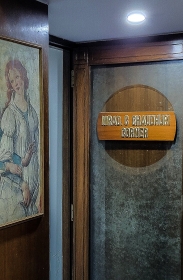
THE CALCUTTA CLUB (in Kolkata) was founded in 1907. Unlike other ‘elite’ clubs in existence at that time, it admitted members regardless of their ethnic background. The Club has a library consisting of several rooms arranged in a line, each one connecting to the next. At the far end of the library, there is a locked door bearing the label:
“Nirad C Chaudhuri Corner”.
Nirad Chaudhuri was one of 20th century India’s great writers. Born in 1897 at Kishoreganj – a place that is now in Bangladesh, but was then in British East Bengal – he died in Oxford (UK), having passed his 101st birthday. He was an original thinker whose views have not been shared by everyone. He wrote about India and its history in an incisive way that was not fettered by the conventional ideas of his contemporaries. In the 1970s, he shifted from India to England, and settled in Oxford. A few years ago, we met and were befriended by his son Prithvi – now a physically and intellectually active octogenarian. When we are staying at the Tollygunge Club (in south Kolkata), we often meet him after breakfast to chat and enjoy cups of coffee.
During one of our morning meetings, he told us how his father’s books and other possessions were shipped to India after his demise. He mentioned that some of these things are now stored in a room at the library of the Calcutta Club in what has been called the ‘Nirad Chaudhuri Corner’. As we expressed interest in seeing this, he said that he would ring the relevant Calcutta Club committee member to arrange for us to view his father’s collection. Although the Club feel they were given the items, Prithvi said that he had simply lent them. The matter is currently being contested in court. He told us that although there is much to see at the Calcutta Club, some of his father’s collection – notably his collection of books written in French – have been stored elsewhere.
The following day, we visited the Club’s library, where a librarian showed us to, and then unlocked, the Nirad Chaudhuri Corner. Apart from books that belonged to Nirad, there are paintings and other objects. One of these is the Royal Proclamation that was written when he was awarded the honour of the Commander of the British Empire (‘CBE’) in 1992. There are also several objets d’art including decorative ceramics (plates and cups), an ancient Egyptian sculpture, some wine glasses, a bottle of vintage port, a set of the first UK metric currency coins to have been issued, and many other things. The paintings include a well-executed hand-painted copy of a picture by Monet – a famous French impressionist. Prithvi told us that when his father bought the painting, he paid a great deal of money for it. Some of the family disapproved, but as Prithvi rightly said, it was his own money.
After examining the Corner, we walked back through the library. On the way, I spotted a small, framed manuscript. It was labelled “Original Signature of Mr Satyajit Ray Membership No. R211”. For those who do not know, Satyajit Ray (1921-1992), born in Bengal, was one of India’s most famous film directors.
Thanks to Prithvi, we were able to see a fascinating collection of possessions once owned by a great Indian writer. Almost hidden in the Calcutta Club’s library, I doubt that many of its members have seen it or are even aware of its existence.
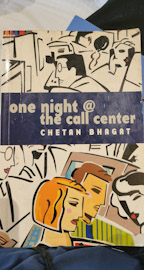
THE AUTHOR CHETAN Bhagat was born in 1974 in New Delhi. He was educated at two prestigious institutions: Indian Institute of Technology (Delhi) and the Indian Institute of Management (Ahmedabad). After graduating he had various jobs including working at the Hong Kong office of the bankers Goldman Sachs. There, he was unhappy with his boss, whom, according to Wikipedia, he: “ … characterized the villain in his second novel One Night @ the Call Center.”
The novel about the call centre was first published in 2005. The villain is Bakshi, the head of a department of a call centre that services customers in the USA. As its title suggests, the book is about one night at the call centre and its main characters are five young people working under Bakshi. I will not give the plot away, but I can tell you that the story is both entertaining and, in parts, profound. All that I will reveal is that the problems that the five workers are experiencing and described in the novel become insignificant after they receive a telephobe call … from God. But, do not worry: the book is not a religious tract. The book deals with many things, including the perception that some young Indians have: that their country is inferior to the USA.
Chetan Bhagat is a highly creative and imaginative story teller. His plots are rich in unexpected twists and turns. He has a great eye for detail and a good understanding of the minds of young Indians and they way they perceive today’s world.
Recently, a couple of people suggested that Bhagat’s humour is inadvertent rather than intentional. I completely disagree with this point of view. He concocts humorous situations in his novels with great care and expertise, and inserts them in his stories skilfully. Like Chinese sweet and sour dishes, Bhagat’s novels contain a harmonious blend of humour and seriousness, both complementing each other intelligently.
What I particularly enjoy about Bhagat’s writing – and by now I have read four of his novels – is his easy-going narrative style. As I read his books, I felt as if he was a good friend sitting and chatting with me in a bar or cafe. His books are easy to read yet full of profound observations about life, expressed effectively but with a light touch.
Adam Yamey is the author of several books, including: “Albania on my Mind”; “Scrabble with Slivovitz;” (Once upon a time in Yugoslavia); “From Albania to Sicily”; “Exodus to Africa”; “Rediscovering Albania”; “Aliwal”; “Bangalore Revealed”; “Indian Freedom Fighters in London (1905-1910)”; “Imprisoned in India”; “Beneath a Wide Sky: Hampstead and its Environs”; “Beyond Marylebone and Mayfair: Exploring West London”.
His latest book is:
“Golders Green & Hampstead Garden Suburb: Visions of Arcadia”
Born in 1952 in London, he attended Highgate School, and then University College London. After a doctorate in mammalian physiology, he became an undergraduate once more and qualified as a dental surgeon. After 35 years in general dental practice in Kent and London, he retired in September 2017.
Adam married a lady from India in 1994, and, since then, has been visiting her native land frequently. India has become his second home. He is a keen traveller. The periods between his journeys are usefully and enjoyably employed with: family, cooking, writing, photography, blogging, cinema, theatre, and exploring the many delights that London has to offer.
CHARLES LUTWIDGE DODGSON (1832-1898), better known as Lewis Carroll, author of “Alice’s Adventures in Wonderland”, was born in the village of Daresbury in Cheshire. During his first few years of life, Charles’s father was the curate of the local church of All Saints.
When he was 11, the Dodgson family moved away from Daresbury. Eventually, Charles entered Christ Church College in Oxford. It was here that he met the young child Alice Liddell, daughter of the Dean of Christ Church. It was this young child who inspired Dodgson to create and later publish his famous story. Unlike many other Victorian tales for children it was free from moral instructions.
Dodgson/Carroll died in Guildford, where he was buried. To celebrate the 100th anniversary of his birth, money was raised to create a window in the church in Daresbury to commemorate him. Known as the Lewis Carroll Window, it allows light into a Chapel in the southeast corner of the church. Designed by Geoffrey Webb, it was dedicated in mid 1935.
The stained window incorporates depictions of both Carroll and Alice Liddell, as well as some of the creatures drawn originally by John Tenniel, who illustrated the book about Alice.
A modern addition to the church was built onto its North side. This contains a Lewis Carroll exhibition. One of the exhibits is an old Bell. This used to be attached to a barge that served the religious needs of the people who lived and worked on the canals near Daresbury. This floating chapel was the creation of Lewis Carroll’s father.
We visited Daresbury on a July day when the air temperature was 37 degrees Celsius. Fortunately, it was cooler inside the church. I am grateful to Christine Casson for encouraging us to visit the church with the Wonderland window.
I HAVE TOLD SEVERAL friends that I am busy writing a book about Hampstead in North London. Hearing this, each one of them has said something like “Aren’t there already so many books about the place?” Well, those words are hardly encouraging. Had I been writing a love story or a book about WW2, they would not have expressed any sentiments about the untold number of already published love stories and books about WW2.
I wondered how many books there are about Hampstead, non-fiction rather than fiction. I searched for “Hampstead” in the book section on Amazon’s UK website and found that there are not more than about 40 different non-fiction titles relating to Hampstead rather than only Hampstead Heath or Hampstead Garden Suburb. Of these titles, 11 were published since 2000, and most of these before 2015. The rest were published before 2000, and of these at least 16 were published before 1980. Since 2015, only 3 books, which deal mostly with Hampstead, have been published. Therefore, although there are many books about Hampstead, few of them have been published in the last six years. So, maybe it is time that another one should appear in print.
While researching the book I am writing, I have consulted many of the books still available on Amazon and many others which have chapters about Hampstead, as well as a wealth of information that can be found on the Internet. I am making much use of what I have discovered from these sources and from my own observations, and I believe that when it is completed my book will contain a distinctive combination of facts and observations, which differs from presentations in other books about the locality.
The greater part of the book’s subject matter will be about Hampstead and its ‘satellites’, North End, Swiss Cottage, Belsize Park, and West Hampstead. I am also including shorter, detailed sections on Highgate and Golders Green. I am still at an early stage in the book’s production, but I do not feel deterred by observations that my friends have made that imply that I am simply ‘sending coals to Newcastle’, by writing yet another book about Hampstead. Time will tell.
UNTIL NOW I HAVE been self-publishing my books satisfactorily using a print on demand company called ‘X’. I typed the manuscript on Microsoft Word using one of X’s many templates and then uploaded it to the site. In the past, X convert the uploaded document to a .pdf file. As conversion from Word to ‘pdf always results in changes in formatting, I have always had to make modifications of my Word manuscript, often several times, before I am happy with the proofs provided by X. It was always a little time-consuming but, in the end, I produced a printed book that was, if not perfect, always satisfactory.
Now, all has changed. X will no longer accept manuscripts uploaded in Word. Instead, authors are required to submit their manuscripts in the .pdf format after fulfilling extremely detailed formatting specifications, which I must admit are beyond my technical abilities at present. I discovered that a well-known on-line trading company offers a self-publishing process, which permits authors to upload their manuscripts in the Word document format on their downloadable Word templates. I tried this, but the proofs generated by the company’s publishing system looked disastrous, to say the least. Maybe, I could have tried modifying my manuscript’s layout, but there did not appear to be a facility for doing so and, I could foresee hours if not days of frustrating work ahead.
I have spent several months writing my latest book, and even longer researching it, and now I would like people to be able to enjoy it and, I hope, comment on it. So, as many people often say in India: “What to do?”
Well, here is my current solution. I am going to upload my manuscript to one of my personal websites and make it downloadable for anyone who cares to read it. It will be downloadable free of charge because I write for pleasure rather than for profit and I value the thought that people might find what I write of interest. It is more important for me that my writing gets read rather than gets sold. Eventually, I hope to be able to produce a satisfactory paperback version of my latest work, but in the meantime, watch this space!
If anyone can offer me a simple solution to my problem, I would be grateful to see your suggestion!
GIGS KEBAB SHOP has been in Tottenham Street near to London’s Goodge Street station for over fifty years. Frequently, during the twelve years that I studied at University College London, I used to purchase a pita filled with lamb shish kebab from Gigs and then sit on a bench in the open space next to the nearby American church opposite Heal’s furniture shop on Tottenham Court Road. While I enjoyed the snack, hopeful pigeons used to wander around my feet, hoping for crumbs from the student’s pita. In those far-off days, I had no idea that Tottenham Street had once been the home of an important figure in the movement to abolish the slave trade. It was only this month, March 2021, that we noticed his house at 37 Tottenham Street, which is close to the northern end of Goodge Place, and used to bear the number ‘13’.
Olaudah Equiano, also known as ‘Gustavus Vassa’ (c1745-1797) was born in what is now Nigeria (see https://equiano.uk/the-equiano-project/ for a useful timeline of his life). In 1756, he was kidnapped by slavers and sent to the Caribbean, where he was sold to a British naval officer, MH Pascal. Between 1756 and 1762, he served with Pascal in the Royal Navy during the Seven Years War with France and was baptised in 1759 in London. From 1763 to 1766, he was ‘owned’ by Robert King of Montserrat. During this time, he made money ‘on the side’ and was able to purchase his freedom in 1766. The following year, we find him in London, from where he set sail to Italy and Turkey. In 1773, this intrepid man set sail on an expedition to the Arctic. Its aim was to find a new passage to India. After more adventures in the Caribbean and Central America, Equiano informed the abolitionist Granville Sharp (1735-1813) about the Zong massacre of 1781, during which more than 130 enslaved Africans were murdered on the Zong, a British slave ship.
After a trip to New York and Philadelphia in 1784-85, Equiano returned to London, where he became involved in the relief of the plight of ‘black’ people in London. After another sea voyage to Sierra Leone, we find him back in London in 1788. In his book “The Interesting Narrative of the Life of Olaudah Equiano, or Gustavus Vassa, The African. Written by Himself” (published in 1789), he recorded:
“March the 21st, 1788, I had the honour of presenting the Queen with a petition on behalf of my African brethren, which was received most graciously by her Majesty”.
The Queen was Charlotte, wife of King George III. Part of his petition was as follows:
“I presume, therefore, gracious Queen, to implore your interposition with your royal consort, in favour of the wretched Africans; that, by your Majesty’s benevolent influence, a period may now be put to their misery; and that they may be raised from the condition of brutes, to which they are at present degraded, to the rights and situation of freemen, and admitted to partake of the blessings of your Majesty’s happy government; so shall your Majesty enjoy the heartfelt pleasure of procuring happiness to millions, and be rewarded in the grateful prayers of themselves, and of their posterity.”
Although Equiano might have begun writing his “The Interesting Narrative…” in London’s Baldwin’s Gardens (number 53) near Grays Inn Road, from where he sent the petition to the Queen, he had moved to the house in Tottenham Street by the 25th of June 1788, according to an interesting article by Gene Adams, published in “Camden History Review Vol.29” (2005). Tottenham Street is near Warren Street, where The Committee for the Relief of the London Black Poor was founded in 1786. It is also close to the former Tottenham Court Chapel founded in 1756 by George Whitefield (1714-1770), an American founder of Methodism, who had inspired Equiano. The chapel stood where the American church stands today. By 1774-5, Equiano was already a ‘Calvinist-Methodist’ Christian.
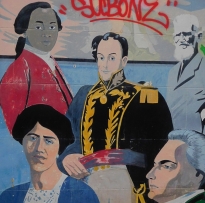
The house on Tottenham Street, which bears a plaque recording his stay there is undistinguished architecturally. Around the corner from it on the east side of the north end of Goodge Place, there is a fading mural, painted by Brian Barnes in 2000, which depicts Equiano with other local celebrities, all in 18th century attire. This is next to another mural depicting the nearby Post Office Tower and four women, two of whom are wearing Indian saris.
Equiano married an English woman, Susan Cullen, in 1792 from Soham in Cambridgeshire. They had two daughters, Anna Maria (1793–1797) and Joanna (1795–1857), who were both baptised in Soham i (https://en.wikipedia.org/wiki/Olaudah_Equiano#Marriage_and_family). The family lived in Chandos Street in London, where his youngest daughter died. Susan died in 1796, aged 34, and Equiano the following year.
For many years after his death, it was not known where Equiano was buried. Eventually, it was discovered that he had been buried in the churchyard of Whitefield’s chapel, on the site of the present American church. Unlike many of the other corpses that had been buried there and then later shifted to a cemetery in Chingford in 1898, Equiano’s was amongst those which were not shifted and therefore must lie within the churchyard of the former Whitefield’s Tottenham Court Chapel (https://equiano.uk/wp-content/uploads/2019/11/EQUIANO-Campaigner-MP1.pdf), probably near where I used to sit on a bench eating my kebab from Gigs. Looking at an old map, I found that the graveyard was a little to the north of where I used to munch my lunch.





 yamey
yamey 